
On November 20, mathematician Levent Alpöge put a footnote on his website linking to 14 pieces of a computer file. Inside, he says, is a proof he found with Anthropic’s Claude of the Riemann hypothesis, the 167-year-old conjecture about the distribution of primes. His four-page note also claims a proof for a whole family of related functions. Alpöge’s announcement
Within hours, an independent project had checked two things. Its copy of the files matched the release, and the mathematical statements it wanted tested could be written using Lean’s standard mathematics library. The project reported that its check of the proof itself was still running. That distinction is the most direct answer to whether Claude and Alpöge have solved the problem. There is a specific proposed proof that people can examine. Independent confirmation of the full result is pending. Verification project · Completed checks
There is also a second announcement. Alpöge and Tristan Buckmaster have posted a paper claiming that a smoothly flowing fluid can develop a singularity under the unforced Navier–Stokes equations. That paper identifies a numerical file readers need to reproduce the argument. The two claims share an author, a date and a role for Claude. They have reached different stages of verification. Scientific American’s report on Riemann · The Navier–Stokes release
The puzzle hidden in the primes
There are 25 primes up to 100 and 168 up to 1,000. Nobody needs a conjecture to get those counts. The difficulty is to estimate how many primes there are up to any number and know how far the estimate can miss.
Think of the gaps. The primes 101 and 103 are two numbers apart. From 113 to 127 the gap is fourteen. This local irregularity coexists with a dependable long-run trend. The prime number theorem says the count up to x approaches x divided by its natural logarithm in relative terms as x grows. For a closer estimate mathematicians use the logarithmic integral, which accumulates the changing density of primes along the way.
Riemann’s insight in 1859 was to study the error in that count through a function. The connection begins with unique factorization. Because every integer greater than one has a unique factorization into primes, a sum over all positive integers can, where it converges, be written as a product with one factor for each prime. These are two ways of writing the same zeta function. Its zeros carry information about how the actual count fluctuates around the predicted one. NIST’s definition and Euler product · Clay’s account of the problem
What is a zero, and what is the critical line?
A zero is an input at which a function returns zero. The zeta function takes complex numbers as inputs, so each input has an address on a plane. Its real part gives the horizontal position. Its imaginary part gives the height.
The zeros at −2, −4, −6 and the other negative even integers have long been explained. The infinitely many remaining zeros all lie in a vertical strip between real parts 0 and 1. Riemann’s hypothesis places every one of them exactly halfway across, on the line with real part ½. Their heights vary. In the figure, the first three above the horizontal axis sit at roughly 14.135, 21.022 and 25.011. NIST on zeta zeros · Numerical reference
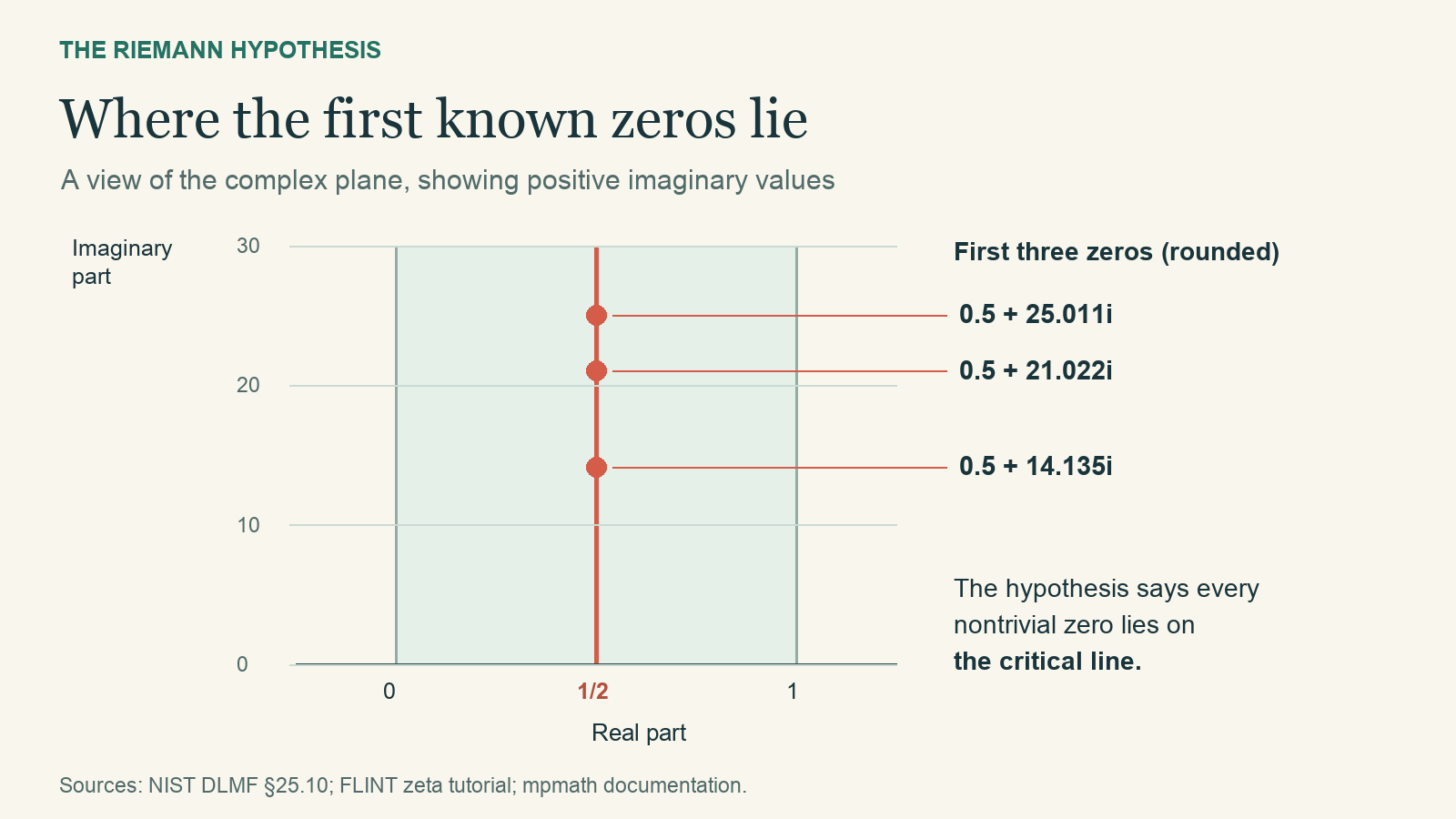
Clay notes that the first ten trillion zeros have been checked. A single off-line zero beyond that range would still disprove the hypothesis. This is why a proof that applies at every height would tell us something that another trillion numerical checks could never establish. Clay Mathematics Institute
A zero’s horizontal position controls the scale of its contribution to the prime-counting formula. Moving a zero to the right of ½ would introduce fluctuations on a larger scale. Holding every zero to the middle line puts a square-root-scale ceiling, up to logarithmic factors, on the error in the prime count relative to the logarithmic integral. In standard notation the bound is O(√x log x). Enrico Bombieri’s official problem description for Clay, section 2
A broader claim about related functions
Alpöge says the method also resolves the generalized Riemann hypothesis, or GRH. The name refers to extensions of the same kind of zero-location question to other mathematical functions related to the zeta function. One important family consists of Dirichlet L-functions, built using objects called Dirichlet characters.
A useful way to picture their role is to sort numbers by their remainders. For instance, primes greater than 5 end in 1, 3, 7 or 9. Dirichlet L-functions help mathematicians study how primes are distributed among eligible remainder classes. Generalized hypotheses can give strong control over discrepancies in those distributions.
We read the two files that declare the top-level theorems directly from the archive. They make the scope more precise than the announcement. They cover the zeros in the critical strip for Dirichlet L-functions. At the top of the project, the classical theorem has the same target, RiemannHypothesis, that Lean’s mathematics library already defines. Alpöge also mentions an extended hypothesis that he hopes to reach with more time. He presents that as future work. Formal statements · Top-level theorems
How Alpöge describes working with Claude
The four-page note includes a rough research timeline, which Alpöge says Claude assembled, and cautions that some descriptions may need correction. Alpöge describes a collaboration in which he directed the investigation toward a setting suggested by two ideas in a simpler model. He credits Claude with rapid progress near the end. He also gives specialists a glimpse of the proposed approach: it involves a weighted sum associated with primes, called a von Mangoldt sum, and a chain of mathematical constructions known as theta lifts.
One detail in the note gives a sense of the proposed mechanism. A von Mangoldt sum counts prime powers with a weight tied to the underlying prime. For a sum of length X, Alpöge says Claude proposed using a chain of theta lifts of length √X. A theta lift transfers mathematical information from one setting to another. Alpöge describes chaining them to recover an effect called multiplicity that helps in a related setting. This is his account of how they found a route. His note leaves the derivation to the much longer formal argument. Alpöge’s account, pages 1–4
What Kingy.ai checked in the original archive
We streamed all 14 files linked in Alpöge’s announcement, in order. The joined archive contained 239,275,554 bytes and 175,187 Lean source files. We computed its SHA-256 fingerprint and matched it to the one reported by an independent mirror. We also extracted Main.lean and Statements.lean to read the classical and Dirichlet claims directly. That establishes which files we examined and what the authors set out to prove. We did not compile or replay the proof. Original download links in Alpöge’s note · Mirror with archive fingerprint
The top-level source is surprisingly short. One line reads theorem riemannHypothesis : RiemannHypothesis := rhOfAll. To the left of the assignment is the target from Mathlib. To the right is the name of the proof on which that line depends. Reading the line tells us that the release targets the familiar hypothesis. Checking the work behind that last name is the expensive part. Top-level source
What the green check on GitHub means
Lean lets a researcher express a mathematical statement precisely and supply a chain of deductions for its kernel to check. Here the independent project wrote down the targets separately. That gives a reviewer a short file to read before asking the machine whether Alpöge’s much larger submission proves those exact statements.
The public verification run finished at 15:07 UTC on November 20. Its two successful jobs had descriptive names. One downloaded the source archive and compared it with the mirror. The other compiled only the independently stated challenge against Mathlib, Lean’s mathematical library. A statement can be perfectly well formed while its proof is still unknown. The actual run and its two jobs
The project listed its full Comparator run as in progress on the morning of November 20. That test compares the submitted conclusions with the challenge, checks what axioms the proof depends on and replays the proof terms. A successful result would be substantial independent evidence for those precise theorems. A reader trying to understand why the theta lifts work would still have a different task. Alpöge says he wants to simplify and explain the argument himself. Independent verification record
How this relates to Anthropic’s earlier result
In August, Anthropic reported that at least 67.25% of the nontrivial zeros, in the asymptotic sense, are both on the critical line and simple. A simple zero has multiplicity one. A proof of the Riemann hypothesis would put every nontrivial zero on the line while leaving open whether two or more can coincide there. Conversely, a result about a percentage leaves room for an exception, even if that percentage comes very close to 100. Alpöge and Furman’s August paper · Kingy.ai’s explanation of the 67.25% result
The new announcement attributes the work to Alpöge and Claude. It does not identify a specific Claude model or provide enough information to measure which parts of the mathematical work each contributed. Its account of the collaboration is Alpöge’s own.
The new Navier–Stokes claim removes the external force
The fluid question starts with smooth initial motion. Viscosity tends to smooth out sharp differences in velocity, but the fluid’s own motion can concentrate them. Can the differences grow so extreme that a smooth solution breaks down after a finite time? In their 79-page paper, Alpöge and Buckmaster say yes. They describe specially chosen starting flows in open three-dimensional space and in a periodic box, a mathematical space where fluid leaving one face reappears at the opposite face. The quantity the authors say diverges is a measure of spatial changes in velocity. Alpöge and Buckmaster’s paper
Their route runs through a numerical certificate. First they seek an approximate flow pattern that repeats when viewed at successively finer scales. Then they give conditions under which such an approximation guarantees a true solution with the claimed behavior. This is where a computer-assisted proof differs from a simulation that merely looks unstable. A reviewer needs the actual data and rigorous bounds showing that every required inequality holds.
The paper prints a hash identifying the promised certificate. A hash can tell a reviewer whether a file is the one the authors intended. It cannot supply the file’s contents. The authors say the public repository omits both the certificate and the interval-arithmetic computation used to verify the bounds. They also say they had made a patch to the Lean package and had yet to rebuild that version when they released it. The paper credits Claude throughout and describes how the researchers guided the agents with leads from their earlier work. Authors’ release notes · What the Lean package proves
In September, OpenAI claimed it could make a fluid starting at rest develop unbounded speed by applying a specially designed smooth force. Clay’s formulation allows a smooth external force in its breakdown alternatives. Proving breakdown with the force set to zero would also answer whether the fluid can do it under its own evolution, a question September’s construction left open. Clay’s September 11 comment that the problem had “apparently been settled” predates the new paper by more than two months. OpenAI’s September announcement · Clay’s dated statement · Kingy.ai’s coverage of the forced case
When Clay can consider a prize
The Riemann hypothesis carries a $1 million Millennium Prize, but an announcement and an archive do not settle the award. Under Clay’s published rules, a proposed solution must appear in a qualifying outlet, at least two years must pass after publication, and the global mathematics community must generally accept it before the institute considers it for a prize. Clay’s own Riemann hypothesis page still listed it as unsolved when we checked on November 20.
For the Riemann claim, the next result readers can check is the independent Comparator report for the five published theorem statements. For unforced Navier–Stokes, it is the release of the numerical certificate and a calculation another team can reproduce. Neither requires waiting two years to learn something new.
- Tested
- Streamed and hashed the 14 original archive parts in order. Read the top-level theorem declarations. No full proof build or replay.
- Files
- 239,275,554 bytes and 175,187 Lean source files. The SHA-256 matched the independent mirror.
- Dates
- run 2026-11-20 · checked 2026-11-20
Sources and verification
The reporting draws on Alpöge’s original announcement and archive, the independent proof-checking project, the Navier–Stokes authors’ release and Clay’s official prize rules. The figure uses NIST’s description of the critical strip and numerical references from FLINT and mpmath.
Trending on Kingy
Keep reading with the stories getting the most attention now.