

On November 18, a coalition of AI researchers, technology founders, legal scholars and safety advocates published the MisAnthropic Statement. The group says Anthropic warns that AI capable of building better AI could concentrate power and escape human control, while selling its own progress toward that capability as a competitive advantage. The Center for AI Safety (CAIS), a nonprofit focused on large-scale AI risks, signed and announced the statement ahead of Anthropic’s planned Nasdaq debut. Read the statement. CAIS announcement.
In February, Anthropic rewrote its voluntary safety policy and dropped its previous unconditional pause commitment. The technology at issue is already being used inside the company in a limited form. Anthropic reports that Claude leads some research work under human supervision. Fully autonomous development of a successor model is a further step. Anthropic’s February policy update. Anthropic’s research automation report.
What the MisAnthropic Statement says
The statement makes three related accusations. It says Anthropic is competing to build recursively self-improving AI despite its warnings about the technology. It argues that the company uses its safety reputation to win over investors, employees and the public. And it accuses Anthropic of weakening its own safety pledges and lobbying for rules that serve its interests. The signers conclude that Anthropic’s conduct makes it an unsafe AI company. They ask the public to reject what they see as an attempt to accumulate power under a safety rationale and leave the choice of law or enforcement mechanism open. Original statement.
The introduction puts other frontier developers in the same race. The reason it singles out Anthropic is the gap the signers see between the company’s safety pitch and its pursuit of an advantage over those rivals. This is a public appeal aimed at the company’s credibility as it goes to market. Original statement and introduction.
Who signed it, and what did CAIS do?
Kingy counted 92 distinct people on the public list when we checked on November 18. The website accepts additional signatures and says it confirms them by email. CAIS issued the launch announcement, its executive director Dan Hendrycks is on the list, and the site gives a safe.ai email address as the organizers’ contact. The public materials describe a coalition and identify no sole author. Public signatory list. Organizers’ privacy policy. CAIS announcement.
- Science and mathematics. Nobel laureates Oliver Hart (economics) and Sheldon Lee Glashow (physics), Turing Award recipient Judea Pearl, and Fields Medalists Peter Scholze, James Maynard and David Mumford. Harvard psychologist Steven Pinker also signed.
- Law and public life. Harvard legal scholars Laurence Tribe and Lawrence Lessig, Columbia law professor Katharina Pistor, former Nepalese prime minister Baburam Bhattarai and Authors Guild CEO Mary Rasenberger.
- Technology and AI ethics. Hugging Face co-founder Thomas Wolf, xAI co-founder and River AI CEO Igor Babuschkin, Humane Intelligence founder Rumman Chowdhury, Go co-creator Rob Pike and former Y Combinator president Geoff Ralston.
- AI advocacy. Future of Life Institute co-founder Max Tegmark, Center for Humane Technology co-founder Tristan Harris, Machine Intelligence Research Institute president Nate Soares, PauseAI Global CEO Maxime Fournes and Extropic founder Guillaume Verdon, known online as Beff Jezos.
A leader of PauseAI and a founder of the pro-acceleration e/acc movement endorsed the same criticism of Anthropic. The affiliations on the page identify the individuals. One relevant industry tie comes from CAIS itself. Its bio says Hendrycks has advised rival lab xAI. Full public list. CAIS’s description of the coalition. Hendrycks’s CAIS bio.
What Anthropic tells investors about self-improving AI
Recursive self-improvement describes a feedback loop. A model helps researchers build a more capable successor, and that successor can take on more of the work on the next generation. The more consequential threshold is full recursive self-improvement, where a system can develop its successor autonomously. Automating an experiment or writing a training tool is one part of the research process. The full loop also involves decisions about which experiments to run, whether the results hold up and whether a new model is ready to use. Anthropic Institute’s explanation.
Anthropic’s November 17 amended registration statement tells investors that each generation of Claude already helps speed up development of the next. It points to work such as running experiments, evaluating models and reviewing code, and presents this feedback as a structural advantage. The same filing lists a risk from that speed. AI-assisted research could push capabilities ahead of Anthropic’s ability to develop and verify safety and security measures. Anthropic’s Form S-1/A, Prospectus Summary and Risk Factors.
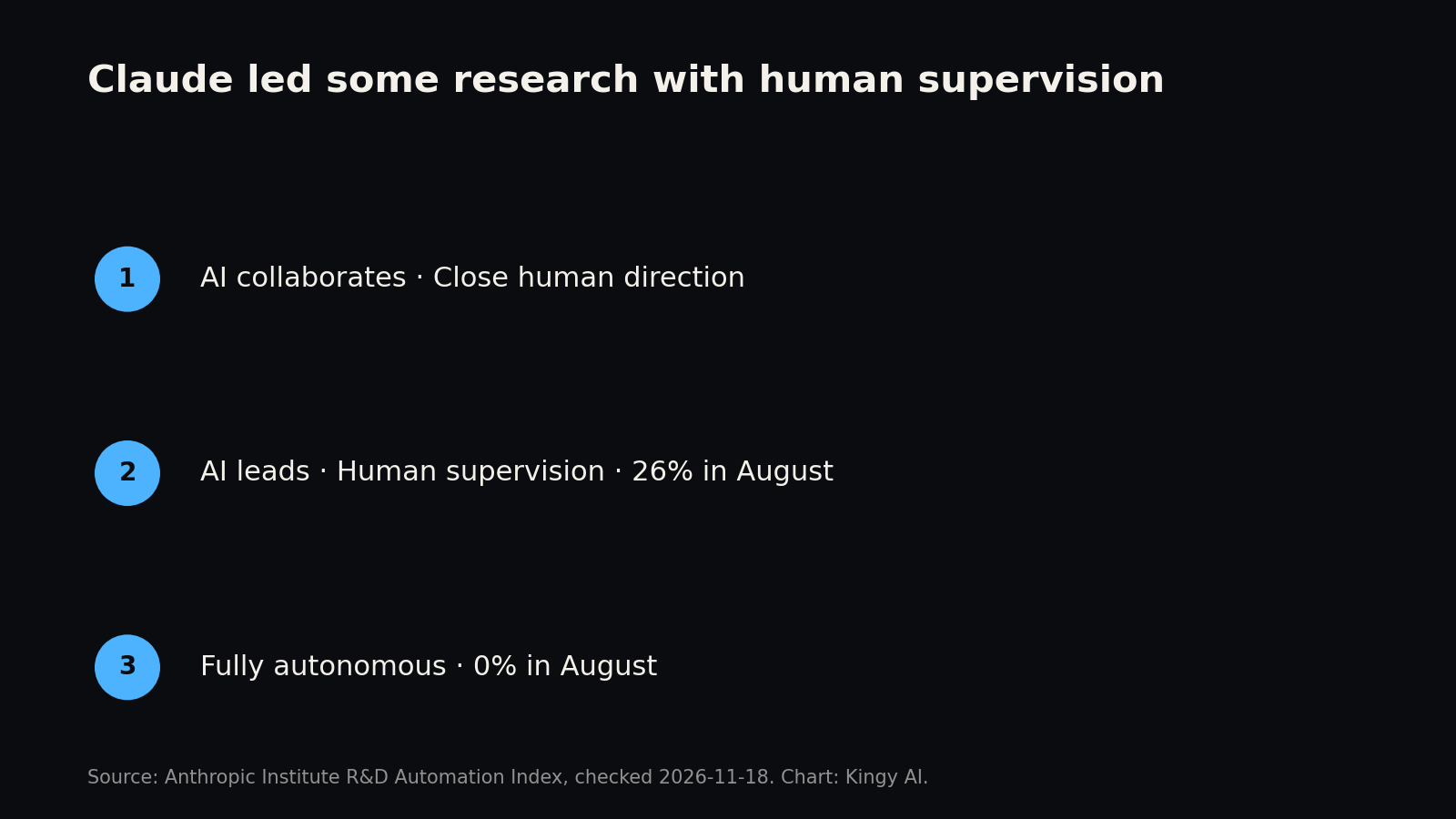
Anthropic’s own index estimated that Claude led 26% of its model research and development work as of August, up from under 1% in February. In the index, a model leads when it can complete most of a task from a high-level prompt under human supervision. The August estimate put 0% of measured work in the fully autonomous tier. These are company estimates based on its internal catalog of work and a rating scale for automation. Anthropic’s methodology and results.
METR, an independent evaluator given access to internal research data and staff, found that Anthropic models’ scores on a broad capability benchmark were improving faster. Its team judged AI assistance likely to be contributing to the acceleration, with uncertainty about how much. METR said Anthropic redacted most of the evidence its evaluators considered most informative, while allowing them to publish their highest-level risk conclusions. Access to the work and the ability to show supporting evidence are distinct parts of external oversight. METR’s November assessment.
What changed in Anthropic’s safety policy?
Earlier versions of Anthropic’s Responsible Scaling Policy tied some activities to capability thresholds. If a model crossed the relevant threshold, the company had to have the corresponding safeguards before proceeding with the activity. The February 24 rewrite removed the general unilateral pause commitment and introduced public Frontier Safety Roadmaps and recurring Risk Reports. It retained conditional commitments to delay certain activities, for example when Anthropic had clear evidence it was ahead and had yet to contain a catastrophic risk. The company said uncertainty about when models crossed a threshold made it hard to build an industry-wide case for action. Its UK managing director confirmed the change to Parliament in October and said the company could still choose to delay a release for safety. Current policy and version history. February rewrite. Version 3.0, Appendix A. UK Parliament evidence, Q110–Q113.
CAIS also accuses Anthropic of lobbying for weaker rules, citing California’s SB 1047, New York’s RAISE Act and a federal proposal known as the AEGIS Act. It also alleges private advocacy for federal preemption of state AI laws. Anthropic publicly described SB 1047 as making progress while criticizing parts of the bill, and says it advocated for laws including the RAISE Act. Its June 2026 framework supports narrowly defined preemption if federal rules are at least as strong as the safeguards it proposes. The published positions document what the company advocated in public. CAIS’s judgment about motive and its account of private advocacy come from the coalition’s announcement. CAIS’s lobbying allegations. Anthropic on SB 1047. Anthropic’s public policy positions. Anthropic’s Advanced AI Framework.
Why the statement matters at the IPO
Nasdaq said it expected Anthropic to begin trading on November 19 under the ticker ANT. Anthropic is asking public investors to put a value on its ability to improve Claude quickly. That makes who can slow development, under what conditions, a question about the company’s governance as well as its technology. The prospectus says Anthropic’s Long-Term Benefit Trust generally has the right to select and remove a majority of the board. It also discloses that the founders’ vehicle will hold a separate class of stock with 50.1% of voting power on matters put to shareholders generally, including elections for the other directors. Buyers of the listed Class A shares receive one vote per share on matters submitted to shareholders generally. Nasdaq listing notice. Anthropic’s Form S-1/A, capital structure and risk factors.
The most concrete question raised by the letter is what evidence would trigger a delay if each new model speeds up development of the next. Anthropic’s roadmap calls for a proposal on embedded third-party evaluators by December 15, 2026 and a proposal on the pace of AI development, or an explanation of why it chose against one, by January 15, 2027. Those are two public milestones for examining who gets access to the evidence and when they can act on it. Anthropic’s Frontier Safety Roadmap.
Sources and related coverage
The petition and CAIS release document the coalition’s position. Original statement and signer list. CAIS launch announcement.
Kingy found no public Anthropic response to the statement as of publication. The company disclosures cited here cover its research, governance and safety policy. November 17 amended filing. Safety policy and revisions. Research automation report.
For earlier context, see Kingy’s Anthropic IPO coverage and our explainer on recursive self-improvement.