
The public evidence reviewed does not establish a shared cause for the FAA’s nationwide ground stop on November 13 and the Microsoft 365 outage that began the previous day. The FAA reported a telecommunications problem affecting multiple air traffic control centers; the underlying cause has not been verified in the sources reviewed.
That leaves a real gap in the public record. The incidents overlapped, and AI products were affected, but neither fact establishes a link. A connection remains possible if investigators find evidence of a shared dependency or failure chain.
What happened, and when
The FAA ordered a nationwide ground stop after communications problems affected multiple Air Route Traffic Control Centers, Axios reported, citing the agency. A ground stop holds affected departures on the ground. Travelers should check their airline and airport for flight-specific information; a national advisory alone does not tell an individual passenger when their flight will leave.
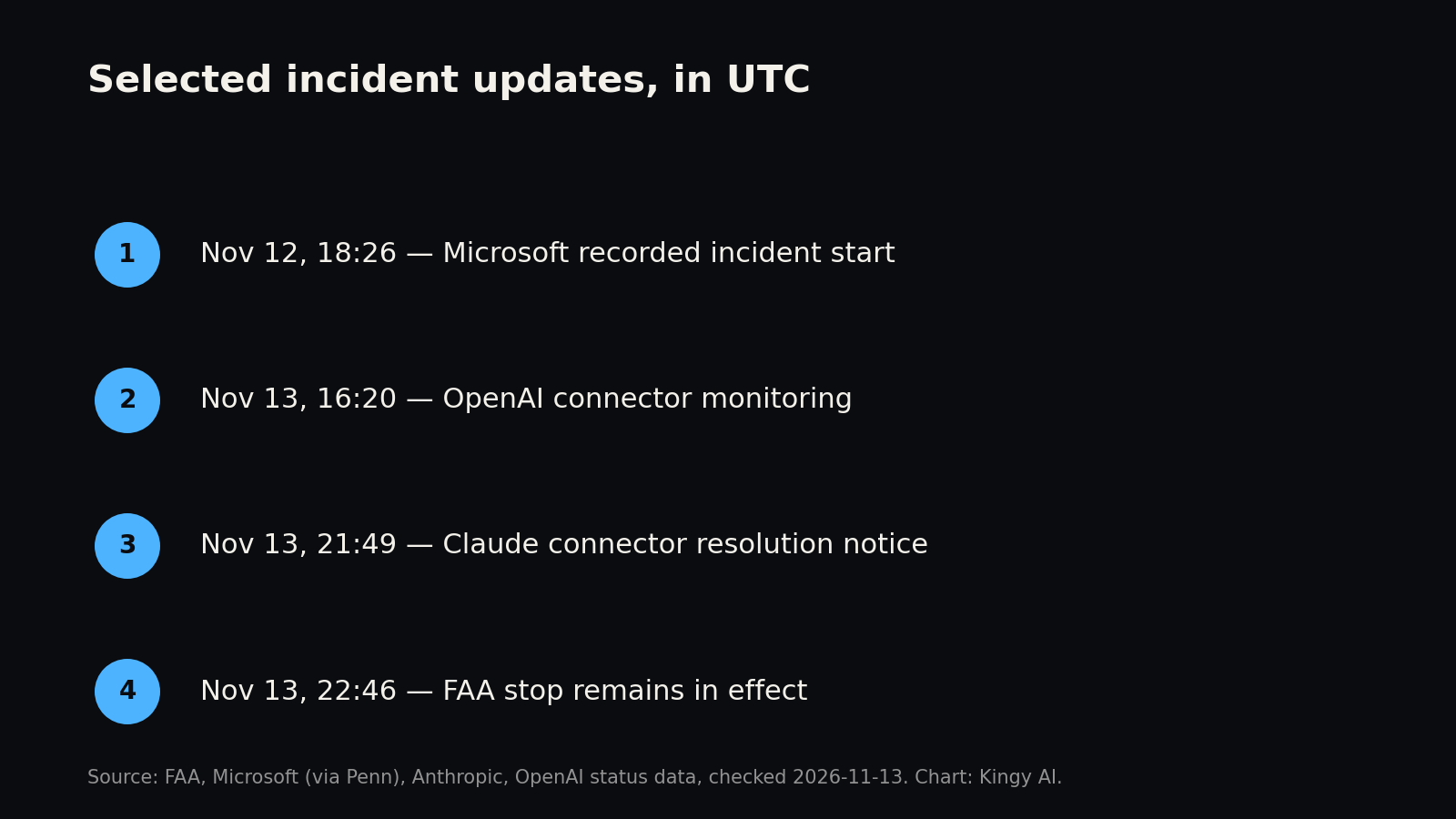
The following times use UTC and Eastern Standard Time (EST, UTC−5):
- November 12, 18:26 UTC (1:26 p.m. EST): Microsoft’s recorded start for MO1550821.
- November 13, 16:20 UTC (11:20 a.m. EST): OpenAI moved its Microsoft 365 connector incident to monitoring.
- November 13, 21:49 UTC (4:49 p.m. EST): Anthropic posted that its Microsoft 365 connector incident was resolved.
- November 13, 22:46 UTC (5:46 p.m. EST): An FAA advisory said the ground stop remained in effect and allowed for coordinated departures as facilities recovered. It expected another update at 04:00 UTC on November 14 (11:00 p.m. EST on November 13), not a guaranteed restoration time.
The chronology matters: these were not two new incidents that began simultaneously. Overlapping incidents can share a cause, but timing alone cannot identify one.
 Music, footage and AI tools for video
Microsoft’s explanation and the remaining questions
In incident updates reproduced by the University of Pennsylvania, Microsoft attributed the disruption to an earlier network upgrade and a subsequent network change. On November 13, it said: “This was a technical issue not related to cyber or AI / agents.”
This preliminary account contains no code-provenance details. Investigating AI-written code would require development records connecting a particular change to the failure. The public statement does not establish human-only authorship.
AI products were affected
The clearest documented AI connection is downstream impact. Microsoft listed Copilot Chat and access to work data among affected functions. That does not mean all Copilot functions, all Microsoft services or the entire Azure cloud were offline.
Anthropic said the Microsoft 365 incident caused failures for Claude’s Microsoft 365 connector and Claude for Outlook. Its retrospective identifies the main impact window as November 12 at 16:03 UTC (11:03 a.m. EST) through November 13 at 16:40 UTC (11:40 a.m. EST). Anthropic later marked the incident resolved while warning that occasional errors or delays could continue as Microsoft recovered.
OpenAI reported problems with new Microsoft 365 connector connections and connector tools, then moved that incident to monitoring. Its official incident data records the monitoring update at 16:20 UTC on November 13.
A connector lets an AI product request information or perform an authorized task through another service. If that service or the connection to it fails, a mail or calendar task can fail even when the AI interface itself responds. Conversely, a working chat window does not establish that every connected tool is healthy. These reports concern specific integrations; they do not establish a general failure of Claude, ChatGPT or AI models.
Why people are asking about SMART
The FAA has recently expanded an AI-supported planning system called SMART. The agency unveiled it on September 21 and announced expansion on November 10 to the airspace of all 22 centers. AP reported that Homeland Security Secretary Markwayne Mullin said investigators would examine whether the AI rollout was linked. That is an investigative question, not a finding that SMART failed.
According to the FAA’s SMART fact sheet, the cloud-based system analyzes traffic, weather and other operational information to produce planning recommendations. Controllers remain responsible for separating aircraft. The distinction matters: planning software can influence decisions and deserves testing, but the announced role is not an autonomous replacement for controllers.
The FAA awarded Air Space Intelligence a contract for the related Flow Management Data and Services, with SMART described as an enhancement. The FAA says FMDS is intended to replace the legacy Traffic Flow Management System and help balance flight demand with available capacity. Those documents describe a modernization effort; they do not identify SMART as the component behind Friday’s telecommunications problem.
They also do not establish that SMART uses Microsoft 365, or identify Microsoft as SMART’s cloud or identity provider. A cloud-based system and an outage involving cloud services may have a dependency in common, but that dependency must be identified and verified. It cannot be inferred from the word “cloud.”
In a November 13 statement, ASI denied that SMART, its other products or its FAA and ATC integration caused the ground stop. This is the vendor’s account, rather than an independent root-cause finding.
What evidence would connect the incidents?
Our assessment is that a credible link would need more than a shared date. Investigators would need to identify the failed FAA component and show how it depended on a specific service, network, identity system or carrier involved in the Microsoft incident. Correlated logs, change records and a documented path from that dependency to the communications failure would be stronger evidence than a coincidental timeline.
A technical link could also be narrower than a single root cause. For example, one failure might interrupt a service another system needs without causing every part of the second incident. The public material reviewed does not establish even that narrower chain. The FAA’s underlying telecommunications failure and Microsoft’s final root-cause analysis remain open questions.
Claims of an AI-directed attack need their own evidence. Mullin said there was no indication of a malicious attack on the FAA at that point, according to AP. That preliminary assessment could change as investigators obtain evidence. We found no published logs or investigation findings establishing a coordinated agent swarm.
The oversight questions predate the outage
On October 13, House Transportation and Infrastructure Committee Democrats asked the Government Accountability Office to review SMART and FMDS. Their signed letter requested scrutiny of safety work, testing, performance measures, training and deployment.
That request is oversight, not an audit finding or evidence that SMART caused the November 13 disruption. It does identify useful records to seek: what was tested, how operators were trained, how recommendations are checked and what happens when supporting systems are unavailable. Human responsibility remains essential, and so does evidence that people have reliable information and workable fallback procedures.
Update log and questions to follow
November 13, 23:37 UTC (6:37 p.m. EST): Added ASI’s November 13 denial; the FAA cause remains unverified.
November 13, 22:58 UTC (5:58 p.m. EST): Initial report based on the available FAA reporting and vendor incident updates. The 22:46 UTC FAA advisory said the ground stop remained in effect with coordinated departures as facilities recovered; a final FAA cause was not verified.
For travelers, airline and airport notices are the practical sources for an individual flight. Microsoft 365 administrators can check their service health information for the affected tenant. We will look for answers to these specific questions as records become available:
- Which FAA telecommunications component failed, and when was the ground stop lifted?
- Did investigators identify a dependency shared with Microsoft’s incident, supported by system and network records?
- What does Microsoft’s final incident review say about the network change, recovery and any relevant tooling?
- Was SMART or any FMDS component involved in the FAA event, and what did its operators see?
Sources
- FAA: Air traffic advisories
- ASI: Statement on the ground stop
- Axios: FAA nationwide ground stop
- AP: FAA communications problems and investigation
- University of Pennsylvania: Microsoft incident updates
- Anthropic: Microsoft 365 connector incident
- OpenAI: Microsoft 365 connector incident
- FAA: SMART fact sheet
- House committee members: SMART and FMDS GAO request
Trending on Kingy
Keep reading with the stories getting the most attention now.