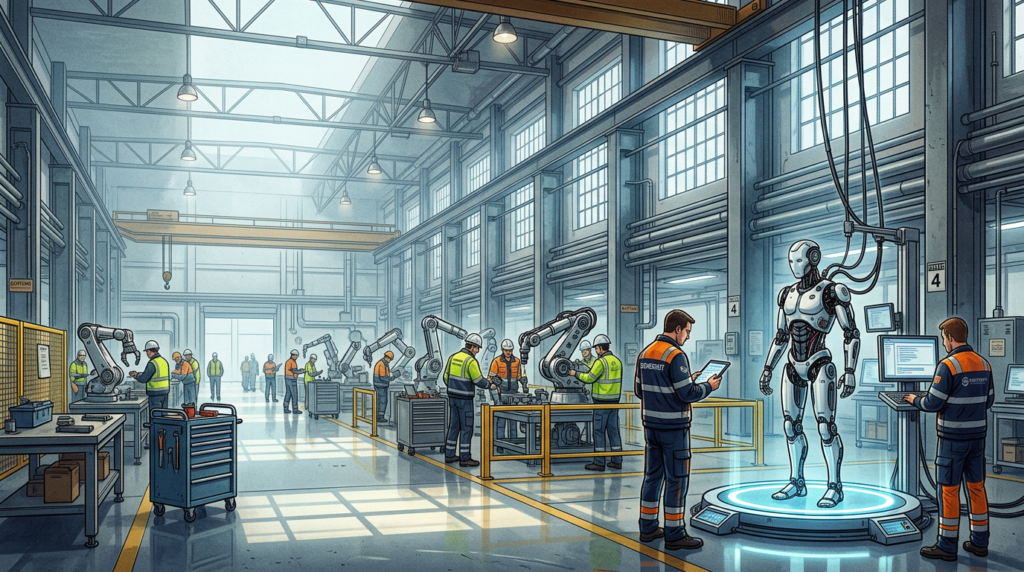
A $500 Million Bet on the Factory Floor
Agile Robots has raised $500 million at an $8.5 billion valuation, giving the Munich robotics company fresh capital to build more machines, expand in the United States, and develop new industrial applications. SoftBank Group led the Series F. Nvidia, Hitachi Group, and T.Capital also participated. Agile Robots says the round brings its total invested capital to $2 billion. The deal gives the company room to pursue a question that matters well beyond robotics labs. Can machines that sense, move, and handle objects adapt to the daily interruptions of a real production line? A factory has plenty of ways to find out. The parts arrive slightly crooked. A tray comes back half empty. Somewhere, a technician is already reaching for a wrench.
What the Funding Will Pay For
Agile Robots named three priorities in its funding announcement. It plans to add production capacity, including in Germany, strengthen its US presence, and develop new robotics applications. Those plans are connected. Manufacturing more units makes it possible to supply more sites. Application engineering helps turn a general machine into something useful at a particular workstation. Local support helps keep it there once a customer relies on it. Think about a simple task such as loading a part into an inspection fixture. The robot needs a reliable grip, a way to tell the fixture is ready, and a response when the part fails inspection. Each step sounds small. Together, they determine whether a customer can put that machine on the schedule.
The Investors Bring Different Perspectives
SoftBank led the financing, while Nvidia and Hitachi came in alongside other investors. The group reflects the mix of businesses involved in getting physical AI into production. Nvidia already has a product relationship with Agile Robots. The companies introduced the Agile ONE SN research platform together, pairing Agile’s humanoid hardware with Nvidia’s Isaac GR00T software. Hitachi and Hitachi Ventures participated in the funding through Hitachi Group. That establishes who backed the round. The funding release leaves future customer deployments and commercial commitments open. The existing Nvidia relationship offers a more concrete example of what collaboration can look like. Researchers get an integrated platform for developing and evaluating robot skills, while Agile gets another route for developers to work with its hardware.
What Physical AI Means at a Workstation
Physical AI is a broad label for systems that use information about their surroundings to act in the physical world. Put a robot in front of a tray of parts and the term becomes easier to understand. It needs to locate the right component, figure out where to grip it, and judge how much pressure to apply. Once it starts moving, the job can change. A part might shift, the gripper might meet resistance, or the next station might still be busy. Software helps the machine decide what to do with the information its sensors collect. The hardware has to carry out that decision. A clever plan is only useful if the arm can reach the part and the gripper can hold it.
The Factory Near Munich Is Already Open
Earlier in 2026, Agile Robots opened a facility in Fürstenfeldbruck, near Munich. The company says the site can produce up to 10,000 legged and wheeled humanoid robots a year, a capacity figure Reuters also reported. Actual output is a separate figure, and the financing announcement gives no annual production tally for the site. Capacity matters because a line capable of building many units can support larger customer orders. Deliveries depend on orders, component supply, assembly, testing, and acceptance at customer sites. Each machine also needs consistent calibration so that a replacement unit behaves predictably. The existing factory gives Agile a place to build that manufacturing experience as it adds capacity. The next numbers to watch are how many systems it delivers and where customers put them to work.
Twenty Thousand Deployments Tell a Broader Story
Agile Robots reports roughly 20,000 industrial robotic solutions deployed worldwide across sectors that include automotive, consumer electronics, and logistics. That total covers its broader portfolio of robotic solutions. The company traces its roots to the German Aerospace Center, whose spin-off profile highlights robotic arms, hands, force sensing, and computer vision. That background helps explain why Agile sells several types of machines. Some jobs revolve around precision at a fixed bench. Others need equipment that can move between stations. A history of industrial deployments gives the company experience with the interfaces, tooling, and service arrangements those customers require. It also gives readers a clearer way to interpret the funding. Agile is building a humanoid business alongside an existing industrial automation portfolio.
Why One Factory Might Buy Three Kinds of Robot
Picture a factory where one station assembles a component, another checks it, and a third packs it for shipment. A fixed arm can serve the first station if it has a predictable supply of parts. A mobile robot could move finished batches between areas. A humanoid might make sense where one machine needs to work at several stations built around human reach and existing tools. Each design solves a different part of the problem. Each comes with costs, too. A mobile platform needs clear routes. A fixed arm needs a layout that brings work within reach. A humanoid adds more joints and movements to maintain. The sensible choice depends on how often the job changes and how much the plant would need to redesign around the machine.
Dexterity Starts With a Lighter Touch
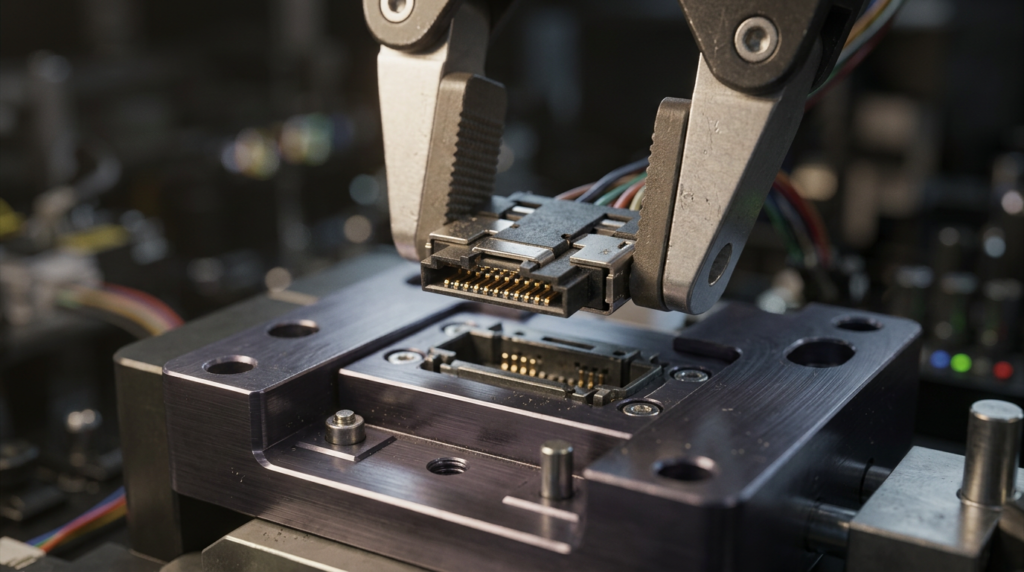
Agile’s Diana 7 robotic arm has torque sensors in all seven axes. Those sensors help the arm detect forces it encounters during movement. Imagine fitting a connector into a housing. A camera can help line up the two pieces, but contact provides new information. Resistance may mean the connector is tilted or the opening is narrower than expected. An arm that can sense that resistance has a chance to adjust before it damages the part. The same principle matters when handling thin plastic or guiding a component into a fixture with tight tolerances. It’s easy to make dexterity sound mysterious. At a workbench, it can come down to knowing when to stop pushing and how gently to try again.
What Agile ONE Brings to the Line
Agile markets Agile ONE as an industrial humanoid designed to move between workstations and handle objects with sensor-equipped hands. The attraction is easy to see in a plant built around people. Benches have familiar heights, carts sit in familiar places, and tools already fit a hand. A machine with a similar reach could use some of that infrastructure. The payoff depends on the details. How often can it complete the job without help? Also how long does a changeover take? How quickly can a technician replace a worn finger or recalibrate a sensor? A robot that answers those questions well can earn a useful assignment even if that assignment looks ordinary in a launch video.
The Nvidia Collaboration Starts in Research
The Agile ONE SN serves a different audience. Agile describes it as a compact research and development platform with preconfigured Nvidia Isaac GR00T software. Its product specifications list tactile five-finger hands, wrist cameras, and onboard Nvidia Jetson Thor computing. A researcher can use the system to collect demonstrations, train a skill, and evaluate it before trying it in a real environment. That integrated setup can spare a lab some work assembling compatible hardware and software. A factory trial would still have to answer its own questions. A skill that works with a clean set of parts under steady lighting may behave differently when a supplier changes packaging. Those variations are part of what makes the trip from research bench to production line interesting.
Why US Expansion Is Also About Service
Agile says the funding will help strengthen its US presence. The announcement leaves the shape and timing of that expansion open. For customers, a useful local presence can mean people who understand the plant, can train operators, and can get spare parts to the right site quickly. Picture a robot that handles a repetitive task reliably for weeks, then starts missing an alignment mark after a fixture is replaced. Someone has to diagnose whether the problem is the new fixture, a camera setting, or the robot’s calibration. Support becomes part of the buying decision when a line depends on the machine every day. Agile’s expansion will be easier to assess as customers learn what installation, training, and service they can get close to home.
Integration Is Where the Work Piles Up
A robot joining an existing line has to coordinate with the equipment already there. It may need a signal from a conveyor, an inspection result from a camera system, and a way to tell an operator why it has paused. Agile’s group includes Franka Robotics, mobile robotics specialist Idealworks, and automation businesses BÄR Automation and Krause Automation. That portfolio puts several pieces of an industrial project under the same corporate umbrella. A customer will still judge the integration on how well the pieces work at its own site. When an upstream machine stops, the robot should know whether to wait, clear the station, or call for help. An error message that tells the operator what happened can be worth more than another impressive motion in a demo.
A Pilot Has to Survive the Second Shift
A first demonstration often happens with fresh equipment, a carefully chosen task, and the engineers who set everything up standing nearby. The second shift is a fairer test of how the system fits into the plant. Operators may have different habits. Bins may arrive in a different order. A machine might start the shift with a worn gripper or a dusty lens. How often does someone need to intervene? When they do, can they recover quickly and understand what went wrong? These questions matter because a system can complete most individual tasks and still interrupt the line at inconvenient times. A production pilot gets interesting when it shows how the robot behaves during the ordinary rough edges of a workday.
What an $8.5 Billion Valuation Leaves Open
The $8.5 billion figure is the company valuation reported for the round. The $500 million is the fresh financing Agile announced. The release leaves revenue, margins, and utilization of the German site unspecified. Those figures would help explain how the company’s growth translates into an industrial business. A customer might first pay for one installation and then order additional units if it works. A second site might need different fixtures or more engineering support, which changes the economics. The strongest sign of repeatability would be customers expanding deployments with a clearer idea of what each additional site will cost. The new financing gives Agile resources to pursue those orders while building production and support capacity.
The Announcement Timeline in Manila
Agile Robots’ release carries a November 12, 2026, dateline in the body and displays November 10 in the page header. Reuters coverage carried by MarketScreener places the story in public reporting by the afternoon of November 12, Philippine time. That falls within the roundup’s coverage window. SiliconANGLE’s story shows an update at 12:10 a.m. Philippine time on November 13. The two timestamps describe coverage of the same financing. Agile said the round had closed, but the precise legal closing time remains undisclosed. The practical date for readers following the roundup is November 12, when the financing was already public in Manila.
What Progress Will Look Like From Here
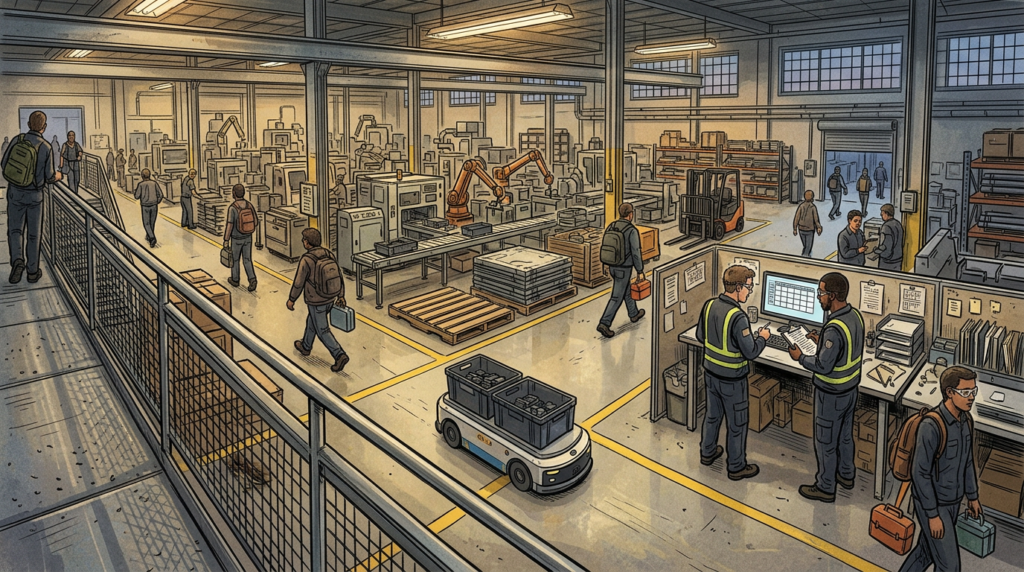
Agile Robots has money to expand, a German site with room to build, and experience across several kinds of industrial automation. The next evidence will come from what customers can do with the machines. A factory might assign a robot to one troublesome station and later add it to another shift. A warehouse might find that a mobile platform makes sense for moving batches while a fixed arm handles sorting. A humanoid might prove valuable where changing tasks makes a dedicated station expensive to rebuild. The useful milestones are repeat orders, consistent deliveries, and equipment that operators can get running again when something goes wrong. The clearest sign of success may be a quiet one. A robot shows up on the production schedule again next week.
Sources
- Agile Robots SE — Series F financing, valuation, investors, and expansion plans
- Reuters via MarketScreener — Funding, German factory capacity, and reporting timestamp
- SiliconANGLE — Funding, robotics portfolio, and industrial applications
- German Aerospace Center — Agile Robots’ research origins and technologies
- Agile Robots SE — Diana 7 robotic arm and torque sensing
- Agile Robots SE — Agile ONE industrial humanoid
- Agile Robots SE — Agile ONE SN and Nvidia Isaac GR00T collaboration
- Agile Robots SE — Agile ONE SN hardware and sensor specifications