Claude Fable 5.2 is the stronger model in the independent results we could find. GPT-6.1 Sol is far cheaper to run. On Artificial Analysis’s Intelligence Index v5.0.1, Fable 5.2 scores 65 and Sol scores 55. In the same snapshot, Fable cost $26.54 per index task and Sol cost $1.27, about one twenty-first as much. Fable results; Sol results.
So the real question is not which model is better. It is whether your work is hard enough for a 10-point lead to pay for itself.
Not tested by Kingy. This comparison draws on published evaluations and provider documentation; Kingy did not run a new matched test of these models. Evidence was checked November 9, 2026, Pacific time. Prices are in US dollars before tax. Our recommendations are editorial interpretations, not guarantees of performance on your work.
The quick verdict
| Your priority | Start with | Why |
|---|---|---|
| The hardest coding and reasoning work | Fable 5.2 | Ranked first of 74 models on Artificial Analysis’s index. |
| Everyday API work at volume | GPT-6.1 Sol | A quarter of the token price, and about one twenty-first of the measured task cost. |
| Speed to a finished answer | GPT-6.1 Sol | 19.7 minutes per index task against 46.4 for Fable. |
| Very long inputs (above 272,000 tokens) | Test both | Sol’s rates rise above that size, so the price gap narrows to about two times. |
Specifications and direct API prices
We compare the exact API models claude-fable-5-2 and gpt-6.1-sol. Rates below are standard direct API prices per million tokens, excluding separate tool charges and taxes.
| Specification | Claude Fable 5.2 | GPT-6.1 Sol |
|---|---|---|
| Context window | 1 million tokens | 1,050,000 tokens |
| Maximum output | 128,000 tokens | 128,000 tokens |
| Knowledge cutoff | June 2026 | April 30, 2026 |
| Standard input / output | $8 / $40 | $2 / $10 up to 272,000 input tokens |
| Input / output above 272,000 input tokens | $8 / $40 (no change) | $4 / $15 |
| Cache read | $0.20 | $0.10 ($0.20 above 272,000) |
| Cache write | $10 for five minutes; $16 for one hour | $2.50 for the default 30-minute lifetime |
Sources: Fable model overview, Anthropic pricing, GPT-6.1 Sol model page and OpenAI pricing. Rates match Kingy’s price records, verified November 10, 2026, 02:20 UTC.
OpenAI’s model page says Sol uses a default context window of 500,000 tokens in Codex and ChatGPT Work. The full window applies to the API.
Independent results: Fable leads, Sol costs far less
| Artificial Analysis Intelligence Index v5.0.1 | Fable 5.2, max, default fallback | GPT-6.1 Sol, max |
|---|---|---|
| Composite score | 65 | 55 |
| Rank among listed models | 1 of 74 | 12 of 74 |
| Estimated cost per index task | $26.54 | $1.27 |
| Time per index task | 46.4 minutes | 19.7 minutes |
| Output tokens used across the index | 275 million | 63.7 million |
| Output speed | 98 tokens per second | 57 tokens per second |
Source: Artificial Analysis model pages for Fable 5.2 and GPT-6.1 Sol, read November 9, 2026. The time figures are live measurements and move slightly between readings. Read the methodology.
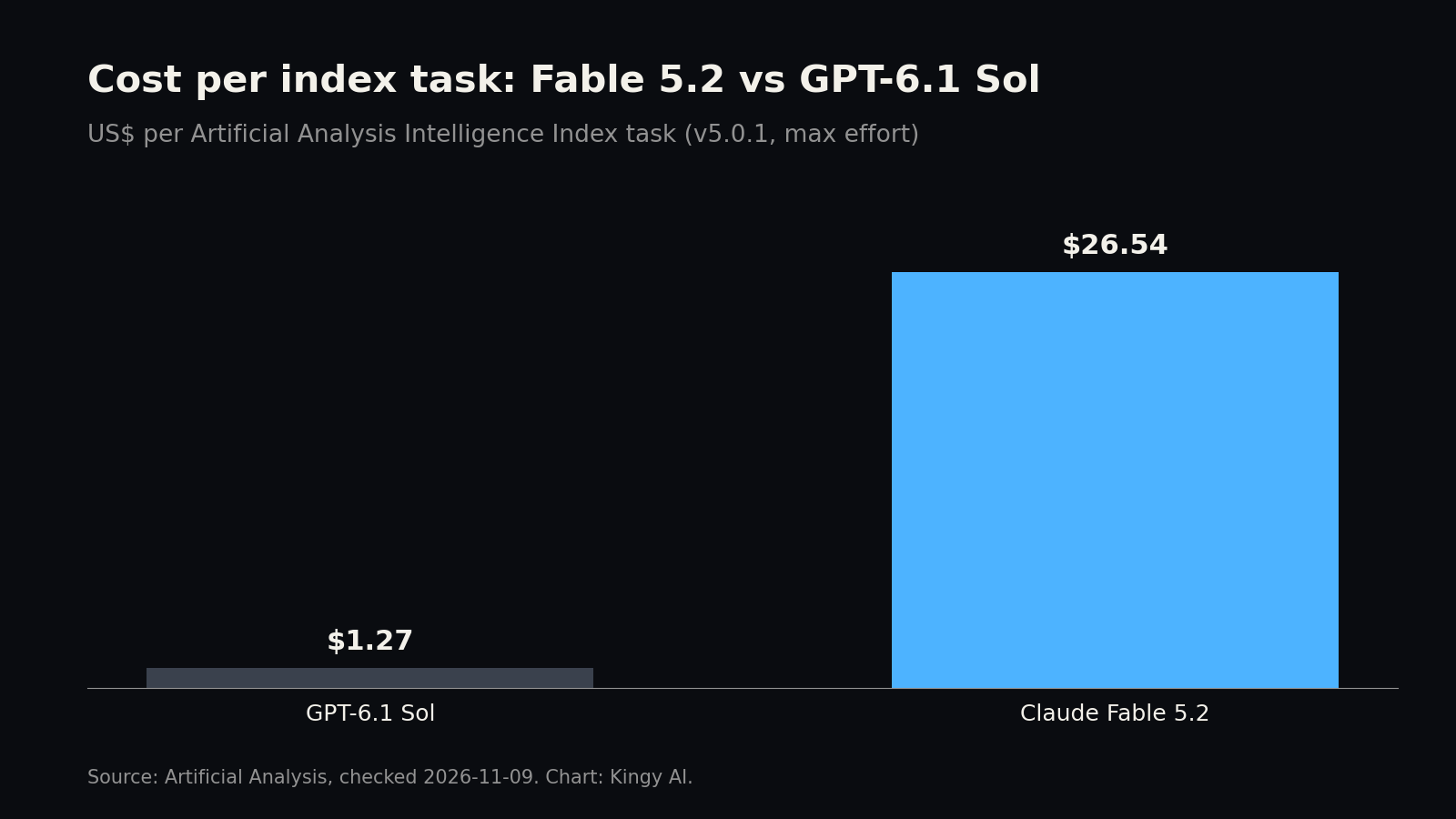
- The cost gap is much wider than the price gap. Fable’s token prices are four times Sol’s. Its measured task cost is about 21 times Sol’s ($26.54 ÷ $1.27), because Fable used about four times as many output tokens and far more input tokens to finish the same index.
- Fable writes faster but finishes later. It produces more tokens per second, yet takes about 2.4 times as long per task, because it writes and reads so much more.
- The Fable result is not a pure Fable run. Artificial Analysis labels it Default Fallback. Anthropic says a configured fallback can retry certain refusals on another model, so some answers may have come from a different model. Fallback documentation.
The index combines nine evaluations. Its score is an index, not a percentage, and a weighted index task is not the same unit as a finished project. Your bill depends on effort setting, caching and retries.
What the API bill can look like
These examples are plain arithmetic on the list prices above, with no caching.
| Request | Fable 5.2 | GPT-6.1 Sol | Fable costs |
|---|---|---|---|
| 100,000 tokens in, 10,000 out | $1.20 | $0.30 | 4 times as much |
| 500,000 tokens in, 10,000 out | $4.40 | $2.15 | about 2 times as much |
The second row is the surprise. Above 272,000 input tokens, Sol’s whole request moves to its higher rate, while Fable’s rate stays flat. If your work is mostly very long documents or large codebases in one request, Sol’s price advantage halves.
Which one should you choose?
- Pick Fable 5.2 when a wrong answer is expensive and the task is at the edge of what models can do: difficult multi-step coding, research, or long agent runs where the 10-point index lead is what you are paying for.
- Pick GPT-6.1 Sol for most routine API work: drafting, extraction, summarising and standard coding help. Our five-model comparison recommended Sol as the default for general API work on cost.
- Run both on your own hard cases before committing. Take ten tasks your current model fails, run each model once, and compare accepted results, total cost and review time.
Related: Claude Fable 5.2 vs GPT-6 Astra, How to get Fable 5.2 and the Compare AI Models tool.
Limits
Kingy did not run either model for this comparison. We found no published evaluation that tests these two models side by side on individual coding or science benchmarks, so this page relies on one composite index. That index uses each model at maximum effort, and Fable’s result includes fallback behaviour. It does not establish writing quality, hallucination rates or production reliability. Prices and index figures are snapshots and can change.
Sources
All sources were read on November 9, 2026, Pacific time.
- Artificial Analysis: Claude Fable 5.2 and GPT-6.1 Sol
- Anthropic: Fable 5.2 overview and pricing
- OpenAI: GPT-6.1 Sol model documentation and pricing
- Artificial Analysis: Intelligence Index methodology
- Anthropic: Refusals and fallback
Revision log
November 10, 2026: first published. Evidence checked November 9, 2026, Pacific time; Artificial Analysis figures re-read just before publishing.