What you actually get today
Claude Fable 5.2: Available now.
Is it free? No, paid access only. The Free plan has no Fable. Pro pays with usage credits; Max and Ultra include it up to half the weekly limit. (pricing)
| Where | Who | Status | Notes |
|---|---|---|---|
| Claude API (Claude Platform), model ID claude-fable-5-2 | Developers with a Claude Platform account | Available now | Requires 30-day data retention; not available under zero data retention unless Anthropic authorizes it. (source) |
| Google Cloud | Eligible Google Cloud customers | Available now | Anthropic does not say every account in this group has it. Google lists Fable 5.2 as generally available. Provider quotas and terms apply. (source) |
| Claude Platform on AWS and Claude Models on Google Cloud (Anthropic managed and Google managed) | Customers of those Anthropic-run and Google-run Claude offerings | Available now | (source) |
| Amazon Bedrock and Microsoft Foundry | Customers of those clouds | Available now | Anthropic does not say every account in this group has it. Anthropic lists AWS and Microsoft Azure availability; confirm the exact service, regional endpoint and account entitlement before deploying. (source) |
| Claude apps (web, desktop, mobile) and Claude Code | Max and Ultra (up to 50% of weekly limits), Pro (paid with usage credits), Team premium seats, Enterprise | Available now | Anthropic does not say every account in this group has it. Team and Enterprise access depends on seat type. A launch offer this week adds Fable resets, and gives Pro and standard Team seats a week of Fable included. (source) |
Not included:
- The Claude Free plan: no Fable models (source)
- Zero data retention, unless Anthropic expressly authorizes it (source)
- Regions: Google documents US and EU multi-regions and global; other provider and account availability must be checked separately. (source)
- Price: API: $8.00 per million input tokens and $40.00 per million output tokens; cache reads $0.20; Batch API 50% off. Fast mode: $16 input and $80 output (source)
- Limits: 1M-token context window and up to 128K output tokens; in the apps, up to 50% of weekly usage limits on Max and Ultra (source)
- Tested by Kingy: Not tested by Kingy yet.
Checked against Anthropic’s own pages on Nov 9, 2026, 20:06 UTC. Rollouts change in the first days; this box is re-checked for 72 hours.
Claude Fable 5.2 costs 20% less per API token than Fable 5.1 and posts much stronger results on several difficult tests. Its most useful improvement may be the choice between speed, reasoning effort and task cost: in Anthropic’s system-card cost estimates for an independent coding evaluation, high effort came close to Opus 5.5’s result for about half the cost per task. The more expensive max setting did worse than Fable’s own xhigh setting on that test.
That is one benchmark, not a guarantee for your codebase. Fable 5.2 has a 1 million-token context window, accepts text and images, and costs $8 per million fresh input tokens and $40 per million output tokens through Anthropic’s standard API. Not tested by Kingy: the results below come from published documentation and evaluations, not our own model runs. Anthropic model overview; system card.
What changed from Fable 5.1?
The standard input and output rates fell from $10 and $50 per million tokens to $8 and $40, respectively. That is a 20% reduction in each rate. Anthropic also claims up to 30% faster output generation. Those are different claims: faster generation does not automatically mean a 30% lower bill or a 30% shorter end-to-end job. Optional fast mode costs twice the standard token rates and is claimed to generate tokens up to 2.5 times as fast. Kingy has not timed either mode. Anthropic announcement; pricing.
Fable 5.2 also improves substantially on 5.1 in Anthropic’s published benchmark table. The differences include 16.7 percentage points on FrontierCode 2.0 and 20 points on AutomationBench. Effort settings, tools and evaluation environments matter, so those figures should be read alongside the methods below.
Claude Fable 5.2 specs
| Specification | Fable 5.2 |
|---|---|
| Release | November 9, 2026 |
| Anthropic API model ID | claude-fable-5-2 |
| Context window | 1 million tokens; Google lists a maximum input of 1,000,000 tokens |
| Maximum output | 128,000 tokens |
| Input and output | Text and image input, including PDFs; text output |
| Thinking and effort | Adaptive thinking is always on. API default is high; Anthropic says apps and Claude Code default to medium. |
| Knowledge and training cutoff | June 2026 |
| Retirement | No sooner than November 9, 2027 |
| Weights and size | No public weights or parameter count disclosed in the documentation reviewed |
Sources: Anthropic model overview, Google Cloud model documentation and Anthropic announcement. A large context window is capacity, not proof that every detail in a long document will be retrieved correctly. Test your own retrieval and output requirements.
Pricing: what will a task cost?
| USD per million tokens | Fable 5.2 | Fable 5.1 | Opus 5.5 |
|---|---|---|---|
| Fresh input | $8 | $10 | $4 |
| Output | $40 | $50 | $20 |
| Five-minute cache write | $10 | $12.50 | $5 |
| One-hour cache write | $16 | $20 | $8 |
| Cache read | $0.20 | $0.25 | $0.20 |
| Fast input / output | $16 / $80 | — | $8 / $40 |
These are Anthropic’s standard first-party/global rates, in US dollars. Subscription fees are separate. Batch gives a 50% input and output discount; it cannot be combined with fast mode. US-only inference through Anthropic adds 10%, and partner-cloud regional prices may differ. Check the current price list before committing to a workload.
Here are three aggregate-workload calculations across one or more requests, not measured jobs. Output means all billable generated tokens, including reasoning, rather than only the final text you see.
| Example workload | Fable 5.2 standard | Fable 5.1 standard | Fable 5.2 fast |
|---|---|---|---|
| 100,000 fresh input + 10,000 output tokens | $1.20 | $1.50 | $2.40 |
| 1 million fresh input + 50,000 output tokens | $10.00 | $12.50 | $20.00 |
| 100,000 cached-read input + 10,000 output tokens | $0.42 | $0.525 | $0.84 |
The cache-read example excludes the initial write. For Fable 5.2, writing 100,000 tokens to a five-minute cache costs $1. If ten requests reuse that context within its lifetime—one write, nine reads and 10,000 output tokens each—the calculated total is $5.18, compared with $12 for ten fresh-input requests. A one-hour write of the same context costs $1.60. Cache expiry, retries, tool charges, retained conversation history and multiple agents can change the bill. Higher effort can also generate more reasoning tokens, so a lower price per token does not guarantee a lower price per completed task.
Benchmarks: where Fable 5.2 improved
The following is the announcement’s headline table, reproduced as reported. Anthropic reports its own runs and results from outside evaluators; Kingy did not rerun them. Safeguards were enabled unless otherwise marked, and the table uses the highest available effort except where a setting is shown. A dash means no score was supplied in this comparison.
| Benchmark | Fable 5.2 | Fable 5.1 | Opus 5.5 | GPT-6 Astra | Gemini 4 Carbon |
|---|---|---|---|---|---|
| FrontierCode 2.0 | 49.1% xhigh | 32.4% xhigh | 45.5% max | 42.8% max | 41.1% medium |
| FrontierSWE v2 | 69.9% | 56.3% | 62.3% | 65.5% | 61.2% |
| AutomationBench | 51.4% | 31.4% | 42.5% | 41.4% | 53.9% |
| Terminal-Bench-Science 0.1 | 74.6% | 52.6% | 58.7% | 68.1% | 64.8% |
| Humanity’s Last Exam, with tools | 74.2% | 65.6% | 67.7% | 57.2% | — |
| Chartography, without tools | 73.4% | 44.8% | 64.4% | 71.0% | 72.5% |
These are different tasks, not interchangeable measures of intelligence. Carbon leads the AutomationBench row, while Fable leads the other rows shown. A benchmark score also reflects its harness, tools, sampling and grading; it cannot tell you which model will solve a particular production issue.
The effort setting can matter more than the headline score
FrontierCode 2.0 is an independent Cognition evaluation, reported in Anthropic’s system card (pages 208–210). It uses 132 public-code pull-request tasks, five trials each and a composite mergeability score. Internet access was allowed, but solutions using sources that contained the answer were penalized. Claude models used Claude Code and Astra used Codex CLI. Anthropic and Cognition list different Carbon harnesses, so the result should not be treated as an identical-wrapper comparison.
| Model and effort | Score | Average cost per task (system-card snapshot) |
|---|---|---|
| Fable 5.2 low | 34.2% | $2.10 |
| Fable 5.2 medium | 37.6% | $2.48 |
| Fable 5.2 high | 45.3% | $6.72 |
| Fable 5.2 xhigh | 49.1% | $14.19 |
| Fable 5.2 max | 45.7% | $44.70 |
| Opus 5.5 max | 45.5% | $12.82 |
| GPT-6 Astra max | 42.8% | $6.68 |
| Fable 5.1 xhigh | 32.4% | $8.68 |
Our arithmetic: Fable high cost 47.6% less per task than Opus max, with a 0.2-point lower score. No confidence interval is supplied here, so that tiny score difference should not be treated as a meaningful ranking. Fable xhigh cost 10.7% more than Opus max. Fable max cost more than three times xhigh and scored lower in this evaluation. Its reported result includes graded work from 22 timed-out attempts out of 660; counting those attempts as zero produces 44.4%.
These costs are the estimates in Anthropic’s system card for Cognition’s runs. Cognition’s live board, checked November 9, lists higher mean rollout costs for the same Fable effort levels: $2.623, $3.103, $8.402, $17.734 and $55.868, from low through max. The sources do not explain the difference. Both snapshots lead to the same within-Fable ordering, but the precise cost comparison depends on which snapshot is used. These are the same Cognition runs, not separate replications.
The practical lesson is to measure success and total cost at several effort levels on your own tasks. Start with a lower setting for routine work, then increase it when the extra solved tasks justify the extra cost. FrontierCode 2.0 rebuilt its suite and grading from 1.1, so scores across those versions are not directly comparable.
Independent launch-day results
Independent results are already available, though they do not establish a universal winner. Artificial Analysis lists Fable 5.2 at 65 on its nine-component Intelligence Index v5.0.1, using max effort and default fallback, at $26.54 per index task. Its Fable 5.1 page lists 49 at $12.99 with the same configuration label. The index is a composite, not a percentage correct on one exam, and some components may use externally sourced results. Lower token rates therefore did not mean a lower average index-task cost here.
Independent timing, checked November 9: Artificial Analysis now lists Fable 5.2 (Max, Default Fallback) at 101 output tokens per second and 171.16 seconds to the first answer token on Anthropic’s API. Its speed metric includes reasoning tokens and the full request duration; first-answer latency includes the reasoning wait. The listed 45.0 minutes per Intelligence Index task is calculated from benchmark-weighted token usage and endpoint speed, rather than timed agent runs. These endpoint measurements are distinct from Anthropic’s “up to 30%” and “up to 2.5 times” speed claims. Kingy has not reproduced them.
Vals’s Terminal-Bench 4.0 leaderboard, updated November 9, provides a useful common-harness comparison: every row below uses Mini-SWE-agent. Cost is the listed average per test, not a quote for your job.
| Model | Score | Cost per test |
|---|---|---|
| Fable 5.2 | 65.15% | $14.56 |
| Opus 5.5 | 65.15% | $12.04 |
| Kimi K3.1 Pro | 63.64% | $4.57 |
| Gemini 4 Carbon | 63.13% | $7.45 |
| GPT-6 Astra | 59.60% | $9.58 |
| Fable 5.1 | 58.08% | $17.18 |
| Qwen3.8-Max-0902 | 38.89% | $12.15 |
| DeepSeek-V4.1-Flash-1017 | 31.82% | $0.54 |
Fable and Opus tie at the displayed precision; Kimi is 1.51 percentage points behind Fable at about 31% of its listed cost. Fable 5.2 improves 7.07 points over 5.1 while costing about 15% less per test. These differences are not established as statistically significant, and the results should not be combined with the system-card Terminal-Bench scores from a different harness.
On the separate Vals Index v2.2, a composite of finance, coding, legal and tax tasks, Fable scored 71.31% at $17.94 per test, Opus 70.14% at $24.77 and Kimi 62.52% at $6.44. The task mix and grading differ from Artificial Analysis’s professional-work preferences, so a different ordering is unsurprising.
What the other evaluations actually measured
Long engineering work: FrontierSWE v2 used 34 long engineering and research tasks, a 20-hour budget, the Proximal harness and five trials per task at max effort. It is not SWE-bench Verified. Terminal-Bench-Science 0.1 used 70 tasks and ten trials each, Claude Code in bare mode, max effort and no internet. Fable’s 74.6% has a task-clustered standard error of 4.3 percentage points; fallback affected 4.1% of trials. Mythos’s 75.3% is a separate result, not Fable’s. System card, pages 211–212.
Terminal work: On Terminal-Bench 4.0, Fable scored 67.6%, Opus 66.4% and Fable 5.1 55.8%. Fable used max effort and Opus xhigh; the first two had 660 and 330 trials respectively. Their 1.2-point gap is smaller than the reported standard errors, and Fable fallback affected 10% of trials. The cached environment was offline. That is not strong evidence of a decisive Fable lead. System card, pages 210–211.
Research and charts: The HLE result covers 2,500 multimodal questions. The 74.2% tool-enabled run had search, fetch, programmatic tool calls and code execution; the no-tools result was 73.2%. Do not compare it as if it were the same setup as a text-only or differently tooled HLE run. Chartography used 100 specialized chart tasks, five runs and a Gemini 3.5 Flash grader: Fable scored 73.4% without tools and 91.6% with them. Chart-source contamination is a concern discussed in the card, which also describes separate redrawn-chart tests. System card, pages 216–218 and 229–231.
Computer use: Fable’s widely quoted 89.3% on OSWorld 2.1 is partial credit, not the share of tasks fully completed. Strict pass was 54.6%. The test used an offline 82-task subset of 108 tasks, five attempts and up to 500 actions at 1080p. Opus scored 87.2% partial and 53.2% strict; Fable 5.1 scored 83.5% and 47.6%. These results do not establish performance across the full benchmark or on your desktop. System card, pages 234–237.
Office work and automation: In independent Artificial Analysis evaluations reported in the card, Fable’s AA-Briefcase 1.1 rubric score was 66.1, but its preference Elo of 1785 was below Opus’s 1800. On GDPval-AA 2.1, Fable’s 1831 Elo was below Opus at 1866 and Muse Wonder Full at 1857. The rubric and preference scores measure different things. Zapier’s AutomationBench 1.0.6 used a private, held-out 657-task set: Fable max scored 51.4% at $4.64 per task, versus low at 39.7% and $1.30. That run was performed October 8 and repriced at launch rates; it is not the public 600-task subset or AutomationBench-AA. System card, pages 239–241.
Scale AI’s Remote Labor Index evaluated 240 selected projects against professional deliverables. Fable completed 99, or 41.3%, using high effort, a 200,000-token context and 32,000-token response cap. That is a result for those selected projects, not a finding that 41.3% of jobs can be replaced. System card, page 242.
Robotics: Anthropic reports 64.9% on RoboDojo Sim at max effort, versus 29.8% for GPT-6 Astra and 27.6% for Fable 5.1. These are Anthropic’s internal runs on a public simulated two-arm-robot benchmark. They do not establish dependable performance on arbitrary physical robots. Anthropic announcement.
Fable versus open-weight alternatives
Fable’s weights are not public. Open weights can offer more control over deployment, but hosting, hardware and operations have costs of their own. The following are current examples from official model cards, not matched head-to-head tests against Fable. Custom licenses also make “open-weight” more precise than an unqualified “open source.”
| Model | Weights and context | Published result and caveat |
|---|---|---|
| Kimi K3.1 Pro | 2.8 trillion total / 104 billion active parameters; 1,048,576-token context; text and image; custom license | Card reports Terminal-Bench 4.0 at 65.7% and HLE with tools at 70.0%. Settings and harnesses vary; they do not establish a matched Fable ranking. Its license has additional conditions for some commercial model-service operators. |
| DeepSeek-V4.1-Flash-1017 | Official MIT-licensed weights; 1 million-token context and vision support; hosted API maximum output 384,000 tokens | Card reports Terminal-Bench 4.0 at 42.3% and DeepSWE 1.1 at 77.0%, using different harnesses. Its AutomationBench result is not Anthropic’s private 657-task run. |
| Qwen3.8-2.4T-A95B | 2.4 trillion total / 95 billion active parameters; text weights; 262,144 native context, extensible to 1,010,000; custom license | Hosted Qwen3.8-Max adds vision and other features; do not assume its hosted specifications or scores apply unchanged to the downloadable weights. |
Cost can differ sharply. DeepSeek says its current deepseek-flash API routes to the 1017 model and lists peak fresh input at $0.30 and output at $1.20 per million tokens; off-peak rates are $0.15 and $0.60. At identical token counts, the 100,000-input / 10,000-output example costs $0.042 peak or $0.021 off-peak, versus $1.20 for standard Fable. That does not establish equal quality, success rates or total task costs. Check DeepSeek’s schedule and pricing for the applicable hours. Qwen’s first-party Model Studio prices are listed in Chinese yuan and vary by region. We did not verify a current numeric Kimi API price. A model with trillions of total parameters should not be assumed to fit on a laptop because only a subset is active per token.
Anthropic’s temporary launch offer gives Pro and standard Team seats up to 50% of weekly usage for all Fable models combined through November 16, 2026 at 11:59 p.m. Pacific; enabled usage credits apply after the cap or deadline. Eligible Max, Ultra, Team premium and legacy seat-based Enterprise premium users may receive one to three Fable-specific resets, depending on subscription length and other conditions. Check your account and the offer terms.
Where to use it, and what developers must change
Anthropic lists Fable 5.2 in Claude apps, Claude Code and its API, as well as AWS, Google Cloud and Microsoft Azure offerings; account and plan eligibility should be checked on the relevant service. Google lists the model as generally available in US and EU multi-regions and globally. Its documentation supports computer use, web search, batch predictions, prompt caching, function calling, token counting and a memory tool. Standard service supports provisioned throughput; fast mode uses a separate shared quota and a fast request sent to dedicated Provisioned Throughput returns HTTP 429. Google Cloud documentation; Anthropic announcement.
Migration requires more than changing the model name. Adaptive thinking cannot be disabled; forced tool_choice of any or a specific tool is unsupported; sampling parameters should be omitted; and preserved-thinking prefix checks apply to every account. Computer-use integrations outside Amazon Bedrock must replace computer_20251124 with computer_toolset_20260801. Review the migration guide and test existing tool calls and conversation handling before switching production traffic.
Retention matters for sensitive work. Anthropic’s model overview says 30-day retention is required unless zero data retention is expressly authorized. Google says it may retain prompts and responses for up to 30 days for abuse monitoring. Confirm your own provider’s terms and data controls before sending confidential material. Anthropic overview; Google documentation.
Enterprise privacy option: Anthropic also offers a qualified enterprise route: Enterprise Frontier Safeguards is in private beta, with safety monitoring of prompts and responses stored in the customer’s infrastructure. Eligible enterprise customers can request access and may receive a limited-time zero-data-retention transition for internal business applications. This is an eligibility-dependent arrangement, not default zero retention for every Fable account; confirm terms with Anthropic or your cloud provider.
Fable and Mythos at a glance
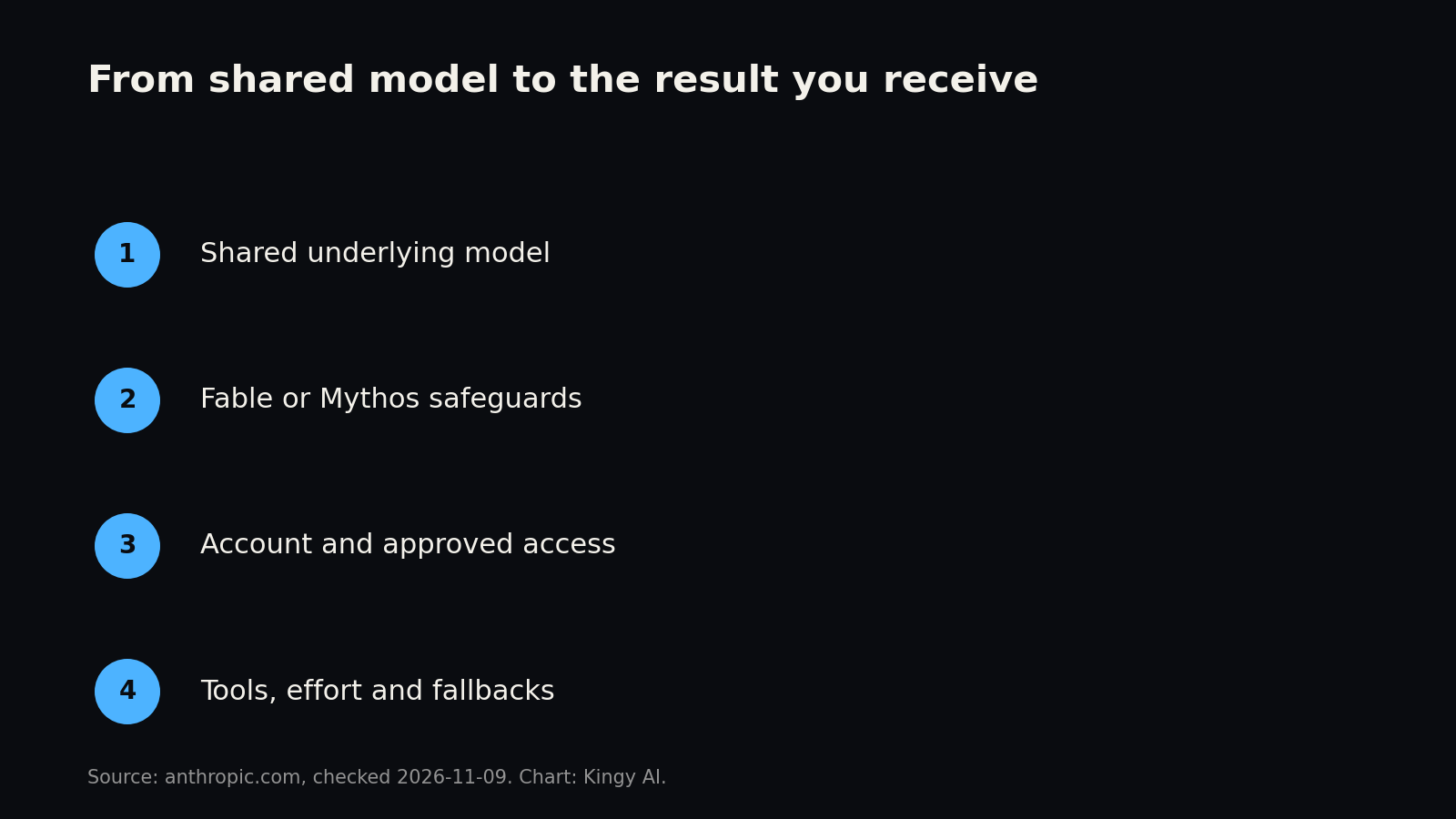
| Question | Fable 5.2 | Mythos 5.2 |
|---|---|---|
| Who is it for? | General-access use, subject to product, plan and rollout availability | Verified sensitive-domain work and selected product experiences |
| Underlying model | Same model, according to Anthropic | Same model, according to Anthropic |
| Cybersecurity and biology safeguards | Broader restrictions; some requests may be routed to a fallback | More permissive access for eligible use; not unrestricted |
| Direct API access | Generally available through the Fable model | Requires a verified grant |
| Standard API price | $8 per million input tokens; $40 per million output tokens | The same published base token rates |
Sources: Anthropic API documentation and system card. General availability does not mean free or unlimited use. A verified grant can have its own scope and provisioning requirements.
Fable, Mythos and safety limits
Fable and Mythos are deployment configurations of the same underlying model. Public Fable has additional cyber and biology safeguards; Mythos is for vetted access. The announcement’s CyScenarioBench, protein and binder results, and vulnerability findings concern Mythos and should not be attributed to unrestricted public Fable. CyScenarioBench also uses different task sets for different labs, limiting cross-lab comparisons. Anthropic announcement.
In first-party use, Fable can fall back to Opus 4.8 for cyber and Opus 5 for biology or certain frontier AI-development requests. Anthropic’s API documentation says API users must opt into fallback; without it an integration can receive a refusal. Other providers and surfaces may differ. Both configurations retain separate limitations around frontier AI development. A safeguards-on benchmark can therefore measure the deployed system, not only one underlying model. The system card reports safety regressions as well as improvements, including a lower single-turn harmless response rate and a multi-turn tracking and surveillance regression addressed with classifiers. It also reports more frequent Opus 4.8 fallback under prompt injection and increased attack success in that setting. These are reasons to test safeguards and review consequential outputs, not evidence that every deployment will behave the same way. System card.
Do you need Mythos for security work?
Not necessarily. Anthropic’s Cyber Verification Program documentation says generally available models still support tasks such as secure code review, threat modeling, patching and alert triage. The program is intended to reduce blocking for legitimate sensitive security work. Whether a particular request proceeds can still depend on the task, product and access grant.
An individual cybersecurity professional can apply for Defense Access under the program, subject to its paid-plan and verification requirements. Red Team and Specialized Access require organizations. Verification is not the same thing as automatic provisioning for every model and product; check the grant you receive before building a workflow around it.
There is also a product-mediated route. Anthropic says Enterprise customers can receive Mythos-powered scans in the Claude Security app without Cyber Verification Program membership. Its Claude Code plugin uses models already available to the account and does not independently unlock Mythos. Getting findings from a scoped security product is different from having direct, general-purpose access to the model.
For a security team, the sensible first test is a set of authorized tasks with known outcomes: for example, review code containing documented issues and compare the findings with your existing process. Record useful findings, missed issues, false positives and blocked requests. Keep human review and normal security controls in place. Those are evaluation recommendations, not results from a Kingy test.
What about life sciences?
Anthropic’s Life Sciences Verification Program is a beta for verified organizations on Enterprise, Team or API. Its form excludes Free, Pro, Max and Ultra plans. Submitting an interest form does not itself grant access.
This is a different boundary from the cyber program, where individual Defense Access applications are possible. A researcher should ask their organization which plan and verification route it has, then confirm the capabilities actually provisioned. Evaluate the tools and permissions actually provisioned to your organization. An impressive biology score alone cannot tell you what your account will do.
Which model should you choose?
For routine production work, start with a cheaper model such as Opus 5.5 and compare its success rate and total task cost with Fable on a representative set. Consider Fable 5.2 for hard coding, long-running agent work or research tasks where your tests show that the added capability earns its price. For coding agents, try high and xhigh separately before assuming max is worth paying for. Keep human review for code, sensitive decisions and computer actions.
If deployment control or token price drives the decision, evaluate an open-weight model or a lower-cost hosted API against the same tasks, context, tools and grading rules. Record failed attempts, retries and infrastructure costs as well as token charges. The published numbers provide a useful shortlist; they do not substitute for that comparison.
Sources
- Anthropic: What’s new in Fable 5.2; Cyber Verification Program; Life Sciences Verification Program; Claude Security; launch offers
- Anthropic: Claude Fable and Mythos 5.2 announcement
- Anthropic: Fable 5.2 and Mythos 5.2 system card
- Anthropic: Fable 5.2 overview, pricing and migration guide
- Google Cloud: Claude Fable 5.2
- Moonshot AI: Kimi K3.1 Pro model card and license; DeepSeek: V4.1 Flash 1017 model card; Qwen: Qwen3.8 model card and license
- Artificial Analysis: Fable 5.2; Cognition: FrontierCode 2.0; Vals: Terminal-Bench 4.0 and Vals Index v2.2
- DeepSeek API pricing; Alibaba Cloud Model Studio pricing
Revision log
- November 9, 2026: Added independent API timing measurements with their methodology, and clarified the eligible enterprise privacy route.
- November 9, 2026: Published with Anthropic’s launch, system card, API and program documentation reviewed. Kingy did not test the models.
- November 9, 2026: Expanded specifications, independent benchmarks, pricing examples and model comparisons.
Trending on Kingy
Keep reading with the stories getting the most attention now.