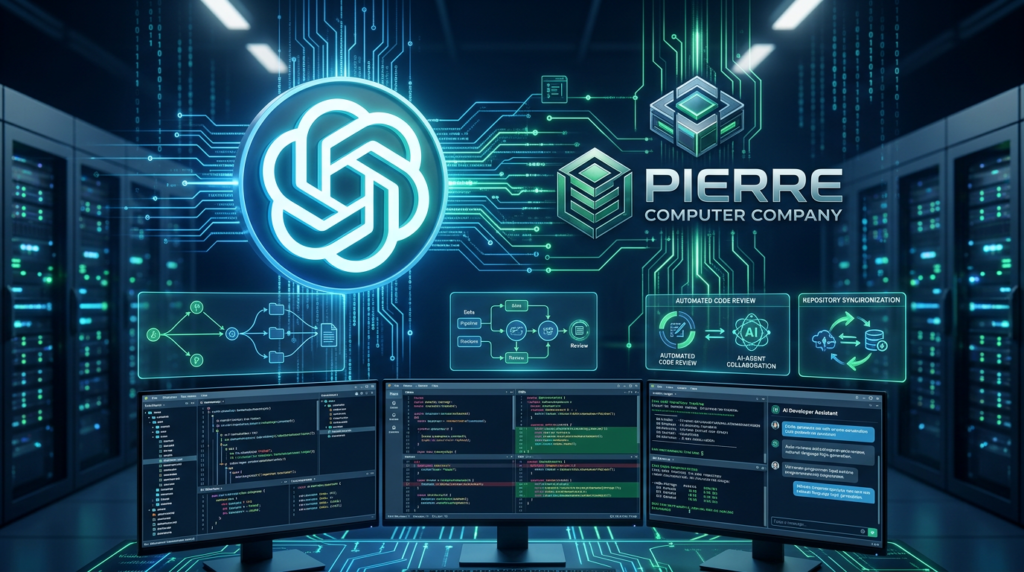
OpenAI wants to do more than help developers write code. Its planned acquisition of Pierre Computer Company could transform Codex into a more complete development platform, where humans and AI agents create, review, store, and manage software together.
OpenAI Just Made Another Big Move in AI Coding
The competition to dominate artificial intelligence-powered software development just got more interesting.
On November 4, 2026, OpenAI announced plans to acquire Pierre Computer Company, a developer-tools startup specializing in Git-based code storage, navigation, and review technologies.
At first glance, this might sound like another acquisition involving a relatively unfamiliar software company.
But look closer.
Pierre develops tools that already power important parts of OpenAI’s Codex application. Its technologies help developers navigate project files, examine code changes, and manage the information behind software projects.
Now OpenAI wants to take that relationship further.
The proposed deal could help Codex evolve beyond an AI assistant that generates programming instructions into a more integrated environment for managing the software development process.
Think of it as the difference between hiring someone who can write excellent code and building an entire workshop where that person can collaborate, organize projects, and deliver finished products.
That’s a much bigger ambition.
OpenAI has not disclosed the acquisition price or a definitive completion date. The transaction still requires customary closing conditions, including regulatory approvals.
Nevertheless, the announcement reveals something important about the direction of AI-powered programming.
The next battle might not be about which AI writes the most code.
It could be about which platform makes that code easiest to manage.
Meet Pierre Computer, the Startup Behind the Deal
Pierre Computer Company isn’t necessarily a household name.
However, among developers building modern coding tools, its technology has already attracted attention.
The company specializes in software infrastructure that helps developers interact with code repositories, inspect modifications, and manage version history.
Its portfolio includes several products with different responsibilities.
Trees provides interfaces for exploring project files. Diffs helps developers compare changes. Highlights supplies syntax highlighting, while Code Storage handles Git-based repository management.
These technologies address problems that become increasingly complicated as software projects grow.
Imagine an application containing thousands of files.
Finding the correct component can become a challenge. Reviewing changes across dozens of files adds another layer of complexity.
Now imagine several AI agents simultaneously editing different portions of that application.
Suddenly, organization becomes essential.
Pierre’s technology helps make this activity understandable and manageable.
OpenAI already uses Trees and Diffs inside Codex. That existing relationship helps explain the acquisition.
Rather than purchasing unfamiliar technology and hoping it fits, OpenAI is pursuing a company whose engineering work already contributes to its product.
The move is about expanding an existing technical foundation.
Why Git Is Suddenly So Important to AI
To understand this acquisition, we need to talk about Git.
Don’t worry. No computer science degree required.
Git is a version-control system that tracks changes to software projects.
It allows developers to create branches, record modifications, compare versions, and collaborate without constantly overwriting one another’s work.
Think of Git as a sophisticated history book for software.
Every important change can leave a record.
Traditional development teams have relied on Git for years. But AI coding agents introduce a new challenge.
They can generate and modify code rapidly.
One developer might direct multiple agents to investigate bugs, build features, and run experiments simultaneously.
Each agent can create branches and produce new versions of project files.
That’s exciting.
It’s also a potential organizational nightmare.
Without capable infrastructure, development teams could struggle with growing numbers of changes, repository operations, and competing updates.
OpenAI’s acquisition strategy recognizes that generating code is only one part of the equation.
AI agents also need reliable systems for storing, retrieving, reviewing, and coordinating their work.
Git remains central to those activities.
The opportunity lies in adapting the surrounding tools for a world where software development increasingly involves both people and autonomous agents.
Codex Already Uses Pierre’s Technology
Here’s one of the most revealing details.
OpenAI doesn’t need to wait for the acquisition to start benefiting from Pierre’s engineering.
That relationship already exists.
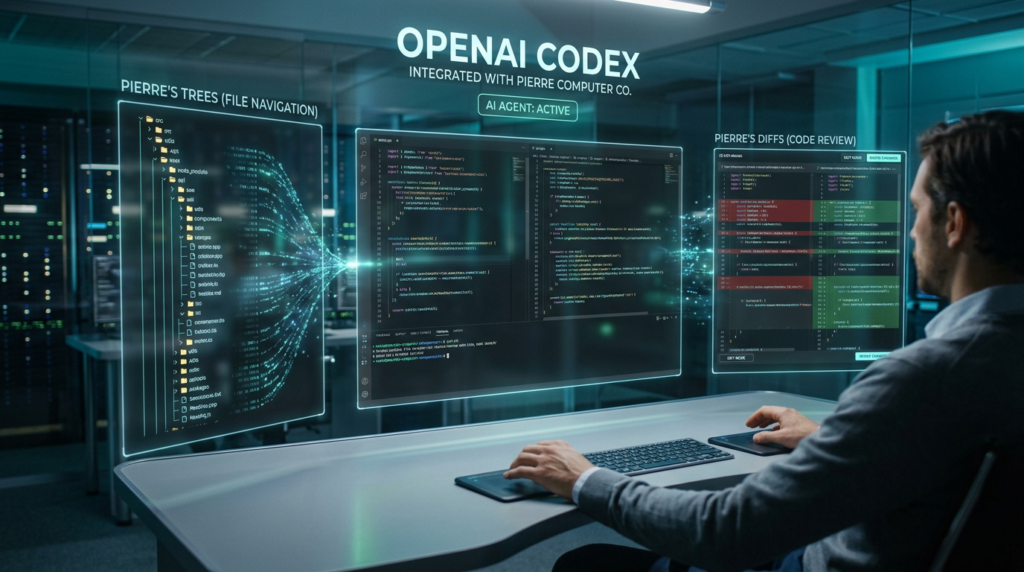
According to OpenAI’s announcement, developers who browse files or review changes inside the Codex application have already interacted with Pierre’s Trees and Diffs libraries.
Trees supports navigation through a project’s file structure.
Diffs helps users understand which lines have changed.
These might sound like relatively modest functions.
But software developers interact with them constantly.
When an AI agent modifies a project, the developer must understand what happened.
Which files changed?
What lines were added?
Did the agent delete anything important?
Can the proposed changes be reviewed before they’re accepted?
A responsive interface makes these questions easier to answer.
Pierre’s technology contributes to that experience.
The acquisition could allow OpenAI to build more closely around these existing components while incorporating Code Storage’s capabilities.
However, OpenAI has not announced a complete replacement for existing development platforms or a finished all-in-one product.
For now, the opportunity is substantial, but the broader transformation remains a goal.
Trees Makes Complex Projects Easier to Navigate
Picture yourself opening a project containing hundreds of folders.
Some files handle authentication. Others manage databases, payments, or user interfaces.
Now imagine that an AI assistant has modified several of them.
Where should you begin?
That’s where Trees becomes useful.
Pierre’s Trees library helps applications present a project’s file hierarchy in a structured, navigable interface.
Developers can explore directories and locate relevant files without getting lost in a maze of project components.
The tool also supports features such as searching and moving files through the interface.
This becomes particularly valuable when multiple coding agents work on different parts of a project.
For example, one agent might update the checkout system while another adjusts the inventory database.
A clear file-navigation interface helps the human developer examine both sets of changes.
Of course, Trees doesn’t determine whether those changes are correct.
That’s still a separate responsibility.
Its value comes from making complex projects easier to inspect.
As AI accelerates code production, these seemingly ordinary interface improvements could become increasingly important.
After all, even the smartest coding assistant isn’t particularly useful if nobody can find the files it just changed.
Diffs Could Make AI Code Reviews More Practical
Writing code quickly is impressive.
Understanding the changes afterward is where the real work begins.
Pierre’s Diffs library addresses that challenge.
A code diff shows the differences between versions of a file.
Developers can identify additions, deletions, and modifications without manually comparing entire documents.
This is particularly useful when reviewing work created by AI agents.
Suppose an agent receives a request to improve an online store’s payment process.
It edits several files and submits its work.
A developer can use a diff interface to inspect those modifications and decide whether they make sense.
Pierre also provides an Edit mode that allows reviewers to correct code directly within the comparison interface.
That feature helps shorten the distance between discovering a problem and making a correction.
But a visually polished diff is not proof of reliable software.
Developers still need appropriate testing, security checks, and human judgment.
OpenAI’s opportunity lies in connecting efficient AI-assisted code generation with practical review tools.
A coding platform becomes more valuable when it helps users understand what AI has produced, rather than simply asking them to trust the result.
Code Storage Is the Bigger Piece of the Puzzle
Trees and Diffs already contribute to Codex.
Code Storage represents another important part of OpenAI’s acquisition plan.
Pierre developed Code Storage as a service for applications that need to store source code and manage its history using Git.
That distinction matters.
A coding assistant can generate an application, but the resulting files still need somewhere to live.
Developers also need ways to retrieve earlier versions, maintain branches, and track changes.
Code Storage provides infrastructure for those activities.
It is designed to support applications that interact with repositories programmatically, including systems built around AI agents.
Consider a platform where customers describe an application they want to build.
An AI agent generates the project, edits files, and revises the result following feedback.
Behind the scenes, the application needs reliable source-control infrastructure.
That is the category of problem Code Storage addresses.
OpenAI plans to bring its features and functionality into Codex after the acquisition closes.
The announcement doesn’t specify exactly when that integration will become available.
Nevertheless, the direction is clear.
OpenAI wants Codex to participate more deeply in managing the software that AI helps produce.
Could OpenAI Become a Serious GitHub Competitor?
Now things get especially interesting.
The proposed acquisition raises questions about OpenAI’s future relationship with GitHub.
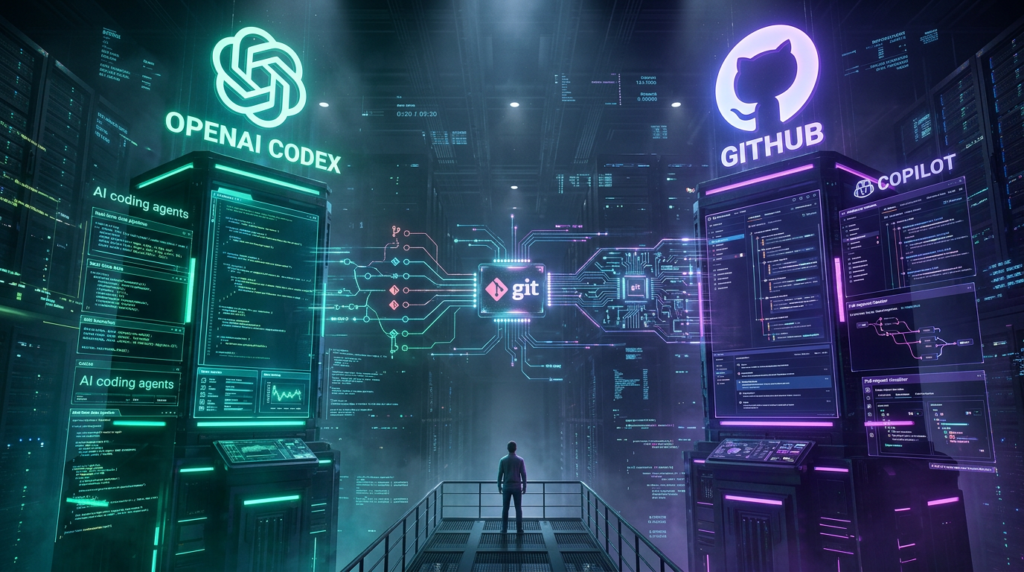
GitHub, owned by Microsoft, remains a major platform for storing repositories, reviewing changes, and coordinating software development.
It also offers AI-assisted coding through GitHub Copilot.
OpenAI’s Codex occupies an increasingly relevant part of this market.
By acquiring Pierre, OpenAI could gain more of the infrastructure needed to support software workflows beyond code generation.
Axios framed the deal as a potential challenge to GitHub’s position.
That interpretation makes sense strategically.
A platform that combines AI coding, repository storage, navigation, and review could compete for developer attention.
However, competition doesn’t necessarily mean immediate replacement.
GitHub has an established ecosystem, extensive collaboration features, and longstanding integration into development workflows.
OpenAI has not announced that Codex will replace GitHub or deliver every feature GitHub provides.
The acquisition creates possibilities rather than guaranteeing a particular market outcome.
Still, one question is worth considering.
If AI agents increasingly perform development tasks, will programmers continue organizing everything around traditional repository platforms?
Or will the AI development environment itself become the primary workplace?
OpenAI appears interested in exploring the second possibility.
Pando Shows OpenAI Has Bigger Infrastructure Plans
The Pierre announcement didn’t arrive in isolation.
On November 2, 2026, OpenAI published an engineering report describing Pando, its internally developed Git backend.
Pando addresses the increasing demands created by engineers and AI agents working simultaneously.
OpenAI reported that the system now supports development across its main code repository.
The company also said Pando reduced median code-push latency by nearly fivefold and delivers almost a petabyte of Git data daily.
Those are OpenAI-reported production results, not independently verified performance comparisons.
Nevertheless, the engineering implications are significant.
When many agents create branches and submit changes, source-control systems must handle more concurrent operations.
Pando was built to accommodate that activity while maintaining compatibility with Git.
This makes the Pierre acquisition particularly noteworthy.
Pando addresses infrastructure scaling inside OpenAI.
Pierre contributes tools for navigating, reviewing, and storing code.
They solve different problems, but both reflect the same broader challenge: adapting software development systems for AI-generated work.
OpenAI has not announced that Pando will become a commercial feature of Code Storage or Codex.
For now, the technologies represent complementary pieces of a developing strategy.
The Rise of Agentic Software Development
Traditional coding assistants mainly respond to instructions.
A developer asks for a function, and the system proposes code.
Agentic coding systems can take on more extended activities.
Depending on their permissions and capabilities, agents may inspect repositories, edit multiple files, execute tests, and revise their work.
This changes the developer’s role.
Instead of personally writing every line, an engineer may increasingly define objectives, supervise execution, and evaluate results.
Imagine assigning three agents to different tasks.
One works on performance improvements.
Another fixes a login problem.
A third updates documentation.
Their assignments might proceed simultaneously.
But coordinating the results requires more than capable language models.
The team needs systems that preserve each change, distinguish competing versions, and support reliable review.
OpenAI’s interest in Pierre fits naturally into this emerging workflow.
The company is investing in technologies that make AI-assisted development easier to organize.
That doesn’t mean coding agents are ready to replace engineering teams.
Complex software still requires design decisions, security expertise, testing, and accountability.
The more realistic opportunity is collaboration.
Humans establish goals and standards.
Agents help complete tasks.
Development infrastructure keeps the work traceable.
A Small Developer-Tools Company With Strategic Value
Large technology acquisitions often attract attention because of enormous valuations.
The Pierre announcement highlights a different consideration.
Sometimes, a company’s strategic value comes from solving a specialized technical problem exceptionally well.
Pierre focuses on developer experiences that might appear unremarkable outside programming circles.
File navigation.
Code comparisons.
Syntax highlighting.
Repository storage.
None of these features sounds as glamorous as announcing a revolutionary AI model.
But developers rely on them every day.
Their importance grows when applications generate larger amounts of code.
OpenAI specifically praised Pierre’s attention to craftsmanship and performance.
It also highlighted Highlights, Pierre’s syntax-highlighting technology, which is designed to update quickly while developers type or agents stream code.
These capabilities can help coding interfaces remain responsive.
The acquisition suggests OpenAI values the engineering expertise behind these tools.
Rather than treating the user interface as decoration, the company appears to see it as an important component of effective agent-assisted development.
Good infrastructure rarely gets standing ovations.
But when it stops working, everybody notices.
Open-Source Developers Receive an Important Assurance
One major concern surrounding technology acquisitions involves the future of open-source projects.
When a larger company acquires a smaller developer-tools business, users naturally wonder whether access will change.
Will previously available libraries disappear?
Will development slow down?
Could the new owner restrict licensing?
OpenAI addressed part of that uncertainty in its announcement.
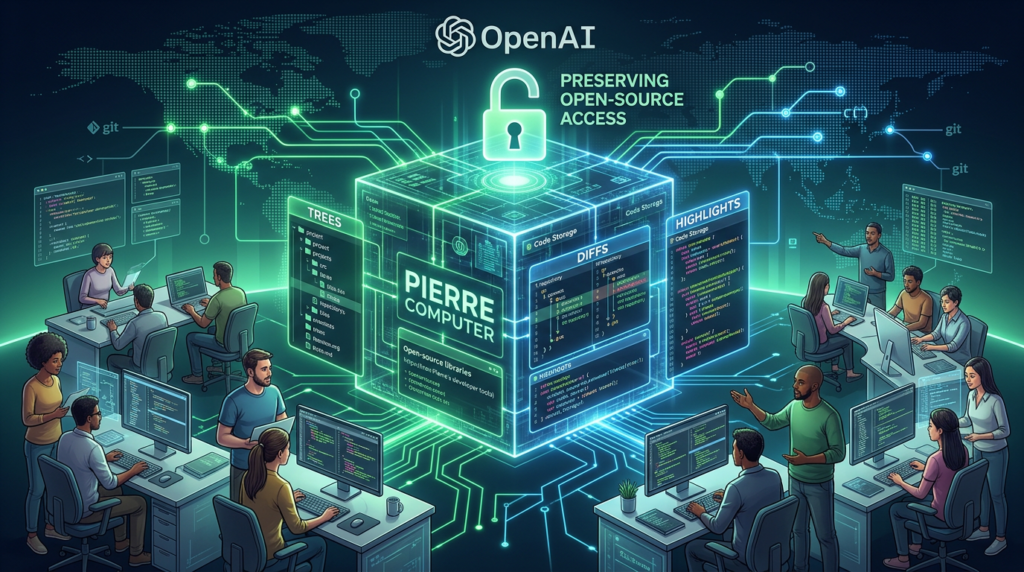
The company stated that Pierre’s open-source projects will remain open-source and that it intends to continue contributing to them.
That commitment matters for developers who already incorporate Pierre’s libraries into their applications.
It also suggests that OpenAI sees value in maintaining a relationship with the broader development community.
However, the announcement doesn’t provide a detailed roadmap for individual repositories or future maintenance schedules.
Developers should therefore distinguish the open-source commitment from assumptions about specific release plans.
The positive takeaway is that OpenAI has publicly committed to preserving the projects’ open-source status.
In an industry where acquisitions sometimes create uncertainty, that’s a meaningful starting point.
What Happens to Existing Code Storage Customers?
Existing customers have a practical concern.
What happens to their repositories and services after the acquisition?
OpenAI says Code Storage customers can continue using the service following the transaction’s completion.
The company intends to integrate Code Storage’s functionality into Codex while maintaining customer access.
That’s reassuring, particularly for organizations that depend on repository infrastructure for their products.
Suddenly replacing a code-storage provider can create serious operational complications.
Businesses need to consider repository availability, integrations, access controls, and continuity.
OpenAI’s announcement offers an initial commitment, but it doesn’t spell out every operational detail.
Questions remain about future pricing, migration options, contractual changes, and the exact product integration schedule.
Those details will matter when customers evaluate their long-term options.
For now, the acquisition has not closed, and the companies remain separate.
Current customers should continue relying on official service communications rather than assuming changes have already taken effect.
The proposed transaction establishes a direction.
It does not instantly merge the two companies’ operations.
Why This Could Matter to Independent Developers
Big acquisitions often sound relevant only to large corporations.
But the implications of improved coding infrastructure can reach much smaller teams.
Consider an independent developer building a mobile application.
Today, that person might use an AI assistant to generate code, a repository service for storage, and separate tools for testing and review.
Each component has its own workflow.
Switching between them creates friction.
A more integrated Codex experience could potentially simplify parts of that process.
Developers might find it easier to inspect agent-generated changes, maintain project history, and coordinate coding tasks.
For startups, such efficiencies could be valuable.
Small teams often lack dedicated infrastructure engineers.
Reducing the overhead of managing AI-assisted development could free them to focus on product design and customer needs.
However, these benefits remain possibilities rather than announced features.
OpenAI has not released a detailed commercial offering based on the acquisition.
Developers will need to evaluate actual functionality, pricing, and reliability when new capabilities arrive.
Integration alone doesn’t guarantee better software.
But if implemented thoughtfully, it could reduce unnecessary complexity for teams of different sizes.
The Security Questions OpenAI Will Need to Address
Giving AI agents greater responsibility creates new engineering concerns.
Code repositories frequently contain commercially sensitive information.
Developers need confidence that access permissions are enforced and changes remain auditable.
An agent that can modify software must operate within appropriate boundaries.
Otherwise, mistakes could affect important applications.
As Codex potentially expands into more aspects of repository management, questions about authorization, security, and oversight will become increasingly relevant.
For example, organizations may want different permissions for agents that suggest changes and agents authorized to merge them.
They may also need clear records showing which changes originated from AI systems and which individuals approved them.
These are considerations for any expanding agentic development platform, not allegations of weaknesses in Pierre’s technology.
OpenAI has not published a comprehensive post-acquisition security architecture.
The eventual implementation will determine how well the combined technologies address these requirements.
A successful AI development platform must do more than accelerate code generation.
It must help organizations retain control over what reaches production.
Speed matters.
Trust matters more when the software runs something important.
The Acquisition Still Faces Important Conditions
Despite the excitement, one detail deserves emphasis.
OpenAI has announced a proposed acquisition, not a completed transaction.
The agreement remains subject to customary closing conditions, including regulatory approvals.
Until the deal closes, OpenAI and Pierre remain separate and independent businesses.
Financial terms have not been publicly disclosed.
Neither has a confirmed completion date.
Those omissions matter because they limit what outsiders can reliably conclude about the transaction.
We don’t know how much OpenAI has agreed to pay.
We also don’t know exactly which future Codex features will emerge from the combined engineering teams.
And while OpenAI has expressed ambitious plans for source control, those plans should not be confused with products already available to customers.
The strongest evidence currently concerns the existing use of Trees and Diffs, the proposed acquisition, and OpenAI’s stated intention to incorporate Code Storage functionality.
Everything beyond that requires careful interpretation.
For developers considering long-term platform decisions, the distinction between announced plans and shipped technology is essential.
What This Means for the Future of Codex
OpenAI’s long-term vision appears increasingly ambitious.
The company wants Codex to become a place where humans and coding agents tackle substantial software projects together.
Pierre’s technology could support that goal by strengthening several fundamental development activities.
Developers need to navigate code.
They need to understand changes.
They need to preserve project history.
And they need dependable infrastructure connecting those tasks.
OpenAI’s existing tools already address parts of this workflow.
The proposed acquisition would give the company more direct access to the expertise behind them.
Combined with its work on Pando, the move illustrates an effort to expand beyond the AI model itself.
This is an important distinction.
The future of AI software development will depend not only on increasingly capable models but also on the environments surrounding them.
An impressive coding agent can produce hundreds of changes.
A useful development platform helps people determine which changes are worth keeping.
That may become one of the defining challenges of the next generation of programming tools.
A Bigger Story Than Just Another Tech Acquisition
OpenAI’s planned purchase of Pierre Computer Company may ultimately prove more significant than its relatively quiet announcement suggests.
The deal reflects a fundamental shift in software development.
AI systems are becoming more capable of producing code, yet the surrounding infrastructure must evolve to accommodate their growing contributions.
Source control, code review, repository storage, and collaboration are moving closer to the center of the AI conversation.
Pierre brings specialized expertise in several of these areas.
OpenAI brings Codex, substantial engineering resources, and a broader ambition for agent-assisted programming.
Their potential combination could help create a more integrated development experience.
There are still unanswered questions about implementation, commercial terms, and regulatory approval.
Nevertheless, the strategic direction is unmistakable.
OpenAI isn’t simply exploring ways to make AI write more software.
It’s working toward a future where AI can participate throughout the development process.
And as that future approaches, the most valuable tool might not be the one that generates the next thousand lines of code.
It might be the one that helps developers understand, organize, and safely ship them.
Sources
OpenAI to Acquire Pierre Computer Company, Inc.
Exclusive: OpenAI Targets Microsoft’s GitHub With Deal
OpenAI to Bring Pierre Computer’s Code Storage to Codex Through Acquisition
OpenAI to Acquire Developer Tooling Startup Pierre Computer
The Kingy Brief
Get the free AI price sheet.
25 AI plans and models on one page, from official pricing pages, updated every month. Free when you join The Kingy Brief: AI changes, original tests and one practical thing to try, Fridays at 09:00 Vancouver time.
Free · Double opt-in · Unsubscribe anytime
Signup help and newsletter schedule
After submitting, check your inbox for "Confirm your subscription to The Kingy Brief" and open its confirmation link. Your price sheet download is on the page that opens. Check Spam or Promotions if you cannot find it.
Fridays at 09:00 Vancouver time: source-checked AI changes, original tests and one practical thing to try. We skip a week when there is not enough verified material. Free. Unsubscribe anytime.