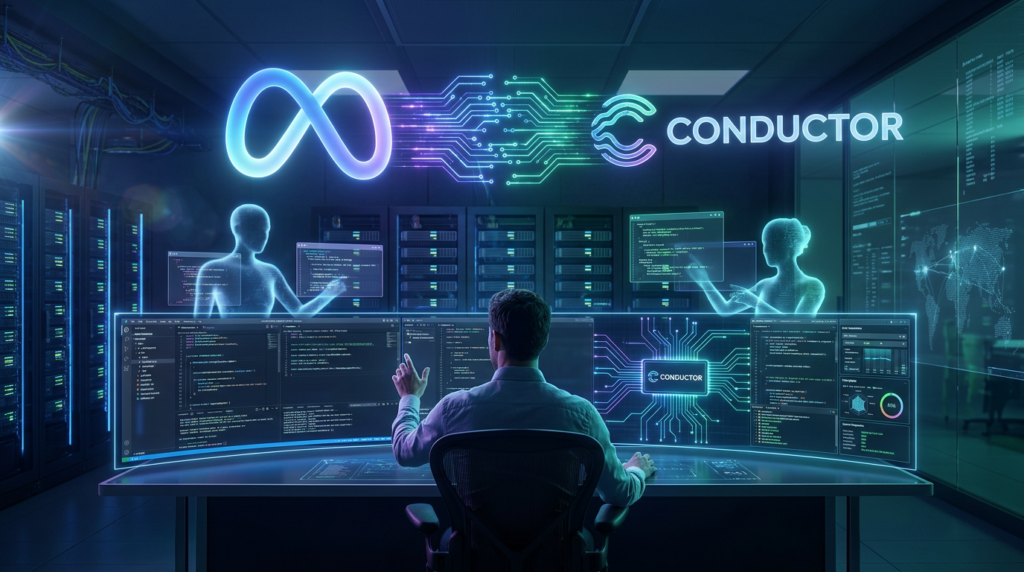
Meta has acquired Conductor, a startup specializing in coordinating multiple AI coding agents simultaneously. The deal could help Meta build a new generation of development tools where programmers manage entire teams of AI assistants instead of working with just one.
Meta Just Made a Big Move in AI Coding
The artificial intelligence coding race has another major contender making moves.
On November 4, 2026, Meta acquired Conductor, an AI startup that helps software developers coordinate multiple coding agents working on different tasks simultaneously.
The acquisition adds a specialized development team to Meta’s growing artificial intelligence operation.
And the timing couldn’t be more interesting.
On the same day, OpenAI announced plans to acquire Pierre Computer Company, another startup focused on developer infrastructure.
Two major AI companies. Two developer-tools deals. One increasingly competitive market.
Coincidence? Perhaps.
But the underlying trend is difficult to ignore.
AI companies are no longer competing solely to produce models that generate impressive code.
They’re increasingly interested in controlling the tools developers use to manage AI-generated software.
Conductor brings something particularly valuable to that competition: experience building interfaces where several AI coding agents can work together.
Instead of asking one assistant to complete an entire project, developers can divide responsibilities among multiple agents.
One fixes bugs.
Another builds features.
A third investigates performance problems.
That’s the kind of workflow Meta wants to explore.
Financial terms weren’t disclosed, and Meta hasn’t announced exactly how Conductor’s technology will appear in future products. (TechCrunch)
Meet Conductor, the Startup Behind the Acquisition
Conductor isn’t another company trying to build the world’s most powerful language model.
Its specialty is making existing AI models easier to use together.
Founded in 2024, the startup developed a platform that allows software engineers to run multiple coding agents across separate workspaces.
Its core product launched in July 2025.
The idea was straightforward.
Why limit developers to one AI assistant when several could tackle different parts of a project?
Conductor built an interface designed around that question.
Its platform lets developers create parallel workspaces, assign tasks to agents, and monitor their progress.
These agents can operate on separate portions of a software project without constantly interfering with one another.
The company was led by co-founders Charlie Holtz, its chief executive, and Jackson de Campos, its chief technology officer.
Conductor attracted attention because it focused on how developers actually work.
Rather than presenting AI coding as a single conversation, it treated software development as a collection of coordinated activities.
That distinction is important.
Writing code is only part of building software.
Developers must also organize tasks, examine changes, resolve conflicts, and decide what reaches production.
Conductor concentrated on making those activities manageable when AI agents perform more of the work.
What Makes Conductor Different From Ordinary AI Coding Tools?
Most people are familiar with AI coding assistants that respond to prompts.
You describe a feature.
The assistant generates code.
You review the result.
Conductor takes a different approach.
Instead of centering everything on one assistant, it allows developers to manage several agents working simultaneously.
Imagine building an online shopping application.
One agent develops the checkout interface.
Another improves product search.
A third investigates database performance.
Each agent operates in its own workspace.
The developer can supervise these activities without manually switching between unrelated conversations.
That’s the appeal of multi-agent orchestration.
Conductor doesn’t necessarily make individual AI models more intelligent.
Instead, it changes how developers organize their capabilities.
The platform has supported agents powered by models from companies including OpenAI and Anthropic.
That model-independent approach gives developers flexibility when choosing tools for different assignments.
However, running several agents doesn’t automatically produce better software.
Their work still requires coordination, testing, and review.
Conductor’s contribution is providing an environment designed to make that coordination easier.
Parallel Workspaces Could Change Software Development
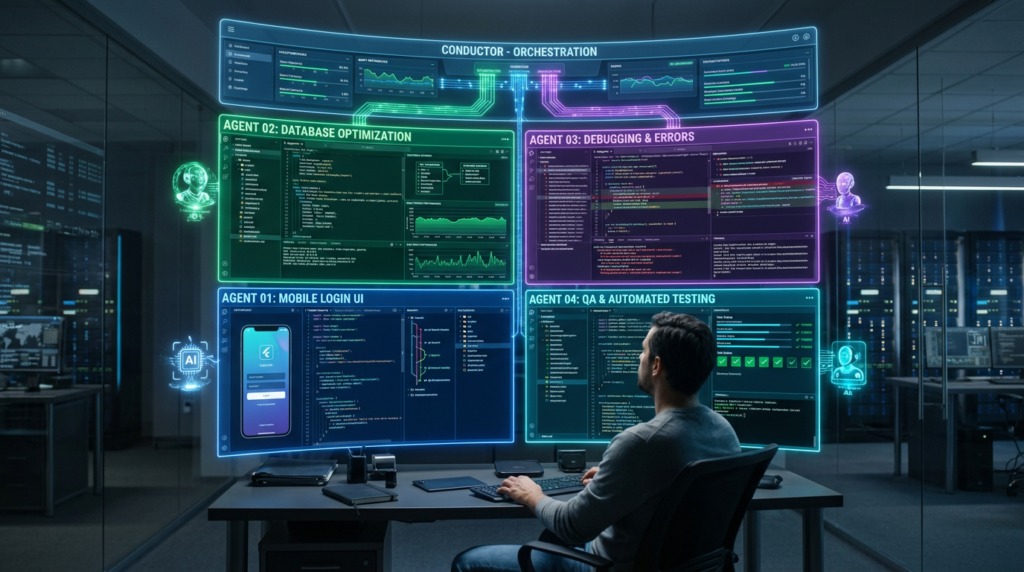
Here’s where the concept becomes especially interesting.
Traditional software development often involves multiple programmers working on separate branches of a project.
They make changes independently before combining their work.
Conductor applies a similar organizational idea to AI coding agents.
Each agent can work in a compartmentalized environment.
That separation helps reduce direct interference between simultaneous tasks.
For example, imagine a developer assigning three agents to improve a mobile application.
The first updates the login interface.
The second optimizes image loading.
The third writes additional tests.
Because the agents work separately, they can make progress without constantly overwriting the same files.
Eventually, the developer must examine their changes and decide how to integrate them.
This approach could improve productivity when tasks are sufficiently independent.
But parallel work introduces complications.
Agents might make incompatible assumptions.
Two changes might conflict when combined.
One agent could depend on modifications another hasn’t finished.
Successful orchestration therefore requires more than launching several assistants.
It requires clear task boundaries, reliable source control, and human supervision.
Conductor’s product addresses an important part of that emerging workflow.
Meta Superintelligence Labs Gets New Expertise
The acquisition also reveals something about Meta’s AI priorities.
Conductor’s team is joining Meta’s broader artificial intelligence efforts, with founder Charlie Holtz publicly expressing enthusiasm about working with Alexandr Wang and Nat Friedman.
Wang serves as Meta’s chief AI officer, while Friedman leads product efforts within Meta Superintelligence Labs.
The organization has become central to Meta’s ambitions in advanced AI.
Adding Conductor’s team could strengthen its ability to create developer-facing products.
Why does that matter?
Because developing powerful AI models and building excellent tools around them require different skills.
Model researchers focus on training, reasoning capabilities, and performance.
Product engineers must consider interfaces, workflows, reliability, and everyday usability.
Conductor brings experience in that second category.
Its team has already built software designed around practical multi-agent coding.
Meta could use that expertise to improve how developers interact with its AI systems.
However, the company hasn’t disclosed specific integration plans.
There is no confirmed announcement that Conductor’s existing application will simply become a Meta-branded product.
The acquisition provides expertise and opportunities.
What Meta builds with them remains an open question. (TechCrunch)
Why AI Companies Are Suddenly Obsessed With Developers
Software developers have become one of the most important audiences in artificial intelligence.
There’s a practical reason.
Programming provides relatively structured tasks where AI systems can produce outputs that developers can test.
A model generates code.
The developer runs it.
Tests help determine whether the result behaves as expected.
This makes software development a valuable environment for applying and evaluating AI capabilities.
It also creates commercial opportunities.
Companies that integrate AI deeply into development workflows may build long-term relationships with businesses.
Developers use these tools repeatedly, often across numerous projects.
Once an organization incorporates a platform into its engineering process, switching can become complicated.
That makes developer tools strategically attractive.
Meta’s acquisition suggests it wants a stronger position in this market.
The company isn’t alone.
OpenAI, Microsoft, Anthropic, and other technology businesses are investing in coding assistants and agent-based development.
The competition increasingly extends beyond model performance.
It includes interfaces, workflow management, integrations, and reliability.
Conductor gives Meta experience in an area that could become particularly important as coding agents grow more capable.
Conductor’s Biggest Advantage Might Be Its Interface
Artificial intelligence companies love discussing model benchmarks.
But raw intelligence isn’t the only factor determining whether people enjoy using a product.
The interface matters.
A lot.
Imagine supervising five coding agents through five separate terminal windows.
Each agent produces updates, asks questions, and modifies files.
Keeping track of everything quickly becomes exhausting.
Conductor approached this problem by creating a workspace designed specifically for coordinating agents.
Developers could organize parallel activities through a more unified experience.
That design philosophy becomes increasingly valuable as AI handles larger assignments.
The human developer needs to understand which agents are active, what they’re doing, and where intervention is necessary.
A good interface makes that information easier to interpret.
A poor one can turn automation into confusion.
Conductor’s emphasis on developer experience appears to be an important reason Meta pursued the company.
The broader lesson is simple.
The next generation of AI development tools may succeed because they make sophisticated systems easier to supervise.
Not because they display the most impressive chatbot conversation.
A New Interface Is Coming in Early 2027

Conductor’s acquisition announcement included an intriguing promise.
The team expects to introduce something new in early 2027.
Founder Charlie Holtz described ambitious plans for the next interface.
Unfortunately for curious developers, the company hasn’t revealed much else.
There’s no detailed feature list.
No confirmed product name.
And no announced public release date beyond the early-2027 target.
Still, the announcement offers an important clue.
The team appears interested in continuing its work on how people interact with AI coding systems.
That could involve improved orchestration, more intuitive supervision, or new ways to organize agent-generated work.
Those possibilities are reasonable interpretations, not confirmed features.
Meta may also combine Conductor’s expertise with its existing AI models and development tools.
Again, the company hasn’t specified how.
For now, developers should treat early 2027 as a stated target rather than a guaranteed launch date.
The announcement signals direction without revealing the destination.
And in the fast-moving AI industry, that leaves plenty of room for surprises.
Conductor Cloud Is Shutting Down
While the acquisition creates opportunities for Meta, existing Conductor customers face an immediate change.
Conductor Cloud is being discontinued.
The company has published a transition schedule explaining what users should expect.
New registrations stopped on November 4, 2026.
Existing customers can continue using supported functionality during the transition, but the cloud service has a firm shutdown timetable.
On November 13, Conductor Cloud will become read-only.
Users will still be able to examine previous conversations and export information, but they won’t be able to send new messages.
On November 20, the cloud service will shut down completely.
Conductor says it will begin deleting cloud user data after that date.
This makes exporting information particularly important.
Developers who depend on cloud workspaces should preserve their projects and relevant conversation histories before the deadline.
The company has provided tools for transferring workspaces to local machines.
Active subscribers are also eligible for refunds.
The acquisition may be positive news for Meta’s AI strategy, but customers should not overlook the operational consequences. (Conductor)
How Existing Users Can Preserve Their Work
Conductor has outlined two principal options for preserving existing information.
Users can transfer individual cloud workspaces to their local Mac.
Within the application, they can right-click a cloud workspace and select the option to transfer it locally.
This moves the workspace and associated chats to the local environment.
Alternatively, users can export an archive of their account data.
That option is available through the application’s account settings.
These steps matter because the November 20 shutdown isn’t simply a pause in service.
Conductor says cloud data deletion begins when the hosted service closes.
Developers should therefore confirm that important files, conversations, and project information have been preserved.
It’s also sensible to verify that exported materials are accessible before relying on them.
Local Conductor will continue receiving new models and critical bug fixes until early 2027.
The company expects the local application to begin winding down around that time.
That gives existing customers a temporary transition period.
However, it doesn’t establish permanent support for the current product.
Users should plan accordingly.
What Happens to Conductor’s Existing Application?
One unusual aspect of this acquisition is that Conductor’s existing product isn’t simply continuing indefinitely under new ownership.
Instead, the company is preparing to wind down its current services while working toward a new interface.
This creates uncertainty for developers who have built workflows around Conductor.
The local application remains usable during the transition.
It will continue receiving important fixes and model updates until early 2027.
After that, support is expected to wind down.
Conductor hasn’t announced that the future interface will preserve every existing feature.
Nor has it confirmed that current accounts or subscriptions will transfer to a replacement product.
Those distinctions matter.
A new application could offer substantial improvements.
It could also introduce different workflows or requirements.
Developers shouldn’t assume compatibility until the companies publish specific information.
For now, the safest approach is to preserve important work and prepare alternatives where necessary.
The acquisition may strengthen Meta’s long-term position, but Conductor customers must navigate the short-term transition.
Data Privacy Remains an Important Question

Whenever a technology company acquires a service that handles source code, privacy deserves attention.
Software repositories can contain commercially valuable information.
Development conversations may also reveal internal architecture, product plans, or engineering decisions.
Conductor addressed these concerns in its acquisition FAQ.
The company says it has never sold customer data or used that information to train AI models.
It also states that it doesn’t intend to change that practice.
Conductor plans to delete user data when its existing application shuts down in early 2027, with cloud data deletion beginning after the November 20 closure.
These are company commitments.
They shouldn’t be interpreted as independent verification of every data-handling process.
Organizations with sensitive repositories should still review applicable privacy terms and their own retention requirements.
They should also preserve records they are legally or operationally required to maintain.
The acquisition highlights a broader issue facing AI development platforms.
As coding agents gain access to more project information, transparent data handling becomes increasingly important.
Convenience is valuable.
But businesses need confidence about where their information goes.
How Meta’s Acquisition Compares With OpenAI’s Pierre Deal
The timing of Meta’s acquisition creates a fascinating comparison.
On November 4, OpenAI announced plans to acquire Pierre Computer Company.
Pierre specializes in developer infrastructure, including code storage, navigation, and review.
Conductor focuses on coordinating multiple AI coding agents.
The technologies address different parts of software development.
Pierre helps applications manage and examine code.
Conductor helps developers organize agents that produce and modify it.
Both are important.
Imagine a future development environment where several agents work simultaneously.
A coordination interface assigns tasks and tracks progress.
Repository infrastructure preserves their changes.
Review tools help developers examine the results.
Together, these capabilities support a more complete software development workflow.
That’s why the two deals are strategically interesting.
They suggest major AI companies recognize that generating code is only one piece of a larger system.
However, OpenAI’s Pierre transaction remains proposed, while Meta’s Conductor acquisition has been publicly confirmed.
The companies have not announced identical products or integration strategies.
The comparison illustrates an industry trend rather than proving that either company will dominate the market.
Could Multi-Agent Coding Make Small Teams More Productive?
One of the most promising applications of multi-agent development involves smaller engineering teams.
Startups often operate with limited resources.
A handful of developers may need to maintain applications, build features, investigate bugs, and handle testing.
Coordinated AI agents could help distribute some of that workload.
For example, a small team might assign routine documentation updates to one agent while another investigates a straightforward software defect.
Meanwhile, human engineers focus on architecture and difficult decisions.
This approach could improve productivity when tasks are well defined.
But the benefits aren’t automatic.
Running multiple agents can increase computing costs.
Poorly coordinated agents may duplicate work or introduce conflicting changes.
Developers still need to evaluate outputs.
In some situations, supervising several agents could require more effort than completing a task directly.
The practical value depends on task complexity, agent reliability, and the quality of the orchestration tools.
Conductor’s acquisition reflects growing interest in solving those challenges.
If future products make coordination easier, smaller teams could gain access to development capabilities previously associated with larger organizations.
The Challenges of Managing AI Agent Teams
Coordinating several AI coding agents sounds exciting.
But anyone who has managed a group project knows that adding more participants doesn’t automatically improve results.
Sometimes it just creates more meetings.
AI agents introduce their own version of that problem.
They can misunderstand requirements.
They may produce incompatible changes.
They can repeat work another agent has already completed.
And they may confidently report progress even when their output requires substantial correction.
Effective orchestration needs mechanisms for dividing tasks, monitoring progress, and resolving conflicts.
Developers also need clear visibility into what each agent has changed.
Testing remains essential.
So does human review.
A system that launches ten agents without helping users understand their work may create more complexity than it removes.
That’s why interface design and workflow coordination matter.
Conductor has experience building tools around these challenges.
Meta now has an opportunity to apply that experience at a larger scale.
Whether it succeeds will depend on the reliability and usability of whatever products eventually emerge.
Why This Acquisition Matters Beyond Coding
The broader implications extend beyond software engineering.
Multi-agent orchestration is relevant wherever complicated work can be divided into coordinated activities.
Consider research.
One agent gathers information.
Another organizes findings.
A third prepares a draft.
A human reviews the final result.
Similar patterns could emerge in business analysis, document processing, and other professional workflows.
However, Conductor’s existing expertise is specifically centered on software development.
Meta hasn’t announced that the acquisition will produce general-purpose agent management products.
Any expansion into other industries remains speculative.
Still, coding offers a useful environment for developing orchestration techniques.
Software tasks often produce artifacts that can be inspected, tested, and compared.
Lessons learned from coordinating coding agents could eventually inform other AI applications.
The key question is whether companies can make multiple agents work together reliably without sacrificing transparency or control.
Conductor’s technology addresses one part of that challenge.
Meta Is Betting on a Different Kind of AI Future
Meta’s acquisition of Conductor illustrates an important shift in the artificial intelligence industry.
The conversation is moving beyond individual assistants.
Increasingly, companies are exploring systems where multiple AI agents cooperate under human supervision.
Conductor brings experience building interfaces for precisely that kind of workflow.
Its team joins Meta at a time when developer tools are becoming strategically important to major AI companies.
The deal could help Meta create more capable and accessible coding environments.
But several questions remain unanswered.
What will the promised early-2027 interface look like?
How closely will it integrate with Meta’s existing AI systems?
Will developers retain the ability to choose models from competing providers?
And can Meta translate Conductor’s specialized approach into a reliable product for larger audiences?
Those answers will determine the acquisition’s lasting significance.
For now, the announcement represents a meaningful addition to Meta’s developer-tool ambitions.
The Future of Coding May Look More Like Managing a Team

For decades, software development has revolved around people writing instructions for computers.
AI is beginning to change that relationship.
Developers can increasingly describe objectives and delegate portions of implementation to intelligent systems.
Conductor’s approach pushes the idea further by allowing several coding agents to operate in parallel.
Meta’s acquisition suggests the company sees substantial potential in that model.
The opportunity isn’t simply to generate more code.
It’s to make software development more organized, collaborative, and efficient.
Of course, experienced engineers won’t disappear because an application can launch several agents.
Human judgment remains essential for architecture, security, testing, and accountability.
The most promising future involves people directing capable tools rather than surrendering control to them.
That’s the bigger story behind Meta’s latest acquisition.
The next major advance in AI coding might not come from a model that writes software faster.
It might come from an interface that helps developers manage an entire team of AI agents.
And if that happens, the programmer of tomorrow may spend less time typing every instruction and more time deciding what the software should accomplish.
Sources
The following sources support the article. Publication dates are omitted from this section as requested.
- Conductor — Official Acquisition AnnouncementConductor Is Joining MetaPrimary confirmation of the acquisition, the planned new interface, customer transition arrangements, shutdown dates, and data-handling commitments.
- Axios — Independent Acquisition ReportingExclusive: Meta Acquires AI Coding Startup ConductorReports the acquisition and examines its strategic significance for Meta’s developer tools and AI coding ambitions.
- TechCrunch — Independent Technology ReportingMeta Acquires AI Coding Startup ConductorCovers the company’s multi-agent development technology, Meta’s confirmation, leadership, and acquisition implications.
- The Register — Independent Technical ReportingMeta Brings Conductor on Board Its Model TrainDiscusses Conductor’s coding-agent orchestration approach, its macOS application, and the service transition.
- Conductor — Official WebsiteConductor AI Coding PlatformOfficial company information and product announcements.
The Kingy Brief
Get the free AI price sheet.
25 AI plans and models on one page, from official pricing pages, updated every month. Free when you join The Kingy Brief: AI changes, original tests and one practical thing to try, Fridays at 09:00 Vancouver time.
Free · Double opt-in · Unsubscribe anytime
Signup help and newsletter schedule
After submitting, check your inbox for "Confirm your subscription to The Kingy Brief" and open its confirmation link. Your price sheet download is on the page that opens. Check Spam or Promotions if you cannot find it.
Fridays at 09:00 Vancouver time: source-checked AI changes, original tests and one practical thing to try. We skip a week when there is not enough verified material. Free. Unsubscribe anytime.