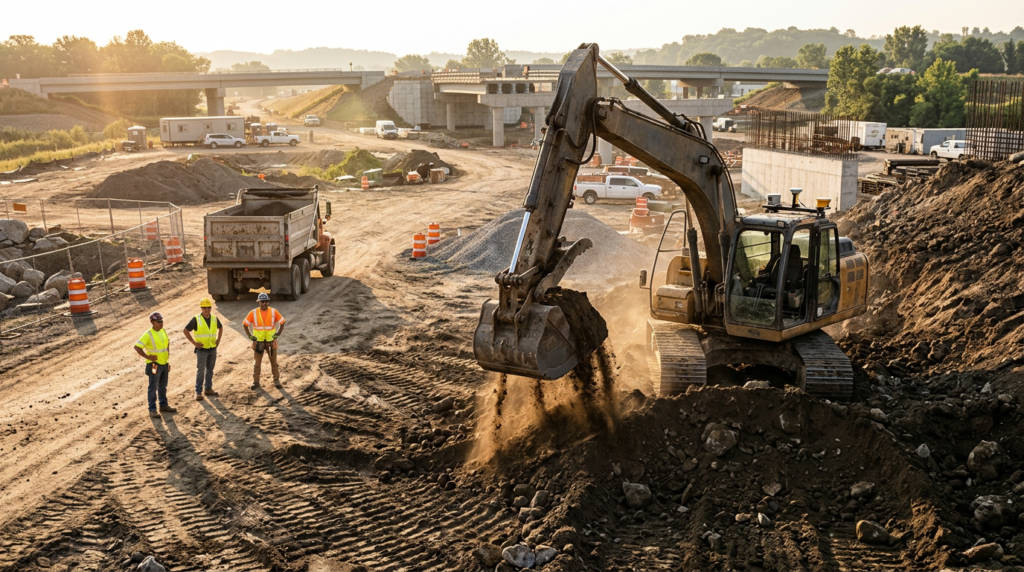
The construction technology company says its self-driving excavators are already performing paid work. Its new funding will support a broader rollout, but questions remain about safety, cost, and how autonomous machines will fit into existing crews.
Bedrock Robotics has raised $600 million to expand the use of autonomous construction equipment across the United States, giving the young company a substantial financial boost as it moves beyond early deployments.
The Series C funding round, announced on October 26, 2026, values Bedrock at $4.1 billion after the investment. CapitalG and Emergence Capital co-led the round, which brings the company’s total funding to nearly $1 billion since its founding in 2024.
Bedrock develops technology that can be added to existing heavy equipment, beginning with excavators. Its goal is to allow those machines to perform construction tasks autonomously while working alongside people and other equipment on active job sites.
The company says its autonomous excavators began performing paid work in mid-August. That earlier milestone is distinct from the new funding announcement: the latest development is the money Bedrock has secured to expand its commercial operations.
The financing reflects growing investor interest in physical AI artificial intelligence that interacts with the physical world through machines and robots. For Bedrock, the challenge now is to turn a promising early deployment into a dependable service that construction companies can use across different sites and conditions.
A Major Investment in Autonomous Construction
Bedrock’s $600 million Series C is a significant round for a company that has existed for only about two years.
Alongside lead investors CapitalG and Emergence Capital, new backers include US Innovative Technology Fund, Bessemer Venture Partners, and Temasek. Existing investors participating in the round include 8VC, Georgian, Valor Equity Partners, Xora, Eclipse, Perry Creek Capital, and Nvidia.
The $4.1 billion valuation is the value assigned to the company after the new investment. It shows how much investors believe Bedrock could be worth, although a private valuation does not guarantee future revenue or profitability.
Bedrock says it will use the funding to increase the number of machines equipped with its technology, expand to more commercial construction sites, and build the field operations needed to support customers.
That last point matters. Construction equipment operates in demanding environments, and a technology provider must do more than deliver a machine. It must also help contractors deploy, maintain, and integrate the technology into their work.
From Testing to Paid Construction Work
Bedrock says it reached an important milestone in mid-August 2026, when its fully autonomous excavators began performing paid work on active commercial job sites.
TechCrunch reported that Bedrock-equipped excavators were operating at a water treatment facility in Nevada, an earthwork site run by Champion Site Prep in Texas, and a civil sitework project involving Zachry Construction Corporation.
These projects suggest that Bedrock’s technology has moved beyond controlled demonstrations and into real construction environments. However, the available reports do not establish how broadly the machines operate across each site, how much work they complete independently, or how their performance compares with human-operated equipment.
Bedrock Chief Executive Officer Boris Sofman said the next challenge is making the technology dependable for more contractors. That will require the company to show that its machines can perform consistently across different projects, not simply succeed in a small number of early deployments.
What Bedrock’s Technology Does
Bedrock develops an autonomous system that can be retrofitted onto existing construction equipment. Instead of requiring contractors to purchase an entirely new type of machine, the company’s approach is designed to add autonomous capabilities to equipment already used in the industry.
The initial focus is on excavators, the heavy machines commonly used to dig, move earth, and load materials. An excavator’s operator normally controls its movement and articulated arm while responding to the ground, surrounding machinery, and instructions from the wider crew.
Automating that work involves more than making the machine move. The system must also operate within the conditions of a changing job site and coordinate with other activities.
Bessemer Venture Partners, which invested in the new round, says it observed two Bedrock-equipped excavators moving earth without anyone in the cab and loading a human-driven dump truck. That account comes from an investor in the company, so it should be read as an interested party’s observation rather than an independent performance assessment.
Why Retrofitting Existing Machines Matters
Construction companies often work with equipment from different manufacturers. Replacing an entire fleet with newly built autonomous machines could be expensive and disruptive.
Bedrock’s retrofit approach is intended to make adoption more practical by allowing customers to use compatible equipment they already own. It could also help contractors introduce autonomy gradually, beginning with selected machines and projects.
Bessemer says Bedrock’s kit can be installed within a couple of hours, does not permanently modify the machine, and can be removed. Those are the investor’s descriptions of the system; the time and work required may vary by equipment and deployment.
For a contractor, the potential attraction is flexibility. An existing excavator represents a major investment, so an upgrade that extends its use may be easier to consider than buying an entirely new autonomous fleet.
Still, the economics will depend on details such as installation, maintenance, training, service fees, and the amount of productive work the system can reliably perform.
Why Excavators Are a Difficult Starting Point
Excavators may look straightforward from a distance: a machine digs into the ground, lifts material, and places it somewhere else. In practice, skilled operation demands coordination and judgment.
An operator must control several movements while considering the stability of the machine, the type of material being moved, the location of nearby workers, and the position of other vehicles. Ground conditions can change, and the surrounding work can shift throughout the day.
TechCrunch reported that Bedrock estimates it can take five years or more to master excavator operation. That estimate comes from the company, but it illustrates why automating the task is challenging.
If Bedrock can make its system useful across varied excavation work, the technology could give contractors another way to perform repetitive earthmoving tasks. The key question is how consistently it can handle the less predictable situations that arise outside carefully defined operating conditions.
The Construction Labor Challenge
Bedrock is entering a market where many construction companies report difficulty finding workers.
In its funding announcement, the company cited industry figures indicating that 87% of surveyed firms had openings for hourly craft positions, while 88% said those roles were as hard or harder to fill than a year earlier.
Those figures describe hiring challenges across surveyed construction firms; they do not measure a shortage of excavator operators alone. Even so, they help explain why contractors may be interested in technologies that could increase the work an existing team can perform.
Construction projects require many skilled workers, including equipment operators, electricians, welders, engineers, and supervisors. A shortage in one role can affect the schedule of an entire project.
Autonomous equipment could potentially help with some tasks, but it cannot resolve every workforce challenge. Contractors would still need people to plan projects, prepare sites, maintain equipment, oversee safety, and perform work outside the machines’ capabilities.
Working Alongside Human Crews
Bedrock presents its technology as a way to help existing crews take on more work. Its early deployments also illustrate that autonomous equipment can operate alongside human-driven machines rather than on a job site emptied of people.
In the example described by Bessemer, an autonomous excavator loaded a dump truck operated by a person. That kind of interaction shows why coordination matters: the equipment must fit into a broader workflow involving people with different responsibilities.
A future construction site using autonomous equipment may need workers to monitor operations, prepare work areas, handle exceptions, maintain machines, and coordinate with other teams. The precise division of responsibilities will depend on the system, the task, and the contractor’s operating procedures.
Whether the technology reduces physical strain or changes the types of skills employers seek remains to be established. Those outcomes will depend on how contractors deploy the machines and how workers are included in the transition.
Haydon Joins Bedrock’s Growing Customer Base
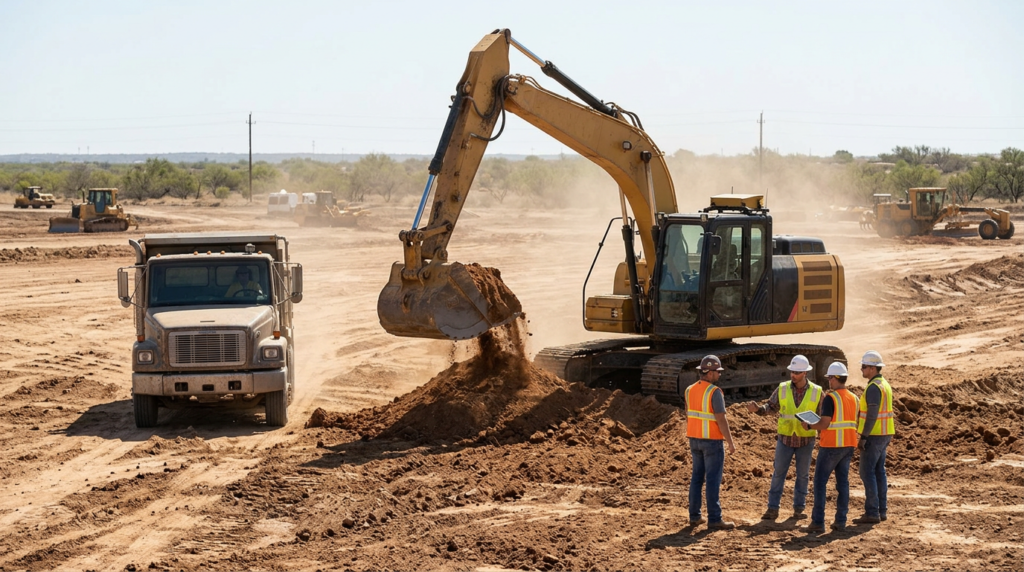
One of Bedrock’s newest partners is Haydon, an employee-owned general contractor based in Tempe, Arizona.
Bedrock says Haydon is deploying its technology at a remote site in Texas for autonomous earthwork. The contractor plans to expand its use of Bedrock-equipped machines across building and heavy civil projects, potentially including advanced manufacturing, transportation, water and wastewater, data centers, and healthcare facilities.
Haydon also plans to test more advanced applications as the partnership develops, including trench work and the automation of larger machine models.
Those future applications are plans, not evidence that the technology has already mastered every task. Trenching, in particular, can involve different risks and requirements from moving earth in an open area.
Haydon CEO Katie Haydon described the potential for more predictable operations and less strain on crews. Those benefits are the contractor’s expectations; the announcement does not provide independently verified results showing how much safer or more efficient the deployments have been.
Expansion Across More US Regions
Bedrock says its customer base has more than doubled since 2025, although it did not provide the underlying customer totals in its announcement.
The company listed new customers and projects in several states, including Wagner Construction in Minnesota, Smith Trucking Company in Florida, B&S Site Development in Virginia, Native Excavating in Colorado, Clarkson Construction in Missouri, and C.W. Matthews in Georgia. It also identified selected ArchKey Solutions projects in Arkansas.
These additions point to a broader geographic footprint beyond the company’s earlier work in the West and Central South. They do not necessarily mean that every named customer is using the same number of autonomous machines or performing the same tasks.
Expanding across regions will also expose Bedrock’s system to varied terrain, weather, project requirements, and site practices. Its ability to support customers under those conditions will be an important test of whether the technology can scale.
The Team Behind the Machines
Bedrock was founded in 2024 by people with backgrounds in autonomous vehicles and robotics.
CEO Boris Sofman previously led Waymo’s self-driving truck program and co-founded consumer robotics company Anki. Bedrock’s other co-founders include Kevin Peterson, the company’s chief technology officer; Ajay Gummalla, vice president of engineering and infrastructure; and Tom Eliaz, vice president of engineering and hardware.
That experience gives the company a foundation in building autonomous systems. However, transferring knowledge from roads or consumer robots to construction equipment presents its own challenges.
A public road and an excavation site are different operating environments. Construction sites change as work progresses, and heavy equipment must perform physical tasks while interacting with materials and nearby crews.
Bedrock’s team is betting that its experience with autonomy can be adapted to those conditions and turned into a service that contractors are willing to use.
What “Physical AI” Means for Construction
The phrase physical AI generally refers to AI systems that perceive and act in the physical world. It includes technologies used in robots, autonomous vehicles, and industrial machinery.
For construction, that idea could involve equipment that performs certain tasks with less direct human control. An autonomous excavator, for example, must do more than analyze information on a screen: its decisions lead to the movement of a large machine and the handling of heavy material.
That physical connection makes reliability especially important. A software error on a construction site can have different consequences from an error in a document or a digital recommendation.
Bedrock’s funding shows that investors see an opportunity in applying AI to physical work. It does not, by itself, prove that autonomous construction equipment is ready for every site or that it will deliver the same benefits everywhere.
Safety Will Be Central to Adoption
Construction sites are busy environments where people, vehicles, equipment, and materials can be in close proximity. Introducing an autonomous machine requires clear operating procedures and careful attention to how the system behaves around other activities.
Potential questions for contractors include how an autonomous machine responds to unexpected obstacles, how its operating area is defined, what happens when conditions change, and how workers stop or intervene in its operation.
Bessemer says the Bedrock-equipped excavators it observed operated with a safety system. However, the available sources do not provide enough independently verified detail to compare Bedrock’s safety record with that of conventional equipment.
Bedrock and Haydon have both highlighted safety as a potential benefit. For customers and workers, the strength of that claim will depend on evidence from real deployments, transparent reporting, and the operating practices used on each site.
The Business Case Goes Beyond the Machine
For contractors, the decision to adopt autonomous equipment will depend on whether it helps a project run better overall.
A machine’s ability to dig is only one part of that calculation. Contractors must also consider installation, training, maintenance, site preparation, support, and the interaction between autonomous equipment and the rest of the crew.
If a system performs reliably on suitable tasks, a contractor might be able to use available equipment more effectively or take on additional work. On the other hand, interruptions, limitations, or added support requirements could reduce the expected benefit.
Bessemer argues that the technology could help contractors bid on projects they might otherwise decline because of staffing constraints. As an investor, the firm has a financial interest in Bedrock’s success, and that potential benefit remains a prediction rather than a broadly demonstrated result.
Independent comparisons of costs, productivity, and uptime would help customers evaluate the business case.
Why Investors Are Interested
Bedrock’s funding round arrives as investors look for ways to apply AI beyond chatbots and digital tools.
Construction is a large industry with substantial spending on labor, equipment, and infrastructure. Investors may see an opportunity for companies that can help contractors carry out more work with existing machines and crews.
The company also has early commercial deployments, which can make its plans more concrete than a proposal built entirely around future demonstrations. Nevertheless, early paid work and a high valuation are different from evidence of sustained profitability or widespread adoption.
Scaling a business that operates heavy machinery can require significant spending. Bedrock must support equipment in the field, work with customers across multiple regions, and adapt its technology to different operating conditions.
Its nearly $1 billion in total funding gives it resources for that expansion. The next test is how effectively it turns those resources into reliable operations and a durable business.
What Still Needs to Be Proven
Bedrock’s announcement offers a clear picture of its ambitions, but many practical questions remain unanswered.
The company has not disclosed enough information in the cited announcement to establish the number of autonomous machines currently in paid operation, their average uptime, their cost to customers, or their productivity compared with experienced operators.
Likewise, the sources do not establish that autonomous excavators are suitable for every construction task or every site. Bedrock’s plans to test additional applications suggest that its technology is still expanding beyond its initial use cases.
The most useful evidence over time would include measurable results from deployments: how much work machines complete, how frequently they need intervention, how they perform across different conditions, and how contractors assess their safety and economics.
Until such information is available, the strongest conclusion is that Bedrock has secured substantial funding and begun commercial work—not that the technology has already transformed the construction industry.
What Happens Next?
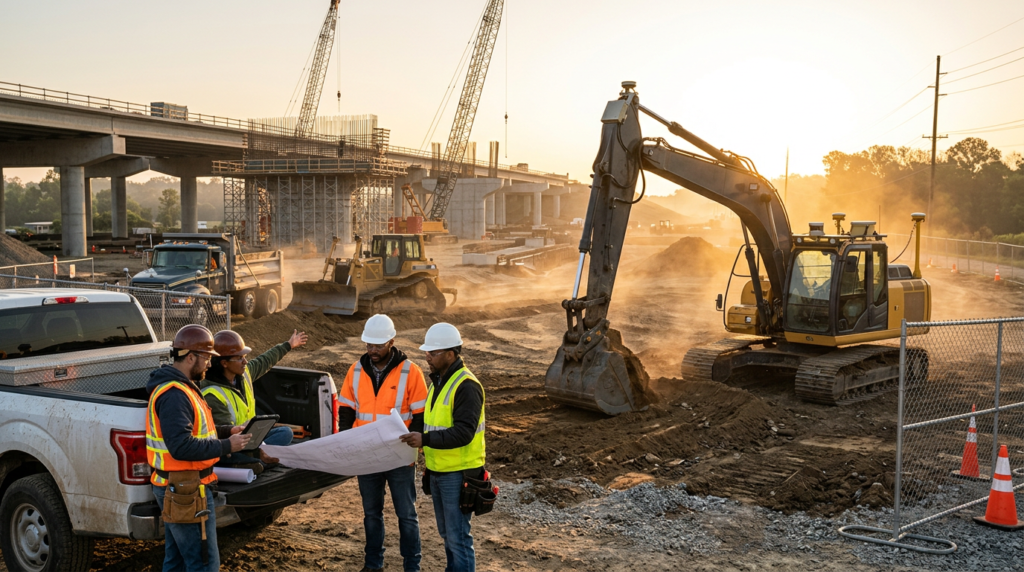
Bedrock’s immediate priority is to bring its autonomous equipment to more US construction sites while building the teams and services needed to support it.
Its partnership with Haydon and the customers named in its announcement give the company opportunities to test its approach across a wider range of projects. The company also says it wants to move beyond excavators toward mixed fleets of autonomous equipment, although that remains a longer-term ambition.
For the construction industry, the development is a sign that autonomous machinery is moving closer to everyday commercial use. For workers and contractors, the more consequential questions will be how safely the machines operate, where they prove useful, and whether they make projects more manageable in practice.
The $600 million investment gives Bedrock the means to pursue those answers. The construction sites themselves will provide the real test.
SOURCES
- Bedrock Robotics: $600 Million Series C Funding Announcement
- TechCrunch: Bedrock’s Self-Driving Excavators and New Funding
- Bessemer Venture Partners: Deploying Autonomous Equipment for the Built World
The Kingy Brief
Get The Kingy Brief.
AI changes, original tests and one practical thing to try. Fridays at 09:00 Vancouver time.
Free · Double opt-in · Unsubscribe anytime
Sign up for The Kingy Brief on Beehiiv.
Signup help and newsletter schedule
Signup form provided by Beehiiv. After submitting, check your inbox for "Confirm your subscription to The Kingy Brief" and open its confirmation link. Check Spam or Promotions if you cannot find it.
Fridays at 09:00 Vancouver time: source-checked AI changes, original tests and one practical thing to try. We skip a week when there is not enough verified material. Free. Unsubscribe anytime.