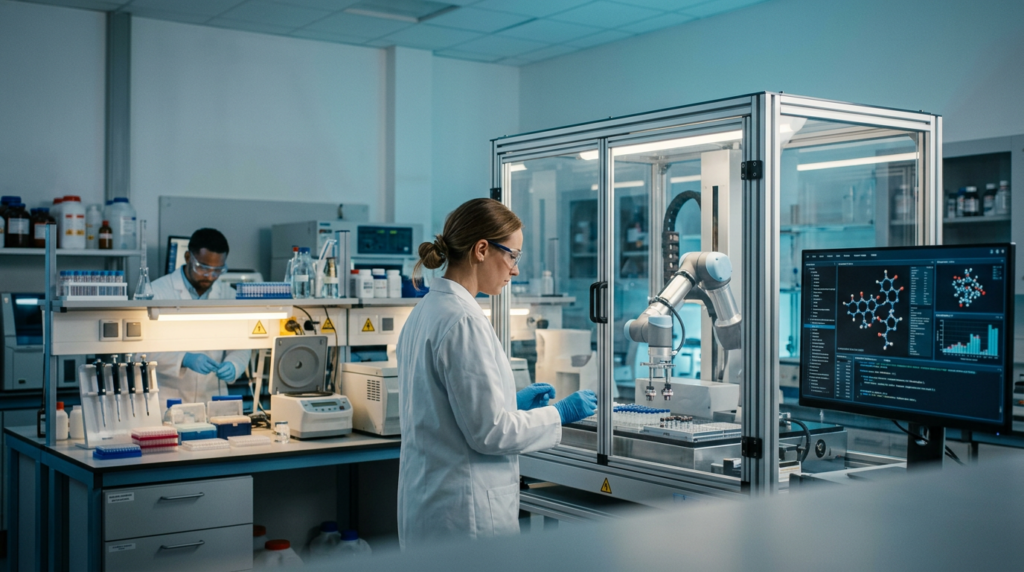
A Big Bet on the Work Behind New Medicines
AI can suggest an intriguing molecule, but somebody still has to make it and find out what it does.
Warp Sciences wants to tackle that physical work.
The startup emerged from stealth on October 22 with $215 million in funding, bringing together expertise in artificial intelligence, robotics, and medicinal chemistry.
Its announcement describes a U.S.-based chemistry contract research organization, or CRO, serving biotechnology and pharmaceutical companies.
That gives the launch a specific commercial focus: helping research teams obtain compounds and experimental evidence.
The company is entering a demanding field where a convincing computer-generated prediction is only the beginning.
Its opportunity lies in making the next steps faster, more dependable, and useful enough that customers return with another research question.
The Gap Between a Digital Idea and a Real Compound
Imagine a research team with several promising molecular designs on its screens.
Each design represents an idea about how a chemical structure might behave.
Before those ideas become useful evidence, the team needs physical material and appropriate experiments.
That transition is where Warp is positioning itself.
A good analogy is architecture: producing a beautiful building design does not pour the foundations or establish whether the finished structure performs as intended.
Drug research has its own demanding version of that divide.
A computational system can help propose possibilities, while laboratory work reveals information that a proposal alone cannot supply.
Warp’s appeal therefore depends on connecting those activities effectively, giving researchers a shorter and more reliable route from a question to a result they can examine.
What Warp Actually Plans to Sell
The company says its initial service will focus on lead optimization analog synthesis.
In plain English, that means making variations of promising molecules so researchers can compare them while searching for a drug candidate.
Warp also states that customers will determine which molecules to pursue and retain control of their programs.
It has no proprietary drug pipeline.
That distinction gives the business a clearer shape.
A customer would be evaluating a research service: can this partner produce the required work at an acceptable standard, cost, and speed?
The commercial opportunity is therefore tied to execution.
A dramatic robot demonstration might attract attention, but a scientist waiting for usable compounds will judge the company by what arrives and whether it meets the agreed requirements.
A Founding Team Spanning Several Disciplines
Warp’s founding team includes CEO Kevin Weil, chief scientific officer Solomon “Sol” Reisberg, chief technology officer Manohar “Mano” Paluri, and chief operating officer DJ Patil.
Their backgrounds span OpenAI, Terremoto Biosciences, Meta, healthcare, and government data science.
That mix helps explain the startup’s ambition to combine software with physical research operations.
However, assembling experienced founders is the opening move.
They still need to build an organization in which chemistry, robotics, and software teams solve problems together.
For example, a process that looks elegant to an AI engineer may be awkward for a chemist working with real equipment.
The reverse can also happen.
The team’s effectiveness will depend partly on how well it turns those different perspectives into systems that laboratory staff can use consistently.
The Funding Provides Room to Build
Lightspeed led the financing, with participants including IVP, Mayfield, Lux, Premji Invest, and Menlo Ventures.
Bloomberg reported an $865 million post-money valuation, citing the company.
That valuation reflects the financing arrangement and investor expectations, rather than demonstrated scientific performance.
The capital could support the long process of building laboratory capacity, hiring specialists, and integrating equipment with software.
Those are potential uses, not a disclosed breakdown of the funding.
A laboratory business also needs enough operational discipline to keep serving customers while developing new capabilities.
The practical question is how quickly spending can become productive capacity.
Investors have supplied substantial backing, but customers will eventually provide another verdict through the projects they commission and the business they choose to repeat.
Robots Already Have a History in Chemistry
Warp is entering a field with established research behind it.
A 2020 Nature paper demonstrated a mobile robotic chemist that performed 688 experiments over eight days while searching for improved photocatalysts.
That study concerned materials research, rather than Warp’s drug-research service.
Its relevance is that it showed how robotic execution and algorithmic experiment selection could operate together in a defined setting.
It also offers a useful reminder about scope.
Success on one experimental task does not establish that the same system can handle every laboratory procedure.
For Warp, the challenge will be choosing activities where automation delivers a dependable advantage and then expanding from demonstrated competence.
The strongest evidence would describe exactly what the system accomplished and under which conditions.
Human Expertise Is Part of the Plan
Warp says experienced chemists will guide experiments as the laboratory becomes increasingly automated.
That framing suggests a progression in capability, with human expertise involved from the start.
It also raises an interesting design question: which parts of a chemist’s work can a machine perform reliably, and which require judgment that remains difficult to capture?
A useful implementation would answer that question task by task.
For example, a system might handle a well-defined repeated operation while a scientist reviews an unexpected outcome.
The benefit would come from allocating work appropriately.
Automation becomes more valuable when people understand its limits and can intervene effectively.
A laboratory that makes those boundaries clear could be easier to operate than one that promises broad autonomy without explaining how exceptions are handled.
The Goal Is a Better Experimental Feedback Loop
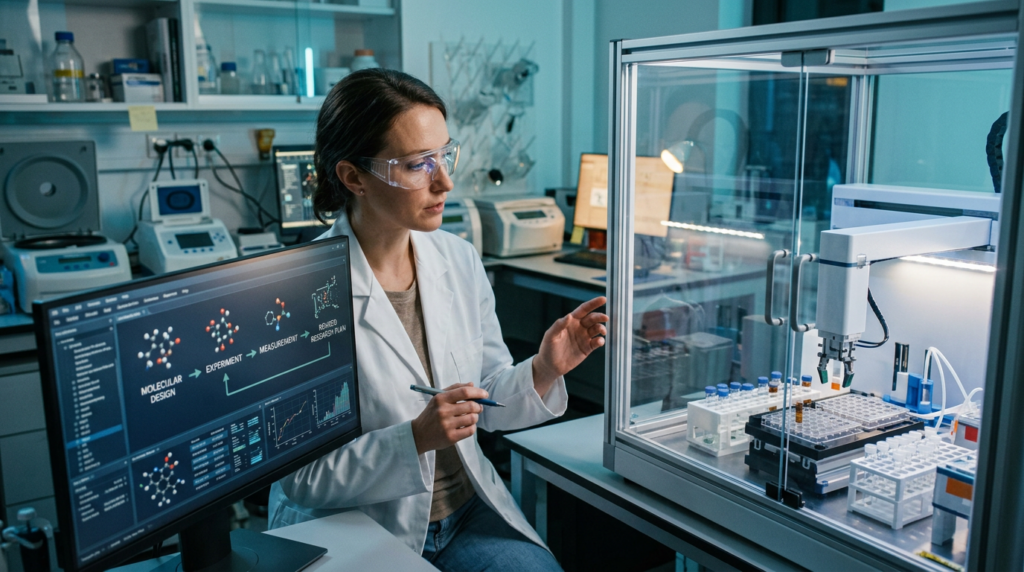
Warp’s stated ambition links experimental data, improved AI, and more capable laboratory operations.
The idea is that information from physical work could help improve subsequent decisions and execution.
That is an appealing direction, but the improvement would need to be measured.
Consider a hypothetical workflow in which a team requests several related compounds, examines the results, and then decides what to request next.
A stronger system might help organize that information or identify a useful follow-up.
However, collecting more data would not automatically make every decision better.
The information must be relevant, sufficiently reliable, and available in a form the system can use.
The opportunity lies in building that connection carefully, with each claimed improvement tied to observable results.
Reliable Measurements Make Automation More Useful
Research published in Nature in 2024 provides another relevant example.
That work combined mobile robots, automated synthesis, and multiple analytical instruments, with software using the resulting measurements to select reactions for further investigation.
It also included automatic checks on the reproducibility of screening hits.
The broader lesson is that laboratory automation involves more than moving objects successfully.
An experimental system needs ways to assess what happened and decide whether the evidence supports the next action.
For a commercial service, that makes verification a central design concern.
A customer should be able to understand what was produced, how it was assessed, and whether the result meets the project’s requirements.
The machine’s activity matters because of the evidence it helps deliver.
Faster Work Should Be Measured Across the Whole Job
Suppose a robotic procedure takes much less time than a manual one.
That sounds encouraging, but it would be only part of the customer’s experience.
The full job might also involve project review, scheduling, material preparation, analysis, and delivery.
If another stage becomes the bottleneck, the customer may see little improvement in the time required to receive a useful result.
A practical evaluation would therefore measure the complete workflow.
How long does an agreed request take?
How often does work need to be repeated?
How much review is required before the customer can use it?
Those questions make the promise of speed more concrete.
They also help distinguish a technically impressive individual operation from a service that consistently improves a research team’s working week.
A Domestic Laboratory Is Part of the Proposition
Warp emphasizes that it is building its chemistry service in the United States.
The company presents location, close collaboration, and control over sensitive research as parts of its customer offering.
Whether those features justify choosing the service will depend on the customer’s circumstances.
A team might value easier communication or a particular arrangement for handling project information.
Another might prioritize price, specialist expertise, or an existing working relationship.
The commercial test is how those considerations come together.
A domestic location can be a meaningful attribute without settling the entire purchasing decision.
Warp will still need to show that its service delivers the chemistry customers need, within arrangements they find workable and at a cost they are willing to support.
More Experiments Could Mean Better Questions
The most interesting possible benefit of improved laboratory capacity is greater freedom to investigate.
Imagine a small research team choosing among several uncertain ideas.
If obtaining compounds becomes easier or less expensive, the team might be able to compare alternatives that would otherwise remain unexplored.
That is a hypothetical benefit, rather than a result established by Warp’s launch.
It also depends on how intelligently the additional experiments are selected.
More activity can create more work to interpret without necessarily resolving the original uncertainty.
The useful outcome would be a clearer understanding of which direction deserves further effort.
An effective research service could therefore help customers learn sooner, including learning that an attractive hypothesis should be abandoned before it consumes more resources.
Drug Discovery Still Has a Long Road Ahead
Laboratory improvements sit within a much larger development process.
The FDA describes stages encompassing discovery, preclinical research, clinical research, regulatory review, and safety monitoring after a product reaches the market.
Making a research compound faster would affect an early part of that journey.
It would not establish that the compound is safe or effective in people.
That distinction is essential when interpreting the promise of AI in drug research.
A company can deliver a valuable improvement without independently solving every challenge between an initial idea and an approved medicine.
For Warp, a credible success could be helping customers complete better early research more efficiently.
The eventual medical outcome would still depend on the evidence generated throughout the rest of the development process.
Customers Will Need Evidence They Can Assess
A strong commercial demonstration would make the conditions of success visible.
For example, Warp could describe a defined category of work, the quality requirements, the time taken, and the amount of human intervention involved.
Those are suggested evaluation criteria, not details the company has already published.
The same comparison would benefit from showing how difficult cases were handled.
Did an exception stop the workflow?
Could the team identify the problem and recover?
Did the customer receive enough information to understand the result?
Those questions would reveal more than a short video of a smooth robotic movement.
A research service earns confidence by handling ordinary complications predictably, especially when the customer’s next scientific decision depends on the work it delivers.
The Potential Value Extends Beyond One Laboratory
If Warp’s approach proves useful, its broader significance could be the service model it demonstrates.
Research organizations do not all have the resources or desire to build their own automation systems.
Accessing capable infrastructure through an external partner could let them concentrate on the scientific questions they want to pursue.
That possibility would still require suitable pricing, clear agreements, and available capacity.
For researchers in the Philippines and elsewhere, the immediate implication is something to monitor rather than assume is already accessible.
The launch does not establish worldwide service availability or affordability.
Over time, the relevant question would be whether advances in laboratory automation create practical options for a wider range of institutions.
The benefit would come from usable access, not simply from impressive equipment existing somewhere else.
The Real Test Begins at the Laboratory Bench
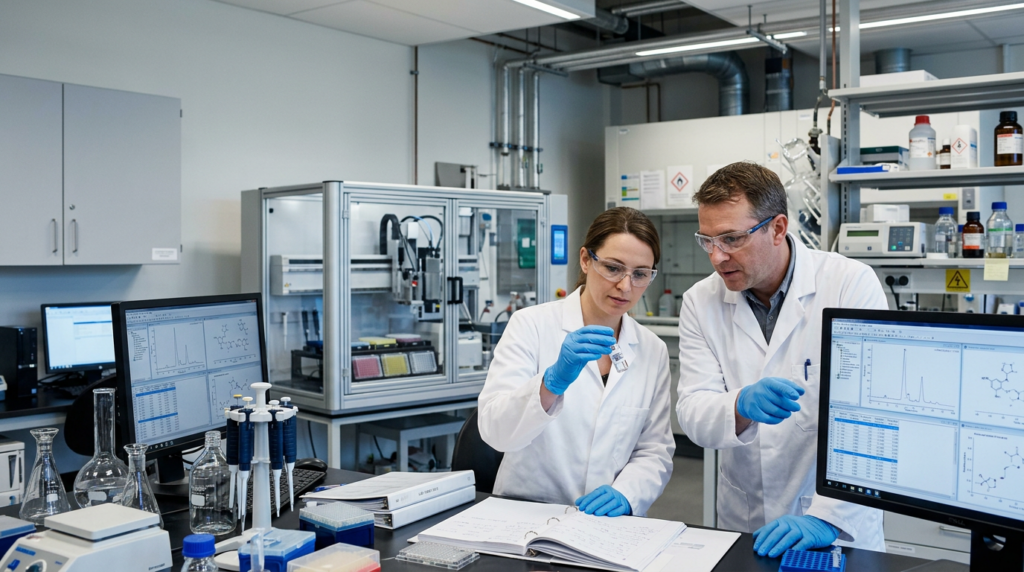
Warp Sciences has launched with substantial funding and a specific opening service.
Its ambition addresses a real dividing line in scientific work: the point where a proposed molecule must become physical material that researchers can investigate.
The company now needs to demonstrate that its combination of chemists, AI, and robotics can serve customers reliably.
Useful evidence would include clear service capabilities, repeatable results, and measurable improvements across complete projects.
The most promising future would give scientists more opportunities to ask questions and obtain trustworthy answers.
That would be a meaningful contribution even before any eventual medicine reaches patients.
For now, Warp has the backing to pursue the idea.
Its next chapter will depend on what the laboratory produces and what researchers can learn from it.
SOURCES
- Warp Sciences — Official launch announcement and description of its chemistry research services. (businesswire.com)
- Bloomberg — Ex-OpenAI Science Head Launches Startup With $215 Million. (news.bloomberglaw.com)
- Pulse 2.0 — Warp Sciences Emerges From Stealth With $215 Million. (pulse2.com)
- Nature — A Mobile Robotic Chemist. (Nature)
- Nature — Autonomous Mobile Robots for Exploratory Synthetic Chemistry. (Nature)
- U.S. Food and Drug Administration — The Drug Development Process. (FDA)
The Kingy Brief
Get The Kingy Brief.
AI changes, original tests and one practical thing to try. Fridays at 09:00 Vancouver time.
Free · Double opt-in · Unsubscribe anytime
Sign up for The Kingy Brief on Beehiiv.
Signup help and newsletter schedule
Signup form provided by Beehiiv. After submitting, check your inbox for "Confirm your subscription to The Kingy Brief" and open its confirmation link. Check Spam or Promotions if you cannot find it.
Fridays at 09:00 Vancouver time: source-checked AI changes, original tests and one practical thing to try. We skip a week when there is not enough verified material. Free. Unsubscribe anytime.