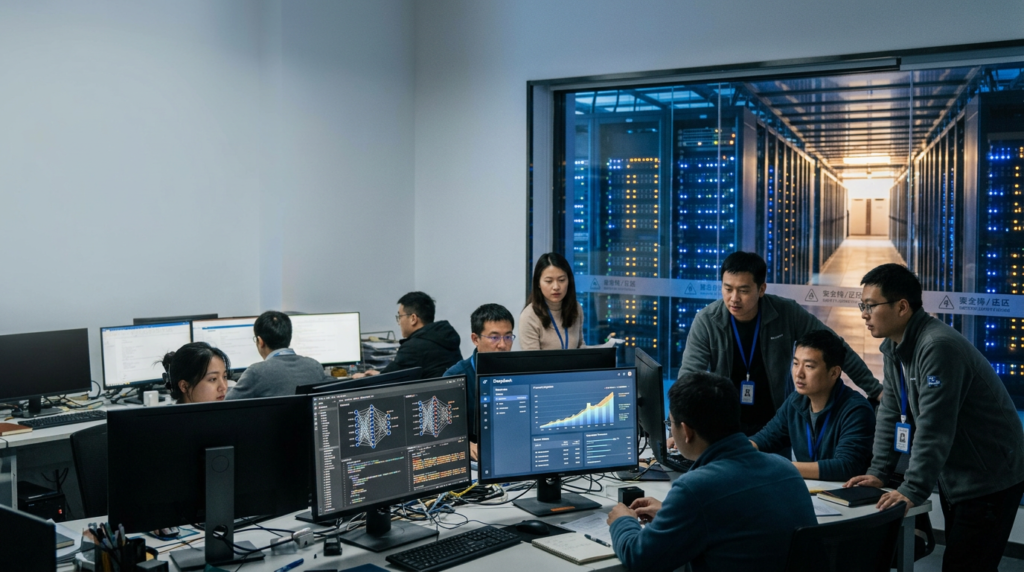
A Huge Funding Story With One Crucial Detail
DeepSeek is reportedly approaching a funding round worth roughly 100 billion yuan, or $15 billion, giving the Chinese AI developer a potentially substantial financial boost.
Reuters reported on October 22 that the fundraising was nearing completion, citing people familiar with the matter.
The distinction matters: financial terms could still change, and the report did not establish that every part of the transaction had closed.
Still, the scale is striking.
If completed as reported, the financing would give DeepSeek more room to pursue research and build the systems needed to support its ambitions.
The interesting question now is what the company could accomplish with those resources and how much of that progress might eventually reach developers, businesses, and everyday users.
Investor Demand Sends a Strong Signal
According to Reuters, the reported amount would double DeepSeek’s original fundraising target, with Tencent and battery manufacturer CATL among the largest participants.
That suggests considerable investor appetite.
However, enthusiasm for a company and evidence of its future success are different things.
Investors are making a judgment about what DeepSeek might become, including its technology, commercial opportunities, and place in a competitive industry.
Their participation supplies capital and expresses confidence.
It does not establish that a particular model will outperform its rivals or that the business will generate attractive profits.
For readers following the AI industry, the useful signal is that DeepSeek appears capable of attracting substantial backing for another phase of development.
The results of that phase remain ahead.
Why Efficient AI Still Needs Serious Money
At first glance, a large financing round might seem difficult to reconcile with an emphasis on computational efficiency.
If an AI developer finds cheaper ways to train or operate models, why would it need billions?
Because efficiency describes how resources are used, while financing determines how much work a company can support.
A more efficient research process could allow a team to investigate more ideas within the same budget.
It could also support broader testing, additional products, or a larger customer base.
Think of a fuel-efficient delivery van: using less fuel per journey does not make a growing delivery business inexpensive to operate.
The important question is whether each additional unit of spending produces enough useful progress to justify the expansion.
DeepSeek’s Earlier Engineering Offers Context
DeepSeek’s published work provides a concrete starting point for understanding its technical approach.
Its earlier V3 model uses a mixture-of-experts architecture, which activates a subset of the model’s parameters for each token rather than using every parameter each time.
The company’s documentation also describes techniques intended to improve training and inference efficiency.
Those details concern an earlier model, so they should not be treated as specifications for an unannounced successor.
Their relevance is historical: DeepSeek has published engineering work focused on getting more capability from available computation.
Additional financing could support further investigation along those lines.
It could also support entirely different research directions.
Without a disclosed spending plan, any claim about the precise architecture or capabilities funded by this round would be speculation.
More Capital Could Buy More Experiments
One plausible benefit of a larger research budget is greater freedom to test ideas.
AI development involves choices about training methods, data, model structure, and evaluation.
A team may have several promising approaches without knowing which will work best until it conducts expensive experiments.
Additional resources could allow more of those possibilities to be explored.
They could also support replication, helping researchers determine whether an apparent improvement is consistent or merely an encouraging result from one run.
That possibility is less dramatic than a headline announcing a revolutionary model.
It is also easier to connect with a productive research process.
The value would come from better decisions about what to build, including the ability to abandon an attractive idea when the evidence does not support it.
Infrastructure Is More Than a Chip Order
Computing capacity could be another important destination for new capital, although no detailed allocation has been confirmed in the reporting discussed here.
An AI system needs more than powerful processors.
A useful infrastructure plan must connect hardware, software, networking, storage, and the people responsible for keeping everything working.
Adding equipment without addressing those dependencies can create bottlenecks rather than eliminate them.
Consider a restaurant that doubles its ovens while keeping the same preparation space and delivery arrangements.
There may be more cooking capacity, but dinner can still arrive late.
For DeepSeek, the operational challenge would be to turn any additional computing investment into dependable capacity for research and customer use.
The size of the budget alone cannot show whether that coordination will succeed.
Domestic Computing Could Require Patient Engineering
The original funding story raises the possibility of support for domestic computing infrastructure.
That would be a development effort with several moving parts, rather than a simple substitution of one processor for another.
In a hypothetical migration between hardware platforms, engineers would need to assess software compatibility, numerical behavior, performance, and operating costs.
A system that runs successfully may still require substantial optimization before it becomes economical.
Financing could provide time and people for that work.
However, a funding announcement cannot establish that a company has achieved independence from any particular supplier or eliminated technical constraints.
The evidence would need to come from functioning systems and clearly described results.
For observers, that means looking beyond hardware ambitions to the workloads a company can reliably support.
Open Models Could Spread the Benefits Further

DeepSeek’s earlier R1 release included publicly available model weights and smaller distilled models, giving outside developers material they could investigate and use.
That history helps explain why additional resources could matter beyond DeepSeek’s own products.
If future releases remain openly available under suitable terms, other teams could build applications, conduct evaluations, or adapt models to specialized needs.
That is a conditional opportunity, rather than a promise about future licensing.
Each release would need to be assessed individually.
For developers, the practical questions include whether the model is available, what its license permits, and what equipment it requires.
A powerful system becomes more useful when people can fit it into an affordable, maintainable workflow.
Open availability can create that opportunity, but implementation still takes work.
Funding Does Not Determine the Next Benchmark Winner
A large financing round can easily become shorthand for technological momentum.
The temptation is to assume that a better-funded company must soon release a better-performing model.
Research does not follow that timetable reliably.
A bigger budget could support valuable progress, disappointing experiments, or improvements that matter only for particular tasks.
The next useful comparison would therefore examine actual released systems under clear conditions.
For a coding assistant, that might mean whether it completes realistic changes correctly and requires fewer corrections.
For a business workflow, it might mean whether the system handles routine requests consistently.
The funding figure tells readers about potential resources.
The performance evidence must come from what DeepSeek builds with them and how those products behave outside carefully chosen demonstrations.
Everyday Reliability Could Matter More Than Rankings
For many customers, the most valuable improvements might be operational.
Imagine a developer whose application performs well during testing but becomes unreliable when demand rises.
A modest gain in benchmark performance may matter less than predictable response times and fewer failed requests.
Additional resources could support those improvements through better infrastructure, monitoring, and engineering.
That is a possible use of capital, not a confirmed DeepSeek initiative.
It nevertheless provides a useful way to evaluate future progress.
Can people depend on the service during the hours they need it?
Can developers understand failures and recover from them?
A model earns a place in a production system through repeated usefulness, and that includes the less glamorous work happening around the model itself.
Cheaper Access Is Possible, but Not Guaranteed
Users may reasonably wonder whether more financing will lead to lower prices.
It could give a company room to invest in efficiency or expand capacity.
However, funding does not dictate the price customers will pay.
A business must decide how to balance growth, infrastructure spending, product development, and revenue.
Even a lower advertised price would need to be considered alongside quality and the amount of human review required.
A hypothetical assistant that costs less per request but needs frequent corrections could be more expensive across an entire project.
For customers, the meaningful comparison is the total cost of getting useful work completed.
That makes price announcements worth watching, while leaving room to examine whether the service delivers enough reliable output to justify the bill.
Businesses Will Want More Than an Impressive Demo
Winning enterprise customers involves questions that a funding headline cannot answer.
A business considering an AI service might ask about documentation, support, deployment options, and how product changes are communicated.
It may also need clear information about data handling and access controls.
Those concerns affect whether the technology can fit into an existing operation.
A convincing demonstration can open the conversation, but dependable implementation keeps it going.
For DeepSeek, greater resources could create an opportunity to strengthen the surrounding product experience.
Whether that happens would be visible in practical details: clearer guidance, more predictable service, and fewer obstacles between experimentation and deployment.
Those improvements may attract less attention than a model launch, yet they could determine whether a customer renews.
A Potential IPO Adds Another Layer
The Wall Street Journal separately reported that DeepSeek was preparing for a possible Shanghai listing, citing people familiar with the plans.
A potential IPO should remain distinct from an approved or scheduled public offering.
Preparations can change, and a reported ambition does not settle the final timing.
Still, the possibility introduces another question: how would DeepSeek explain its business to a broader group of shareholders?
Research strength would be one part of that account.
The company would also need a convincing description of how its activities support a durable business.
For readers, future formal disclosures could be more informative than private-market enthusiasm.
They could provide a clearer basis for examining revenue, spending, risks, and the relationship between technical achievements and commercial results.
Revenue Quality Will Deserve Close Attention
Whatever happens with a listing, a growing AI business eventually needs to demonstrate that customers find enough value to keep paying.
There are several useful questions to ask without assuming access to DeepSeek’s internal accounts.
Do customers return after initial experimentation?
Does increased usage improve the economics of serving them?
Can the business support customers without requiring disproportionate amounts of expensive assistance?
Those questions help distinguish interest from a sustainable commercial relationship.
They also connect directly with product quality.
If a system saves people time and fits their workflow, continued use becomes easier to justify.
A large financing round can provide room to develop that relationship.
It cannot replace the work of earning it repeatedly through products that solve problems people actually have.
Developers in the Philippines Could Gain More Choice
For developers and businesses in the Philippines, the relevance of this story would be any additional choice that emerges from future releases.
A stronger alternative could provide another option for an application, an internal assistant, or a research project.
However, the best choice would depend on the task.
A locally relevant evaluation might examine English and Filipino prompts, mixed-language conversations, document handling, and performance on the organization’s own examples.
Those are suggested tests, rather than claims about DeepSeek’s present capabilities.
Smaller teams would also need to compare hosted access with the cost and effort of operating models themselves.
The practical benefit would come from finding a suitable tool at a workable price.
A financing announcement creates a reason to watch future products, not to skip those comparisons.
The Next Chapter Will Be Written in Results

DeepSeek’s reported financing could give it substantial scope to extend its research and improve the systems surrounding its models.
The most constructive reading is that the company may gain more opportunities to experiment, build, and compete.
Those opportunities still need to become useful results.
The next evidence to watch includes final funding confirmation, released products, independent evaluations, and improvements customers can experience directly.
Clear information about deployment and operating costs would also help developers assess where the technology fits.
For now, the story is a potentially significant expansion of DeepSeek’s resources, with important terms still reported rather than publicly settled.
The number has captured attention.
What DeepSeek builds and how reliably people can use it will determine how much that attention was worth.
SOURCES
- Reuters — DeepSeek wrapping up $15 billion fundraising to fuel AI race, sources say. (reuters.com)
- The Wall Street Journal — Chinese AI Startup DeepSeek Raises $15 Billion Ahead of Potential IPO. (wsj.com)
- DeepSeek — Official DeepSeek-V3 repository and technical documentation. (deepseek-ai/DeepSeek-V3 · GitHub)
- DeepSeek — Official DeepSeek-R1 repository and model documentation. (deepseek-ai/DeepSeek-R1 · GitHub)
The Kingy Brief
Get The Kingy Brief.
AI changes, original tests and one practical thing to try. Fridays at 09:00 Vancouver time.
Free · Double opt-in · Unsubscribe anytime
Sign up for The Kingy Brief on Beehiiv.
Signup help and newsletter schedule
Signup form provided by Beehiiv. After submitting, check your inbox for "Confirm your subscription to The Kingy Brief" and open its confirmation link. Check Spam or Promotions if you cannot find it.
Fridays at 09:00 Vancouver time: source-checked AI changes, original tests and one practical thing to try. We skip a week when there is not enough verified material. Free. Unsubscribe anytime.