Dek: GPT-6 Pro can split a Chat request across several agents, show their progress, and expose completed subtasks. Kingy.ai ran two sequential-versus-parallel test pairs to see what that changes in practice.
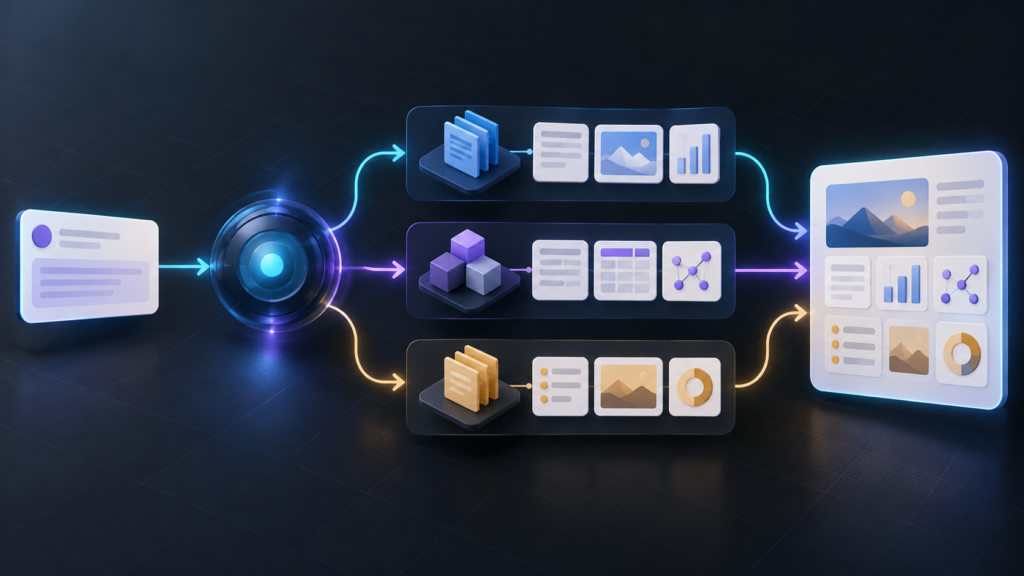
OpenAI has given GPT-6 Pro a way to divide one complicated Chat request into several jobs and run those jobs at the same time. You can follow the agents inside the conversation and open their completed tasks to inspect what they did.
That is the substance of OpenAI’s October 16 announcement. The company also says GPT-6 Pro now responds faster and uses plugins and tools better. OpenAI has not published latency measurements, quality results, a Chat agent limit, or a formula for how multi-agent work counts against a Pro allowance.
The practical promise is straightforward. A single ChatGPT conversation can act more like a project lead with several workers than one assistant completing every step in sequence.
Evidence checked October 16, 2026. Kingy.ai tested the Chat feature in one eligible account using two sequential-versus-parallel research pairs. The small test is evidence about those four runs, not a general benchmark. OpenAI’s broader claims about faster responses and improved plugin and tool use remain unquantified.
The quick answer
| Question | Answer |
|---|---|
| What changed? | GPT-6 Pro in Chat can assign different parts of a request to multiple agents that work in parallel. |
| What can the user see? | Agent progress in the conversation and completed tasks that can be opened for review. |
| Who gets it? | OpenAI says the update is rolling out to eligible Pro users. Managed-workspace access depends on settings and rollout eligibility. |
| Is this a new model? | The October 16 release is an update to the existing GPT-6 Pro Chat experience, which is powered by GPT-6 Astra. |
| Is it proven faster or more accurate? | Kingy’s two parallel runs averaged about 9% faster than two sequential controls, but the individual results varied sharply. The test found no clear accuracy advantage. |
| What remains unknown? | The Chat agent limit, worker models, automatic delegation rules, usage accounting, client coverage, plugin reliability, and performance across other tasks. |
One prompt can become several jobs
Imagine asking ChatGPT to assess whether a new AI service is worth buying. A single agent could search for the price, read the technical documentation, check the usage limits, inspect the safety disclosures, and write the recommendation one step at a time.
Parallel agents allow a different plan. One agent can verify access and pricing while a second examines technical behavior and a third lists limitations. GPT-6 Pro can then combine those results into one answer.
OpenAI’s public developer documentation describes the general multi-agent pattern this way: a main agent delegates independent jobs to subagents, each subagent keeps its own context, the subagents can work at the same time, and the main agent combines their results. The company has not confirmed that Chat uses every API setting or limit, so the following is a conceptual model rather than a diagram of ChatGPT’s private implementation.
Your request
    |
GPT-6 Pro coordinates the work
    |-- Agent A: availability and price
    |-- Agent B: technical behavior
    `-- Agent C: limits and risks
    |
Combined answer, with completed tasks available for review
This is broader than one agent making several tool calls at once. The announced Chat feature creates separate task workers whose progress and completed work can be inspected. OpenAI’s Agents API and Responses API expose related multi-agent patterns for developers, but they are separate products: their agent counts, controls, model choices, and token accounting cannot be treated as specifications for ChatGPT.
The time saving comes from overlap. If three independent investigations would take four, six, and eight minutes in sequence, parallel execution is governed mostly by the longest branch, plus the time needed to divide and combine the work. That illustration is not a ChatGPT benchmark. Tool delays, coordination, failed branches, and final review can erase some or all of the gain.
Agent, tool, plugin, and task are different things
OpenAI’s short post compresses several product concepts into two sentences.
An agent is an AI worker pursuing a goal. It can reason, decide which actions to take, use available tools, and return a result.
A task is the bounded piece of work given to an agent. “Verify the current plans and prices from official sources” is a better task than “research everything.”
A tool performs a capability such as web search, file retrieval, code execution, or an action in a connected service. The agent decides when and how to use it.
A plugin packages reusable instructions, skills, connected apps, tools, or interface elements for a workflow. OpenAI’s plugin documentation says the underlying apps remain subject to workspace access, provider authorization, supported actions, and approval rules. Parallel agents do not gain extra permission merely because more of them are working.
The October 16 upgrade touches both sides of the system. OpenAI says GPT-6 Pro handles plugins and tools better, while the multi-agent feature changes how the work can be organized.
When parallel agents should help
The feature fits jobs with independent lanes and a clear final deliverable.
- Research from several source groups. One agent can read official product documentation, another can inspect pricing and plan rules, and another can check safety or policy material.
- Compare several products or documents. Give each agent the same extraction template, then ask GPT-6 Pro to reconcile the results.
- Review one deliverable from different angles. Separate factual accuracy, security, usability, and copy editing before producing a prioritized report.
- Investigate several explanations for a failure. Each agent can test a different hypothesis, provided they are not changing the same live state at the same time.
- Prepare a launch package. Research, reader questions, source validation, and distribution copy can proceed independently before editorial synthesis.
OpenAI’s multi-agent developer guide recommends independent work such as reviewing separate documents or investigating different failure causes. Its guidance keeps short tasks and dependent steps with the main agent. That is also a useful rule for Chat.
When one agent is the better choice
Parallelism adds delegation, waiting, and synthesis. Those costs can outweigh the benefit.
A short factual question does not need a team. A calculation in which step three depends on step two should usually remain sequential. Several agents editing the same file, spreadsheet, calendar, or account can collide unless their responsibilities are tightly separated. A workflow dominated by one slow download or one external approval will not become much faster because extra agents are waiting beside it.
More workers also create more material to reconcile. Two agents can repeat the same error, rely on the same weak source, or produce conclusions that sound compatible while using different definitions. The main agent’s final answer can still omit a qualification that appeared in a subtask.
Inspectable tasks improve review. They do not remove the need for review.
How to ask GPT-6 Pro to divide the work well
OpenAI has not documented whether Chat delegates automatically for every eligible request. Its developer guidance for Astra says the model responds to explicit instructions about when and how much to delegate.
This prompt makes the work lanes and evidence standard clear:
Research [topic] using official sources. If parallel work would help, assign separate agents to: (1) availability and pricing, (2) technical behavior, and (3) limits and safety. Each agent must return dated source links, established facts, vendor claims, and unknowns. Reconcile disagreements in the final answer. Do not fill gaps with assumptions.
For a product comparison, add a shared schema:
Give each product agent the same fields: plan, current price, availability, supported tools, published limits, evidence date, and unresolved questions. Do not rank the products until every agent has returned its source-backed record.
The structure matters more than asking for the maximum number of agents. Good delegation gives each worker a distinct question, a source boundary, an expected output, and a stopping condition.
What “follow each agent’s progress” does and does not mean
OpenAI says users can follow agent progress in the conversation and open completed tasks to see what each agent did. That adds an inspection surface that ordinary one-stream Chat answers did not provide.
It does not promise access to private chain-of-thought. A useful task record should show the assignment, actions, sources, artifacts, result, and failure state. Private model reasoning is a different category. The announcement does not say that hidden reasoning becomes visible.
The task view may still be valuable even without internal reasoning. A reader can check whether the pricing agent visited the right page, whether a research branch finished, and whether the final answer dropped a caveat. The quality of that record needs hands-on testing.
Who gets the feature
OpenAI’s ChatGPT release notes say the update is rolling out to eligible Pro users. Availability in managed workspaces depends on workspace settings and rollout eligibility. “Rolling out” means some eligible accounts may not see it immediately.
The current GPT-6 plan guide identifies GPT-6 Pro access for Pro $100, Pro $200, Business, and Enterprise plans. Enterprise access also depends on model permissions. Plus includes GPT-6 Astra in ChatGPT Work and Codex, but the guide does not include Plus in GPT-6 Pro access for the ordinary Chat tab.
GPT-6 Pro has usage limits. Work and Codex use separate allowances. OpenAI has not said whether a parallel Chat request counts as one message, several messages, a heavier internal unit, or something else. The API documentation warns that adding subagents can increase token use, but API token accounting should not be presented as ChatGPT subscription accounting. Kingy.ai’s GPT-6 Astra usage-limits guide explains why Chat, Work, Codex, and API usage must be kept separate.
The name is more confusing than the feature
OpenAI’s X post currently calls the product “GPT-6 Astra Pro.” Its edit history shows that the first version said “GPT-6 Pro.” The Help Center consistently describes GPT-6 Pro, powered by GPT-6 Astra.
For readers, GPT-6 Pro is the Chat product label and Astra is the model behind it. The October 16 update adds parallel work to that existing Chat mode. It is not a separate API model named gpt-6-astra-pro in the documentation reviewed for this article.
Kingy.ai’s existing GPT-6 Astra guide covers the model, specifications, price, safety evidence, and comparisons. This article focuses on the new Chat workflow.
What OpenAI established, claimed, and left open
| Evidence status | What we know |
|---|---|
| Established by current OpenAI documentation | GPT-6 Pro is powered by Astra; parallel agents can work on different parts of a Chat task; users can follow progress and open completed tasks; the feature is rolling out to eligible Pro users. |
| Claimed by OpenAI without launch measurements | Responses are faster; plugin and tool use has improved. |
| Supported as a general technical pattern | OpenAI’s developer systems can use a coordinating agent with independent subagent contexts and parallel execution. Chat’s exact internal implementation is not public. |
| Unknown from the announcement | Chat’s maximum agent count, agent hierarchy, worker models, default trigger, usage formula, precise client support, broad performance, and the specific rollout state of each account. |
These gaps are central to the buying decision. A Pro user needs to know whether a research job returns sooner, whether its final answer improves, how much allowance it consumes, and whether the task records make mistakes easier to catch.
Kingy’s hands-on test
Kingy.ai tested the feature on October 16 in an eligible ChatGPT account with GPT-6 set to Pro. The frozen brief asked for an official-source memo covering three independent lanes: the announcement, plan access and naming, and the boundary between Chat plugins and developer multi-agent APIs.
The sequential control prohibited delegation. The parallel version required exactly three agents, one per lane. We ran two pairs in separate chats.
| Run | Mode | Agents used | ChatGPT’s displayed duration |
|---|---|---|---|
| 1 | Sequential control | 0 | 4m 46s |
| 1 | Parallel | 3 | 4m 56s |
| 2 | Sequential control | 0 | 4m 56s |
| 2 | Parallel | 3 | 3m 54s |
| Average | Sequential | 0 | 4m 51s |
| Average | Parallel | 3 | 4m 25s |
The parallel average was 26 seconds lower, or about 9%. That number needs restraint. The first parallel run was ten seconds slower than its control; the second was 62 seconds faster. Live web latency, system load, search choices, and synthesis time can easily move a four-run result.
The interface behavior was clearer. Chat showed three named agents starting together, updated their status as each lane progressed, and reported all three as finished. Each completed task opened into its own panel with the agent’s full result, sources, qualifications, and unknowns. That made it possible to check whether the final synthesis had dropped a caveat.
All four final memos covered the required launch facts, separated OpenAI’s unmeasured claims from documented behavior, and preserved the boundary between Chat and the developer APIs. We found no material accuracy advantage for either mode. The parallel answers were slightly more concise; the sequential answers included a few extra side details.
The test also exposed rough edges. The activity panel continued to say “No outputs yet” after all three agents had finished, even though their completed results were available under the Subagents view. Chat did not expose a per-run usage reading, so we could not measure the allowance cost of delegation. We did not test a connected plugin or a workflow that changes external state.
This was one account, one research brief, and two pairs. It verifies that the feature works and that completed agent work is inspectable. It does not establish a universal 9% speed improvement.
Verdict
The October 16 release brings a working multi-agent workflow into GPT-6 Pro Chat. In Kingy’s test, the strongest benefit was inspection: three research lanes ran as separate tasks, and each result could be opened before trusting the combined answer.
The four-run timing result was mixed. Parallel execution averaged about 9% faster, but one parallel run lost to its sequential control. Use it for research, comparisons, audits, and other jobs that divide cleanly. Keep short requests, dependent chains, and shared-state work with one agent. OpenAI still needs to document usage accounting, limits, supported clients, and the circumstances in which delegation saves time.
Primary sources
- OpenAI announcement on X, October 16, 2026
- ChatGPT release notes
- GPT-6 and other models in ChatGPT
- Using GPT-6: subagent delegation
- OpenAI Agents API: multi-agent
- Plugins in ChatGPT
The Kingy Brief
Get The Kingy Brief.
AI changes, original tests and one practical thing to try. Fridays at 09:00 Vancouver time.
Free · Double opt-in · Unsubscribe anytime
Sign up for The Kingy Brief on Beehiiv.
Signup help and newsletter schedule
Signup form provided by Beehiiv. After submitting, check your inbox for "Confirm your subscription to The Kingy Brief" and open its confirmation link. Check Spam or Promotions if you cannot find it.
Fridays at 09:00 Vancouver time: source-checked AI changes, original tests and one practical thing to try. We skip a week when there is not enough verified material. Free. Unsubscribe anytime.