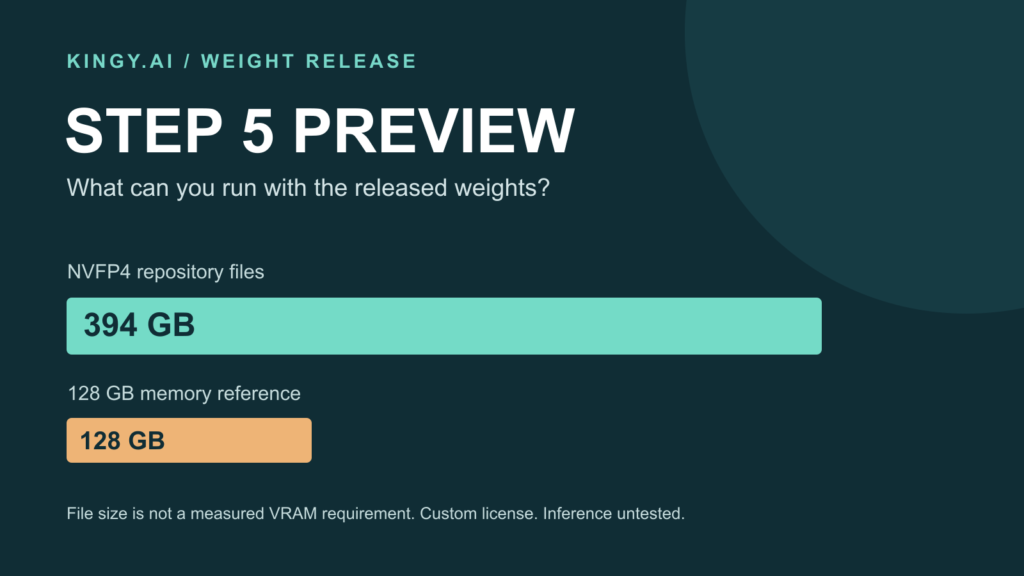
Step 5 Preview’s official weight repositories are visible, including an NVFP4 release listed at 394 GB. That gives developers a concrete checkpoint to investigate for self-hosting. It also puts the hardware question in perspective: this is a large deployment project, with a custom license and runtime requirements that still need testing.
A 128 GB machine should not be presented as an easy home for this checkpoint. The released NVFP4 files alone occupy roughly 367 GiB. Storage, system memory and GPU memory are separate budgets, and a successful download would establish only the first step toward a working deployment.
Verification scope: We checked the official repository pages, file metadata, model card, configuration and license on October 14, 2026 in Vancouver, corresponding to October 15 UTC. We did not download the complete weights, install a serving stack, run local inference or execute a matched coding comparison. The exact time the repositories first opened to the public remains unverified.
What has been released?
The official Step-5-Preview-NVFP4 file listing contains 95 safetensors shards, a shard index, tokenizer files, model configuration, a quantization configuration and a SHA256SUMS file. Hugging Face displays the repository size as 394 GB. Summing the files returned by its current root-directory API gives 394,175,692,861 bytes, approximately 394.18 decimal GB or 367.1 GiB. That calculation describes the listed files, rather than measured runtime memory.
The main Step-5-Preview repository contains an FP8 checkpoint. Its displayed listing is about 650 GB. Keep the precision variants separate when reading deployment instructions or planning capacity. A command for the main FP8 checkpoint does not establish that the NVFP4 variant works with the same software build and settings.
| Evidence | What we verified | What remains unknown |
|---|---|---|
| Official repositories | Main FP8 and NVFP4 listings are visible | Exact public-opening time |
| NVFP4 package | About 394 GB; 95 safetensors shards plus supporting files | Complete working download and checksum verification |
| Access | Fresh anonymous metadata reports gated: false for both repositories | Whether every file can be fully retrieved by a given user |
| Deployment | Official model card includes serving examples | Our installation success, peak memory and usable throughput |
| Performance | StepFun publishes evaluation claims | Matched local-versus-hosted coding results from Kingy |
Access conditions need a fresh check
The earlier report supplied to Kingy described a main-repository screen requiring acceptance of conditions and sharing contact information. Our fresh anonymous checks did not reproduce that screen. Both repository APIs returned gated: false, and the main file listing was visible without signing in. An anonymous HEAD request for one main-repository safetensors shard also returned HTTP 200 through the file CDN; we did not transfer its body. These are observations at the time of our check; they do not establish when access changed or promise unrestricted file retrieval for every user.
Repository visibility and license acceptance are separate questions. A public file listing does not remove the terms attached to using or redistributing the checkpoint. Check the repository again before arranging a large transfer, and retain the exact revision and license used for any deployment.
Why 128 GB is not a straightforward fit
StepFun’s model card describes Step 5 Preview as a mixture-of-experts model with 600 billion total parameters and 27 billion active parameters. Active parameters describe part of the work performed per token. They do not mean the other experts disappear from the checkpoint or that the complete model needs the memory of a 27B dense model.
The roughly 394 GB NVFP4 package is already much larger than a machine’s 128 GB memory budget. Even if that machine has sufficient disk space, a conventional deployment that keeps the checkpoint resident needs a different capacity plan. Runtime buffers, activations, KV cache, operating-system use and concurrency add their own requirements.
We cannot convert repository bytes into an exact VRAM minimum. Backends may pack tensors differently, reserve memory, distribute experts or offload data. An offloaded experiment could have a different memory footprint and severe speed costs. None of those possibilities establishes that this release runs usefully on a particular 128 GB workstation, including our planned Lucy machine.
The NVFP4 configuration names ModelOpt and NVFP4, includes a long list of tensors excluded from quantization, and leaves the KV-cache quantization algorithm unset. The four-bit label therefore does not mean every component uses four bits or that long-context cache memory is negligible.
What the official installation examples establish
The model card documents vLLM and SGLang serving through an OpenAI-compatible API, alongside a standalone Transformers route for offline generation. It calls for framework builds with Step 5 support, including the relevant reasoning and tool-call parsers. A familiar API interface does not guarantee that a generic older inference installation can load the checkpoint.
The published deployment table gives FP8 examples using four B300 GPUs or eight H200 GPUs. Its BF16 examples use eight B300 GPUs or sixteen H200 GPUs across two nodes. Those are StepFun’s example configurations for the specified precision formats, rather than independently measured minimums or a verified NVFP4 recipe.
The documentation also warns that usable context and concurrency depend on KV-cache allocation, and identifies an end-to-end validation gap in its full BF16 file-shard workflow. Read those notes before treating a documented command as a completed deployment test. Kingy has not run these commands.
For an initial deployment trial, the useful sequence is to confirm the exact checkpoint and backend support, verify downloaded checksums, load at a conservative context length, produce a short answer, then test reasoning and tool-call parsing. Increase context and concurrency only while recording peak memory and failures. We have not yet established a working NVFP4 installation path to recommend.
The custom license changes the commercial decision
The checkpoint uses StepFun Model License 1.0. Its initial grant permits use, copying, redistribution and modification subject to its conditions. Redistribution has notice, attribution and model-card obligations. This is a weight release with licensing limits.
Section 2(b) introduces a prominent StepFun attribution requirement when a covered commercial product or service exceeds 100 million active users or US$20 million in revenue in a calendar month. Section 2(c) separately requires a commercial agreement for specified hardware-manufacturer or brand-owner deployments, and for covered commercial use by a MaaS operator when combined affiliate revenue exceeds US$20 million over a consecutive twelve-month period.
The text defines MaaS and includes internal-use and certified-distribution-channel exceptions. The monthly attribution threshold and the twelve-month commercial-agreement threshold are different provisions. The full license controls; its conditions deserve review against the intended product before anyone commits to a commercial deployment.
What a useful local-versus-hosted test would measure
Weight availability alone supplies no evidence that the NVFP4 checkpoint matches the hosted service’s quality or speed. The hosted system may use a different revision, precision, serving configuration or tool wrapper. A credible comparison needs to record those differences.
Our proposed coding comparison would give both systems the same repository snapshot, task instructions, tools, network permissions and acceptance tests. Suitable tasks include fixing a regression with a hidden edge case, implementing a small feature across files, and completing a frontend change checked at desktop and mobile widths. These are proposed tasks, with no results yet.
For each run, retain the generated patch, test output, failures, interventions, time to an accepted result and token usage. On the local side, record hardware, checkpoint revision, backend version, peak system and GPU memory, context length, cache settings and throughput. On the hosted side, record the exact model identifier, reasoning setting and actual billed cost.
Start with an installation and memory check before reserving a larger benchmark budget. If the checkpoint cannot load reliably, parse tool calls correctly or finish a short fixture, report that outcome before attempting a model-quality ranking. Compare complete accepted tasks, including retries and human repair.
We have updated the Step 5 deployment status in our frontier-model comparison. For a local deployment decision today, begin with checkpoint compatibility, available memory and the license. A purchase or rental decision should wait for a verified configuration and a measured workload.
The Kingy Brief
Get The Kingy Brief.
AI changes, original tests and one practical thing to try. Fridays at 09:00 Vancouver time.
Free · Double opt-in · Unsubscribe anytime
Sign up for The Kingy Brief on Beehiiv.
Signup help and newsletter schedule
Signup form provided by Beehiiv. After submitting, check your inbox for "Confirm your subscription to The Kingy Brief" and open its confirmation link. Check Spam or Promotions if you cannot find it.
Fridays at 09:00 Vancouver time: source-checked AI changes, original tests and one practical thing to try. We skip a week when there is not enough verified material. Free. Unsubscribe anytime.