Grok Voice 3.0 gives developers a concrete reason to revisit AI support calls. The October 14, 2026 API release arrives with an independent benchmark improvement, unchanged headline pricing, and an automatic upgrade for applications using the default model alias. The result is encouraging enough to justify a fresh evaluation. It also makes checking what your existing application is running a launch-day priority.
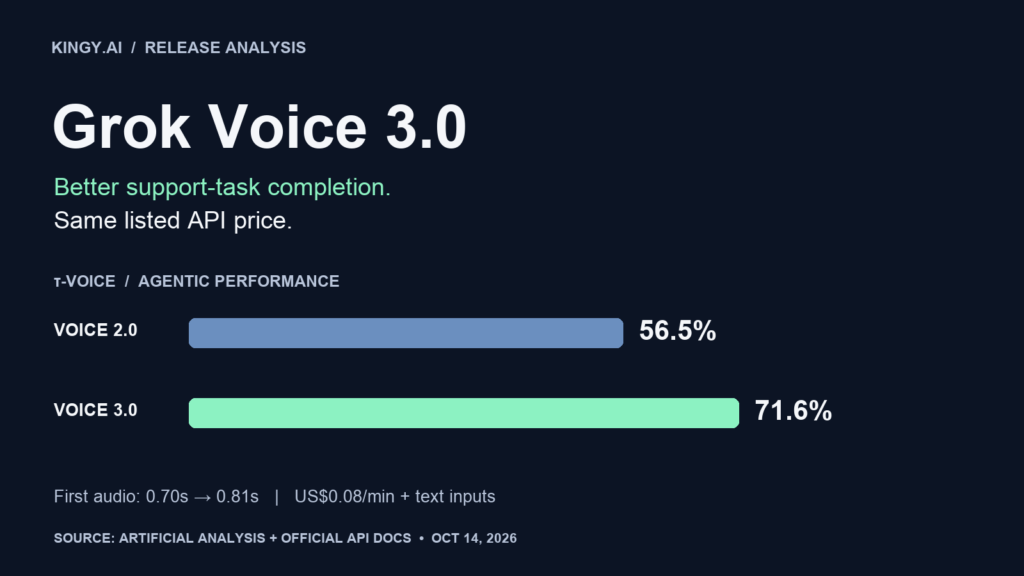
The central finding comes from Artificial Analysis: Grok Voice 3.0 scores 71.6% on its τ-Voice agentic benchmark, compared with 56.5% for Voice 2.0. Its reported time to first audio increases from 0.70 to 0.81 seconds.
That is a meaningful improvement in completing simulated support tasks, accompanied by a small increase in one latency measure. Whether the combination produces better customer calls depends on the workflow, the tools, and the callers.
Evidence disclosure: This is a source-based release analysis. Kingy.ai has not run a Grok Voice 3.0 versus 2.0 support-call experiment. The measured model results below belong to Artificial Analysis. The cost calculations are illustrative, and the evaluation protocol later in the article is proposed work.
What changed on October 14
The official release notes confirm that grok-voice-3.0 is available, that grok-voice-latest now routes to it, and that Voice 2.0 is deprecated. The API remains unchanged. We verified the release date; an exact launch time and a Voice 2.0 shutdown date were not established by the checked documentation.
The alias change deserves immediate attention. A deployment can keep the same application code while receiving a different model. For a support team, that means a new evaluation may be needed even when its own release calendar shows no software update.
For historical context, Kingy.ai previously covered Grok Voice Think Fast 1.0. This article concerns the new 3.0 API release. Earlier rankings and prices should be read in the context of their original publication.
The benchmark gain, with the arithmetic made explicit
| Measure | Voice 2.0 | Voice 3.0 | Change |
|---|---|---|---|
| τ-Voice agentic performance | 56.5% | 71.6% | +15.1 percentage points |
| Time to first audio | 0.70 seconds | 0.81 seconds | +0.11 seconds |
Source: Artificial Analysis speech-to-speech evaluation. Its τ-Voice score uses simulated customer-support interactions with tools and policies, checked against a required final database state. The latency figure is an average on Big Bench Audio, a different workload. The page also reports a separate Speech Agent Arena task-success metric; it should not be substituted for τ-Voice.
Our calculation gives a roughly 26.7% relative increase in the reported completion rate: 15.1 divided by 56.5. Calling it a “15.1% improvement” would confuse percentage points with relative change.
The complementary failure rate falls from 43.5% to 28.4%. That is approximately a 34.7% relative reduction in benchmark failures. This calculation describes the two reported scores. It does not establish that a real support desk would see one-third fewer escalations.
As a scale illustration, the rates correspond to 565 versus 716 completions per 1,000 equivalent benchmark attempts. Those are normalized figures, not the benchmark’s actual sample counts or a forecast for 1,000 customer calls.
The size of the difference makes this release worth examining. The headline rates alone do not provide a confidence interval, reveal every failure type, or establish how stable the improvement would be on a particular company’s traffic.
Why completing the task matters more than sounding convincing
A support agent can give a polished answer and still leave the customer’s problem unresolved. It might explain a refund without issuing it, promise a reservation change without checking availability, or correctly describe an account policy while modifying the wrong record.
The τ-Voice research paper describes a framework that combines grounded task completion with full-duplex conversation. Full duplex means the agent can listen and speak at the same time. Its evaluation addresses tool use, policy adherence, and spoken interaction together. The paper provides methodological background; its original model results should not be mistaken for a test of this new release.
For a buyer, the useful question is whether the intended state change happened correctly. A refund should have the right amount and destination. An appointment should occupy the agreed slot. A cancellation should affect the authorized service and leave unrelated services alone.
That makes the new result more relevant to support automation than a demonstration consisting of a pleasant conversation. It still leaves several business questions open. Can the model handle your account identifiers? Does it respect your escalation rules? Does it recover when your order service times out? Does it distinguish permission to explain a policy from permission to act?
These questions depend on the deployed system. Tool definitions, policy wording, authentication, audio quality, and backend reliability all influence the outcome. A stronger voice model can improve one part of that system while exposing weaknesses elsewhere.
The extra 110 milliseconds needs the right context
Subtracting the published latency figures gives 110 milliseconds. Relative to 0.70 seconds, that is about a 15.7% increase. The absolute difference is more useful for imagining a spoken exchange; the relative figure helps describe the change precisely.
We would not assume either that callers will notice it or that they will never notice it. A short pause can feel natural after a complicated request. Repeated silence during a simple interaction can feel broken. Timing also interacts with whether the agent starts speaking before it has enough information.
Most importantly, time to first audio does not measure time to resolution. An agent might begin an acknowledgment quickly and then spend several seconds waiting for a tool. Another might start slightly later but complete the requested action with fewer corrections.
A production evaluation should therefore record the caller’s end of speech, the first audio packet received, the first audible playback, each tool request and response, and the final confirmed outcome. These timestamps answer different questions. Network buffering and audio playback can add delay after the model has started generating.
Measure the median and the slowest part of the distribution as well as the average. Averages can hide occasional long pauses. Break down simple answers, clarification turns, and turns requiring tools. A single number cannot show whether the problem is model response, turn detection, or a slow booking database.
For appointment scheduling, a modest startup delay may be acceptable if the agent consistently books the right slot. For a workflow with frequent interruptions and short turns, responsiveness may deserve more weight. Those are evaluation priorities, not findings from a Kingy test.
Same API price, with the text-input charge included
The official pricing table lists both Voice 2.0 and Voice 3.0 at US$0.08 per minute, equivalent to US$4.80 per hour, plus US$0.004 per text input. The upgrade does not raise those listed rates.
For planning, the corresponding arithmetic is:
Illustrative voice API cost in USD
= 0.08 × billable minutes
+ 0.004 × billable text inputs
Use the provider’s actual billable usage records when reconciling a deployment. A spoken turn and a billable text input are different units; do not assume every spoken sentence creates a text-input charge.
| Usage assumption | Minute charge | Text charge | Total |
|---|---|---|---|
| 5 billable minutes; 5 billable text inputs | US$0.40 | US$0.02 | US$0.42 |
| 10 billable minutes; 10 billable text inputs | US$0.80 | US$0.04 | US$0.84 |
| 1,000 calls at the first example’s usage | US$400 | US$20 | US$420 |
The table is a budgeting example, not a quoted bill or measured call duration. Telephony, application hosting, external services, human escalation, and recording infrastructure can create additional costs.
“Same price” also does not guarantee the same invoice. If an agent takes longer to finish a call, minute charges can increase. If it resolves the issue with fewer turns, they can fall. A lower failure rate could reduce expensive follow-up work, but that requires evidence from the actual operation.
Cost per successful resolution is the stronger business measure
Consider a deliberately simplified exercise. Assume every attempt costs US$0.42 and the two benchmark completion rates transfer unchanged. Dividing attempt cost by completion rate gives approximately US$0.74 per successful outcome at 56.5%, versus US$0.59 at 71.6%.
That would be about a 21.1% reduction. It is a sensitivity calculation, not a predicted saving. It assumes equal cost per attempt, comparable cases, and unchanged completion rates. It excludes escalation and recovery costs, and it does not model retries.
The useful lesson is the denominator. A cheap call that creates a second call can be expensive. Track total costs against verified resolutions, and account separately for harmful errors such as duplicate refunds or unauthorized changes. Those failures should not disappear inside an attractive average.
The automatic model switch is an operational change
The Speech to Speech API guide supports selecting a version through the connection URL. A versioned model name lets an evaluation target a named release. The documented WebSocket form for 3.0 is:
wss://api.x.ai/v1/realtime?model=grok-voice-3.0For an A/B comparison, the corresponding 2.0 selector is grok-voice-2.0, subject to continued availability. Confirm access before scheduling the experiment; deprecation should not be treated as a promise that an older model will remain available.
Start with an inventory of production connection settings. Record whether each service uses a version or grok-voice-latest. Store the requested model and any model identity the provider exposes in session logs. If the resolved identity is unavailable, retain the request, date, and release-note context, and state that limitation.
Pinning a version helps prevent an alias change from contaminating a comparison. It does not freeze your tool servers, network conditions, application dependencies, or every aspect of a hosted service. Keep those variables under control as well.
A staged rollout should have explicit acceptance criteria and a fallback that is available at the time of deployment. That fallback might be a supported prior configuration or human handoff. It should never depend on an unverified assumption about a deprecated endpoint.
For teams already using the alias, compare operational metrics around the change carefully. A before/after difference can reflect traffic mix, staffing, backend incidents, or updated prompts. The alias switch establishes a reason to investigate; it does not make every subsequent change attributable to the model.
A reproducible support-call comparison
The following is a proposed protocol for testing the release. We have not executed it. Its purpose is to make a future claim such as “3.0 works better for our customers” inspectable.
1. Freeze the application and change the model first
Use the same policy, system instructions, tool schemas, voice, audio settings, timeout behavior, and application code for both versions. Set supported reasoning options explicitly and record them. Avoid comparing a carefully tuned 3.0 application with an old, neglected 2.0 configuration.
Run a controlled comparison before a second round of model-specific optimization. The first round estimates what changing the model does in a fixed system. The second estimates what each complete, tuned application can achieve. Report those as different experiments.
2. Define success before making the call
Each scenario needs an initial database state, an allowed outcome, required confirmations, forbidden actions, and an escalation rule. Grade the final state against that specification. A transcript saying “done” is insufficient evidence.
Use synthetic customer records and sandbox tools. Reset the environment before every attempt. A previous successful refund must not make a later run appear successful without doing the work.
| Scenario | Complication | Evidence of success |
|---|---|---|
| Appointment rescheduling | Caller changes the preferred day mid-sentence | Correct final slot; old booking handled correctly; confirmation matches |
| Retail return | Order contains eligible and ineligible items | Only permitted items returned; correct amount and destination |
| Billing question | Caller initially identifies the wrong transaction | Clarification precedes action; correct transaction handled |
| Service cancellation | Caller wants to retain an associated service | Only the authorized service changes |
| Backend timeout | Write succeeds but acknowledgment is delayed | No duplicate action; state checked before retry |
| Human escalation | Request exceeds the agent’s authority | No unauthorized action; useful handoff with relevant context |
3. Test interruptions as distinct events
A caller correcting “Tuesday” to “Thursday” should affect the pending action. A caller saying “yeah” while listening may require no change. A pause in the middle of an account number should not necessarily end the turn. These events deserve separate labels.
Record whether playback stops when appropriate, whether the corrected detail reaches the tool arguments, and whether the agent resumes coherently. Also test a correction arriving after a tool request has already been sent. That case may require recovery rather than merely changing the next sentence.
For a fixed playback experiment, use the same audio and interruption schedule for both models. For an interactive simulator, hold the caller policy and seeds constant where possible, retain every generated utterance, and acknowledge that conversations can branch. Describe the cases as matched scenarios when the dialogue itself is not identical.
4. Count correct actions and damaging actions separately
Log tool names, arguments, returned errors, retries, and final state. Report successful required actions alongside unauthorized actions, duplicate writes, omitted steps, and false claims of completion.
An application that makes more successful calls but occasionally modifies the wrong account needs a different response from one that safely asks for help more often. A single completion score can hide that distinction.
Keep permission checks and validation in the application and tool layer. A model’s conversational confidence should not determine whether an account change is authorized.
5. Measure timing through to the outcome
Define each latency boundary before collecting data. Report end-of-user-speech to first audible response, tool round-trip time, interruption-to-playback-stop time, and total time to verified resolution. State how silence, abandoned calls, and failed attempts enter those metrics.
Use the same network location and audio path. Interleave model versions so a quiet morning and a congested afternoon do not become an accidental model comparison. Preserve timeout failures rather than silently discarding them.
6. Publish uncertainty and the evidence needed to audit it
Repeat cases and report the number of attempts, results by scenario, and uncertainty around aggregate rates. For matched cases, use an analysis that preserves the pairing. Keep clean audio, noisy audio, accents, and interruption-heavy conversations visible as separate slices where the sample permits.
Publish the harness version, requested model identifiers, dates, settings, prompts, tool definitions, scoring rules, and sanitized action traces. Report measured usage and cost per verified resolution. Explain exclusions and disclose any access failure that prevented a fair 2.0 comparison.
If one version cannot be tested, report that directly. A current 3.0 run compared with an old demo transcript cannot establish an identical-scenario improvement.
What the launch evidence still cannot establish
The release documentation and independent benchmark support a strong reason to evaluate Voice 3.0. They do not establish production uptime, the behavior of every language or accent, performance on your business policies, or the security properties of your integration.
They also do not establish a universal preference between faster first audio and better task completion. Some applications may favor the apparent completion gain; others may reject a model because of a specific error pattern, latency tail, or integration constraint.
We have not verified an exact launch time, a Voice 2.0 shutdown deadline, or a complete account of public X announcements. The dated API release notes provide the basis for timing in this article.
Our assessment
Grok Voice 3.0 deserves timely coverage because the independent support-task result is materially stronger and the listed API rates are unchanged. The automatic alias update also creates an immediate operational reason to review existing deployments.
The evidence is sufficient to prioritize an evaluation. A production adoption decision needs matched scenarios, verified tool outcomes, interruption tests, and end-to-end timing on the actual application. Teams using grok-voice-latest should begin by checking their current configuration and recent call outcomes, then pin a named version for a controlled comparison.
Sources checked October 14, 2026: official release notes, Speech to Speech API guide, API pricing, Artificial Analysis measurements and methodology, and the τ-Voice paper. Benchmark figures are a dated snapshot. This article contains no Kingy.ai hands-on performance results.
The Kingy Brief
Get The Kingy Brief.
AI changes, original tests and one practical thing to try. Fridays at 09:00 Vancouver time.
Free · Double opt-in · Unsubscribe anytime
Sign up for The Kingy Brief on Beehiiv.
Signup help and newsletter schedule
Signup form provided by Beehiiv. After submitting, check your inbox for "Confirm your subscription to The Kingy Brief" and open its confirmation link. Check Spam or Promotions if you cannot find it.
Fridays at 09:00 Vancouver time: source-checked AI changes, original tests and one practical thing to try. The weekly restart begins October 9, 2026. We skip a week when there is not enough verified material. Free. Unsubscribe anytime.