
Meta Gives Its AI Ambitions a New Name
Meta has introduced Muse Wonder and Muse Wonder Full, a pair of models aimed at personal assistance, professional work, and coding.
Announced on October 12, the release puts sustained agentic tasks at the center of the company’s pitch.
The defining ideas are Active Memory and Active Focus.
One concerns carrying useful information between conversations.
The other concerns continuing toward a goal when the work becomes difficult.
Together, they suggest an assistant designed for projects that outlast a single chat window.
That is an appealing direction for anyone tired of repeatedly explaining the same assignment.
However, the launch should be understood through its actual access options, documented capabilities, and limitations.
A model that remembers the brief still has to do something useful with it.
Two Models With Different Access Routes
Muse Wonder is available through the Meta Model API and Muse Code.
Muse Wonder Full initially requires a Muse Code subscription.
Meta says Wonder will reach additional Muse experiences, starting with subscribers.
Developers accessing the API are working with Wonder, while subscription access offers a route to Full.
Readers should avoid treating results for the larger variant as guaranteed performance from the API model.
The names are related, but the available experiences differ.
Before adopting either, users should check the actual product, account requirements, and available features.
That practical step is less glamorous than a launch video.
It is also more useful than discovering halfway through a project that the advertised capability belongs to another offering.
The Bigger Shift Is Toward Ongoing Work
A single answer can be helpful without completing a task.
Writing an application, assembling research, or resolving an administrative problem usually requires several decisions and revisions.
That is the territory Meta wants the Wonder family to address.
The interesting change is the unit of work.
Instead of judging assistance only by a response, users can evaluate whether it advances an entire assignment.
Consider a hypothetical research project.
Finding an article is one step; comparing evidence, identifying gaps, and producing an accurate draft are others.
An effective agent needs to keep those steps connected.
A fluent paragraph can impress immediately, while a coherent workflow has to survive corrections and changing requirements.
Muse Wonder’s promise becomes meaningful when that continuity produces a dependable result.
Active Memory Targets the Repeated Brief
Meta describes Active Memory as retaining important context across conversations and retrieving it when relevant.
The attraction is straightforward.
You should not need to restate every project preference each time you return.
Imagine a hypothetical assistant that remembers an agreed audience, an approved outline, and a requested tone.
Those details could make the next drafting session easier.
But remembering a statement and understanding its current status are separate challenges.
A suggestion might remain tentative.
A deadline might change.
A preference might apply to one client alone.
Useful memory should distinguish those situations rather than flatten them into permanent facts.
The potential improvement is therefore selective continuity.
An assistant earns trust by recalling the right information at the right time, with enough transparency for the user to correct it.
Good Memory Must Handle Changed Information
A system that remembers old information confidently can create fresh problems.
Suppose a project budget changes after the first conversation.
The next plan should reflect the update, rather than quietly revive the original amount.
Meta’s model card describes an internal memory evaluation involving long conversations, distractions, and facts that are later revised.
That tests an important behavior, but it does not guarantee flawless recall in ordinary use.
The practical question is how gracefully the assistant handles corrections.
Can users identify a mistaken assumption?
Does the new instruction replace the old one where appropriate?
These are useful evaluation questions, rather than confirmed interface features.
For ongoing projects, memory quality includes knowing what to discard.
Nobody needs a digital colleague who preserves every outdated instruction with the dedication of a museum curator.
Active Focus Aims to Survive the Difficult Parts
Active Focus is Meta’s term for sustained effort toward a challenging objective.
The company describes trying alternatives, recovering from errors, adapting to new information, and seeking clarification when needed.
That addresses a familiar frustration with automation.
A task can begin smoothly and still become stuck at the first unexpected obstacle.
In a hypothetical coding workflow, an assistant might need to reconsider an approach after a failed check.
Continuing intelligently would be useful.
Repeating the same failure indefinitely would not.
Persistence needs a stopping rule as well as enthusiasm.
A dependable system should recognize when it lacks information or needs human judgment.
The valuable outcome is progress that remains aligned with the assignment.
More activity alone does not establish that the work is moving in the right direction.
Coding Makes the Promise Easier to Examine
Meta’s developer site promotes Wonder for work across codebases, tool use, and tasks involving multiple agents.
Software development offers concrete ways to evaluate those claims.
A proposed change either satisfies its requirements or leaves something important unresolved.
Tests, code review, and working behavior can provide evidence beyond an impressive explanation.
Consider a hypothetical request to add a feature.
A useful assistant would need to understand the existing project, make appropriate changes, and verify the result.
It should also explain meaningful limitations.
The number of files edited is not the achievement.
The achievement is a functioning change that a reviewer can understand.
This gives Muse Wonder a practical proving ground.
Its coding value will depend on how consistently it turns instructions into maintainable software under ordinary project conditions.
A Million Tokens Is Room, Not Guaranteed Understanding
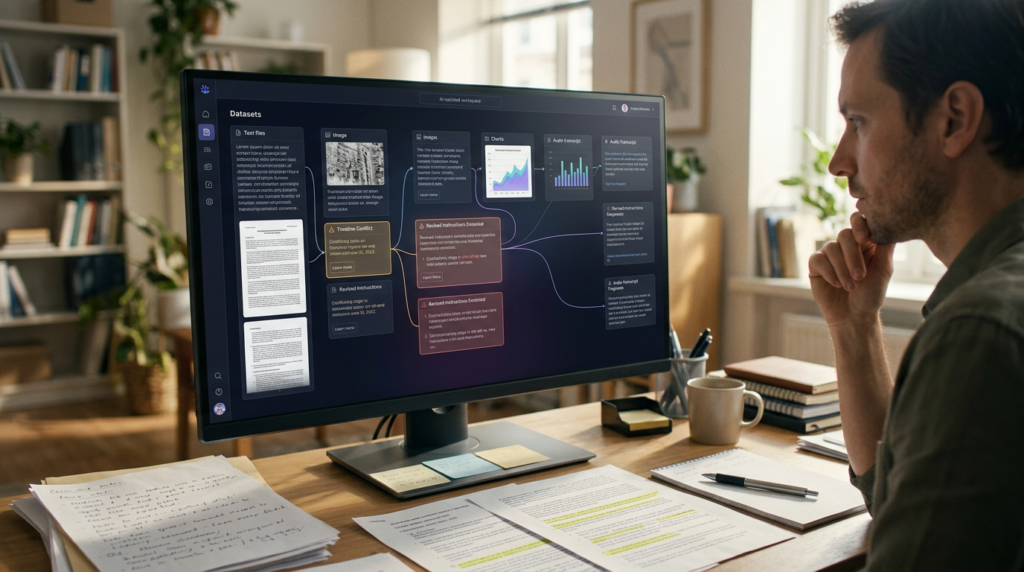
Meta’s model card lists a context length of one million tokens.
It also specifies text, image, video, and audio inputs, with text output.
That gives developers a substantial input envelope, but capacity should not be confused with perfect comprehension.
A system may accept extensive material while still overlooking a crucial detail.
The useful question is whether it finds and applies the information that matters.
For example, a hypothetical document collection could contain contradictory dates and superseded instructions.
An effective assistant should identify those conflicts instead of treating everything as equally current.
Large context and persistent memory also solve different problems.
One concerns what a model can process within its working input.
The other concerns carrying relevant information forward between interactions.
Users benefit when both operate reliably.
Professional Knowledge Needs Careful Framing
Meta highlights work involving legal, financial, and health information among the family’s intended applications.
Those examples show the ambition, but they should not be read as professional credentials.
A useful assistant could help organize supplied documents, explain terminology, or prepare questions for an expert.
A confident explanation can still omit a decisive qualification.
For a hypothetical lease review, identifying a clause is different from establishing how it applies to a specific situation.
The same distinction matters across specialized work.
Muse Wonder’s contribution should be assessed through the particular task and the evidence supporting its answer.
The sensible target is better preparation and clearer information.
That can be valuable without assigning the model authority it has not earned.
Writers Could Benefit From Better Continuity
For writers, the memory-and-focus combination has an obvious attraction.
An article develops through research, drafting, revision, and decisions about what to leave out.
A hypothetical assistant that preserves the agreed angle could help keep those stages connected.
It might also reduce the need to repeat formatting requirements or explain why a particular section changed.
These are possible workflows, rather than measured productivity gains from this launch.
Editorial judgment remains central.
A remembered preference does not verify a source.
A coherent draft does not establish that every claim is accurate.
The strongest writing support would make preparation easier while preserving the writer’s control over interpretation and voice.
The assistant should help carry the work forward.
The writer still decides what deserves a place on the page.
The Benchmark Story Has More Than One Winner
Meta reports strong results across memory, coding, and professional tasks.
However, those comparisons include company-generated evaluations, and the model card identifies differences in some testing setups.
Decrypt’s launch coverage reports that Artificial Analysis placed Claude Opus 5.5 ahead of Wonder Full on its overall intelligence index.
That complicates any simple declaration that Meta has won the model race.
Different evaluations emphasize different capabilities.
A model leading a particular coding test may not lead an aggregate measure.
Readers should also distinguish Wonder Full from the version offered through the API.
The practical takeaway is to evaluate the workload that matters.
A business choosing an assistant for document analysis needs evidence about document analysis.
The largest number on an unrelated chart cannot make that decision for it.
Price Belongs Beside Task Success
Launch reporting lists Muse Wonder API pricing at $4 per million input tokens and $20 per million output tokens.
That provides a starting point for estimating usage costs, rather than a complete price for finishing a project.
An agentic workflow may involve repeated calls, substantial context, and revisions.
Developers therefore need to examine total task cost.
A hypothetical cheaper response becomes less attractive if several retries are required.
A more expensive call could be worthwhile if it completes the assignment accurately with less review.
The useful comparison combines cost, latency, and successful completion.
This is an evaluation principle, not a forecast of Wonder’s operating expense.
Teams should measure representative work before extrapolating.
A price sheet explains billing units.
It does not tell the whole story of productivity.
Personal Memory Makes Permission More Important
Meta says it trained the Wonder family to avoid sharing private information without permission.
That commitment matters because personal agents may work with messages, calendars, and documents.
The design challenge extends beyond remembering accurately.
An agent must also respect which information belongs in which interaction.
Consider a hypothetical assistant supporting several clients.
A detail useful for one assignment should not casually appear in another client’s draft.
That is a practical boundary worth testing.
Users also need understandable choices about what an agent can access and do.
These are expectations for trustworthy deployment, rather than a description of every available control.
Personalization becomes valuable when it respects context.
An assistant should remember enough to help while keeping private information within the boundaries the user actually intended.
Safety Depends on the Surrounding System
Meta’s published scaling framework describes safeguards during training and evaluation, including containment measures and monitoring for risky behavior.
The Wonder model card also recommends additional protections suited to a deployment’s purpose.
That points to an important distinction.
A capable model is one component of an agent.
The surrounding product determines tools, access, confirmation steps, and how errors are handled.
A draft prepared for review presents different consequences from an action carried out externally.
For that reason, testing should include the workflow rather than the model’s words alone.
Could the system stop when asked?
Would it seek approval at an appropriate moment?
Those are practical questions for deployment.
Safety claims become more informative when they connect to observable behavior in the situations where people will use the assistant.
A Pilot Should Look Like Real Work
The useful next step for interested teams is a limited evaluation built around representative assignments.
That could include a document task, a coding change, and a project whose requirements evolve over several interactions.
The objective would be to observe continuity and correction.
Does the assistant preserve the current brief?
Can it recover from an error?
Does it explain unfinished work clearly?
Teams should also account for the effort spent reviewing results.
A polished deliverable that requires extensive repair may provide little net benefit.
These are proposed evaluation methods, not published findings about Wonder.
The most informative trial would include imperfect inputs and ordinary interruptions.
Demonstrations show what a system can do under selected conditions.
Daily work reveals whether that capability remains useful when the assignment becomes messy.
The Real Frontier Is Following Through

Muse Wonder gives Meta a clearer proposition in the market for capable personal and professional agents.
The company is emphasizing assistance that remembers relevant context and continues through difficult work.
That direction addresses a recognizable need.
People want help that remains coherent after the first answer.
The launch also leaves a practical test ahead: turning those capabilities into reliable experiences across the products where users can access them.
Performance charts can attract attention, but sustained usefulness will determine the stronger story.
For writers, developers, and other professionals, success would feel concrete.
Less repeated explanation.
Fewer abandoned tasks.
More work completed with clear oversight.
Meta has presented an ambitious approach to that goal.
Now users can judge whether Wonder’s memory and persistence make the next project easier to finish.
SOURCES
- Introducing Muse Wonder and Muse Wonder Full: Frontier Models for Agents — Meta Newsroom (about.fb.com)
- Muse Wonder: A Frontier Model for Personal and Professional AI Agents — Meta AI Research (research.meta.ai)
- Muse Wonder Model Card — Meta AI Research (research.meta.ai)
- Products and Solutions for AI Developers — Meta (Meta)
- Meta’s New Muse Wonder Finally Puts Zuckerberg in the Frontier AI Race — Decrypt (Decrypt)
- Developing Capable Models Responsibly — Meta AI Research (Meta AI Research)
Trending on Kingy
Keep reading with the stories getting the most attention now.
The Kingy Brief
Get The Kingy Brief.
AI changes, original tests and one practical thing to try. Fridays at 09:00 Vancouver time.
Free · Double opt-in · Unsubscribe anytime
Sign up for The Kingy Brief on Beehiiv.
Signup help and newsletter schedule
Signup form provided by Beehiiv. After submitting, check your inbox for "Confirm your subscription to The Kingy Brief" and open its confirmation link. Check Spam or Promotions if you cannot find it.
Fridays at 09:00 Vancouver time: source-checked AI changes, original tests and one practical thing to try. The weekly restart begins October 9, 2026. We skip a week when there is not enough verified material. Free. Unsubscribe anytime.