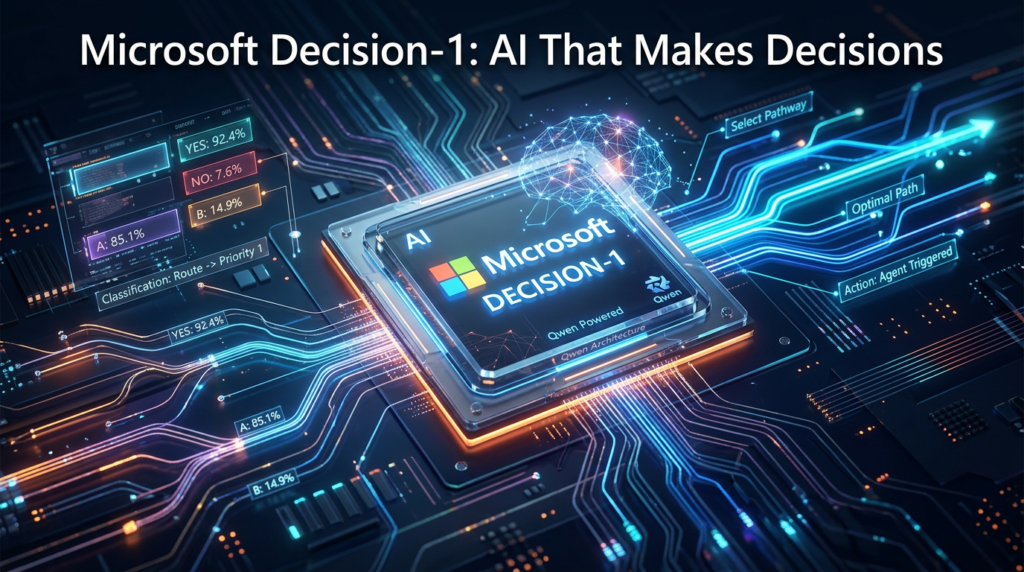
Microsoft is entering a new category of artificial intelligence with a model designed to make quick decisions, rank options, and guide autonomous AI agents. Built on Alibaba’s Qwen technology, Microsoft-Decision-1 could change how developers think about AI efficiency, reliability, and cost.
A Different Kind of AI Has Entered the Conversation
Artificial intelligence has become remarkably good at talking. It writes emails, explains complicated subjects, generates software, and occasionally delivers an answer so confidently wrong that you almost admire the commitment.
But what if the next important breakthrough isn’t about making AI more talkative?
What if it is about making AI better at choosing?
That’s the idea behind Microsoft-Decision-1, a specialized artificial intelligence model introduced by Microsoft on October 9, 2026.
Unlike conventional large language models, Decision-1 doesn’t focus on writing detailed paragraphs. Instead, it evaluates predefined choices, assigns probability scores, and helps software determine what should happen next.
Think less digital storyteller, more lightning-fast decision assistant.
The model is available through Microsoft Foundry, the company’s platform for building and managing enterprise AI applications.
What makes this announcement particularly interesting is the technology underneath. Microsoft built Decision-1 by further training Alibaba’s Qwen3.5-9B, an open-weight model developed within China’s increasingly competitive AI ecosystem.
A major American technology company using Chinese-developed AI technology to build a specialized enterprise tool?
Now that’s a development worth examining.
And the implications stretch far beyond Microsoft’s latest product announcement.
Why Artificial Intelligence Needs a Decision Specialist
Most people experience AI through chatbots.
Ask a question, receive an answer. Request a summary, get several paragraphs. Need assistance drafting an email? AI happily produces three versions and might even offer a fourth nobody requested.
However, enterprise applications operate differently.
Behind a seemingly straightforward customer interaction, software might need to make dozens of small decisions.
Should this request go to customer support or technical assistance? Which AI model should process the next instruction? Does a generated answer meet the company’s requirements?
These questions rarely demand a lengthy explanation.
They require a reliable choice.
Traditionally, developers have often used general-purpose language models to perform such tasks. Those systems can work well, but their capabilities may exceed what the job actually requires.
It’s like hiring a world-class chef to decide whether a restaurant order belongs in the kitchen or at the cashier.
Microsoft believes specialized decision models can handle many of these repetitive tasks more efficiently.
Decision-1 evaluates available options and produces structured results that applications can immediately process.
Rather than replacing conversational AI, it handles a different part of the workload.
That distinction matters because modern AI applications increasingly depend on coordinating multiple specialized systems.
How Microsoft-Decision-1 Actually Works
The fundamental concept behind Decision-1 is surprisingly straightforward.
A developer supplies a question, relevant context, and a predefined collection of possible answers.
The model evaluates those options and assigns probability scores indicating their relative likelihood.
Imagine an online retailer receives this customer message:
“My order arrived yesterday, but the package contains the wrong item.”
A decision model might classify the message against three possible categories: delivery problems, product returns, and payment concerns.
An illustrative response could assign 10% to delivery problems, 85% to product returns, and 5% to payment concerns.
These figures are hypothetical, but they demonstrate the process.
The software could then route the customer to the appropriate workflow without requiring a general-purpose chatbot to compose an explanation.
Microsoft says Decision-1 supports yes-or-no questions, multiple-choice classification, numerical ratings, and evaluations based on predefined scoring criteria.
Its architecture emphasizes single-pass scoring, allowing it to assess options without producing lengthy intermediate responses.
The model also returns structured data, including probability information, making integration into automated systems easier.
Importantly, these are judgments based on supplied context and learned patterns.
They are not guarantees that the selected answer is correct.
The Alibaba Connection That Makes This Launch Interesting

One of the most fascinating details about Microsoft’s announcement concerns the model’s foundation.
Decision-1 builds on Qwen3.5-9B, part of Alibaba’s Qwen AI family.
The 9B designation refers to approximately nine billion model parameters, giving developers a comparatively compact foundation for specialized tasks.
Instead of developing Decision-1 entirely from scratch, Microsoft applied additional training to optimize Qwen for rapid decision scoring.
This approach reflects a broader development strategy: start with an existing capable model, then adapt it to a particular application.
It also demonstrates how AI research increasingly crosses national and corporate boundaries.
American companies may compete with Chinese technology providers while simultaneously benefiting from their openly available research.
Microsoft has indicated that future Decision-1 versions may use other foundations, including models from Microsoft AI and OpenAI.
That means the Qwen-based implementation should not necessarily be considered the model’s permanent architecture.
Nevertheless, its inclusion is significant.
It reinforces the commercial relevance of open-weight technology and shows that enterprise AI innovation does not always require a completely proprietary foundation.
Sometimes the competitive advantage lies in what developers build on top.
Microsoft’s Performance Claims Turn Heads
Speed is one of Microsoft’s biggest selling points.
According to the company’s published benchmarks, Decision-1 achieved the highest accuracy in its comparison involving 36 benchmarks and nearly 150,000 questions.
Those evaluations covered tasks including classification, ranking, multilingual inputs, reasoning, and safety-related decisions.
Microsoft also reported striking latency advantages.
MICROSOFT-REPORTED BENCHMARK RESULTS
35×
Faster median latency than GPT-6 Sol
2.5×
Faster than H2O-Lightning-4B v1.1
36
Benchmarks in Microsoft’s evaluation
~150K
Questions used in the comparisons
These are Microsoft’s internal evaluation results, not independently verified performance guarantees.
The speed comparison is especially attention-grabbing.
However, context is essential. Decision-1 and general-purpose language models are designed for different workloads.
A faster result on a structured decision task does not mean Decision-1 can outperform a general-purpose model across writing, research, coding, or complex reasoning.
Independent testing will be important before developers can determine how well Microsoft’s claims translate into their own applications.
Why Speed Becomes Critical for Autonomous AI Agents
To understand why milliseconds matter, consider how autonomous AI agents operate.
Unlike chatbots that simply respond to questions, agents can perform sequences of actions.
An agent might inspect a request, choose a tool, retrieve information, evaluate results, and decide whether another action is necessary.
Every step introduces another decision.
Microsoft provides a useful illustration: adding 100 milliseconds to each of 20 sequential decisions creates two additional seconds of processing time.
That might sound insignificant.
But when thousands of automated tasks run simultaneously, delays accumulate.
Faster decision-making can improve responsiveness, reduce infrastructure pressure, and potentially lower operational expenses.
Decision-1 targets exactly these situations.
It can evaluate whether an agent should continue, stop, retry, or transfer control to another system.
It can also help select between specialized models based on application requirements.
Picture an AI agent coordinating a customer-service workflow.
Instead of asking an expensive reasoning model to examine every tiny operational choice, the application could assign routine decisions to Decision-1.
More capable models would remain available when genuinely complicated questions arise.
The result could be a more efficient division of computational labor.
Low Pricing Could Become Microsoft’s Secret Weapon
Performance matters, but economics often determines whether new technology reaches widespread deployment.
Microsoft has priced Decision-1 at $0.042 per million input tokens, with no separate charge for output tokens.
That’s an unusually low published token rate.
For companies processing millions of repetitive classification requests, such pricing could make experimentation attractive.
There is an important qualification, however.
A million input tokens is not the same as a million individual decisions. The number of decisions possible depends on how much context each request contains.
Actual deployment expenses can also include application hosting, data processing, monitoring, and other infrastructure.
Still, the pricing illustrates Microsoft’s intended market.
Decision-1 isn’t positioned primarily as a premium chatbot for occasional conversations.
It’s designed for software environments where countless small decisions happen continuously.
The New Stack also noted how Microsoft’s pricing aligns with TypeSafe AI’s Jev, another entrant in the emerging decision-model category.
This suggests that specialized decision services may develop their own competitive market.
For businesses, that competition could translate into greater choice.
For AI providers, it creates pressure to demonstrate efficiency rather than relying exclusively on model size.
Microsoft’s Xbox Team Offers an Early Real-World Example
Microsoft isn’t presenting Decision-1 purely as an experimental research project.
The company has already described internal evaluations involving different business and engineering teams.
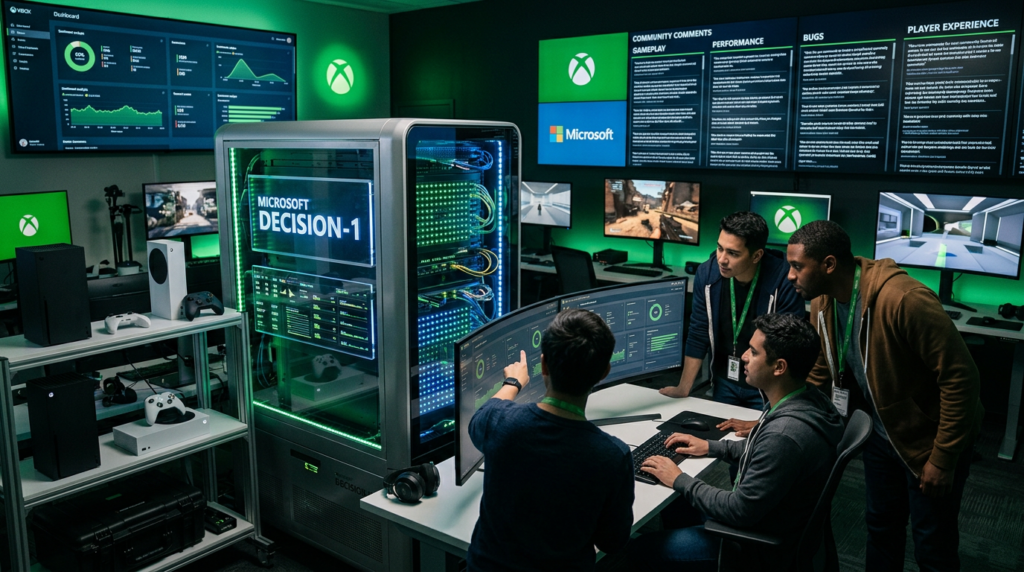
One notable example comes from Xbox Research.
Researchers used Decision-1 to classify more than 10,000 pieces of open-ended feedback gathered from surveys, Steam, and social platforms.
The objective was to organize customer opinions into predetermined themes.
That’s an enormous amount of feedback for employees to classify manually.
According to Microsoft, Decision-1 delivered quality competitive with GPT-6 Sol while operating more than 14 times faster and at approximately 200 times lower cost in the internal comparison.
Those numbers are impressive, although they remain company-reported.
More importantly, the example demonstrates a practical use case.
Gaming companies constantly collect information about bugs, gameplay balance, launches, and customer satisfaction.
Automatically organizing this feedback can help research teams identify recurring issues and understand audience sentiment.
The same approach could apply to hotels analyzing guest reviews, retailers categorizing complaints, or publishers examining reader responses.
Decision-1 doesn’t replace human interpretation.
It helps organize information so people can spend more time understanding what the findings mean.
Decision-1 Could Help AI Systems Judge Their Own Work
Another promising application involves quality control.
AI systems frequently generate outputs that must be checked before reaching users or triggering actions.
Consider an automated assistant preparing a response to a technical support question.
A separate decision model could evaluate whether the answer follows established guidelines, addresses the user’s request, and meets a predefined quality standard.
If the response scores poorly, the system could request a revision.
Microsoft reports that its Copilot team tested Decision-1 for evaluating chat and agentic responses.
In those experiments, the company found quality competitive with GPT-5.6 Luna while achieving approximately 100 times faster processing.
That points toward an interesting future architecture.
One AI model produces content. Another evaluates it. A third determines what action should follow.
Specialization could make this arrangement more economical than assigning every responsibility to one large model.
Of course, AI evaluating AI introduces its own difficulties.
A model might incorrectly approve a flawed response or reject an acceptable one.
Therefore, automated judging still requires careful testing, clear evaluation criteria, and appropriate human oversight.
Speed alone cannot establish reliability.
Better Routing Could Make AI Applications More Efficient
Not every question needs the most powerful AI model available.
Some requests involve straightforward classification. Others demand sophisticated mathematical reasoning, creative writing, or extensive analysis.
The challenge is knowing which system should handle each task.
That’s where model routing becomes valuable.
Imagine an application with access to several AI models, each offering different capabilities and prices.
A routing model could inspect an incoming request and recommend the most appropriate option.
Simple tasks might go to smaller, cheaper systems.
More difficult requests could be sent to larger reasoning models.
Microsoft designed Decision-1 to support exactly this kind of workflow.
The potential benefit extends beyond saving money.
Applications could become more responsive by avoiding unnecessary processing while preserving access to advanced capabilities when needed.
However, routing introduces additional engineering questions.
How accurately can the model identify difficult requests? What happens when it chooses an inadequate system? When should an application escalate uncertainty?
Those questions must be answered using real workload data.
An effective routing system should optimize the complete user experience, not merely minimize the cost of individual requests.
Reliability Matters Just as Much as Raw Speed
A decision system can be extremely fast and still cause trouble if its choices change unpredictably.
Consider a customer-service classification request.
If two nearly identical messages receive entirely different classifications, the resulting workflow becomes unreliable.
Microsoft says it tested Decision-1 against variations in input wording, option ordering, formatting, and other changes that should not affect the answer.
Across its reported perturbation tests, the model changed its selected decision approximately 1.3% of the time.
Microsoft also reported no decision changes in certain tests involving paraphrased option descriptions or rearranged choices.
This is an encouraging claim, though it requires independent replication.
Another important concept is probability calibration.
If a decision system assigns 90% confidence to many predictions, roughly nine out of ten should prove correct across representative cases.
Well-calibrated confidence scores help software determine when to proceed automatically and when to request assistance.
An uncertain decision might require another model or human review.
That ability to recognize uncertainty could be especially valuable in enterprise workflows.
After all, a fast wrong decision is still wrong.
It just arrives ahead of schedule.
Security and Safety Cannot Be Afterthoughts

As AI systems gain access to business applications, databases, and external tools, even small decisions can have significant consequences.
A model that decides whether an action should proceed may influence sensitive workflows.
Microsoft says it evaluated Decision-1 against 5,250 requests across 11 safety benchmarks.
The tests covered categories including harmful requests, jailbreak attempts, and prompt injection.
According to the company, the model demonstrated an ability to refuse harmful behavior while maintaining useful performance.
But benchmark results alone cannot establish that a system is safe for every deployment.
An application that recommends products involves different risks from one that handles financial transfers, modifies production software, or accesses confidential records.
Developers must define what the model is allowed to decide.
They also need safeguards around actions with irreversible consequences.
Human approval, conventional security controls, and clearly established escalation procedures remain essential.
A decision model should be treated as one component within a larger security architecture.
It is not a replacement for that architecture.
Microsoft’s announcement suggests the company understands the importance of these distinctions as autonomous AI becomes more widespread.
From Incident Response to Scientific Discovery
Microsoft’s internal testing extends beyond customer feedback and chat evaluations.
The company also described experiments involving incident response and scientific research.
In incident response, engineers must identify relevant information from logs, tickets, messages, and other operational records.
Decision-1 reportedly performed better and faster than a general-purpose language model in Microsoft’s internal knowledge-retrieval evaluation.
That could help engineering teams prioritize information while investigating system problems.
Another example comes from Microsoft Discovery, an initiative involving AI-assisted scientific workflows.
The team uses adaptive replanning, where an agent evaluates experimental results, scores possible next steps, and adjusts its approach.
Microsoft reported that Decision-1 produced substantially more consistent scoring and faster replanning than the language-model-based approach evaluated internally.
These examples hint at why specialized decision models could become important.
Many sophisticated applications involve repeated cycles of evaluation and action.
Scientific research, robotics, software operations, and logistics all depend on choosing among alternatives.
Nevertheless, the current evidence should be interpreted carefully.
Microsoft has described internal use cases and performance measurements.
Those examples do not yet establish that Decision-1 will deliver equivalent improvements across unrelated organizations or scientific disciplines.
A New Competitive Front in Artificial Intelligence
For years, much of the AI industry’s attention has focused on increasingly capable general-purpose models.
Companies competed on benchmark performance, reasoning ability, context windows, and multimodal capabilities.
Decision-1 highlights a complementary direction.
Instead of asking one enormous model to perform every task, developers can assemble systems from specialized components.
A language model might interpret a complex request.
A retrieval system finds supporting information.
A decision model chooses the next step.
Another service executes the required action.
This modular approach is not entirely new, but increasingly accessible decision models could accelerate its adoption.
Microsoft also faces competition.
The New Stack identified rival developments involving OpenAI’s Decisions API and TypeSafe AI’s Jev, suggesting that several companies see opportunities in structured AI decision-making.
The real competition will likely involve more than benchmark speed.
Developers will evaluate reliability, integration complexity, observability, deployment flexibility, and total operating cost.
Microsoft’s connection to Foundry could offer an advantage for organizations already using its cloud ecosystem.
However, whether it can establish lasting leadership in this category remains an open question.
The market is still developing.
What Developers Should Know Before Trying Decision-1
Microsoft has made Decision-1 available through Microsoft Foundry as a hosted service, with public-preview documentation explaining how developers can use it.
The company also identifies OpenRouter as an access option.
Developers can experiment with predefined decision categories, scoring rules, and application workflows without needing to train an equivalent model themselves.
One important distinction is that the underlying model weights are not being distributed as part of this hosted offering.
Although Decision-1 builds on an open-weight Qwen model, Microsoft’s specialized implementation is not automatically available for unrestricted local deployment.
Before adopting the service, teams should evaluate several practical questions.
Does the model consistently recognize the categories their application requires? Are its confidence scores reliable with real customer data? How does its latency compare with existing classification approaches?
Developers should also compare the total cost against simpler alternatives.
Some classification tasks may be handled adequately by traditional machine-learning systems or deterministic rules.
Using AI isn’t automatically the best engineering decision.
The sensible approach is to begin with representative test cases, measure performance, and expand only when the results justify it.
That’s how a promising model becomes a dependable production component.
Why Microsoft’s New AI Model Matters

Microsoft-Decision-1 arrives at a moment when the AI industry is increasingly focused on what systems can accomplish, not merely what they can say.
The model represents an important shift in emphasis.
Large language models remain valuable for generating text, analyzing complex problems, and interacting naturally with people.
But intelligent applications also need to classify information, rank possibilities, evaluate results, and choose actions.
Those tasks deserve tools designed around their particular requirements.
Microsoft’s decision to build on Alibaba’s Qwen technology adds another dimension to the story, demonstrating the importance of reusable model foundations.
Its aggressive pricing suggests the company wants decision intelligence to become an inexpensive, widely accessible component of software development.
Meanwhile, its performance claims indicate substantial potential, even though independent testing remains necessary.
The most interesting possibility isn’t that Decision-1 will replace familiar AI assistants.
It’s that future assistants may rely on specialized systems like Decision-1 behind the scenes.
One model writes. Another reasons. Another checks. Another decides.
And together, they could make applications faster, more efficient, and more dependable.
For years, the AI industry has worked on teaching machines how to answer.
Microsoft’s latest announcement suggests that teaching them how to choose may become just as important.
Sources
Microsoft — Introducing Microsoft-Decision-1, Our Model for Fast Decision-Making Microsoft Official Announcement
Microsoft Community Hub — Introducing Microsoft-Decision-1 in Microsoft Foundry for Decision and Classification Workloads Microsoft Technical Introduction
The New Stack — Microsoft Skipped OpenAI’s Decision Model and Built Its Own on Alibaba’s Qwen The New Stack Article
Microsoft Foundry Labs — Microsoft-Decision-1 Microsoft Foundry Labs Model Overview
Microsoft Foundry — Microsoft-Decision-1 Model Catalog Microsoft Foundry Model Catalog
Microsoft Learn — Using Microsoft-Decision Models in Foundry Microsoft Developer Documentation
The Daily Star — Microsoft’s New AI Model Scores Decisions Instead of Writing Text The Daily Star Article
The Kingy Brief
Get The Kingy Brief.
AI changes, original tests and one practical thing to try. Fridays at 09:00 Vancouver time.
Free · Double opt-in · Unsubscribe anytime
Signup help and newsletter schedule
Signup form provided by Beehiiv. After submitting, check your inbox for "Confirm your subscription to The Kingy Brief" and open its confirmation link. Check Spam or Promotions if you cannot find it.
Fridays at 09:00 Vancouver time: source-checked AI changes, original tests and one practical thing to try. The weekly restart begins October 9, 2026. We skip a week when there is not enough verified material. Free. Unsubscribe anytime.