A Partnership With Something Worth Saying
AI announcements often arrive carrying bigger benchmarks, enormous funding figures and enough technical jargon to make your coffee feel underqualified.
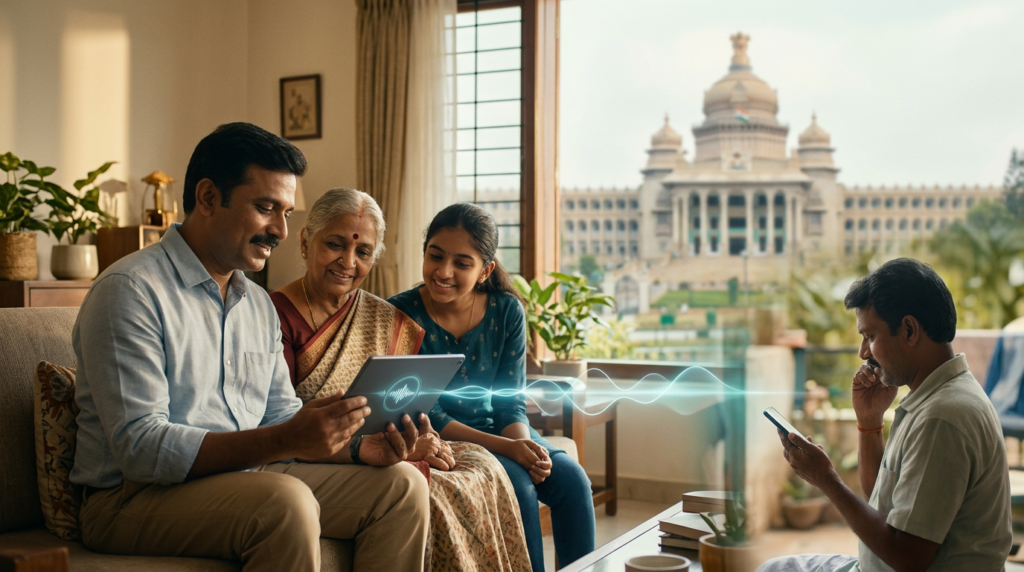
Karnataka’s new agreement with ElevenLabs starts with a more immediate ambition: helping people communicate and making public services easier to access.
On October 6, the Indian state signed a memorandum of understanding through the Karnataka Innovation and Technology Society, or KITS, to explore voice AI applications.
The collaboration covers voice restoration, citizen services and safeguards against synthetic voice misuse.
Its most personal proposal would help eligible people who have lost their ability to speak communicate through an AI-generated version of their own voice.
That is a powerful possibility, but the announcement establishes a partnership rather than a completed statewide deployment.
The next chapter will depend on implementation, eligibility decisions and carefully selected pilots.
For now, the agreement offers a practical example of where AI could make everyday life less difficult.
What the Agreement Actually Establishes
The arrangement gives Karnataka and ElevenLabs a framework for exploring several related projects rather than announcing one finished product.
Express Computer reports that the memorandum is voluntary and non-binding, with individual initiatives subject to further arrangements, applicable approvals and laws.
That detail keeps the story grounded.
A signed agreement does not mean every resident can immediately call an AI government assistant or receive a personalized synthetic voice.
The state will determine the scope, sequence and pace of implementation.
For readers, the useful distinction is between a stated commitment and an available service.
The partnership creates an opportunity to organize trials, connect institutions and identify people who could benefit.
Its eventual value will come from whether those steps produce services that people can use reliably.
The paperwork opens the door, but someone still has to build the accessible entrance and make sure it leads somewhere useful.
Voice Restoration Begins With Personal Identity
The most compelling part of the agreement concerns people who have lost their ability to speak.
Moneycontrol reports that eligible citizens could receive free lifetime licences through ElevenLabs’ One Million Voices programme.
The proposed technology would let participants communicate using a synthetic version of their own voice, including in Kannada.
Here, “restoration” describes an assistive communication capability rather than a medical reversal of the underlying condition.
The person still chooses what to express, while technology supplies an audible voice.
That distinction matters because the achievement is meaningful without turning it into a claim of recovery.
A familiar voice can carry associations that a generic digital voice cannot reproduce.
For a family, hearing a recognizable tone may make an ordinary exchange feel more personal.
For the user, the important outcome is greater control over communication, whether the message concerns work, daily needs or a perfectly deserved complaint about dinner.
Free Access Could Remove One Important Barrier
ElevenLabs describes its global One Million Voices initiative as a commitment to provide free lifetime access to voice restoration technology for one million people with permanent voice loss.
The company identifies that commitment as a $1 billion in-kind contribution.
That means access to technology, rather than a billion dollars distributed directly to participants.
The worldwide target also should not be mistaken for the number of Karnataka residents enrolled or already supported.
Those are different measures.
Free licensing could remove a significant obstacle, but a licence is only one component of successful access.
Participants may also need appropriate devices, help getting started and a convenient way to generate speech.
A thoughtful programme would assess those practical requirements alongside the availability of software.
The crucial question is whether people can use the technology comfortably in their own routines.
An account that remains unused is a statistic, while a tool used every day becomes part of someone’s life.
Local Institutions Could Make the Difference
According to Moneycontrol, KITS is engaging with the All India Institute of Speech and Hearing in Mysuru to explore implementation and identify eligible beneficiaries.
That involvement gives the proposal an institutional connection beyond the technology supplier.
It could help bridge the distance between a product demonstration and a person’s actual communication needs.
The announcement does not establish a completed assessment process, a final enrolment pathway or a timetable for every participant.
Those details remain important next steps.
Implementation should account for the fact that people use communication technology differently.
Some may want short exchanges with family, while others may need support for longer professional or social conversations.
The best starting point is to ask prospective users what they want to accomplish.
A voice that sounds convincing in a presentation is encouraging, but the more revealing test is whether its owner can use it when the presentation team has gone home.
Kannada Belongs at the Centre of the Story
The partnership’s emphasis on Kannada makes the proposal more locally relevant.
A service can be technically impressive and still fail someone who cannot comfortably use its language.
The New Indian Express reports that ElevenLabs currently supports 14 Indian languages, with plans to expand coverage to all 22 languages described in the announcement.
That planned expansion is a future goal rather than evidence that every language already has equivalent support.
Language quality also involves more than producing recognizable words.
Names, pronunciation, local expressions and switches between languages can all affect whether an interaction feels understandable.
For a government service, a misunderstood date or document requirement can cause unnecessary work.
For a personalized voice, awkward pronunciation can weaken the sense of familiarity.
Testing should therefore include the speech people actually use rather than only carefully written demonstration scripts.
The best interface should meet users in their language without making them audition for the software.
Government Services Could Become Easier to Navigate

The agreement also explores voice interfaces for citizen helplines, grievance redressal and access to government information and entitlements.
These are proposed applications, not a list of services already launched under the partnership.
Their appeal is straightforward.
A resident could potentially ask a question aloud instead of searching unfamiliar menus or navigating several pages of instructions.
Consider a hypothetical caller trying to understand which documents are required for a particular application.
A useful assistant could explain the requirements, clarify the question and direct the caller to the appropriate official channel.
However, the system would need dependable information and a clear limit on what it can decide.
Explaining a process differs from approving an application.
Good design would make those boundaries understandable without burying the caller in administrative language.
The goal is a simpler route to the correct answer, with fewer opportunities to get lost between “select an option” and “please try again.”
Grievance Handling Needs More Than a Friendly Voice
Grievance redressal deserves particular attention because a pleasant conversation does not automatically resolve a complaint.
A useful system would need to capture the issue accurately and connect it to an actual administrative process.
Imagine a resident reporting a recurring problem with a public service.
The assistant might help collect details, but someone or something must still route the complaint, record its status and communicate what happens next.
Without that connection, voice AI risks becoming an exceptionally polite waiting room.
This is an implementation challenge rather than evidence of a failure in a service that has yet to launch.
Pilot projects could examine whether voice interactions improve the completeness of submissions and reduce repeat calls.
They could also test how easily residents correct a misunderstood name, location or description.
A clear confirmation matters because an error at the beginning can follow a complaint through every later stage.
Trust Is Part of the Proposed Design
Karnataka and ElevenLabs are also working toward a platform-agnostic voice AI safety framework.
Reporting on the agreement identifies consent for voice cloning, deepfake detection, audio provenance, watermarking and protection against impersonation among the areas to examine.
These are proposed safeguards rather than proof that every risk has already been solved.
“Platform-agnostic” suggests a framework intended to address voice AI more broadly than one company’s products.
That ambition fits the problem.
A convincing synthetic recording can circulate beyond the service that created it, so protections need to consider how audio is used and shared.
For the partnership, trust has practical consequences.
People need confidence that a personalized voice remains under appropriate control.
Residents also need a way to distinguish legitimate government communication from a fabricated message.
If uncertainty makes people avoid the service, impressive voice quality will not be enough to rescue its usefulness.
Consent Should Be Easy to Understand
Personalized voice technology makes consent a central product requirement.
A participant should understand what they are authorizing and how the resulting voice may be used.
The agreement’s reported attention to consent creates space to address these questions before wider deployment.
A useful explanation would cover access, permitted uses and the process for changing or withdrawing authorization.
It should also clarify whether a helper can operate the account and what control remains with the person whose voice it represents.
These are design questions, not claims about terms already finalized for Karnataka’s programme.
The explanation needs to be understandable to the people using it.
A long document may technically contain every answer while leaving the user unsure about the most important ones.
Clarity is especially valuable when technology represents something as personal as a voice.
The ideal experience gives participants confidence that the system helps express their wishes and continues to follow them.
India Is More Than a Launch Venue
The Karnataka agreement sits within ElevenLabs’ broader expansion in India.
The New Indian Express reports that India has become the company’s second-largest market after the United States.
It also reports company figures describing more than 250 business and enterprise users and 100 million conversations on ElevenAgents over the preceding year.
Those figures concern wider commercial adoption, not the number of people helped through Karnataka’s proposed initiatives.
Reuters separately reports plans to invest hundreds of millions of dollars in India, although the company did not disclose an exact amount.
The investment is intended to support local teams, model development and Indian language work.
That commercial context helps explain why the company is seeking deeper local partnerships.
It does not establish a budget for the Karnataka agreement.
The relevant connection is capacity: a stronger local presence could support implementation, but public-service outcomes will still require their own evidence.
Everyday Conditions Will Test the Technology
A launch demonstration usually gives technology a cooperative audience and a reasonably controlled environment.
Public use is less considerate.
People call from noisy rooms, speak at different speeds, interrupt explanations and change their minds halfway through a question.
A practical pilot should explore those conditions rather than treating them as unusual exceptions.
For an assistive voice, testing should examine how readily a person can prepare a message and use it during an exchange.
For a government assistant, testing should examine whether it understands the request and preserves important details.
Users also need a recovery path when the technology gets something wrong.
The system should permit correction and provide an appropriate handover when it cannot help.
These checks can expose limitations early, when changes are easier to make.
The software does not need flawless theatrical timing, but it does need to cope when everyday life refuses to follow the script.
Success Needs Measures Beyond Conversation Counts
The strongest evaluation would distinguish activity from benefit.
A large number of conversations tells administrators that people are interacting with a system, but it does not establish that their problems are being solved.
For citizen services, useful measures could include accurate answers, completed tasks and the frequency of repeat contact.
For voice restoration, evaluation could ask whether participants use the tool regularly and whether it supports the situations they consider important.
Feedback should capture frustration as well as satisfaction.
A service may perform well overall while remaining difficult for a particular language group or type of user.
Those differences are worth investigating before expansion.
The partnership announcement does not supply a completed outcomes dataset, which is understandable at this exploratory stage.
The opportunity is to define useful measures before launch enthusiasm takes over.
A programme becomes easier to improve when its goals describe changes in people’s lives rather than impressive numbers on a slide.
A Promising Agreement With Work Ahead

Karnataka’s partnership with ElevenLabs brings together three closely related ambitions: personal communication, easier public access and stronger protection against voice misuse.
Each could address a practical problem if implementation follows the announcement’s intent.
The next milestones should make the proposal more concrete through clear eligibility rules, selected pilots and understandable access arrangements.
Public reporting on results would help distinguish a successful demonstration from a service worth expanding.
The most meaningful achievements may turn out to be ordinary moments.
Someone could participate more easily in a family conversation, while another person could get an accurate answer without navigating an unfamiliar website.
Those possibilities explain why the agreement deserves attention even before a full deployment exists.
The technology has a compelling role to play, but institutions and users will determine whether that role becomes useful.
For now, Karnataka has opened a promising conversation about AI that helps people speak and government that becomes easier to hear.
Sources
- Moneycontrol — ElevenLabs Partners With Karnataka Government to Help People Regain Their Voices With AI (moneycontrol.com)
- The New Indian Express — India Becomes ElevenLabs’ Second-Largest Market as Voice AI Push Accelerates (newindianexpress.com)
- Express Computer — Karnataka Takes a Citizen-First Step Towards Using AI for Public Good (expresscomputer.in)
- Reuters — AI Firm ElevenLabs to Invest Hundreds of Millions of Dollars in India (reuters.com)
- ElevenLabs — Impact Program (elevenlabs.io)
The Kingy Brief
Get The Kingy Brief.
AI changes, original tests and one practical thing to try. Fridays at 09:00 Vancouver time.
Free · Double opt-in · Unsubscribe anytime
Signup help and newsletter schedule
Signup form provided by Beehiiv. After submitting, check your inbox for "Confirm your subscription to The Kingy Brief" and open its confirmation link. Check Spam or Promotions if you cannot find it.
Fridays at 09:00 Vancouver time: source-checked AI changes, original tests and one practical thing to try. The weekly restart begins October 9, 2026. We skip a week when there is not enough verified material. Free. Unsubscribe anytime.