
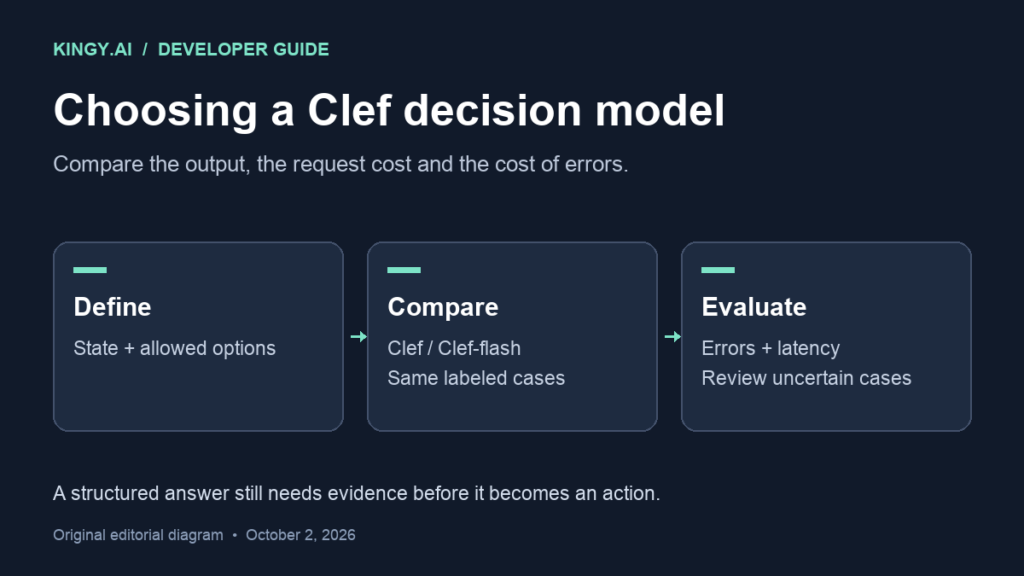
Clef-flash is cheaper, but its hosted context is smaller. Cloudflare’s October 9 update cuts the input-token rate from $0.09 to $0.038 per million tokens while reducing hosted context from 65,536 to 24,576 tokens. For a short support ticket, that can improve the economics. For a long case history, the more consequential question is whether the decision still sees the evidence it needs.
Cloudflare also introduced Clef-omni, with audio and video input, hosted access and public weights. This comparison now covers the three hosted options and the boundary cases teams should check before routing real work through the cheapest one.
Material update, October 10, 2026: The original comparison used Flash’s then-published $0.09 rate and 65,536-token hosted limit. The current tables and calculations below replace those figures following the October 9 announcement. Kingy has not run hosted correctness or latency tests. Cost examples are calculations, and the boundary-test plan is unexecuted.
Current hosted prices and limits
Clef models take a state and typed questions, then return decisions and probabilities over permitted answers. They are useful candidates for routing, classification and constrained agent decisions. They do not provide a free-form generated explanation of the kind expected from a chat model.
| Model | Workers AI identifier | Hosted context | Input price per million tokens |
|---|---|---|---|
| Clef-flash | @cf/cloudflare/clef-flash |
24,576 tokens | $0.038 |
| Clef | @cf/cloudflare/clef |
65,536 tokens | $0.24 |
| Clef-omni | @cf/cloudflare/clef-omni |
64,000 tokens | $0.15 |
Sources: the current Flash, Clef and Omni endpoint pages. The displayed dollar rates are model-input prices, not an all-in application quote. Confirm the billing currency and account conditions before purchase. Clef models do not charge output tokens.
Keep the exact context values in configuration. Omni’s page lists 64,000; Clef’s lists 65,536. “64K” is convenient shorthand, but treating those limits as identical could create a boundary error.
The price cut is 57.8%; the context reduction is 62.5%
The price calculation is ($0.09 − $0.038) / $0.09 = 57.777…%, conventionally rounded to 58%. The new Flash rate is about 42.2% of the old rate.
The hosted window calculation is (65,536 − 24,576) / 65,536 = 62.5%. The new limit is 37.5% of the old limit. Those percentages describe different quantities. A 58% lower token rate does not imply that a long ticket can be processed with the same retained context.
Cloudflare says only 0.24% of its observed requests exceeded 24K tokens. That is a vendor aggregate, not a prediction for your workload. A service handling lengthy security incidents, legal correspondence or customer histories could have a much larger share of long inputs. Count the distribution in your own permitted records before accepting that trade-off.
Worked costs for ticket volumes
For a text-only budgeting example, cost = requests × billed input tokens per request ÷ 1,000,000 × rate. The table assumes one successful request per decision and the stated total billed input length. It excludes retries, allowances, tax, storage, preprocessing, engineering and downstream actions.
| Hypothetical workload | Old Flash | Current Flash | Clef | Clef-omni |
|---|---|---|---|---|
| 100,000 decisions × 1,000 tokens | $9.00 | $3.80 | $24.00 | $15.00 |
| 1 million decisions × 1,000 tokens | $90.00 | $38.00 | $240.00 | $150.00 |
| 1 million decisions × 10,000 tokens | $900.00 | $380.00 | $2,400.00 | $1,500.00 |
| 10,000 decisions × 20,000 tokens | $18.00 | $7.60 | $48.00 | $30.00 |
The old Flash column is historical arithmetic, not a current purchasing option. These examples assume the complete input fits the selected endpoint. A 30,000-token case cannot be represented as a full-context request within hosted Flash’s 24,576-token budget. Use actual usage returned by the endpoint to reconcile a real test; do not assume that submitting a string of a given length proves all of it was retained or billed.
For one million 1,000-token decisions, the Flash price cut saves $52 compared with its former rate. Choosing current Flash instead of Clef saves $202 in model input. That $202 is also a useful error budget: in a hypothetical workflow, 202 additional mistakes costing $1 each would consume the entire saving. This calculation does not claim Flash causes those errors.
What disappears beyond 24K?
The Flash documentation says long text state is truncated to fit. Media and questions also consume the context budget. If those exceed the window, the request fails; otherwise, text state is shortened to the remaining space.
This makes 24,576 an overall limit, not a promise that 24,576 tokens of ticket text will survive. A schema and images leave less room for the case history. The documentation reviewed here does not specify which text portion is retained in every scenario, so we cannot say that it always drops the beginning or always drops the end.
Imagine a hypothetical ticket that begins with a routine billing question but later records a confirmed account compromise. A decision based on the early portion alone could be wrong even if the endpoint returns valid probabilities. Conversely, a retained closing note saying the incident was resolved could conflict with an earlier urgent report. The location of decisive evidence matters as much as the raw length.
Treat a successful HTTP response as evidence that the request returned an answer. Correctness requires the reference label and retained evidence to agree with that answer. A schema-valid response cannot establish that the complete submitted history was evaluated.
An application can choose an explicit strategy for oversized records: move to a larger-context model, retrieve the relevant evidence, create a validated summary, split the record, or send it for human review. Each changes cost or the information available. A summary can omit the deciding fact; splitting can lose relationships between events. Include those failures in the evaluation.
Hosted limits and open weights are separate
The release announcement says Flash’s downloadable weights are unchanged and trained to support a 256K context, despite the smaller hosted limit. That does not restore a 256K window to the Workers AI endpoint.
The Flash model card and Omni model card provide the self-hosting reference. Public weights let teams evaluate another deployment path, with its own hardware, memory, serving and maintenance costs. The hosted $0.038 rate is not a quote for that infrastructure, and a trained context ceiling is not evidence of acceptable quality at every length.
What Clef-omni adds
Omni is a decision model built on a 30-billion-parameter mixture-of-experts backbone with 3 billion active parameters. Its hosted interface supports text, structured state, images, audio and video. Cloudflare released its weights under Apache 2.0. It still answers typed questions rather than becoming a general spoken-response or video-generation model.
The Omni endpoint documentation lists approximate duration-based tokenization: audio around 780 tokens per minute; maximum-resolution video up to roughly 15,400 frame tokens per minute, plus audio where present. A 480p clip uses about 8,600 frame tokens per minute. Resolution therefore belongs in both the cost record and the context record.
As an illustrative calculation, one minute of audio at 780 input tokens and $0.15 per million costs about $0.000117 for that audio component. Ten thousand such clips would be about $1.17, before text, questions, retries or other inputs. One minute of maximum-resolution video with sound, using the stated approximate rates, is about 16,180 tokens and $0.002427. These estimates are not guaranteed per-file bills.
Use Omni when a decision depends on sound or synchronized video that the other hosted options do not supply in the same way. For example, an appliance assessment might need both visible operation and an unusual noise. A lower text-only rate is irrelevant if the evidence needed for the decision is absent from the request.
Keep vendor latency results in their original context
Cloudflare’s October 9 release reports improved hosted Clef serving latency. At roughly 3,400 input tokens, it reports a median falling from 616 to 305 milliseconds, and p95 from 777 to 531 milliseconds. These figures describe Clef’s serving update, not a measured speedup for Flash or a Kingy reproduction.
Earlier model-card results in our original comparison remain historical vendor evaluations. They should not be combined with the new serving table into a single ranking: request sizes, infrastructure and evaluation conditions differ. For your application, measure from request submission to a usable parsed answer, including failures and retries.
A boundary test that can expose missing evidence
Our proposed long-ticket test starts with a fixed classification schema and synthetic cases with unambiguous labels. Put the decisive fact near the beginning, middle and end in separate variants. Then add irrelevant history to approach and exceed the hosted limit, using the model’s tokenizer rather than character count to measure input.
| Case | What it checks |
|---|---|
| Short labeled controls | Whether the fixed questions and categories work before length becomes a factor. |
| Increasing length around the limit | Returned answers, failures, usage and sensitivity to evidence position. |
| Same ticket, larger question schema | Whether reduced room for text changes the decision. |
| Same ticket plus permitted media | The shared context budget and explicit failure conditions. |
| Late correction contradicting an early report | Whether the model uses the case’s current state rather than an obsolete event. |
Run Flash, Clef and Omni on comparable text-only cases without changing the labels or schema after seeing answers. Retain request hashes, model IDs, timestamps, complete responses, billed usage and client-side durations. Report correctness by length and evidence position, alongside median and p95 latency. Keep warm-up, concurrency and network location explicit.
For multimodal comparisons, add a separate set that genuinely requires audio or video. Do not score a text-only configuration as an equivalent competitor when it never receives the deciding signal. Keep production actions disconnected during the test, and inspect disagreements before defining any automatic routing threshold.
Flash’s new rate makes high-volume short decisions inexpensive. The deployment decision still depends on preserving decisive evidence and measuring the cost of mistakes. Check that boundary before replacing a working long-context path.