
What you actually get today
Gemini Omni 1.2 Flash: Available now.
| Where | Who | Status | Notes |
|---|---|---|---|
| Gemini API / Google AI Studio | Developers on the Gemini API paid tier | Available now | Google does not say every account in this group has it. General availability announced. No free API tier. Feature restrictions below. (source) |
| Google Cloud | Cloud customers using the console or enterprise API | Available now | Google does not say every account in this group has it. Cloud specifications list a global endpoint and Provisioned Throughput. (source) |
| Flow | Eligible Flow users; exact plan and credit limits not verified | Rolling out, not every account yet | Google does not say every account in this group has it. Google names Flow as a rollout surface for scene direction and conversational edits. (source) |
| Google Vids | Users with a Google account or Google Workspace subscription | Rolling out, not every account yet | Google does not say every account in this group has it. Google announces 15-second clips at no additional cost; this does not establish unlimited usage. (source) |
| Gemini app | Google AI Ultra subscribers | Rolling out, not every account yet | Google does not say every account in this group has it. Google explicitly describes a rollout of 15-second video creation. (source) |
| Google Ads | Advertisers; eligibility details not specified in the announcement | Rolling out, not every account yet | Google does not say every account in this group has it. Listed as a rollout surface; exact quotas and regions not verified. (source) |
Not included:
- Uploaded audio references and voice editing in the current Gemini API. Generated video can include native sound. (source)
- Gemini API editing or extension of uploaded videos for EEA, Switzerland and UK users; generated-clip editing remains supported. (source)
- Regions: Gemini API feature restrictions apply in the EEA, Switzerland and UK. A complete per-app country rollout is not stated in the pages checked. (source)
- Price: Standard Gemini API: $12.00 per million video-output tokens (about $0.07 per second at 720p), plus input and text-output charges. No API free tier. (source)
- Limits: Native generation/editing: 3–15 seconds. First/last-frame interpolation: up to 10 seconds. 1080p and 4K use upscaling. API reference and extension limits vary by mode. (source)
- Tested by Kingy: Not tested by Kingy.
Checked against Google’s own pages on Nov 5, 2026, 17:44 UTC. Rollouts change in the first days; this box is re-checked for 72 hours.
Google’s Gemini Omni 1.2 Flash can generate or edit video clips up to 15 seconds long, up from 10 seconds for its predecessor. The video model is generally available on the paid Gemini API tier and Google Cloud, with a lower output-token rate than Omni 1.1 Flash. Google is also rolling the model into its consumer and business products, although access and pricing differ by surface.
The longer clip is useful, but the rules around it matter. A 15-second Gemini API generation can use one short video reference; first-and-last-frame interpolation still tops out at 10 seconds. The API produces native 360p or 720p drafts, while its 1080p and 4K options upscale those drafts.
Kingy has not tested Gemini Omni 1.2 Flash. This report examines Google’s specifications and evaluations, its published prices, and two independent video leaderboards checked on November 5, 2026. No paid API calls were made.
Gemini Omni 1.2 Flash specifications
| Specification | What Google documents |
|---|---|
| Model ID | gemini-omni-1.2-flash |
| Gemini API duration | 3–15 seconds, in whole seconds; 10 seconds by default |
| First-and-last-frame interpolation | 3–10 seconds |
| Resolution | Native 360p or 720p; upscaled 1080p or 4K; 720p default |
| Aspect ratios | 16:9 and 9:16 |
| Output | Video with generated audio |
| Gemini API image references | Up to six, including up to three per character for two characters |
| Gemini API availability | Generally available on the paid tier; no free API tier listed |
Sources: Gemini API guide, API pricing and Google Cloud model specification. Specifications below are platform-specific where stated.
Fifteen seconds is a 50% longer maximum than 1.1’s 10 seconds, giving a shot more room for movement or dialogue before an editor needs a cut. It does not promise a coherent 15-second result on every prompt. Google’s announcement says fast sports, rapid script changes and complex physics remain areas for development. Its demonstrations are selected examples, not an estimate of how often a production prompt succeeds.
In the Gemini API, an explicit response-format duration takes precedence over a duration written in the prompt. A single starting image can be used for a 15-second generation, but a workflow requiring both a fixed first frame and a fixed last frame must stay within 10 seconds. That distinction can determine whether a planned transition fits in one generation.
What changes for video workflows
Google claims better consistency, reference following, camera control, dialogue and lip synchronization. Its selected lighting, weather and background edits do not establish how reliably details survive revision.
The API supports stateful edits through the Interactions API using previous_interaction_id. A team can ask for a change to an existing generated clip instead of describing the entire scene again. This depends on retaining interaction state: the API guide says store=false prevents later stateful editing. Save the prompt, reference assets, output and settings alongside each usable take, because a later request can change details the team wanted to preserve.
Reference limits change with duration. For a new 3–10-second API generation, Google allows up to three reference videos, each up to three seconds. For an 11–15-second generation, the limit is one reference video, also up to three seconds. Video references apply to new generation rather than editing or extension; the guide says sound in reference videos is ignored and multi-video reasoning is unsupported. A long shot that depends on several moving references may therefore need a shorter generation or a different workflow.
Generated audio is supported, but the public Gemini API guide says uploaded audio inputs and audio references are not currently supported, and voice editing is unavailable. An uploaded video of a person speaking cannot be extended to add dialogue under the documented rules. Multi-turn extension of generated video can generate speech. The launch and model materials discuss audio more broadly, so check the actual API surface before designing a voice-matching workflow. Google Cloud also marks standalone audio modality unsupported while listing sound generation with video. Gemini API guide; Cloud specification.
Google’s benchmark results: 1.2 versus 1.1
Google’s model-family page compares 1.2 with 1.1. These are side-by-side preference rates, not accuracy, quality-gain percentages or competitor rankings. Every row below is Google-reported; gaps are percentage points.
| Task | Google metric | 1.2 | 1.1 | Gap |
|---|---|---|---|---|
| Editing | Instruction Editing | 57% | 43% | 14 points |
| Editing | Edit Instruction Adherence | 54% | 46% | 8 points |
| Text to video | Prompt Adherence | 55% | 45% | 10 points |
| Text to video | Visual Consistency | 62% | 38% | 24 points |
| Text to video | Visual Quality | 54% | 46% | 8 points |
| Image to video | Overall Preference | 59% | 41% | 18 points |
| Image to video | Reference Identity Consistency | 60% | 40% | 20 points |
| Image to video | Visual Consistency | 57% | 43% | 14 points |
| Reference to video | Overall Preference | 63% | 37% | 26 points |
| Reference to video | Prompt Adherence | 52% | 48% | 4 points |
| Reference to video | Multi-Reference Identity Consistency | 63% | 37% | 26 points |
Google omits prompt counts, raters, evaluation dates, confidence intervals, tie handling and generation settings. The comparisons cannot establish statistical significance or a universal quality score.
Independent leaderboard context
Neither independent board reviewed by Kingy displayed a 1.2 result. Arena’s text-to-video page displayed a September 21 snapshot in which Omni 1.1 Flash ranked first at 1516 ± 15, based on 1,784 votes; the original Flash ranked second at 1513 ± 9. Their displayed rank ranges both span first through fourth, so the ordering is uncertain. The snapshot predates the new model.
On Artificial Analysis’s AA-Video-T2V v2.1 with-audio board, 1.1 ranked tenth at 1129 ± 13 from 7,666 samples when checked. Its evaluation uses blind same-prompt pairs judged by validated private evaluators. The two boards use different populations, prompts, dates and scales; their predecessor rankings cannot be combined into a universal ranking, and neither validates 1.2’s performance.
Gemini Omni 1.2 Flash pricing
Google’s standard paid-tier Gemini API rate card lists $1.50 per million input text, image or video tokens, $9 per million output text tokens including thinking, and $12 per million output video tokens. There is no free API tier listed for this model. Video output for 1.1 was $17.50 per million tokens; the new $12 rate is approximately 31.4% lower by our calculation. Google describes it as 30% lower.
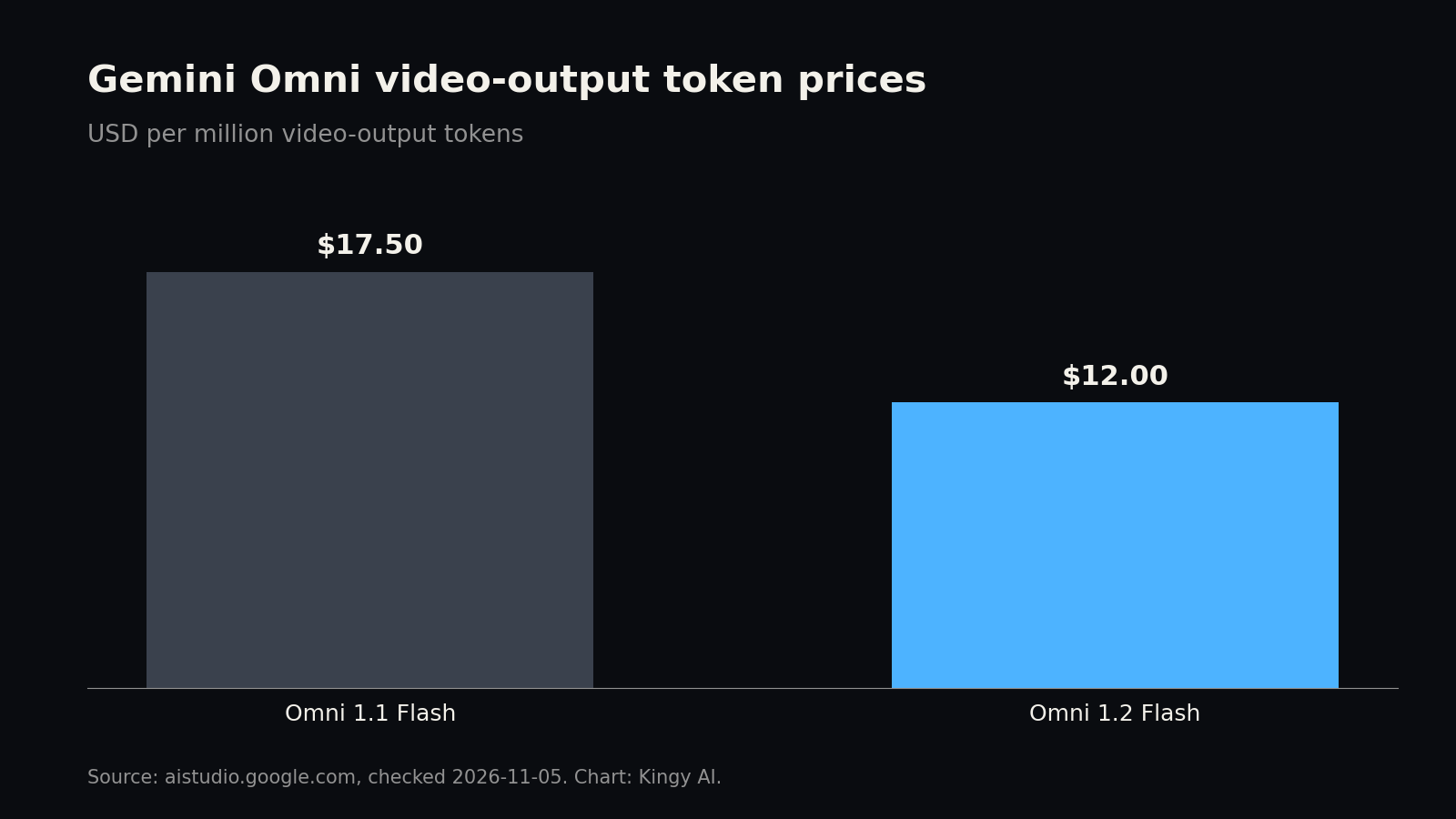
The following calculations use Google’s published video tokens per second and the $12-per-million output rate. They cover video output only. Input, text or thinking output, retries, edits, other services, taxes, storage and networking can add to the bill.
| Output resolution | Video tokens per second | 10 seconds | 15 seconds | 100 × 15 seconds |
|---|---|---|---|---|
| 360p native | 1,931 | $0.23 | $0.35 | $34.76 |
| 720p native | 5,792 | $0.70 | $1.04 | $104.26 |
| 1080p upscaled | 8,688 | $1.04 | $1.56 | $156.38 |
| 4K upscaled | 17,376 | $2.09 | $3.13 | $312.77 |
At 720p, the exact token-derived output charge is $0.069504 per second, which Google rounds to about $0.07. Multiplying the rounded figure by 15 yields $1.05; using the published token rate yields $1.04256, or about $1.04. A single pass of 100 fifteen-second 720p outputs is about $104.26 in video output. Three fully billed passes would be about $312.77, before the excluded costs. Three passes are an illustration, not an observed retry rate.
For another useful comparison, a 10-second 720p output at the old 1.1 rate works out to $1.0136. A 15-second 1.2 output at the new rate works out to $1.04256: about 2.9% more for 50% more output time. This comparison assumes the same published token rate per second and says nothing about quality, usable-take rates or total project cost. Budget against the number of candidates a real job needs, not only the price of its final clip.
API and Cloud differences to check before building
For Gemini API extension, Google documents 3–10 seconds added per turn, up to 30 seconds total, with a lookback at the last 10 seconds. Extensions append to the end; earlier details may need to be restated or supplied as references. Cloud documentation describes continuation concatenated onto the last 30 seconds, so its wording should not be treated as proof that the Gemini API has a longer total limit. Google’s older prompt guide discusses 40-second extension for 1.1; it is not a specification for 1.2.
Other limits differ by surface. The Gemini API guide lists up to six reference images; the Cloud specification lists a maximum of ten images per prompt. Cloud documents a 131,072-token input limit and 260,640-token output limit, as well as a global endpoint and Provisioned Throughput. The Gemini API guide says Provisioned Throughput is unavailable there. Cloud lists temperature and top-p controls, while the Gemini API guide says those parameters are unsupported on its surface. Check the documentation for the endpoint you intend to use instead of combining the largest limits from each page.
For Gemini API users in the European Economic Area, Switzerland and the United Kingdom, uploading video for editing or extension is unavailable, although editing or extending model-generated clips is supported. The guide also restricts uploading or editing images containing minors in those regions and restricts certain recognizable people. English is fully supported; other languages have not been evaluated according to the guide, so results may vary.
Migration deadline: Google says the 1.1 alias will automatically route to 1.2 beginning December 3, 2026, at 1.2 rates. An application can therefore change behavior without a code change. Before that transition, run representative prompts through the new model, check reference and duration constraints, and compare usable outputs and costs. Google’s Cloud page gives November 5, 2027 or later as the support retirement horizon for 1.2; that is not a precise shutdown date or a Gemini API retirement promise.
Limits
Kingy has not generated clips, measured latency or tested prompt adherence, identity retention, speech, safety or cost on this model. Google has not supplied a reproducible benchmark method for the charts examined here, and the two independent boards we checked did not show a 1.2 score. App quotas, credits and country-by-country availability were not established in the sources reviewed.
Google documents an invisible SynthID watermark in generated video. A watermark can help with provenance, but it does not establish that a scene is true or guarantee detection in every circumstance. Google’s 1.2 model card links much of its background to an older Flash model card; that earlier document is not a new 1.2 benchmark report. Google has not published a parameter count, training cutoff or full dataset size in the sources examined.
For teams considering the model, a small evaluation should include long and short clips, the actual references and languages required, and several rounds of the edits their workflow depends on. Record all billed attempts and have reviewers score usable takes. That will answer a production question the list price and Google’s selected demos cannot: how much a finished, acceptable shot costs for your work.
Sources
- Google: Gemini Omni 1.2 Flash announcement
- Google: Gemini API Omni guide and pricing
- Google Cloud: Omni 1.2 Flash model specification
- Google DeepMind: Gemini Omni model page and evaluations and model card
- Arena: text-to-video leaderboard and Artificial Analysis: text-to-video leaderboard
Revision log
November 5, 2026: Initial publication. Specifications, pricing and leaderboard pages checked on November 5.
The Kingy Brief
Get the free AI price sheet.
25 AI plans and models on one page, from official pricing pages, updated every month. Free when you join The Kingy Brief: AI changes, original tests and one practical thing to try, Fridays at 09:00 Vancouver time.
Free · Double opt-in · Unsubscribe anytime
Signup help and newsletter schedule
After submitting, check your inbox for "Confirm your subscription to The Kingy Brief" and open its confirmation link. Your price sheet download is on the page that opens. Check Spam or Promotions if you cannot find it.
Fridays at 09:00 Vancouver time: source-checked AI changes, original tests and one practical thing to try. We skip a week when there is not enough verified material. Free. Unsubscribe anytime.