OpenClaw Enterprise arrived on September 29 with a practical proposition: give organizations a common way to deploy and govern persistent agents on their own infrastructure. The project is free and open source, but its announcement describes it as work in progress before version 1.0, suitable today for internal pilots. Source: the OpenClaw announcement.
That is the useful starting point for an evaluation. A team can inspect and try the control plane now, while keeping its production rollout conditional on the controls it can actually demonstrate.
This article reviews the announcement, repository, and setup documentation. We have not deployed OpenClaw Enterprise or validated its security boundaries in a running cluster.
What the control plane manages
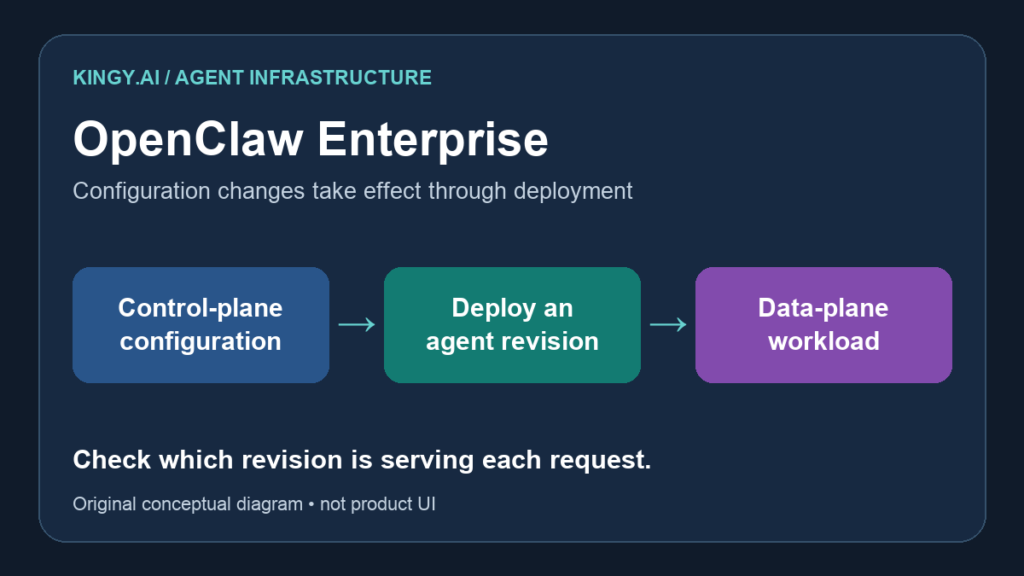
The project’s concepts guide separates deployment management from agent execution. OpenClaw Control Plane, or OCC, authorizes resource changes and provisions workloads. Agent gateways and harnesses handle conversations, models, and tools in the data plane.
The distinction helps explain the product. A model answers a request. A harness organizes the work around that model. A control plane manages the deployed workloads and their configuration. You need to evaluate each layer against its own job.
The guide also describes immutable AgentRevisions. Editing an Agent or Configuration does not update its running revision; another deployment applies the change. That is a detail operators should test early. A console showing the latest settings does not, by itself, prove those settings are active in the workload receiving traffic.
Write the desired revision and active revision into the pilot record. After a change, check the deployed behavior and identify the revision that produced it. That makes a later failure easier to reproduce.
Free software still needs an operating budget
The repository identifies the license as MIT, with third-party components retaining their own licenses. It includes controller, identity, audit, resource-lifecycle and CLI components. This is an inspectable platform, rather than a subscription that supplies all the infrastructure behind it.
Your budget still needs compute, storage, model access, maintenance, and an owner who handles incidents. Free access to the code does not remove those responsibilities. No dollar estimate is defensible without the deployment size and workload.
Red Hat’s September 29 contribution announcement places the control plane alongside agent sandboxing, AI gateways, and tracing and evaluation. Red Hat says it is contributing engineers and expanding its work on the project. Those are useful signs of infrastructure investment, not a substitute for checking your chosen deployment.
The project’s own announcement emphasizes multi-tenancy, security boundaries, auditability, and interchangeable harness, model, and sandbox components. It also says a reference architecture explaining the protections will follow. Evaluate those as stated design goals and evolving implementation, rather than assume every promised protection is already proven in your environment. Announcement.
The local setup trap worth catching
There is a concrete difference between opening a control-plane preview and deploying an agent. The current README says the default occ dev up starts a Compose preview that cannot deploy Agents. Its runnable local path explicitly selects the Kubernetes profile.
The local quickstart runs OCC, PostgreSQL, and agent workloads in a k3d cluster. It requires container tooling, Kubernetes utilities, Helm, the pinned Go and pnpm versions, and Node.js 24 or newer. The guide describes that setup as development use with loopback addresses.
For an evaluation, follow the current quickstart rather than lift a short command block from a social post. Record the repository revision and selected profile. Confirm that an agent can actually be deployed and receive a request before declaring setup complete.
Keep development credentials and synthetic data separate from production accounts. A successful local demonstration establishes that the selected path works on that machine. It does not establish a supported production architecture, availability target, or recovery procedure.
What an internal pilot should prove
Choose one narrow job, such as investigating a synthetic failed build and preparing a proposed fix for review. Give the pilot a small test repository and the minimum tool access needed for that job. Avoid mixing many workflows into the first evaluation; otherwise a failure becomes difficult to attribute.
Use two test users or teams. Give each different permitted resources, then try to access the other team’s synthetic record from the first agent. Retain the denial and audit evidence. This is a proposed boundary test, not a report that OpenClaw Enterprise has passed it.
Test a configuration change while a workload is running. Establish which revision serves the next request. Then exercise a rollback and confirm that the expected behavior returns. A revision identifier is useful only when it can be connected to observed execution.
Finally, remove a permission and stop a workload during a deliberately long task. Check what the agent can still do, what the operator can see, and whether work resumes after a restart. Write down unresolved behavior before granting additional authority.
Our n8n Agents article covers a different deployment choice: an agent selecting among bounded workflows. Our NVIDIA agent-safety explainer examines the runtime boundary. Those layers can inform an evaluation, but neither article establishes OpenClaw Enterprise’s behavior.
Who should investigate it now
OpenClaw Enterprise is worth a pilot for teams already responsible for container infrastructure and looking for a common way to manage persistent agents. A team seeking a fully operated service should first account for the infrastructure and maintenance it would own.
The next useful result is a small, reproducible deployment record: selected source revision, active agent revision, scoped permissions, a successful task, a denied action, and a recovery attempt. Bring that evidence to the production decision instead of treating the word “Enterprise” as the acceptance test.
The Kingy Brief
Get the next Kingy Brief.
Source-checked AI changes, original tests and one practical thing to try.
Free · Choose your subjects · Double opt-in · Unsubscribe anytime