The news before liftoff
A satellite can take a picture of Earth in seconds. Getting that picture to someone who can use it is another matter.
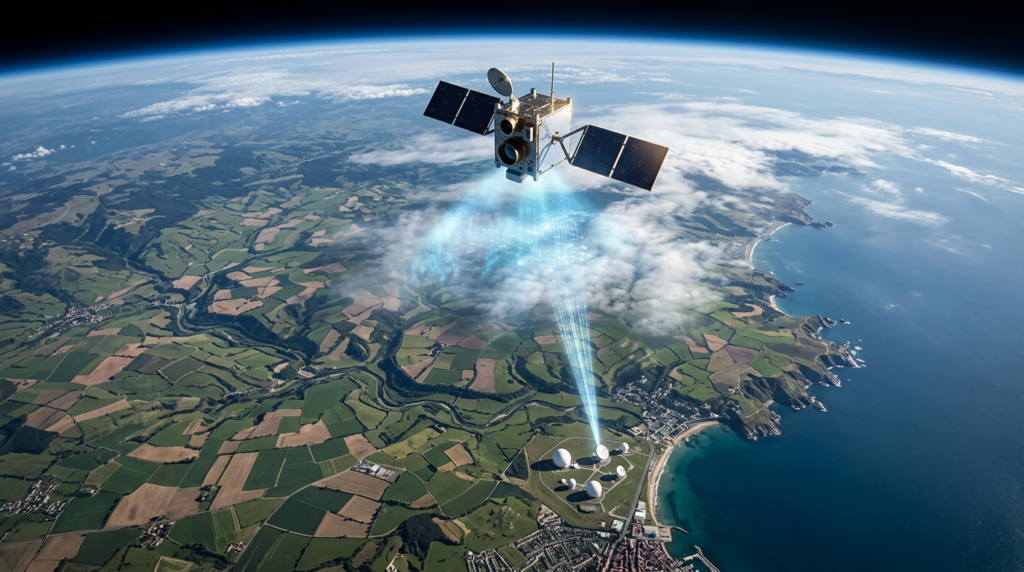
India’s TakeMe2Space wants to shorten that trip. The Hyderabad startup is preparing MOI-1A, a satellite designed to run customer software and AI models in orbit. Instead of sending every raw image to Earth for analysis, it aims to process selected data onboard and transmit the useful result.
On September 28, the company told Reuters it had signed 23 customers for the mission. They include geographic information system companies and educational institutions. Founder and CEO Ronak Samantray said commercial users also work in agriculture, mining, supply chains and insurance.
MOI-1A is scheduled to ride a SpaceX Falcon 9 on October 1, 2026. That is a plan, not a completed launch. The satellite still has to reach orbit, begin operating and demonstrate that its customer workloads work as intended.
Even at this stage, the news offers a neat question: what happens when a satellite sends an answer instead of a mountain of pictures?
Why Earth gets the data late
Earth-observation satellites collect valuable information. Farmers may want to assess crop conditions. Insurers may need a view of damage after a storm. Mapping companies track how places change. The raw images can serve all of them, but they first need to travel from orbit to a ground station.
That journey has limits. A satellite can collect data while it circles the planet, yet it can only transmit as much as its communications equipment and ground access allow. After the data arrives, someone still has to store it, sort it and run analysis.
TakeMe2Space’s idea is to move part of that work upstairs. A customer could upload a model to MOI-1A. As the satellite passes over a chosen area, the model could analyze data there and return a smaller result.
Picture a request for a flood map. A traditional workflow might send down imagery for a computer on Earth to inspect. The proposed orbital workflow would identify relevant information before transmission. The exact data sent would depend on the customer’s task and how the system performs in flight.
It sounds simple when reduced to one sentence. Building a dependable computer that can do it in space is considerably less simple.
Meet MOI-1A
MOI-1A is a small spacecraft, not a server building with solar panels attached. Reuters described it as weighing less than 50 kilograms and carrying Nvidia Orin NX edge-computing processors. The company’s technology page describes its onboard “AI Cube” around an Nvidia Jetson Orin NX and lists 2 terabytes of storage.
The company also describes a nine-band multispectral imager. Multispectral imaging records information across several portions of the light spectrum. That can give an analysis model more to work with than an ordinary color photograph.
The parts have to work as a team. The imager gathers data. The onboard processor runs the assigned task. Storage holds information while the spacecraft operates. The communications system sends selected output home.
TakeMe2Space publishes further specifications, including a claimed 117 TOPS of compute performance. Those figures describe the planned hardware. They do not yet show how quickly customer applications will run in orbit or how much useful data the satellite will deliver.
That distinction matters. A satellite’s specification sheet tells us what its builders intend to fly. The mission will show what it can actually do.
Twenty-three customers, many different questions
The customer count is the clearest commercial development in this story. TakeMe2Space said it has signed 23 customers ahead of launch. Reuters reported that US space-data analytics company Little Place Labs is among them.
The mix helps explain the appeal of shared orbital computing. One organization may care about farmland. Another may want geographic measurements. An insurer may need information about an area after severe weather. They would ask different questions of data gathered from space.
TakeMe2Space says customers will be able to upload containerized AI models. In plain language, a container packages software so it can run in a defined computing environment. The aim is to let different customers bring their own applications to the same spacecraft.
Signing customers is an important step. It is also a different milestone from delivering paid, repeatable results after launch. The company has not yet demonstrated MOI-1A’s full commercial service in orbit. We do not know from the available reporting how much each customer will use, what every customer is paying, or which applications will perform best.
For now, the 23 agreements show interest in trying the approach. The orbital performance test comes next.
Sending answers instead of every image
Samantray put the business case to Reuters in terms of data costs. Some customers pay to bring large amounts of raw satellite data to Earth and then pay again to compute on it. If orbital processing cuts enough of that transfer, the savings could help offset the cost of computing in space.
The word could carries a lot of weight. Whether the calculation works will depend on the size of the original data, the task performed onboard, the result transmitted and the price of the service.
Some jobs lend themselves to a compact answer. A model might flag a location for closer inspection or produce a classification that takes far less room than its source images. Other customers may still need full-resolution imagery for their own analysis or records. Processing in orbit will not erase the need to download raw data in every case.
TakeMe2Space’s website describes a pipeline that captures imagery, processes it, filters for useful output and downlinks selected information. That is the proposed workflow. The company also advertises substantial cost reductions compared with traditional approaches, but those are company claims, not results independently established for MOI-1A’s customer missions.
A useful test is approaching: after launch, how much data comes down, how useful is it, and what does the entire job cost?
A satellite people can program
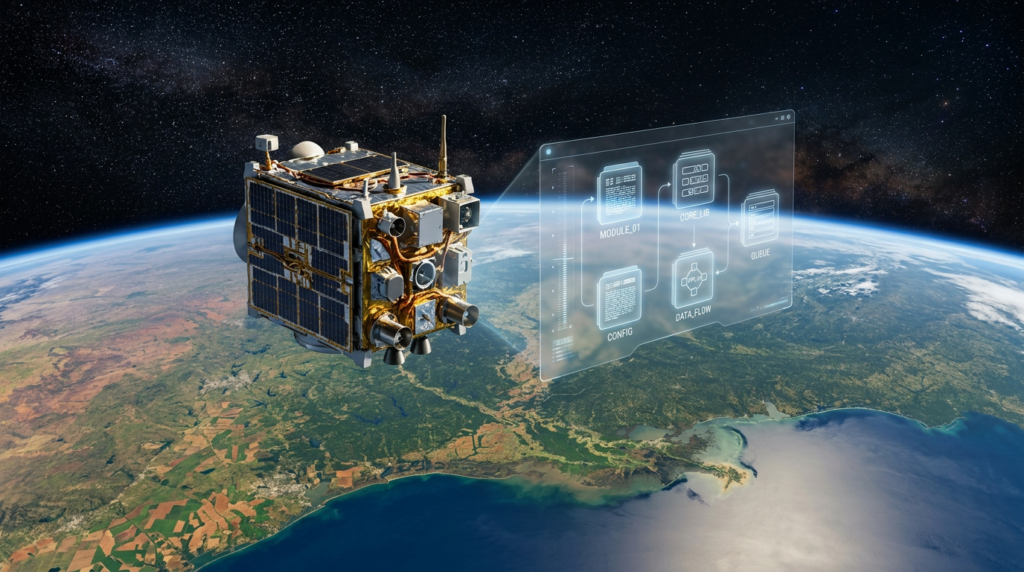
The most interesting part of MOI-1A may be its flexibility. Its pitch goes beyond taking pictures for one predefined purpose. Customers could upload software suited to their own questions.
That changes what a small satellite might be sold to do. A spacecraft with onboard computing can, in principle, host different analysis tasks over its mission life. If one customer wants a mapping application and another wants a different image-processing model, the operator does not necessarily need to build a dedicated satellite for each.
The design raises practical questions, too. Customers will need a way to upload applications, allocate limited computing resources and receive results. The operator will need to manage power, storage and competing tasks on a spacecraft that cannot simply plug in another server.
The company calls its customer-facing orbital computing offering OrbitLab. Reuters reported that users will be able to send containerized models to the satellite. The launch will test the hardware foundation beneath that service.
This is why MOI-1A is best understood as a step toward an orbital computing business. It has customers waiting to use it, but the full service still needs an operating satellite.
Why the Nvidia chip matters
Putting an Nvidia processor aboard MOI-1A makes the concept easier to picture. It is a compact computer doing work close to where the data is collected. Engineers call that edge computing. Here, the “edge” happens to be in orbit.
On Earth, edge computing can mean analyzing information near a camera or a factory machine instead of sending everything to a distant data center. The same broad logic applies to MOI-1A: reduce the amount that must travel before a useful result emerges.
Space makes the engineering harder. Power is limited. Heat needs careful management. Electronic components face radiation. Operators also have to plan around communication windows and a machine they cannot visit for a quick repair.
TakeMe2Space says it builds much of its satellite system itself, including the spacecraft bus, subsystems, AI Cube and imager. Reuters reported that it sources some components, including chips, externally. The company says its own protective coating helps terrestrial-grade electronics tolerate the low-Earth-orbit environment.
Those design choices explain how TakeMe2Space hopes to use familiar computing technology beyond Earth. MOI-1A’s flight will provide the more demanding evidence: whether the assembled system works together reliably.
A comeback after a launch failure
MOI-1A also carries a recent setback in its backstory.
TakeMe2Space’s MOI-TD technology demonstration launched in December 2024. The company says that mission completed more than 20 experiments in low Earth orbit, including tests of onboard AI inference and data handling.
Its next spacecraft, MOI-1, did not reach its intended mission. It was lost during a January 2026 launch after an anomaly in the launch vehicle’s third stage. TakeMe2Space says its satellite systems showed no fault up to the point of loss.
MOI-1A is the next planned attempt. Reuters describes the October flight as a step following that setback; the company’s mission timeline lists its date and launch location as tentative.
There is a human rhythm to this, familiar well beyond the space industry. A team builds a machine, loses the chance to operate it because the ride fails, then prepares another. The experience does not guarantee success the second time. It does help explain why the upcoming launch matters to TakeMe2Space as more than a product announcement.
This time, customers are waiting alongside the engineers.
The October date is a target
Reports published on September 28 name October 1 as the planned date for MOI-1A’s SpaceX rideshare launch. TakeMe2Space’s own mission page uses the broader description October 2026 and marks the schedule as tentative.
Both details belong in the story. The precise date tells readers what the company was aiming for when the reports appeared. The tentative listing reminds us that launch plans can change.
A successful liftoff would only begin the next phase. The spacecraft would still need to deploy, communicate and complete its initial checks. Its onboard computing system would then have to run the customer tasks that give the mission its purpose.
Those steps may sound less cinematic than a rocket launch. For the 23 customers, they are the main event. They need results they can use, sent through a service they can depend on.
So the date to watch is October 1. The bigger question will take longer to answer: once MOI-1A is operating, can it make orbital AI processing practical for customers?
There is a bigger mission on the drawing board
MOI-1A is not the largest machine TakeMe2Space has described. In a separate interview with the Times of India, Samantray outlined a planned 2028 mission involving two larger satellites designed to share work and data with each other.
That future project is distinct from the satellite scheduled for October 2026. The proposed pair would test a more ambitious idea: linked spacecraft behaving as parts of a distributed orbital computer.
It is tempting to jump straight from one small satellite to “data centers in space.” For MOI-1A, that label can mislead. Reuters reported that the spacecraft has a power budget of about 150 watts, a very different scale from a ground data center. It is more useful to think of the upcoming mission as onboard edge computing.
The longer-term plan shows where the company wants to go. MOI-1A shows what it is trying to prove first: that customers can send their own software into orbit, process useful information there and get the output back.
The path between those two points includes technical performance, reliability and cost. None can be settled by an announcement alone.
What success would look like
A successful MOI-1A mission would mean more than a satellite appearing on a tracking map.
First, the spacecraft must operate. Then its computing hardware must run customer applications under real orbital conditions. The system must collect relevant data, process it correctly and deliver results to the right users. Finally, the service has to make sense economically.
That last test is easy to overlook. A satellite may produce an impressive demonstration yet struggle to beat a familiar workflow that sends data to Earth. TakeMe2Space’s central bet is that, for certain jobs, avoiding unnecessary downloads creates enough value to make onboard processing worthwhile.
The customers give the company a chance to test that bet across more than one kind of work. Mapping, agriculture and insurance do not all need identical outputs. If MOI-1A handles different tasks well, that flexibility could become one of its strongest arguments.
We should also expect uneven results. One application may suit the satellite’s hardware and communications limits better than another. That would be useful information, not a failure of the whole idea.
An answer worth waiting for
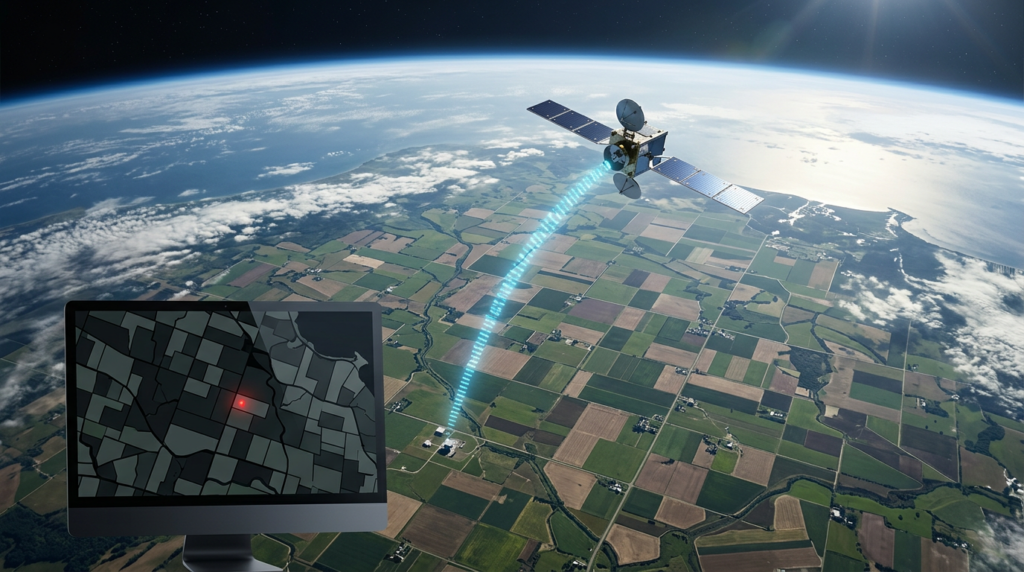
TakeMe2Space has assembled several ingredients that make MOI-1A worth following: a planned October launch, onboard AI hardware, a way for customers to upload applications and 23 signed customers.
The attractive idea is wonderfully compact. See something from orbit. Analyze it there. Send home what matters.
Now comes the difficult part: doing it repeatedly, accurately and at a price customers will accept. MOI-1A has not launched as of this article, and the announced customer count is not proof that the service already works at commercial scale.
Still, the coming mission gives the concept a real test. If its models run well and its outputs prove useful, a small spacecraft could do more than collect data for computers on Earth. It could become part of the computing workflow itself.
The rocket will draw the crowd. The answers coming back from orbit will tell the story.
Sources
- Reuters reporting carried by Moneycontrol (www.moneycontrol.com)
- Times of India interview on MOI-1A and the separate 2028 plan (The Times of India)
- SatNews coverage of MOI-1A (SatNews)
- TakeMe2Space technology and spacecraft details (The LEO satellite infrastructure)
- TakeMe2Space mission timeline (TakeMe2Space)
- TakeMe2Space OrbitLab (tm2.space)
The Kingy Brief
Get the next Kingy Brief.
Source-checked AI changes, original tests and one practical thing to try.
Free · Choose your subjects · Double opt-in · Unsubscribe anytime