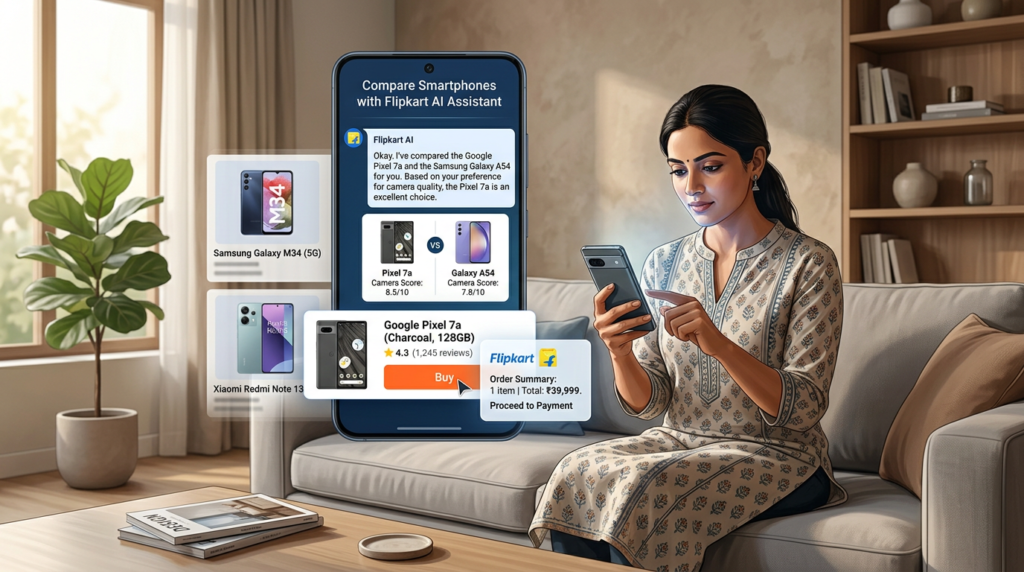
Some shoppers can move from an AI product listing to a Flipkart checkout without leaving Gemini or Google’s AI Mode. The small test raises a much bigger question: who owns the online shopping journey when it begins with an AI assistant?
A Buy Button Appears in the Conversation
Imagine asking an AI assistant which phone suits your budget. It compares a few options, answers a question about battery life and shows you a listing. Then, beside one product, you see a Buy button.
That is the experience Google is testing with Flipkart in India. According to TechCrunch’s September 26 report, some users can select a Flipkart product in Gemini or Google Search’s AI Mode and proceed to a Flipkart-branded checkout without leaving the AI interface.
The experiment is narrow. It covers certain users and selected products, including smartphones, electronics and mobile accessories. Other shoppers still see ordinary Flipkart listings without an in-interface purchase option.
Even at that scale, the change is significant. Search and AI assistants already help people decide what to buy. Google is now testing whether the same experience can carry a shopper closer to completing the order. The question for customers, retailers and Google is how useful that extra step proves to be.
What the Test Actually Does
The reported flow starts with product listings shown in Gemini or AI Mode. For eligible Flipkart items, a shopper in the test sees a Buy button. Selecting it opens a Flipkart checkout flow within Google’s AI interface.
That description contains two important boundaries. First, the feature is available only to some people and products. A person opening Gemini in India today should not assume the button will appear. Second, the checkout carries Flipkart branding. TechCrunch says the technology powering this particular test has not been disclosed.
Google did not announce a full launch when asked about the experiment. A spokesperson told TechCrunch that the company regularly tests ways to help people find and connect with businesses, and offered no additional details. Flipkart did not immediately respond to the publication’s request for comment.
A person familiar with the plans told TechCrunch that Google intends to expand the experience later in October. That is a reported plan, rather than a confirmed public rollout date. For now, this is an observed test with a limited catalogue and a great deal still to learn.
Why the Last Step Matters
Online shopping often starts long before someone visits a retailer. A buyer may search for a phone, compare specifications, read opinions and ask a friend for advice. By the time they reach checkout, much of the decision has already been made elsewhere.
AI assistants bring more of that research into one conversation. A shopper can describe what they need, narrow the options and ask follow-up questions without repeatedly starting a new search. Adding a purchase route means the conversation can also become part of the transaction.
That could save a few steps. It could also make the assistant’s recommendations more consequential. If two products are equally appealing but only one has a convenient Buy button, the difference in checkout experience may affect which one the shopper chooses. That is an inference about the possible effect of the design; the current reporting does not show whether the test has changed sales or customer behavior.
The small button therefore represents a large commercial question. As AI helps people decide what to buy, how should the path from recommendation to retailer work?
A Phone Purchase Makes a Useful Example
The early catalogue includes smartphones and related electronics. Those are sensible categories for understanding the experiment because shoppers often have several specific questions before buying.
Someone comparing two phones may want to know whether one has better battery life, how much storage they need or which model fits a particular budget. An assistant can help organize that research. If an eligible Flipkart listing appears during the conversation, the Buy button gives the shopper a route to checkout.
That does not mean Gemini has completed the shopping job on the buyer’s behalf. The buyer still needs to assess the product, price, seller terms and final order. Nor does the test establish that Google’s AI will consistently recommend the best purchase. Those outcomes would require evidence from real use.
What the example shows is the appeal of joining two moments that are usually separate: deciding and buying. The fewer times a shopper has to reconstruct their choice while moving between services, the smoother the journey may feel. Whether the new flow improves it is what a test can begin to reveal.
Gemini and AI Mode Offer Two Entrances
The test appears in both Gemini, Google’s AI assistant, and AI Mode within Google Search. That gives Google two ways to encounter a shopper.
One person may open Gemini deliberately and ask for help choosing a device. Another may begin in Search, enter a shopping question and continue exploring in AI Mode. In either case, the user is already engaged in product research when a listing appears.
For a retailer, that placement could be valuable. A listing presented during a relevant conversation reaches a shopper who has expressed a need. A purchase route beside it may shorten the distance between interest and an order. For Google, the test offers a way to see whether its AI products can support more of the shopping process.
There are unknowns. The reporting does not establish how often the Buy button appears, how products qualify or how much of a purchase users complete after selecting it. Those details would be needed before anyone could judge its commercial impact. The confirmed news is the limited experience itself.
Why Flipkart Is the Partner to Watch
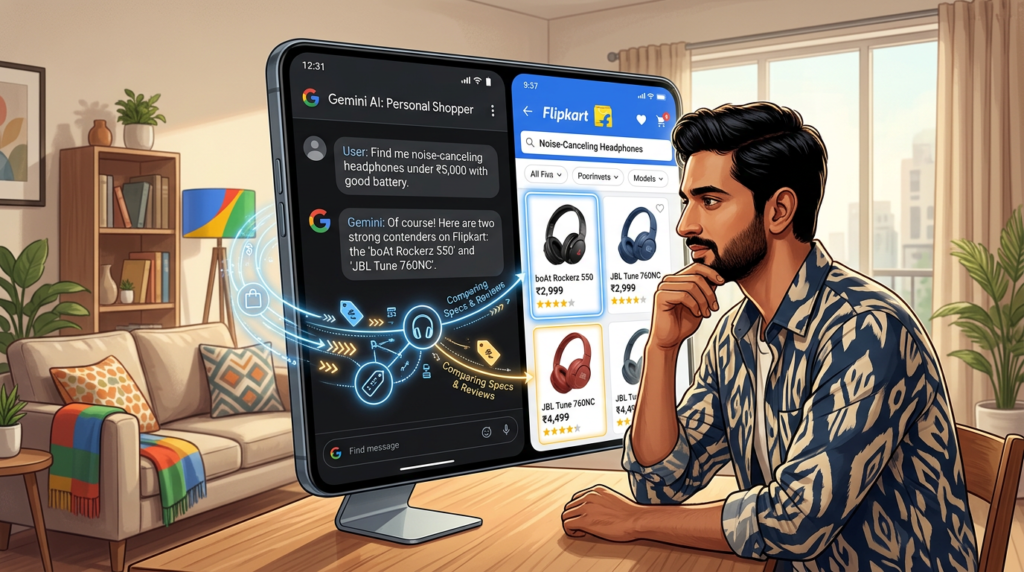
Flipkart is one of India’s major online retailers and is owned by Walmart. Google has a financial connection as well: TechCrunch reports that it invested about $350 million in Flipkart in 2024, taking a minority stake.
That relationship gives the companies an existing basis for working together, although neither has publicly explained the arrangements behind this checkout test. Google had previously identified Flipkart as a merchant partner for AI shopping experiences in India, according to TechCrunch. The newly observed Buy button shows what one such experience can look like for selected shoppers.
The partnership also makes the design worth examining closely. Shoppers want useful choices, retailers want access to customers, and Google operates the interface where a recommendation may appear. Those interests can align, but the details of how listings are displayed matter.
Nothing in the available reporting establishes that Flipkart products receive preference in Gemini or AI Mode. The test does show a difference in purchasing capability among some listings. That is a concrete starting point for questions about how wider participation might work.
Other Listings Still Appear
In the experience viewed by TechCrunch, products from other retailers—including Amazon—appeared alongside Flipkart items. Those rival listings did not show the same in-interface Buy option.
It would be easy to read too much into that observation. The report describes a limited test; it does not establish Google’s long-term rules for retailer access. A different retailer’s missing button in this trial does not prove it will be excluded from future shopping features.
Still, the distinction explains why retailers will pay attention. A product listing helps a shopper discover an option. A listing with an immediate route to checkout may be more convenient at the moment the shopper is ready to act. If Google expands the experience, merchants will want to know what it takes to offer a comparable path.
Shoppers will have questions of their own. Can they compare the full price and delivery terms before committing? Is it obvious which retailer handles the order? The available reporting describes the button and checkout flow, but does not answer every question about the finished customer experience.
Is This Google’s Commerce Protocol at Work?
Google has been developing a broader approach to AI shopping, including a standard called the Universal Commerce Protocol, or UCP. It is intended to help AI services and retailers work together across stages of a purchase.
The Flipkart test should not automatically be presented as a UCP launch. TechCrunch notes that the observed checkout differs from the Google-hosted experience the company had previously described. Here, selecting Buy brings up a Flipkart-branded flow. The report says it is unclear which technology powers this integration.
That may sound like a technical distinction, but it affects the story. One can accurately say Google is testing a purchase path inside its AI products. One cannot yet say exactly how the companies connect their systems for this test, or what framework another retailer would need to use to join it.
For an eventual wider rollout, those details will matter. A shopping feature must do more than recommend an item. It must hand the buyer, product and order information through a process that works reliably for both the shopper and the merchant.
The Retailer’s Place in an AI Checkout
The Flipkart branding offers a visible reminder that a retailer still sits behind the order. The shopper may begin in Google’s interface, but the test leads into a Flipkart checkout flow.
That arrangement opens several practical questions. Who presents the final price? Where does a customer check the delivery estimate? If something goes wrong, which service explains the next step? The answers may be apparent to people inside the trial, but the published account does not provide a complete account of every screen and responsibility.
These are ordinary shopping concerns, not obscure AI puzzles. Buyers already expect to see charges clearly and know whom to contact about an order. Moving checkout into an AI experience should make those basics easier to follow, not harder.
Retailers have an interest in the answers as well. They want people to discover products through useful new channels while retaining a clear relationship with customers who buy from them. The Flipkart experiment gives Google and its partner a chance to see how that relationship feels when the customer starts in a conversation.
Why Test This in India?
India provides a large and fiercely competitive setting for an online shopping experiment. Flipkart and Amazon compete for customers there, and major festive shopping periods give retailers a reason to improve how people discover and buy products.
TechCrunch reports that a broader expansion is planned for later in October, ahead of that season, citing a person familiar with the matter. Google has not supplied a public launch date or described the number of users it expects to include. The timing is therefore best understood as a reported intention.
A limited test before a busy shopping period can help a company observe everyday questions: Does a buyer notice the button? Can they complete checkout comfortably? Do they understand which store is fulfilling the order? The published reporting does not provide results for any of those measures.
India also matters because a successful feature there would show that AI shopping can work in a market with substantial scale and strong existing retailers. Success cannot be assumed from the test’s location. The current evidence shows that Google has chosen India for an early experiment with Flipkart.
The Race to Turn AI Answers Into Actions
Google is part of a broader effort by AI companies to make assistants useful beyond producing answers. Shopping offers an obvious opportunity: a user states a need, considers options and may then want to buy one.
But there are many ways to connect those steps. An assistant could send someone to a retailer’s website, open a retailer’s checkout within its own interface or use a more automated process with the buyer’s approval. The Flipkart trial demonstrates one reported design. It does not settle which approach shoppers or merchants will prefer.
Convenience will be only part of the contest. An AI shopping experience needs to present relevant products accurately, make the seller clear and give buyers confidence about what happens after they press Buy. If it saves a tap but makes those details confusing, the advantage may disappear.
For Google, the immediate test is also a test of its role. It has long helped people find places to shop. Gemini and AI Mode give it a chance to remain present further into the decision. How far shoppers want an assistant involved is still an open question.
What Would Make the Test a Bigger Story?

The most important next development would be a confirmed expansion: more users, more products or more retailers able to offer an in-interface purchase path. Until then, the feature remains a limited trial.
Details about how participating merchants join would also clarify its significance. So would a fuller explanation of the checkout technology and the roles Google and Flipkart play when an order is placed. Those details could show whether this is a design that many retailers can adopt or an experience built for a narrower partnership.
Then come the results. Do shoppers use it? Does it help them make informed decisions? Are they comfortable completing an order while staying inside an AI interface? Google has not released answers to those questions for this test.
For now, the story is compelling precisely because the action is small and the implications are large. A Buy button has appeared where people ask questions. If the experience expands, the competition to help shoppers choose may become a competition to help them complete the purchase, too.
Sources
- TechCrunch — “Google tests buying from Walmart-owned Flipkart through Gemini and AI Mode in India” — September 26, 2026. Original reporting, based on an observed experience, people familiar with the test and a response from Google.
- The Indian Express — “Google tests Flipkart ‘Buy’ option within Gemini, AI Mode in India” — September 27, 2026. Follow-up coverage citing TechCrunch.
- NewsBytes — “Google tests Flipkart purchases directly through Gemini and AI Mode” — September 27, 2026. Follow-up coverage citing the original report.
The Kingy Brief
Get the next Kingy Brief.
Source-checked AI changes, original tests and one practical thing to try.
Free · Choose your subjects · Double opt-in · Unsubscribe anytime