Published September 22, 2026. Prices are in US dollars. This is a source-based comparison of published evaluations and documentation, not a claim that Kingy AI ran these benchmarks. Cost scenarios below are calculations, not measured customer workloads.
GPT-6 Sol is the cheaper starting point for high-volume coding and agent workflows. Claude Opus 5.5 has the stronger launch-day results across the independent benchmark set examined here. The buying decision gets more interesting when you change the reasoning setting: Opus at medium effort can beat Sol at maximum effort while costing only moderately more per benchmark task.
That is the useful comparison. A model name without its effort setting, tools, fallback policy and bill leaves out too much.
Both models arrived on September 22, 2026. OpenAI’s official name is GPT-6 Sol, with API ID gpt-6-sol; Anthropic’s is Claude Opus 5.5, with ID claude-opus-5-5. Sol is available in the API, ChatGPT Work and Codex, with launch-day rollout across eligible paid plans; OpenAI says it is not yet available in ordinary Chat. Opus is available through Claude and its developer platforms. OpenAI launch announcement, Anthropic launch announcement.
For a purchasing decision today, I would put Sol on the shortlist for economical routine work and Opus at medium effort on the shortlist for demanding work. Reserve maximum effort for tasks where it demonstrably improves the result. The evidence behind that recommendation follows, including the cases where the apparent price advantage reverses.
The basic specifications put these models in a similar class. Both accept text and images and produce text. Neither of these particular model endpoints is a native audio or video generator. A surrounding app can add speech, image generation or other tools; that does not change the endpoint’s native modalities.
| Specification | GPT-6 Sol | Claude Opus 5.5 |
|---|---|---|
| API model ID | gpt-6-sol |
claude-opus-5-5 |
| Advertised context window | 1,050,000 tokens | 1,000,000 tokens |
| Standard maximum output | 128,000 tokens | 128,000 tokens |
| Larger batch output option | No equivalent verified here | 300,000 tokens, beta |
| Native inputs | Text, images | Text, images |
| Native output | Text | Text |
| Published knowledge cutoff | April 20, 2026 | June 2026 |
| API reasoning settings | none, low, medium, high, xhigh, max | low, medium, high, xhigh, max |
| Default effort | medium | medium |
| Can reasoning be disabled? | Yes | No; adaptive thinking is mandatory |
Sources: OpenAI model specification, Anthropic model specification, Claude effort controls.
Sol’s advertised context is 5% larger. That is a capacity difference, not proof of better recall. You also cannot assume that two tokenizers fit the same number of pages into a million tokens. Reserve room for the response and reasoning, and distinguish the API’s advertised ceiling from an application’s working context.
A later knowledge cutoff can help with newer material, but neither date guarantees current facts. For fresh prices, news or software releases, retrieval and source checking still matter. Neither provider supplies a public parameter count or training-compute figure in the specifications reviewed here. Claims about which model is physically larger, or uses a particular multiple of compute, would be speculation.
The strongest direct comparison comes from Artificial Analysis, an independent evaluator. Its Intelligence Index v4.3.2 combines ten evaluations across agent work, coding, scientific reasoning and general tasks. It is primarily an English-language, text-focused suite, with visual and multilingual evaluations reported separately. Its index is a composite score, not an IQ or a percentage of all work a model can complete. Artificial Analysis methodology.
There is a crucial qualification on the Claude results. Artificial Analysis tested Opus 5.5 with Anthropic’s default fallback enabled. When a safety classifier declines a request, that configuration can route it to another Claude model. These figures therefore describe the evaluated service configuration, including permitted fallbacks. They do not isolate Opus 5.5 weights on every response. Artificial Analysis Opus report, Anthropic fallback documentation.
The following snapshot compares maximum effort on both sides. Percentages are rounded to one decimal; Elo ratings are rounded to whole numbers. Higher is better except for the final row.
| Independent evaluation | GPT-6 Sol, max | Opus 5.5, max, default fallback |
|---|---|---|
| Intelligence Index | 47.5 | 57.6 |
| AA-Briefcase v1.1, knowledge-work Elo | 1,483 | 1,822 |
| GDPval-AA v2.1, professional-work Elo | 1,487 | 1,846 |
| AutomationBench-AA, business workflows | 61.6% | 69.5% |
| Terminal-Bench 4.0, terminal tasks | 43.9% | 59.6% |
| SciCode, scientific coding | 57.6% | 66.9% |
| Humanity’s Last Exam, no tools | 47.9% | 61.4% |
| GDP.pdf, document all-pass score | 24.8% | 26.2% |
| CritPt, physics reasoning | 30.9% | 31.7% |
| AA-LCR v1.1, long-context reasoning | 83.7% | 84.7% |
| MMMU-Pro, visual reasoning | 83.3% | 87.7% |
| AA-Omniscience, accuracy | 54.5% | 66.2% |
| AA-Omniscience, hallucination rate; lower is better | 60.1% | 58.6% |
Sources: Artificial Analysis GPT-6 Sol results, Artificial Analysis Opus 5.5 results. MMMU-Pro is reported separately from the Intelligence Index. The benchmark names, scoring rules and tool conditions matter; these rows are not interchangeable measures.
GDPval-AA’s Elo scale is anchored to another model. An Elo of 1,846 does not quantify superiority to a human worker. GDPval-AA scoring.
Opus leads every displayed point estimate at maximum effort. The practical significance varies sharply. The gap is substantial on terminal work and broad knowledge questions. A one-point long-context difference or a sub-one-point physics difference deserves much less confidence as a buying signal without task-specific replication. Averaging those percentages into a new overall score would conceal their different meanings.
The hallucination row needs particularly careful reading. Artificial Analysis defines that metric as incorrect answers divided by all non-correct responses, including partial answers and abstentions. A 60.1% result does not mean 60.1% of everything Sol says is false. Read it alongside accuracy, and remember that it measures performance on a deliberately difficult question set. AA-Omniscience definitions.
Maximum effort also hides the most useful cost tradeoff. Here are three configurations from the same evaluator’s Intelligence Index reporting:
| Evaluated configuration | Index score | Weighted API cost per task | Output tokens per task, including reasoning |
|---|---|---|---|
| GPT-6 Sol, max | 47.5 | $1.06 | Approximately 31,200 |
| Opus 5.5, medium, default fallback | 51.2 | $1.34 | Approximately 25,700 |
| Opus 5.5, max, default fallback | 57.6 | $5.98 | Approximately 119,200 |
Sources: Artificial Analysis Sol launch report, Opus medium results, Opus maximum results. Sol’s $1.06 figure comes from the launch report; its model page showed cost as unavailable when checked. Costs are evaluator-weighted estimates across the suite, not quotes for your next task.
Artificial Analysis combines provider-reported token usage with measured typical cache-hit rates. Its cost estimates can therefore differ from the bill for a single evaluation run. Cost methodology.
Using those published figures, Opus medium costs about 26% more than Sol max while scoring 3.7 index points higher. Opus max costs about 5.6 times Sol max. Moving Opus from medium to max raises the estimated cost roughly 4.5 times for 6.4 additional index points. These are calculated comparisons, not percentages of added intelligence.
This makes medium effort a serious starting point for Opus. It also prevents a misleading conclusion that Claude always consumes more output tokens: in this snapshot, Opus medium uses fewer than Sol max. Same-named effort settings are not equal compute budgets, and equal token budgets would not guarantee equal capability.
For coding, the terminal and scientific-code results support trying Opus on difficult debugging and reasoning-heavy changes. They do not guarantee better results on every repository. Artificial Analysis separately reports a Coding Agent Index of 57 and an average cost of $2.99 per task for GPT-6 Sol in Codex. That is a different evaluation and agent configuration from the Intelligence Index above. Artificial Analysis Sol report.
A repository task includes more than code generation. The agent must find the right files, understand the test suite, change the appropriate scope and avoid breaking unrelated behavior. Tool permissions, context handling and the coding harness can change the outcome. A team’s own accepted-patch rate is more useful than treating any terminal score as a universal software-engineering grade.
Vendor launch scores add information, but several popular comparisons use the wrong opponents. OpenAI’s cost claims often compare Sol against Opus 5, while Anthropic’s launch table includes GPT-5.6 Sol and GPT-6 Astra. Neither is this exact pair.
| Vendor-reported result | Published figure | What it establishes |
|---|---|---|
| Sol, AutomationBench 1.0.6, xhigh | 33.2%; $0.27/task | OpenAI’s business-workflow result |
| Sol, Agents’ Last Exam V1, max | 56.4% | OpenAI’s professional-agent result |
| Sol, DeepSWE v1.1, max | 68.8% | OpenAI’s repository-task result |
| Opus 5.5, FrontierCode v1.1 Main, max | 54.4% | Anthropic’s mergeability-focused result |
| Opus 5.5, Terminal-Bench 4.0, xhigh | 66.4% | Anthropic’s terminal result |
| Opus 5.5, AutomationBench, max | 40.0% | Anthropic’s reported workflow result |
Sources: OpenAI launch evaluations, Anthropic launch evaluations. These are separate reports, not one controlled head-to-head. The AutomationBench figures are also distinct from AutomationBench-AA above. Anthropic discloses fallback use for affected evaluations; its AutomationBench result counts safeguard interventions as failures instead.
The 66.4% Anthropic terminal result and 59.6% Artificial Analysis result can coexist because the effort and evaluation setup differ. Do not mix whichever scores make a preferred model look best. The same rule applies to SWE-bench, GPQA, ARC-AGI and FrontierMath: a score belonging to Astra or an older Sol cannot fill a missing GPT-6 Sol cell.
Computer-use scores illustrate the problem. Anthropic’s system card reports Opus at 81.8% on OSWorld 2.0 partial credit, but 48.7% on strict success. OpenAI reports Sol at 60.5% on its offline partial-reward evaluation at xhigh. Those disclosures do not establish a matched head-to-head. The Opus card also reports Toolathlon at 77.8%, below Opus 5’s 80.6%: improvement depends on the evaluation. Opus system card, OpenAI evaluation conditions.
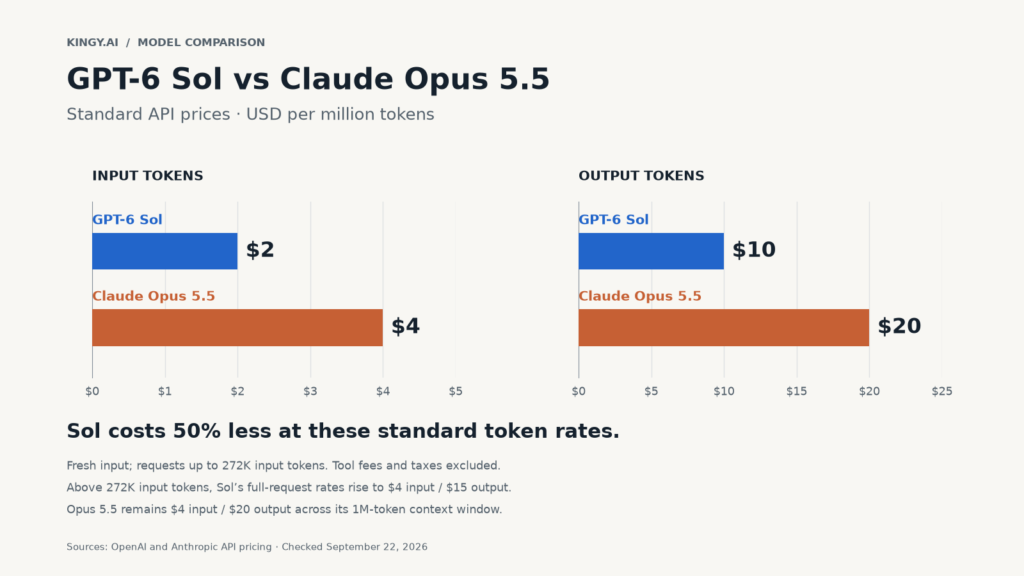
Token pricing is easier to compare, provided the billing conditions stay visible. All figures below are dollars per million tokens on the direct APIs. Short-context Sol means a prompt with at most 272,000 input tokens.
| Billing category | GPT-6 Sol | Claude Opus 5.5 |
|---|---|---|
| Standard uncached input | $2.00 | $4.00 |
| Standard output | $10.00 | $20.00 |
| Standard cache read | $0.20 | $0.20 |
| Cache creation | $2.50; 30-minute minimum lifetime | $5.00 for 5 minutes; $8.00 for 1 hour |
| Batch uncached input / output | $1.00 / $5.00 | $2.00 / $10.00 |
| Flex uncached input / output | $1.00 / $5.00 | No equivalent verified here |
| Fast-mode uncached input / output | $4.00 / $20.00 | $8.00 / $40.00 |
| Standard input / output above 272K input | $4.00 / $15.00 | $4.00 / $20.00 |
| Standard cache read above 272K input | $0.40 | $0.20 |
Sources: OpenAI pricing, Anthropic pricing, OpenAI cache lifetime rules. Regional premiums and separately priced tools are excluded.
For ordinary uncached short-context work with identical token counts, Sol costs exactly half as much. But the cached-input rate is already equal. A conversation that mostly rereads a cache therefore has a smaller advantage than the headline rates suggest.
Sol’s long-context threshold is more consequential. Once a prompt exceeds 272K input tokens, input and cache rates double and output rates rise 50% for the whole request. The higher prices do not apply only to the tokens above the threshold. Opus keeps its standard rates across its full advertised context. Sol billing conditions, Claude long-context pricing.
Caching also has an upfront cost. A $5 cache-write rate is the price for those cache-created tokens; do not add the ordinary input rate again. A useful calculation separates uncached input, cache writes, cache reads and output into distinct buckets. Cache lifetimes differ, so a cheaper write that expires before the next request may not save anything.
For each request, calculate:
Token cost = (uncached input × input rate + cache-created tokens × write rate + cached input × read rate + output × output rate) ÷ 1,000,000.
Then add tool, storage and execution charges, and sum every request in the task. Count reasoning in billed output. OpenAI explicitly bills hidden reasoning as output; Anthropic likewise includes thinking in output usage even when a user sees only a summary. A short final answer can follow a long, chargeable reasoning process. OpenAI reasoning billing, Anthropic task-cost explanation.
Both providers list ordinary web search at $10 per 1,000 calls, plus applicable content-token charges. Fifty searches add $0.50 before those tokens. OpenAI also lists a 1GB hosted container at $0.03 per 20-minute session, with eligible sessions billed by the minute subject to a five-minute minimum. OpenAI tool pricing, Claude web-search pricing.
Claude’s code execution adds no execution fee when the request includes its February 2026 or later web-search or web-fetch tool. Otherwise, it includes 1,550 free container-hours per organization monthly, then charges $0.05 per container-hour with a five-minute minimum. Files can trigger execution billing through preloading even without a tool call. These are different runtime products, so compare the setup your application will use. Claude code-execution billing.
These examples use identical token counts to isolate the rate cards. They assume Standard processing, no regional premium and no separate tools. Ordinary input is uncached and not written to cache; cache-hit examples assume the cache already exists and exclude its initial creation cost.
| Illustrative request | Sol | Opus 5.5 |
|---|---|---|
| 10K uncached input + 2K output | $0.04 | $0.08 |
| 100K uncached input + 10K output | $0.30 | $0.60 |
| 250K uncached input + 20K output | $0.70 | $1.40 |
| 300K uncached input + 20K output | $1.50 | $1.60 |
| 100K cached input + 10K uncached input + 5K output | $0.09 | $0.16 |
| 900K cached input + 10K uncached input + 10K output | $0.55 | $0.42 |
The last row is a useful counterexample. Sol’s long-context cache reads cost $0.36, fresh input $0.04 and output $0.15. Opus costs $0.18, $0.04 and $0.20 respectively. With that heavily cached workload, Opus is cheaper despite its higher output rate. This does not establish that it will be cheaper over the full conversation; the setup cost, actual tokenization and generated output still matter.
At 10,000 requests matching the second row, the calculated token bill is $3,000 for Sol and $6,000 for Opus. Scale changes the significance of a few cents. Conversely, saving one engineer ten minutes on a difficult task can matter more than a several-dollar inference difference.
The business metric to track is total workflow cost divided by accepted outcomes. Include failed attempts, retries, fallbacks and human correction time. For a hypothetical batch of 100 attempts costing $0.30 each, 60 accepted results produce $0.50 of model spend per accepted result. A competing workflow costing $0.40 per attempt with 90 accepted results costs about $0.44 per accepted result. Those numbers illustrate the arithmetic; they are not measured success rates for either model.
Speed needs the same care. Output throughput describes how quickly tokens arrive after generation starts. Time to first answer describes the initial wait. Whole-task duration also includes reasoning, tool execution, retries and work that happens in parallel.
| Artificial Analysis API snapshot | Sol, medium | Opus 5.5, medium, default fallback |
|---|---|---|
| Median output speed | 114.3 tokens/second | 75.8 tokens/second |
| Median time to first answer token, 10K-input prompt setting | 2.0 seconds | 22.5 seconds |
Sources: Sol medium performance, Opus medium performance. These are provider- and prompt-specific launch-day measurements, not service-level guarantees. The medium settings do not produce equal benchmark quality.
At maximum effort, the same Sol page family reports roughly 107 seconds before the first answer token in the 10K-input setting. A fast decoder can still make a user wait while it reasons. There was no corresponding maximum-effort Opus speed value in the snapshot, so there is no defensible max-versus-max speed winner here. Sol maximum performance.
Anthropic advertises up to 2.5 times the output speed in its fast-mode research preview. That is a throughput claim, not a promise that a task finishes 2.5 times sooner. Access is restricted, and the feature is not available across all its cloud routes. Claude fast-mode documentation.
For writing and research, the evidence is less complete than the scoreboards can suggest. Opus’s professional-work results make it a strong candidate for reports, spreadsheets and multi-source synthesis. Those results do not establish that its prose will better match a particular publication’s voice. The decisive test is a blind comparison on the same brief, source packet and editing standard.
For multilingual work, do not promote the mostly English Intelligence Index into a universal language ranking. The sources reviewed here do not provide a complete matched comparison across the languages a business might need. For visual work, MMMU-Pro supplies useful evidence, but it does not measure every chart, scanned document or interface workflow. For long documents, test contradictions and cross-document synthesis as well as simple fact retrieval.
API integration can also decide the purchase. Sol supports structured outputs and tool calling, with Responses as the appropriate API for reasoning plus tools. In Chat Completions, Sol’s function calling requires reasoning effort none. GPT-6’s API also supports asynchronous tool calls and mid-turn steering, which can help an application respond to changes during long tasks. OpenAI model and migration guidance.
Opus 5.5 introduces meaningful migration changes. Adaptive thinking is mandatory; requests that disable it fail. Forced tool_choice values any and tool are rejected, although structured outputs and strict tool schemas remain supported. Thinking blocks are tied to their model and conversation. Computer-use integrations on affected platforms need the newer toolset. What’s new in Opus 5.5.
There is also a user-visible integration trap: progress text between tool calls can arrive in thinking blocks whose text is empty under the default display setting. An application that only renders ordinary text may appear silent. Review the response handling rather than assuming the model has stopped. Opus migration guide.
Both providers offer mechanisms to vary reasoning during a conversation while preserving cache, subject to their documented interfaces. For Opus, per-message effort changes use a beta interface; changing top-level effort can invalidate the cache. That difference can affect a long-running agent’s bill. Claude effort documentation, OpenAI reasoning configuration guidance.
Subscriptions require a separate comparison from API rates. A monthly plan buys access and a usage allowance; it does not buy an unlimited quantity of API work.
| Individual subscription | OpenAI | Anthropic |
|---|---|---|
| Entry paid plan | ChatGPT Plus: $20/month | Claude Pro: $20/month, or $200/year |
| Higher-use tier | ChatGPT Pro 5x: $100/month | Claude Max 5x: $100/month |
| Highest listed personal usage tier | ChatGPT Pro 20x: $200/month; new subscriptions paused | Claude Max 20x: $200/month |
Sources: OpenAI plan pricing, ChatGPT Pro tiers, Claude plan choices. Figures are advertised US prices; billing terms and taxes can differ. The usage multipliers use each provider’s own baseline and are not equivalent quantities of work.
At the time of writing, OpenAI has paused new Pro $200 subscriptions and upgrades, with a limited return option for eligible former subscribers. Existing subscriptions continue to renew. Treat the $200 row as a documented tier with restricted availability. OpenAI’s Pro subscription notice.
OpenAI lists roughly 15–150 local Sol messages per five hours on Plus, explicitly as estimates rather than fixed limits; task complexity and weekly limits matter. Claude also applies session and weekly limits. Ordinary developer API usage is billed separately from these subscriptions. A claimed dollar-per-task subscription comparison is unreliable unless it measures the work actually completed within each allowance. Codex and Work usage rules, Claude Max limits, Claude subscription/API billing distinction.
For enterprise deployment, Opus’s documented routes include Anthropic’s API, Amazon Bedrock, Google Cloud, Microsoft Foundry and Claude Platform on AWS. Sol’s direct API and OpenAI’s documented Bedrock offering give another deployment path. Verify the exact model, region and feature combination; availability of a provider does not establish parity for every tool. Opus platform availability, OpenAI provider billing information.
Privacy is a product and configuration question. OpenAI’s API does not use customer data for training by default, but standard abuse-monitoring retention can be up to 30 days and application state has separate rules. Approved retention controls have feature-specific conditions. Sol’s EU data residency is limited to Standard processing. OpenAI data controls.
Anthropic’s commercial API normally deletes inputs and outputs within 30 days, subject to its stated exceptions and agreements. Opus 5.5 is eligible for zero-data-retention arrangements, but features such as batches, files, code execution and stateful agents have their own retention behavior. Consumer subscription terms are different. Anthropic commercial retention, Claude API retention controls.
Neither model offers downloadable weights for local self-hosting. A local coding agent or a self-hosted execution sandbox does not make the underlying model local. For regulated data, procurement needs to check where inference and storage occur, what gets sent to tools and which retention agreement covers that route. Claude residency documentation, OpenAI data controls.
Safety and reliability should remain separate from capability. OpenAI reports approximately 36% fewer severe misalignment flags for Sol than its predecessor in a matched internal deployment simulation, while warning that internal results do not directly measure external deployment risk. That establishes neither a zero failure rate nor a safety victory over Opus. OpenAI system card, Sol and Luna addendum.
Anthropic’s fallback design can improve completion on requests its primary classifier declines, but changes which model answers. Log the actual model and refusal/fallback status when evaluating sensitive or technical workflows. Neither launch-day scoreboard establishes months of uptime, resistance to every prompt injection, or reliable autonomous operation in your environment. Claude refusal and fallback behavior.
The practical pros and cons can now be stated without guessing about unseen architecture or pretending that every task has the same requirements.
| Model | Principal advantages | Principal drawbacks |
|---|---|---|
| GPT-6 Sol | Lower ordinary token rates; optional non-reasoning mode; Batch and Flex discounts; strong measured medium-effort throughput; useful fit for existing Codex workflows | Lower scores in the displayed maximum-effort comparison; full-request long-context surcharge; cached-input advantage can disappear; higher effort can bring a long initial wait |
| Claude Opus 5.5 | Stronger results across the displayed maximum-effort tests; compelling medium-effort quality/cost balance; flat long-context rates; low cache-read pricing; broad cloud availability | Higher fresh-input/output rates; maximum effort can spend heavily; mandatory thinking and API migration changes; reported fallback-enabled results do not isolate one model |
These are conclusions from the evidence above, not guarantees about a particular project. I would test Sol first for large volumes of routine coding, extraction and automation where you can grade the result cheaply. I would test Opus medium first for demanding document synthesis and difficult agent work where correction time is expensive. For maximum-quality work, compare Opus high, xhigh and max instead of assuming the largest setting pays for itself.
For an existing team, switching tools also has a cost. Keep the editor, repository, permissions, source material and acceptance criteria as consistent as possible. Run a representative set of real tasks, score the outputs without revealing the model, and record accepted results, total API charges and human repair time. Include a few long-context and cache-heavy tasks if those are common in production.
The production decision should name a configuration: for example, “Sol medium for routine changes, with escalation after a failed acceptance check,” or “Opus medium for research deliverables, with extra effort reserved for unresolved reasoning.” Choose the configuration that produces acceptable work at the lowest total cost on the tasks you actually have.
For the wider model landscape, see Kingy AI’s GPT-6 Sol and Luna comparison and Claude Opus 5.5 specifications and benchmarks.