Research cutoff: September 22, 2026. Prices are US dollars for the direct, paid developer APIs unless stated otherwise.
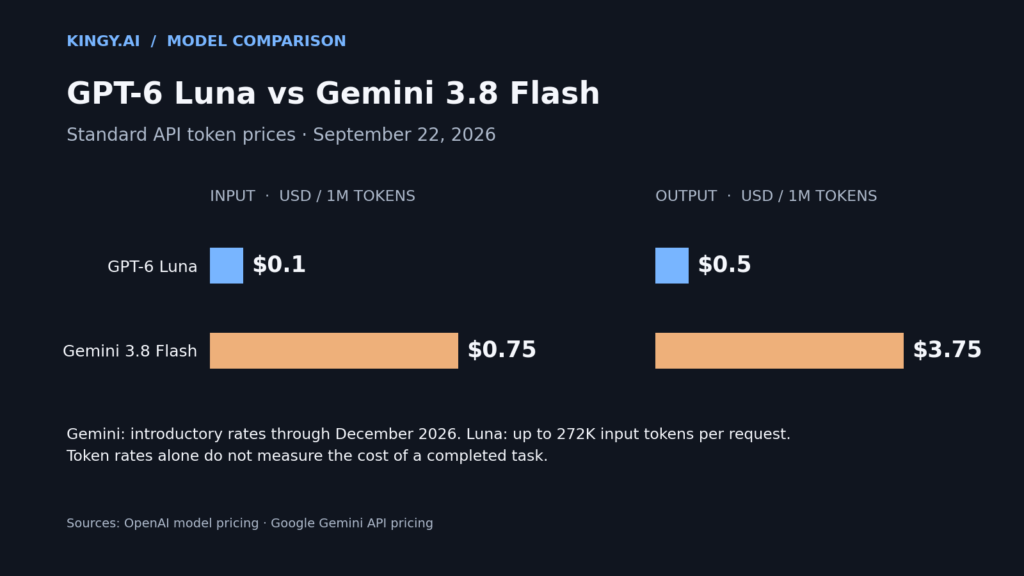
GPT-6 Luna and Gemini 3.8 Flash both target coding agents, document processing, and other work where repeated calls make the bill add up. Luna costs $0.10 per million input tokens and $0.50 per million output tokens. Gemini 3.8 Flash costs $0.75 and $3.75 at its introductory rate. Google therefore charges 7.5 times as much per listed input or output token: $0.75 ÷ $0.10 = 7.5, and $3.75 ÷ $0.50 = 7.5. The cost of a completed job also depends on how many tokens, attempts, and tool calls each model needs. OpenAI’s Luna model page and Google’s pricing page publish the rates.
Gemini accepts audio, video and PDF as well as text and images. Luna has a larger maximum output and a lower token price. Published coding results give each model a case worth examining, although a shared GPT-6 Luna versus Gemini 3.8 Flash run is not yet public. The evidence below separates each vendor’s results from DataCurve’s leaderboard.
Key takeaways
- Listed price: Luna is 7.5 times cheaper per standard input, cached-input and output token at Gemini’s current introductory rates. Google’s listed rates double on January 1, 2027, making that ratio 15 to 1 if Luna’s prices stay the same. OpenAI model page; Google pricing.
- Input types: Both accept text and images and return text. Google also lists audio, video and PDF as Gemini 3.8 Flash inputs. OpenAI lists audio and video as unsupported for Luna. Google model page; OpenAI model page.
- Coding evidence: OpenAI reports 66.6% for Luna at max effort on DeepSWE v1.1. Google’s model card reports 73.7% for Gemini 3.8 Flash. DataCurve’s public leaderboard shows a Gemini run near 74%, but no GPT-6 Luna run as of this article’s cutoff. Those figures cannot settle a same-harness head-to-head. OpenAI launch; Google model card; DeepSWE leaderboard.
- A costly threshold: Luna requests with more than 272,000 input tokens incur double input and cache rates and 1.5 times the output rate for the entire request. A million-token context window does not mean a flat price across that window. OpenAI model page.
- Starting choice: Try Luna first for text and image jobs where cost dominates. Choose Gemini when the job requires native audio or video input. Put both through the same coding or computer-use tasks before choosing one for those workloads. These recommendations come from the specifications and published evidence; Kingy has not run this pair.
Specs at a glance
| Specification | GPT-6 Luna | Gemini 3.8 Flash |
|---|---|---|
| API ID | gpt-6-luna | gemini-3.8-flash |
| Status | Available through OpenAI API | Stable / generally available |
| Context or input limit | 1,050,000 tokens | 1,048,576 tokens |
| Maximum output | 128,000 tokens | 65,536 tokens |
| Inputs | Text, image | Text, image, audio, video, PDF |
| Output | Text | Text |
| Reasoning settings | none, low, medium, high, xhigh, max; medium default | low, medium, high; medium default |
| Knowledge cutoff | May 18, 2026 | March 2026, with some domains potentially limited to January 2025 |
| Tool support | Function calling and built-in tools through Responses, including web search, file search and computer use | Function calling, code execution, search grounding, file search and computer use; computer use is preview |
Sources: OpenAI’s Luna specification, Google’s Gemini specification, Google’s model guide, and Google’s model card.
The input limits are close. Luna’s billing changes when one request exceeds 272,000 input tokens; 272,000 tokens spread across several requests do not trigger that rule. Google’s current Gemini 3.8 Flash price table does not list a corresponding long-context rate. OpenAI model page; Google pricing.
Token pricing, caching and the January increase
| Standard paid API rate, per 1M tokens | GPT-6 Luna | Gemini 3.8 Flash through Dec. 31, 2026 | Gemini 3.8 Flash from Jan. 1, 2027 |
|---|---|---|---|
| Fresh input | $0.10 | $0.75 | $1.50 |
| Cached input | $0.01 | $0.075 | $0.15 |
| Output | $0.50 | $3.75 | $7.50 |
Sources: OpenAI API pricing and Gemini API pricing. The Google output rate includes thinking tokens.
The cached-input comparison has the same ratio as fresh input: $0.075 ÷ $0.01 = 7.5 today, rising to $0.15 ÷ $0.01 = 15 at Google’s listed January rate. Luna also lists a $0.125 per million cache-write rate. Google separately prices explicit cache storage at $0.50 per million tokens per hour through December 2026 and $1.00 from January 2027. These systems do not have identical cache mechanics, so a real bill needs the actual hit rate, any cache writes, and storage duration. OpenAI model page; Google pricing.
Both providers list cheaper Batch and Flex routes. Luna’s Batch and Flex rates are half its standard rates, which gives $0.10 × 0.5 = $0.05 input and $0.50 × 0.5 = $0.25 output per million short-context tokens. Google currently lists $0.375 input and $1.875 output for Gemini 3.8 Flash on Batch and Flex. The relative price gap therefore remains $0.375 ÷ $0.05 = 7.5 on input and $1.875 ÷ $0.25 = 7.5 on output at those published rates. Processing routes have different latency and availability terms; compare the same route when pricing a job. OpenAI model page; Google pricing.
Google warns that 3.8 Flash may spend more tokens on difficult work, especially at higher effort. That can improve a result while increasing its cost. List price alone cannot tell us how many attempts, reasoning tokens, or tool calls a task will take. Our Gemini 3.8 Flash review examines that trade-off against Gemini 3.7 Flash. Google launch post and model card.
What two example workloads cost
The first example uses the same workload as our GPT-6 Sol and Luna comparison: a session with 2 million input tokens, of which 90% are cached, plus 150,000 output tokens. That means 0.2 million fresh input tokens, 1.8 million cached input tokens, and 0.15 million output tokens. We hold token counts equal to isolate the rate-card difference.
| Model and rate period | Fresh input | Cached input | Output | Total |
|---|---|---|---|---|
| Luna | 0.2 × $0.10 = $0.020 | 1.8 × $0.01 = $0.018 | 0.15 × $0.50 = $0.075 | $0.113 |
| Gemini, through Dec. 2026 | 0.2 × $0.75 = $0.150 | 1.8 × $0.075 = $0.135 | 0.15 × $3.75 = $0.5625 | $0.8475 |
| Gemini, from Jan. 2027 | 0.2 × $1.50 = $0.300 | 1.8 × $0.15 = $0.270 | 0.15 × $7.50 = $1.125 | $1.695 |
At current rates, $0.8475 ÷ $0.113 = 7.5. At Google’s listed January rates, $1.695 ÷ $0.113 = 15. These are token-charge illustrations, not measured session costs. They exclude cache-write and storage charges, tools, retries and provider-specific tokenization. They also assume no individual Luna request in the session crosses the 272,000-input-token threshold. OpenAI pricing; Google pricing.
That threshold deserves its own calculation. Take one uncached request with 300,000 input tokens and 20,000 output tokens. Since 300,000 exceeds Luna’s 272,000 threshold, its effective input rate is $0.10 × 2 = $0.20 per million and its effective output rate is $0.50 × 1.5 = $0.75 per million. Luna’s bill is 0.3 × $0.20 = $0.060 for input plus 0.02 × $0.75 = $0.015 for output, or $0.075 in total. At Gemini’s current standard rate, the same fixed token counts cost 0.3 × $0.75 = $0.225 for input plus 0.02 × $3.75 = $0.075 for output, or $0.300. The ratio falls to $0.300 ÷ $0.075 = 4. The example excludes cache and tools, and it assumes the 20,000 output tokens include any billable Gemini thinking tokens. OpenAI model page; Google pricing.
What the published benchmarks can tell us
OpenAI and Google did not release a shared Luna-versus-Flash evaluation. Their charts use different model sets and sometimes different task configurations. A score from one chart can describe a model’s published performance; placing it beside a score from another chart does not turn the pair into a controlled race.
OpenAI-reported Luna results. OpenAI’s launch materials report Luna at 66.6% on DeepSWE v1.1 at max effort, with an average cost of $0.22 per task in its chart. The same chart puts Luna at 20.7% on AutomationBench 1.0.6, 50.9% on Agents’ Last Exam V1, 42.4% on FrontierCode 1.1 Main, and 52.7% on OSWorld 2.0 offline at its strongest reported settings. Those are evaluations published by OpenAI, using the configurations and accounting in its launch charts. Our Sol/Luna article transcribes the per-effort data. OpenAI launch.
The effort curve is a warning against defaulting Luna to low for difficult work. In OpenAI’s DeepSWE chart, Luna moves from 2.4% at low effort and $0.006 per task to 44.5% at medium and $0.052 per task, then 66.6% at max and $0.22 per task. The cheapest setting produced very few accepted patches in this evaluation. The chart helps identify which Luna settings merit a test. OpenAI chart, transcribed in our Sol/Luna article.
Google-reported Gemini results. Google’s model card reports 73.7% on DeepSWE v1.1, up from 65.3% for Gemini 3.7 Flash in its paired chart: 73.7 − 65.3 = 8.4 percentage points. It also reports 19.1% on Terminal-Bench 4.0 and 59.0% on OSWorld 2.0 with partial scoring and batch tool enabled. Those results establish Google’s claims for its published configurations. OpenAI did not report Luna on Google’s Terminal-Bench chart. Google model card and evaluation methodology.
DataCurve’s public leaderboard. Its DeepSWE v1.1 page, updated September 22, lists Gemini 3.8 Flash at high effort at roughly 74% ±1%, with $2.36 average cost per task, about 143,000 output tokens, and 166 agent steps. Its public best-configuration view does not yet list GPT-6 Luna. DataCurve uses mini-swe-agent across models, so a Luna entry there would provide a cleaner comparison than putting the two vendors’ charts side by side. DeepSWE leaderboard.
The 66.6%/$0.22 OpenAI row and 74%/$2.36 DataCurve row come from different evaluations. Dividing one model’s score or task cost by the other’s would give a precise-looking answer to a question these runs did not test.
Computer use and professional work
The OSWorld figures look close enough to tempt a simple ranking: 52.7% for Luna in OpenAI’s offline evaluation, and 59.0% for Gemini in Google’s partial-score result with batch tool enabled. The configurations differ. Report both with those labels and leave the winner open. A shared OSWorld run or a controlled workflow test would answer the reader’s practical question more reliably. OpenAI launch; Google model card.
The professional-work charts have an even clearer boundary. OpenAI publishes Luna scores for AutomationBench and Agents’ Last Exam. Google publishes Gemini results for GDPVal-AA v2, finance-agent tasks and legal workflows. They test different work and grade it differently. A missing score in either company’s table is not a zero. OpenAI launch; Google model card.
For a team choosing an agent model, the useful measure is the share of its own tasks accepted without a repair pass, alongside the total cost of attempts and tool calls. That is especially important here: Gemini’s model card warns of extra tokens and occasional slowness or timeouts at higher effort, while Luna’s published agent scores change sharply with effort. Both details can alter the cost of a completed job. Kingy’s 192-run Gemini 3.8 Flash versus GPT-5.6 test shows one way to measure accepted work and cost on a fixed task set; it is a different model pairing. Google model card; OpenAI chart analysis.
Where Gemini’s broader inputs matter
Gemini 3.8 Flash’s API accepts text, images, audio, video and PDF, and returns text. Luna’s model page lists text and image input with text output; it marks audio and video as unsupported. If the job is to inspect a recording or reason over a video directly, Gemini offers a documented input path that Luna does not. For text extracted from a document, both models can be considered, but the extraction method, preprocessing and token bill belong in the comparison. Google model page; OpenAI model page.
Neither model’s million-token limit proves it will retrieve the right detail from every position in a huge source. For very long documents, test answer accuracy at the intended length as well as the price. Luna’s long-context surcharge makes that length a billing question too.
Which model should you use?
| If your job is… | Start with… | Why, and what to verify |
|---|---|---|
| High-volume text classification or extraction | GPT-6 Luna | Its listed token rates are much lower. Test effort settings against accuracy, retries and the full bill. |
| Repeated coding sub-tasks | Both on the same task set | Luna has a low rate and promising OpenAI-reported results; Gemini has a strong public DeepSWE run. Record accepted changes, full token usage and cost per accepted change. |
| Native audio or video understanding | Gemini 3.8 Flash | Its model page lists both as inputs; Luna’s lists neither. Check the token bill for the actual files. |
| One request above 272K input tokens | Price both | Luna’s whole-request surcharge narrows its advantage. The 300K/20K example is $0.075 versus $0.300 at today’s rates, before cache or tools. |
| Computer use | Test both in one workflow | The published OSWorld configurations differ, and Google labels its computer-use support preview. |
Luna is the lower-priced starting choice for text and image workloads. Gemini is the documented choice of this pair for native audio and video input. For coding and agents, run both on representative tasks and compare accepted results, retries and the complete bill. That test will show whether Gemini’s higher token rates pay for themselves in your workflow. OpenAI model; Google model; DeepSWE leaderboard.
Methodology and update note
This is a source-led comparison. Kingy has not run a Luna-versus-Gemini API test. Product specifications and rates were checked against the providers’ documentation on September 22, 2026. The calculations use published Standard rates and the token assumptions stated beside each example. Vendor benchmark results are labelled by publisher; DataCurve’s leaderboard is labelled separately.
The first update to watch for is a GPT-6 Luna entry on DataCurve’s DeepSWE leaderboard. The second is Google’s scheduled January 1, 2027 price change. Both could change the purchasing advice above without changing a single model specification.