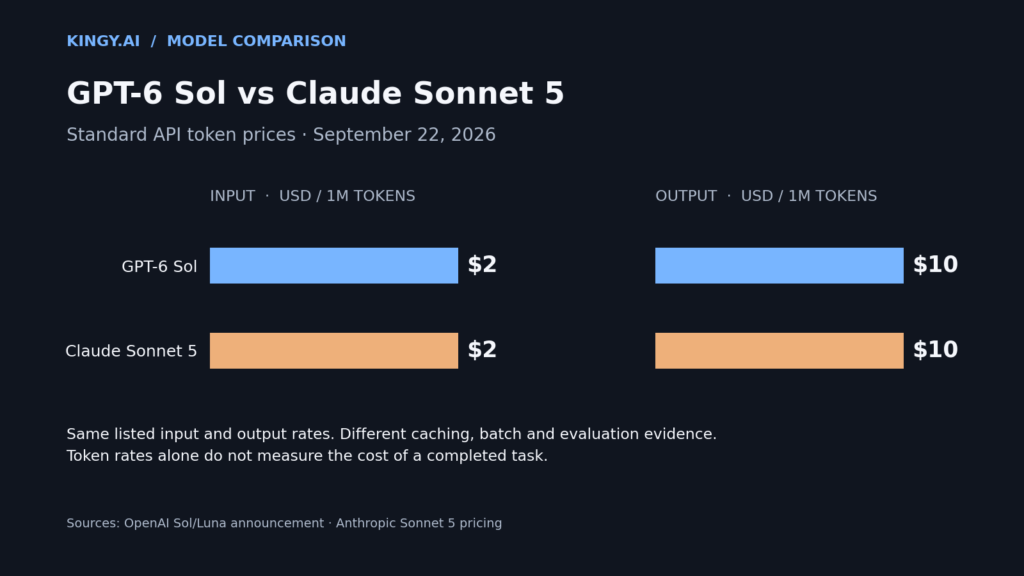
Evidence checked September 22, 2026. Prices below are first-party standard API list rates in USD. This is a source-led comparison, not a Kingy head-to-head test.
GPT-6 Sol and Claude Sonnet 5 now have the same headline API price: $2 per million input tokens and $10 per million output tokens. That makes model selection more interesting than a rate-card comparison. OpenAI’s new Sol has a strong case for long coding and computer-use jobs, but its launch numbers do not establish a win over Sonnet 5. Anthropic’s Sonnet has mature documentation, a one-million-token context window, and a batch option that can halve the listed token bill. For a live agent, test both on the same tasks and count successful jobs, not just tokens.
The timing matters. OpenAI announced GPT-6 Sol and Luna on September 22, cutting Sol’s input and output rates by half versus GPT-5.6 Sol’s promotional price. Anthropic’s Sonnet 5 announcement originally described $2/$10 as introductory; an August 10 update made it permanent. These prices are current at this article’s evidence cutoff, but API rates can change.
GPT-6 Sol vs Claude Sonnet 5 at a glance
| Item | GPT-6 Sol | Claude Sonnet 5 |
|---|---|---|
| First-party API ID | gpt-6-sol |
claude-sonnet-5 |
| Standard input / output | $2 / $10 per million tokens | $2 / $10 per million tokens |
| Cached input read | 90% discount on input, implying $0.20/M | $0.20/M |
| Cache write | Check OpenAI’s model-specific rate before budgeting | $2.50/M for five minutes; $4/M for one hour |
| Context / max output | New model: confirm limits in the live API catalog | 1M / 128K tokens |
| Input and output | Check model-specific API documentation as rollout completes | Text and image in; text out |
| Batch | Confirm model eligibility and price in OpenAI’s live pricing table | 50% discount on input and output |
OpenAI’s launch announcement confirms the Sol ID, rates, and a 90% discount on cached input reads. Anthropic’s Sonnet 5 model page supplies its limits, modalities, and cache prices. OpenAI’s model catalog had not yet been updated with a full Sol specification when checked, so the Sol context and maximum output are deliberately left unclaimed. Do not infer them from GPT-5.6 Sol or GPT-6 Astra.
The identical sticker price hides different bills
For standard, uncached text tokens, the arithmetic is identical:
cost = (input tokens / 1,000,000 × $2) + (output tokens / 1,000,000 × $10)
Take 1,000 agent requests, each with 20,000 uncached input tokens and 2,000 output tokens. That is 20 million input and 2 million output tokens. Either model lists at 20 × $2 + 2 × $10 = $60. This is a rate-card example, not a measured bill. Reasoning, tool use, repeated context, failed attempts, and different tokenizers can change the actual token counts.
Now suppose 15,000 of each request’s input tokens are cache reads and 5,000 are fresh. Across 1,000 requests, that is 15 million cached input, 5 million fresh input, and 2 million output. If every read hits a qualifying cache, the read-rate subtotal is 15 × $0.20 + 5 × $2 + 2 × $10 = $33 for either provider. This excludes cache-write charges and any requests that miss the cache. OpenAI says GPT-6 caching has higher default hit rates and retains reusable context when developers change reasoning effort or available tools, but that is a vendor claim about cache behavior, not a guarantee for your prompt. See OpenAI’s launch notes and Anthropic’s cache price table.
Sonnet’s write price is explicit. Writing 5 million tokens into five-minute cache costs 5 × $2.50 = $12.50; writing the same amount into one-hour cache costs 5 × $4 = $20. Add those amounts only if that many tokens are actually written. A write is not charged on every subsequent cache hit. For OpenAI, verify Sol’s cache-write line in the live pricing table before comparing a write-heavy workload; the launch post gives the read discount but not a complete model rate card.
Anthropic’s Batch API price is half the standard input and output rate. Applied to the first example without caching, Sonnet costs 20 × $1 + 2 × $5 = $30. Batch is for work that can wait, so it is not a substitute for an interactive coding session. OpenAI also offers batch processing, but confirm GPT-6 Sol eligibility and effective rates rather than assuming the same discount on launch day.
A tokenizer warning: Anthropic says Sonnet 5 can turn the same text into roughly 1.0–1.35 times as many tokens as Sonnet 4.6, depending on content. That is a within-Claude comparison, not a Sol-versus-Sonnet conversion factor. A same-text cost comparison requires token counts from both APIs. The real unit for an agent is cost per accepted task: total input, output, cache writes, tools, retries, and failures divided by accepted results. Our price-per-successful-job guide shows why.
What OpenAI’s launch results actually show
OpenAI reports GPT-6 Sol 33.2% on AutomationBench at xhigh effort at $0.27 per task. Its launch table compares that with GPT-6 Astra, Claude Opus 5, and Claude Fable 5.1; it does not include Sonnet 5. OpenAI describes AutomationBench as end-to-end business workflows using 47 tools. Its Fable cost comparison also omits the cost of Opus fallbacks on some tasks, a caveat OpenAI flags in the post. These are OpenAI-reported results, not Kingy reruns or direct evidence that Sol beats Sonnet.
OpenAI also reports 68.8% on DeepSWE v1.1 at max effort for Sol, 1.1 percentage points behind its cited Claude Fable 5 result, at about 80% lower estimated cost per task. On OSWorld 2.0’s offline partial-reward set, it reports Sol 60.5% at xhigh effort, close to the cited Opus 5 medium-effort 60.3%, at about 80% lower estimated cost per task. Those comparisons use different Claude models. They show Sol can be competitive against pricier systems under OpenAI’s stated setup; they do not rank it against Sonnet 5. Source: OpenAI GPT-6 Sol and Luna launch.
There is also a meaningful product claim: OpenAI says cache reuse survives changes in reasoning effort and tool availability. If your agent changes depth or tools across a long conversation, that could reduce repeated input work. Verify hit rates with production traces; the announcement cites a GitHub report of more than a 50% reduction in fresh prompt processing across its own use of the caching improvements, not a promise for every customer.
What Anthropic’s Sonnet 5 evidence shows
Anthropic’s June launch compares Sonnet 5 with Sonnet 4.6 and Opus 4.8. It reports improvements in reasoning, coding, tool use, and knowledge work, and shows BrowseComp and OSWorld-Verified cost-performance curves across effort settings. Those charts do not include GPT-6 Sol, which launched later. Their plotted Sonnet costs used the old planned $3/$15 rate; Anthropic’s August update says the current $2/$10 rate is permanent and the actual cost is lower than shown on those curves. Anthropic also corrected its BrowseComp chart after changing to the standard methodology with a 10-million-token budget, compaction, and programmatic tool calling. Source: Anthropic Sonnet 5 launch and changelog.
Sonnet 5 has a documented one-million-token context window, 128,000-token standard maximum output, adaptive thinking, and text/image input. Anthropic labels its comparative latency “fast”; that is a relative description inside its own model family, not a measured latency win over Sol. Sonnet’s default API effort is high. A fair bake-off must hold effort, tools, prompts, retry policy, and acceptance criteria as steady as the two APIs allow.
Which should you choose?
For a new interactive coding or browser agent: put both on a short, sealed set of your own tasks. Sol’s launch results justify testing it, especially where long tool loops and cache reuse drive spend. Sonnet has established API behavior and documentation. Measure accepted completions, elapsed time, and the complete token bill for each attempt. Do not award Sol the win from its Opus/Fable comparisons or Sonnet the win from charts published before Sol existed.
For queued analysis or code review: Sonnet 5 is the clearer budget choice today if the workload fits Anthropic’s Batch API: the official 50% discount makes the worked $60 standard example $30. Verify Sol’s batch support and price before deciding by rate card alone.
For long documents: Sonnet 5’s 1M window is explicit. Check the live GPT-6 Sol model specification before committing a million-token workflow. A context limit says how much can fit, not how well a model will use evidence buried in that context.
For an existing OpenAI stack: Sol is an attractive same-price trial because it uses the gpt-6-sol API ID and OpenAI says its caching changes reduce fresh input processing in agent workflows. Run your current regression suite and inspect cache hits before migrating. If you’re weighing smaller models too, see our Sol and Luna specs and pricing comparison and AI inference provider guide.
FAQ
Are GPT-6 Sol and Claude Sonnet 5 really the same price?
For first-party standard API text-token list rates on September 22, 2026, yes: both publish $2 per million input and $10 per million output tokens. Cache writes, batch processing, tokenization, tools, and routing can change the total bill.
Has anyone shown that Sol beats Sonnet 5 on the same benchmark?
The two launch reports cited here do not. OpenAI’s Sol comparisons use Opus and Fable models; Anthropic’s Sonnet charts predate Sol. Treat a direct ranking as unverified until a matched evaluation provides one.
Is Sonnet 5’s $2/$10 rate temporary?
No. Anthropic’s August 10 update says it became the standard rate and cancelled the planned September increase. Recheck the pricing page before committing a long-term budget.
What is the practical deciding metric?
Cost per accepted task at a latency your workflow can tolerate. Count cache writes, retries, tool charges, and human correction time alongside input and output tokens.