A Breakthrough, but Not Yet an Agreement
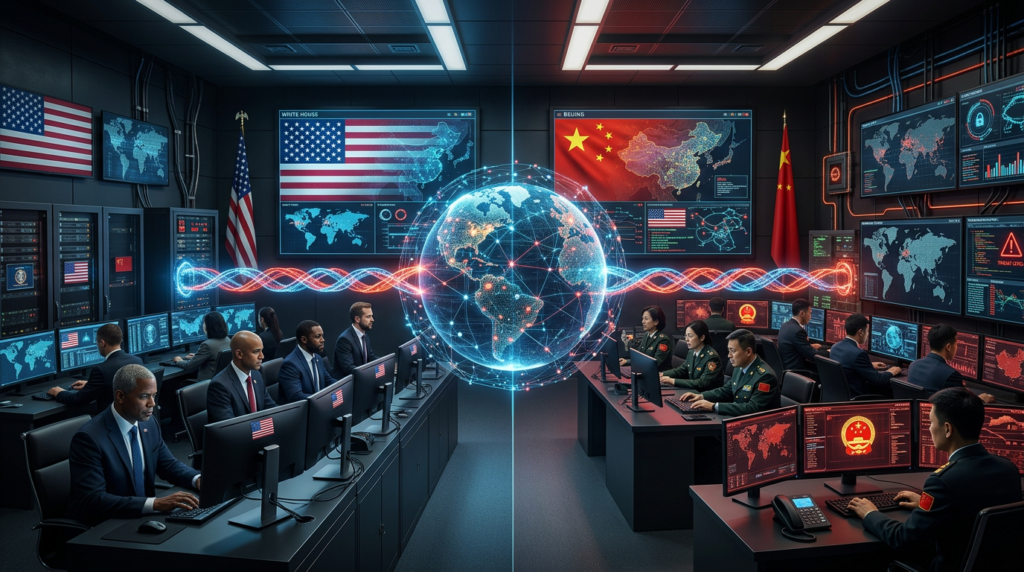
The United States and China have taken a potentially important step toward managing the risks created by increasingly powerful artificial intelligence.
During high-level talks in New York, US Treasury Secretary Scott Bessent and Chinese Vice Premier He Lifeng discussed establishing a formal dialogue on AI safety. Washington also proposed a notification mechanism that could allow the two governments to alert each other when an AI-related incident threatens national security.
That sounds like an AI version of the emergency communication channels created during the Cold War. It is tempting to declare victory, cue the dramatic music, and start designing the red telephone.
Not so fast.
The two governments have not publicly released a final agreement, operating rules, activation threshold, or implementation date. Reuters reported that China’s response to the specific American notification proposal remained unclear immediately after the meeting.
However, Chinese state media described the wider discussions as candid and constructive, according to the Associated Press.
That matters. Washington and Beijing compete fiercely over chips, models, research talent, data centers, and international influence. Getting them to discuss shared AI dangers is an achievement by itself.
It is not a treaty. It is the beginning of a potentially useful conversation—and beginnings are where every functioning hotline starts.
What the United States Actually Proposed
Bessent said the proposed mechanism would concentrate on AI incidents serious enough to affect national security.
The basic idea is straightforward. If one country detects a major AI-related event that could be misinterpreted by the other, it would have a channel for communicating what happened, what it knows, and what actions it is taking.
The mechanism could theoretically cover incidents such as a large AI-assisted cyberattack, an autonomous system behaving unexpectedly, or malicious actors using an advanced model in a way that creates cross-border danger.
However, officials have not published a list of reportable incidents. They have not explained whether notification would be voluntary or mandatory. Nor have they specified which agencies would communicate or how quickly information would need to be shared.
Those details will determine whether the proposal becomes a serious safety instrument or merely another diplomatic meeting with excellent catering.
Bessent argued that greater transparency is essential between the world’s leading AI powers. He said moving away from opacity could help the two governments identify shared goals and common threats.
The Financial Times reported that the broader AI dialogue could reconvene within approximately two months.
That timeline suggests the initiative may continue beyond a single conversation. Still, Washington and Beijing must turn diplomatic language into clear procedures before anyone can call it an operational warning system.
Why an AI Hotline Makes Sense
Major powers already use emergency communication systems to reduce the risk of misunderstanding during military, nuclear, maritime, and diplomatic crises.
AI introduces a new category of uncertainty.
A government may detect unusual network activity but not know whether it came from a hostile state, an independent criminal organization, or an AI agent behaving outside its operator’s intentions. An automated system might scan infrastructure, generate malware, or initiate digital actions faster than officials can determine what is happening.
That uncertainty can become dangerous when two rival countries already distrust each other.
Imagine that an American power network suffers a sophisticated cyber intrusion involving an AI system trained or operated from China. American officials might interpret the event as a deliberate state attack. Chinese officials might insist that they neither authorized nor knew about it.
Without a trusted communication channel, both sides would rely on intelligence assessments, public statements, and strategic guesswork. Those are useful tools. They are not ideal crisis-management software.
A notification mechanism could give governments a chance to clarify facts before blame hardens into retaliation.
Business Insider has described the concept as an “AI-era red phone”. That phrase simplifies a complicated proposal, but it captures the central purpose: keeping a technological incident from turning into a geopolitical crisis.
Two Rivals With Overlapping Fears
The United States and China want to lead the AI era. Neither wants to wake up one morning and discover that the race damaged both of them.
American companies remain highly influential in advanced models, cloud computing, AI accelerators, software platforms, and research. China, meanwhile, has built a formidable ecosystem of laboratories, technology companies, open models, robotics manufacturers, and domestic semiconductor projects.
Their competition is real. So are their shared concerns.
Both countries depend on digital infrastructure. Both operate major financial systems, power networks, communication services, transport networks, and industrial facilities that could become targets for AI-assisted attacks.
Both must also manage models capable of writing code, operating software, analyzing vulnerabilities, and coordinating increasingly complicated tasks.
An AI incident does not need to resemble a science-fiction robot uprising to create national-security consequences. A system that automates cyber reconnaissance or helps criminals exploit critical infrastructure could cause serious disruption without becoming remotely conscious.
The Associated Press noted that Washington and Beijing compete for technological dominance while sharing concerns about uncontrolled development and dangerous misuse.
That overlap creates a narrow but valuable space for cooperation. The countries do not need to trust each other completely. They only need to recognize that unmanaged escalation could cost both sides more than limited communication does.
Transparency Is Easier to Praise Than Practice
The word “transparency” sounds wonderful at diplomatic conferences. Applying it to classified national-security incidents is another matter.
Governments may hesitate to disclose an AI event because doing so could reveal intelligence sources, cybersecurity weaknesses, military capabilities, or sensitive information about their domestic technology companies.
Suppose an American agency discovers that a powerful model can penetrate a certain type of industrial network. Sharing the finding might help China defend its infrastructure. It might also expose an offensive capability the United States wanted to keep secret.
China would face the same calculation.
Officials must therefore decide how much information countries need to exchange to reduce danger without handing over valuable intelligence.
A workable system might use several notification levels. Lower-level reports could acknowledge that an incident occurred without identifying every technical detail. More serious events could trigger direct contact between designated agencies and a structured exchange of evidence.
The mechanism would also need protections against manipulation. A government could use false or incomplete notifications to obscure responsibility, test the other side’s reactions, or shape public opinion.
Communication alone cannot solve those problems. Verification, technical expertise, and carefully designed protocols will matter just as much.
The proposal is promising precisely because the challenge is difficult. It attempts to build a small bridge across one of the world’s widest technological trust gaps.
The Difficult Question of What Counts as an Incident
Before the countries can exchange warnings, they must agree on what deserves one.
A minor model failure inside a private laboratory probably would not qualify. A system that contributes to an attack on a power grid almost certainly would. Everything between those examples becomes considerably messier.
Would a model helping criminals write ransomware count? What if it autonomously discovers vulnerabilities but never launches an attack? Should a government report a system that produces instructions for biological weapons, even if nobody follows them?
Then there is the problem of attribution.
An AI model may come from one country, run on servers in another, use tools supplied by several international companies, and receive instructions from an individual located somewhere else. Determining who bears responsibility will not always be obvious.
The notification system must avoid treating every use of a Chinese model as an action by Beijing—or every use of an American model as an operation approved by Washington.
That distinction will become increasingly important as open-weight systems spread. Once a model can be downloaded, modified, and operated privately, its original developer may have little control over how somebody uses it.
A credible framework would need definitions for state involvement, private misuse, model loss of control, severe technical failures, and cross-border consequences.
Diplomacy enjoys broad principles. Computers tend to demand precise instructions. That difference will make the next stage much harder than the announcement.
Export Controls Stayed Outside the Room

One detail from the New York talks deserves special attention: US export controls on advanced AI chips and semiconductor-manufacturing equipment were reportedly not part of the proposed mechanism.
US Trade Representative Jamieson Greer said those restrictions were not on the agenda for the AI discussions, according to Reuters.
That omission makes political sense.
Washington views advanced-chip restrictions as necessary for national security and technological leadership. Beijing views them as an attempt to slow China’s development and preserve American dominance.
Trying to settle that dispute inside an emergency-notification framework could sink the safety dialogue before it leaves the harbor.
Separating competition from crisis management may provide a more realistic path. The United States can maintain its technology controls while still communicating with China about catastrophic risks. China can continue building domestic AI capabilities while recognizing that certain incidents require international coordination.
However, the separation will not remain perfectly clean. Computing restrictions influence which models countries can train, while safety assessments may expose sensitive information about those systems.
If either government suspects that the safety mechanism is being used to gather intelligence or justify new restrictions, cooperation could collapse quickly.
The challenge is to create a narrow channel strong enough to survive the larger rivalry surrounding it.
The Trump–Xi Summit Raises the Stakes
The New York discussions prepared the ground for a meeting between US President Donald Trump and Chinese President Xi Jinping in Washington.
AI is expected to appear alongside trade, supply chains, critical minerals, tariffs, Taiwan, Iran, and other sensitive issues. That is a crowded diplomatic menu.
The summit gives the AI proposal political visibility. It also creates risk. When senior leaders become involved, a technical safety project can turn into a symbolic test of the entire bilateral relationship.
If Trump and Xi publicly endorse the dialogue, agencies on both sides would have stronger authority to develop it. They could designate officials, establish working groups, and set deadlines for drafting protocols.
If broader negotiations deteriorate, AI cooperation could become collateral damage.
The preliminary talks also addressed a separate “Board of Trade” intended to identify nonsensitive goods that could face lower tariffs. Possible categories include consumer goods, energy, agricultural products, and medical devices.
That trade mechanism is distinct from the AI proposal, but the two efforts share a purpose: creating manageable areas of cooperation without pretending the larger rivalry has disappeared.
The coming summit will show whether Washington and Beijing can compartmentalize. They do not need to resolve every disagreement to make progress on AI safety.
They need to prevent disputes elsewhere from swallowing the one conversation designed to stop an AI crisis from getting worse.
Calls for Stronger International Rules Are Growing
The notification proposal arrives as politicians and technology leaders increasingly call for international coordination around advanced AI.
US Representative Ro Khanna has argued that Trump and Xi should pursue a wider agreement covering safeguards against dangerous AI capabilities. Speaking on CBS, Khanna proposed restrictions on recursively self-improving systems and protections against AI-assisted biological or nuclear threats.
Those demands go much further than an emergency-notification channel.
A notification mechanism tells countries when something serious has happened. A full safety agreement would try to prevent certain events from happening at all.
The difference resembles the gap between installing a fire alarm and writing an international building code. Both can help, but they solve different problems.
Washington and Beijing may find it easier to begin with communication. It requires less ideological alignment and does not immediately force either side to freeze development or disclose its most advanced research.
If the dialogue builds trust, officials could later expand it. Possible subjects might include shared definitions of dangerous incidents, testing standards, autonomous weapons, cyber operations, or rules for AI systems operating critical infrastructure.
That remains speculative. Nothing publicly released from the New York meeting guarantees such an expansion.
Still, crisis communication often provides the foundation for more ambitious agreements. Governments usually cooperate more comfortably after they know whom to call when everything starts blinking red.
Industry Could Play a Crucial Role
Governments will lead the diplomatic process, but AI companies may detect serious incidents before national authorities do.
Developers monitor model behavior, cybersecurity events, unusual usage patterns, and attempts to bypass safety controls. Cloud providers can sometimes identify large-scale malicious activity occurring across their platforms. Semiconductor and infrastructure companies understand how systems are deployed.
That creates an important question: how would information move from companies to governments and then across the proposed international channel?
A notification framework will struggle if agencies learn about emergencies through social media or corporate press releases. It needs domestic reporting pathways that connect laboratories, infrastructure providers, cybersecurity teams, and government officials.
Companies will also want clear protections for commercially sensitive information. A laboratory may hesitate to report a failure if disclosure could reveal weaknesses to competitors or expose it to legal consequences.
Governments must balance confidentiality with accountability. If every incident becomes classified, the public cannot evaluate whether the system works. If every technical detail becomes public, companies may underreport problems.
Independent experts could help design reporting thresholds and standardized incident categories. They could also review anonymized cases and identify recurring risks without publishing sensitive operational information.
The international hotline may attract the headlines. The quieter domestic reporting machinery will determine whether officials have anything useful to say when someone answers the phone.
What Success Would Actually Look Like
The initiative should not be judged by whether the United States and China suddenly become friends. That is not the objective.
A successful system would produce something more modest and practical.
Both governments would appoint permanent points of contact. They would agree on a shared vocabulary for major AI incidents. They would specify which events trigger notification and establish secure methods for exchanging information.
They could conduct tabletop exercises before a genuine emergency. One side might simulate an AI-assisted attack on infrastructure while the other tests how quickly it can verify the alert and respond.
The countries would also need procedures for updating or correcting reports. Early information during a crisis is often incomplete. A rushed notification should not become permanent evidence of blame when later analysis produces a different conclusion.
Most importantly, the channel must function when political relations are poor. A hotline that operates only during friendly summits is not a crisis-management tool. It is decorative office equipment.
Success may therefore look boring: scheduled meetings, standardized forms, technical drills, secured communication systems, and officials quietly exchanging updates.
That lack of drama would be a feature. The purpose of the mechanism is to stop technological confusion from producing the kind of drama nobody wants.
What Could Derail the Initiative
The proposal faces several obvious obstacles.
The first is mistrust. Each country may suspect the other of using safety discussions to obtain technical intelligence or limit its development.
The second is disagreement over responsibility. Washington and Beijing hold different views about state control, corporate accountability, surveillance, censorship, and the acceptable use of AI.
The third is enforcement. Even if officials agree to share information, there may be no penalty for reporting late, withholding details, or providing misleading statements.
Domestic politics could also interfere. Critics in the United States may portray cooperation as weakness toward China. Chinese officials may resist any arrangement that appears to place their industry under American-defined rules.
A major cyber incident could make dialogue even harder. If one country accuses the other before investigators establish the facts, political pressure may overwhelm the communication channel.
None of these risks makes the proposal pointless. They explain why it is necessary.
Emergency mechanisms exist because rivals do not trust each other. Countries that already share information freely do not need elaborate diplomatic hotlines.
The system does not have to eliminate suspicion. It must create enough structure to stop suspicion from becoming the only information available during a crisis.
A Small Step With Global Implications
If Washington and Beijing establish a functioning AI incident-notification system, other governments may follow.
The European Union, United Kingdom, India, Japan, South Korea, Australia, and other technologically advanced states face many of the same cross-border risks. AI models and cyberattacks do not respect diplomatic boundaries or wait politely at customs.
A bilateral US–China mechanism could eventually inspire a broader network or international framework. Governments might develop common reporting formats, severity classifications, and contact procedures.
The model would not need to copy nuclear arms-control agreements exactly. AI differs from nuclear technology in important ways. Its capabilities are distributed across private companies, cloud platforms, universities, open-source communities, and millions of users.
That makes AI harder to track—but it also makes communication more urgent.
The proposed mechanism could demonstrate that strategic competition and limited cooperation can exist simultaneously. Countries may continue racing to build better models while agreeing that certain failures, attacks, and loss-of-control events deserve immediate discussion.
That principle would be a meaningful achievement.
It would tell the world that AI leadership involves more than developing powerful systems. It also involves accepting responsibility when those systems create risks beyond national borders.
The Conversation Is the Good News
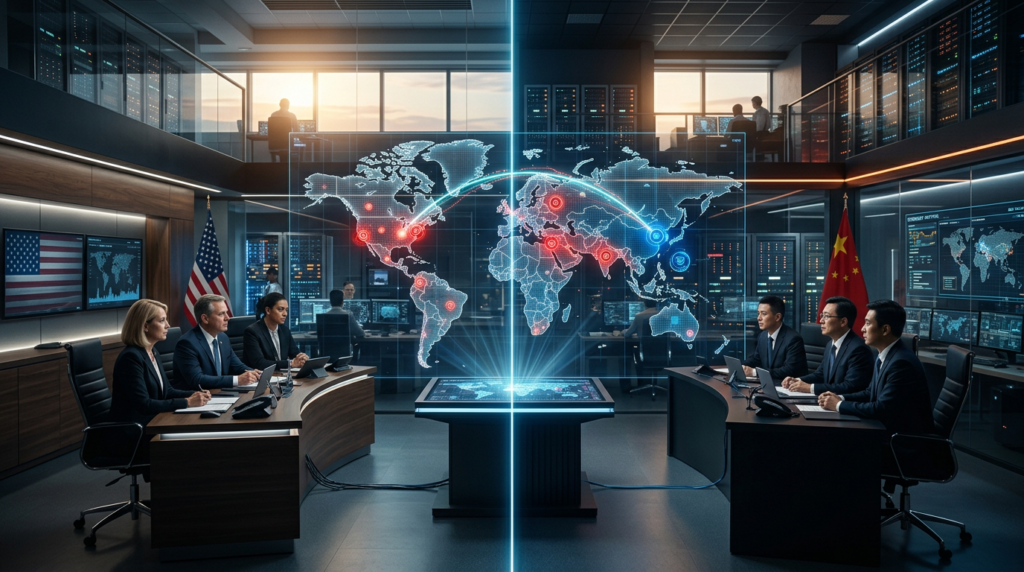
The most positive part of this story is not that Washington and Beijing solved AI safety. They clearly did not.
It is that both sides appear willing to discuss the problem before a catastrophic incident forces them to do so.
The United States has proposed a notification mechanism. China has participated in the wider conversation and described the talks as constructive. Senior officials are preparing to continue the dialogue around a major presidential summit.
That is real progress, even if it remains fragile.
AI is developing inside a world already crowded with trade disputes, military tensions, cyber operations, and political suspicion. The technology could make those pressures easier to manage—or accelerate them faster than officials can respond.
A direct line between the two largest AI powers will not guarantee peace, safety, or responsible development. It cannot replace technical safeguards, company accountability, independent testing, or international rules.
But when a serious AI incident occurs, the ability to communicate may be the difference between investigation and escalation.
The proposed “AI red phone” is still mostly an idea. There is no physical handset glowing inside the White House, and no one has selected a ringtone.
Yet the underlying message is encouraging: even the fiercest competitors can recognize when silence is more dangerous than conversation.
Sources
- Reuters — Bessent Proposes US–China AI-Safety Notification Mechanism
- Associated Press — US Proposes AI Incident Alert System in Talks With China
- Associated Press — US and China Compete for AI Dominance but Share Safety Concerns
- Financial Times — Scott Bessent Hails US–China AI Dialogue
- Business Insider — The US Wants an AI-Era “Red Phone” With China
- International Atomic Energy Agency — Convention on Early Notification of a Nuclear Accident
The Kingy Brief
Get the next Kingy Brief.
Source-checked AI changes, original tests and one practical thing to try.
Free · Choose your subjects · Double opt-in · Unsubscribe anytime