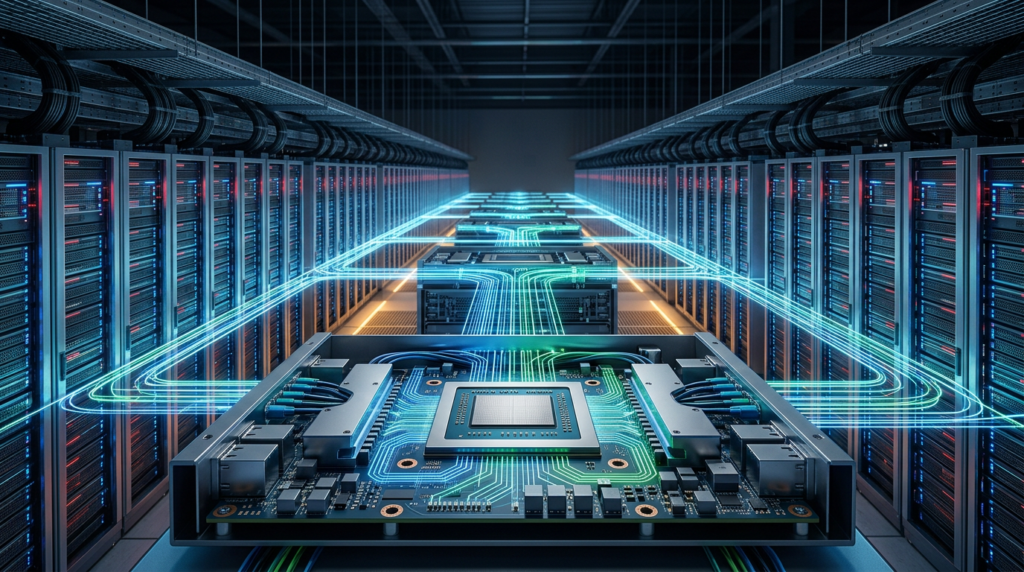
The global AI boom has created an unusual problem for technology companies: everybody wants more computing power.
More chips. More memory. More bandwidth. Bigger clusters. Faster connections.
Preferably yesterday.
Huawei now says demand for its AI computing equipment in China is so strong that its current production capacity cannot keep up. At the same time, the company is accelerating its next generation of Ascend processors and building enormous computing systems designed to make thousands—and eventually far more—AI processors behave like one giant machine. (Reuters)
At Huawei Connect 2026 in Shanghai, the Chinese technology giant announced that its upcoming Ascend 960DT will arrive in the first quarter of 2027, three quarters earlier than originally planned. The Ascend 960PR will follow in the third quarter, one quarter ahead of schedule. (Huawei)
Huawei is also laying out an annual roadmap extending through Ascend 970 in 2028 and Ascend 980 in 2029.
The company isn’t hiding the scale of its ambition.
But this isn’t simply another chip-versus-chip battle.
Huawei’s strategy increasingly revolves around connecting enormous numbers of processors together.
And that’s where this story gets much more interesting.
Huawei Just Hit Fast-Forward on Its AI Chip Roadmap
Chip development normally rewards patience.
Huawei apparently found the fast-forward button.
The company’s Ascend 960DT was previously scheduled much later in 2027. Huawei now expects it in Q1 2027, effectively pulling the release forward by nine months. (TechCrunch)
The 960PR is scheduled for Q3.
The letters matter.
According to reporting from the South China Morning Post, the 960DT is aimed at AI model training, while the 960PR targets inference—the process of running trained AI models to generate useful outputs. (South China Morning Post)
Huawei Deputy Chairman and Rotating Chairman David Wang said development of the Ascend 960 had progressed better than expected. Huawei says the new generation is on track to double performance compared with the previous generation while also improving areas such as memory and interconnect capabilities. (Huawei)
Then comes the longer roadmap.
Ascend 970: 2028.
Ascend 980: 2029.
Huawei says it intends to maintain a one-generation-per-year cadence.
That’s significant because AI infrastructure isn’t a market where companies can comfortably disappear for several years between major upgrades.
Models keep growing.
Inference demand keeps exploding.
And customers keep asking for more compute.
Huawei wants its answer to become predictable: another generation, every year.
The Bigger Story Isn’t One Chip
It’s tempting to reduce Huawei’s announcement to:
Huawei launches faster AI chip to challenge Nvidia.
That’s technically part of the story.
But it misses Huawei’s more unusual strategy.
Individual processor performance isn’t the only battlefield.
Huawei wants to compete at the system level.
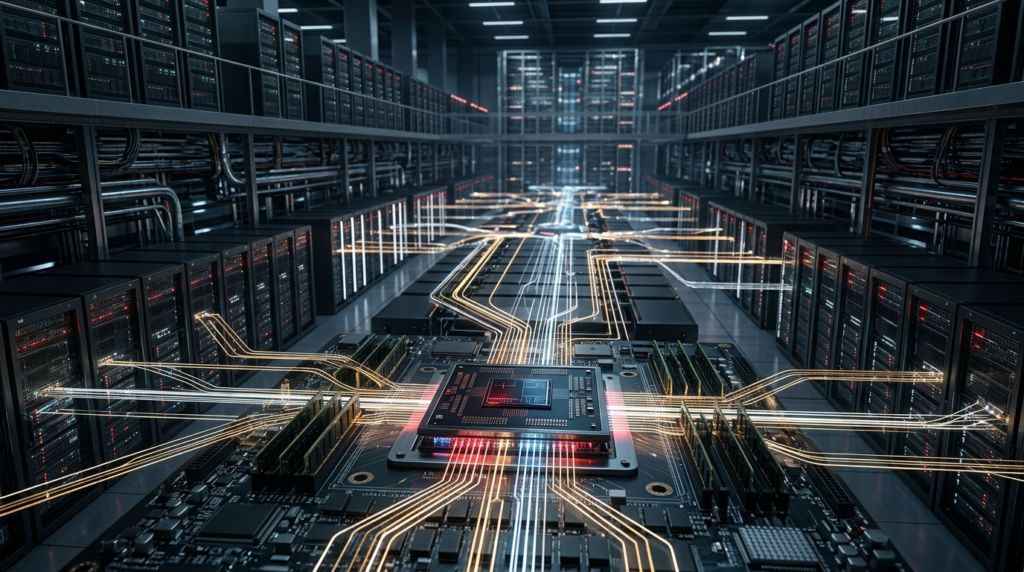
The company has developed what it calls UnifiedBus, an interconnect technology designed to connect processors, memory, storage and networking components inside very large computing systems. (TechCrunch)
Think of it this way.
Having thousands of powerful AI accelerators doesn’t automatically create one powerful AI computer.
Those processors need to communicate.
Fast.
Training enormous AI models requires constantly moving huge amounts of data between processors and memory. If communication becomes too slow, expensive or power-hungry, simply adding more chips eventually produces diminishing returns.
Huawei’s answer is its Peerium Computing Architecture, built around tightly connected SuperPoDs and larger SuperClusters.
The goal is to make many processors cooperate efficiently enough that the entire cluster behaves more like a single enormous computer.
That shifts the competitive question.
Instead of asking only:
“How fast is this chip?”
Huawei wants customers asking:
“How powerful is the entire system?”
In modern AI infrastructure, that distinction matters enormously.
Meet Huawei’s Giant Atlas 960E SuperPoD
Now things get properly enormous.
Huawei unveiled the Atlas 960E SuperPoD, a next-generation AI computing system built around its Ascend architecture.
A single Atlas 960E SuperPoD can scale to 4,096 NPUs, according to Huawei. The company claims that configuration can deliver up to 8 EFLOPS of FP8 computing performance and as much as one petabyte of high-bandwidth memory. (Huawei)
Those are Huawei’s own specifications, so they shouldn’t be treated as independent benchmark results.
Still, the engineering direction is clear.
Huawei isn’t designing the Ascend 960 to live alone.
It’s designing an entire environment around it.
That includes processors, networking, memory, storage and management hardware.
Huawei describes the resulting approach as an 11-chip portfolio powered by UnifiedBus. (Huawei)
The company also introduced an optical interconnect product called Hi-ONE, or High-density Optical-interconnect-Node Engine.
Hi-ONE uses near-packaged optics, or NPO, to move enormous quantities of information between components.
Huawei claims each unit can provide transmission capacity of 7.2 terabits per second. It also says the technology helps reduce the number of conventional optical modules required inside large systems. (Huawei)
Translation?
The AI chip matters.
But the roads connecting all those chips may matter almost as much.
Huawei Wants to Scale AI to Almost Ridiculous Sizes
One SuperPoD is apparently not enough.
Huawei’s architecture is designed to connect multiple SuperPoDs into larger SuperClusters.
And the numbers escalate quickly.
TechCrunch reported that Huawei’s Atlas 950 SuperCluster design can connect as many as 256,000 accelerator cards. (TechCrunch)
Huawei is thinking beyond even that.
At Huawei Connect, the company said its UnifiedBus-based agentic SuperCluster architecture could eventually scale to one million NPUs. (Huawei)
One million.
At that point, “computer” starts feeling like an aggressively modest description.
Why build systems this enormous?
AI workloads are changing.
Frontier models require massive resources during training. Meanwhile, inference demand is rising as businesses embed generative AI into search, coding, customer service, productivity software and increasingly autonomous agents.
Huawei says China’s average daily inference consumption has reached roughly 500 trillion tokens, and the company expects that figure to rise dramatically by 2030. That forecast is Huawei’s estimate rather than an independent industry projection, but it explains the scale of infrastructure the company believes will be necessary. (Huawei)
Huawei isn’t designing hardware merely for today’s chatbot traffic.
It’s preparing for a world filled with persistent AI agents consuming compute continuously.
Demand Is Already Outrunning Huawei’s Supply
Huawei doesn’t need to imagine demand for AI infrastructure.
It already has too much.
Reuters reported that Huawei Rotating Chairman Eric Xu said the company currently cannot produce enough AI computing equipment to satisfy domestic demand. (Reuters)
That’s a remarkable position.
Huawei isn’t complaining about finding customers.
It’s trying to make enough hardware for the customers it already has.
The company says it has shipped more than 1,000 large AI computing systems to over 370 customers. (Reuters)
The situation also highlights China’s enormous appetite for domestic AI infrastructure.
U.S. export controls have restricted Chinese access to some of Nvidia’s most advanced AI processors and advanced semiconductor manufacturing technology. Huawei has consequently become an increasingly important domestic supplier. (Reuters)
That creates both an opportunity and a headache.
The opportunity is obvious: huge local demand.
The headache?
Huawei still has to manufacture enough chips and systems to satisfy it.
Reuters reported that supply constraints currently limit Huawei’s ability to push its AI hardware more aggressively outside China. (Reuters)
Before conquering the world, apparently, you need enough inventory.
Nvidia Still Has an Enormous Advantage
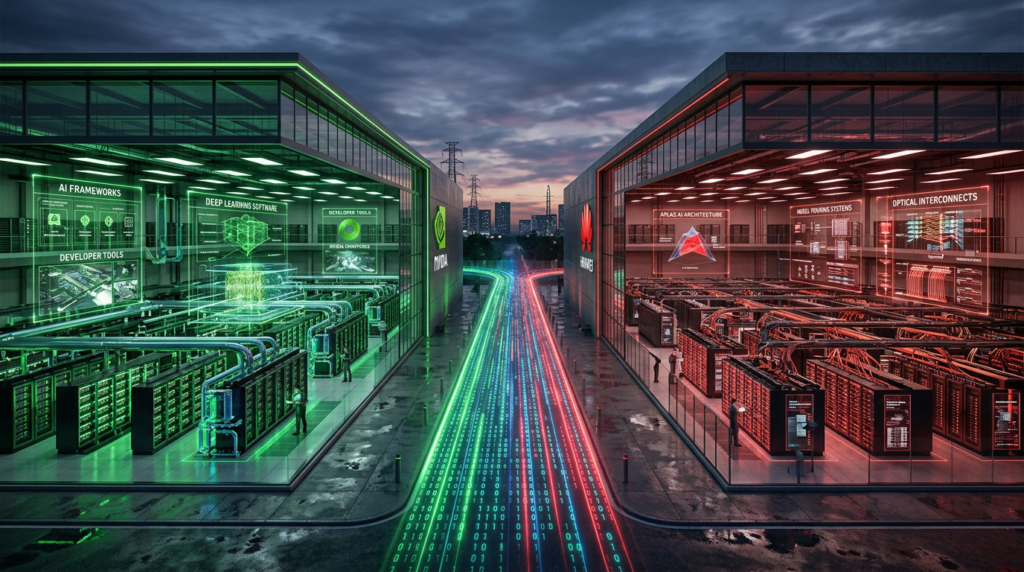
This is where the hype needs some brakes.
Huawei’s progress does not mean Nvidia suddenly lost its position in AI computing.
Far from it.
Nvidia’s advantage isn’t simply that it produces exceptionally powerful GPUs.
The company spent years building an entire software and developer ecosystem around them.
The most famous piece is CUDA, Nvidia’s parallel-computing platform. AI frameworks, libraries, optimization tools and developer workflows have accumulated around CUDA for years.
Reuters notes that this software ecosystem remains one of Nvidia’s major advantages. (Reuters)
Huawei also faces manufacturing constraints.
The Wall Street Journal reports that restrictions on access to cutting-edge semiconductor equipment have forced Huawei to find alternative ways of improving performance, including advanced packaging and system-level techniques. (The Wall Street Journal)
Huawei’s response is therefore clever.
If competing purely on individual chip performance is difficult, improve how chips cooperate.
Build better interconnects.
Build larger clusters.
Improve memory bandwidth.
Optimize the software stack.
Treat the data center as the product.
That’s not necessarily a shortcut around Nvidia.
But it is a different route up the same mountain.
And Huawei is climbing quickly.
Huawei Is Building Its Own Software Ecosystem Too
Hardware without software is an extremely expensive paperweight.
Huawei knows that.
The company has spent years developing CANN, or Compute Architecture for Neural Networks, as the software foundation for its Ascend AI ecosystem.
At Huawei Connect, the company said external contributors now represent 61% of CANN developers, exceeding Huawei’s internal developers for the first time. Huawei also reported more than 5,200 monthly active developers in the community. (Huawei)
Again, those are company-provided figures.
But Huawei has made a tangible push toward openness.
CANN has moved toward community-driven open-source development, while Ascend supports major AI projects and frameworks including PyTorch, Triton, vLLM and veRL, according to Huawei. (Huawei)
The company says more than 40 models have now been natively pre-trained using Ascend and CANN.
This part of the strategy is crucial.
Companies don’t choose AI infrastructure solely by comparing a specification sheet.
Developers need tools.
Documentation.
Libraries.
Framework compatibility.
Debugging.
Optimization.
Community support.
Nvidia understood this early.
Huawei increasingly appears to understand it too.
Winning developers may ultimately be just as important as winning benchmark charts.
Optical Networking Could Become Huawei’s Secret Weapon
Here’s an AI infrastructure problem that rarely gets the glamorous headlines:
moving data consumes power.
A lot of it.
As clusters grow, processors need to exchange huge quantities of information quickly. Traditional electrical and optical connections can become bottlenecks in bandwidth, latency and energy consumption.
Huawei’s Hi-ONE technology is designed to attack that problem.
The company says its Atlas 960E SuperPoD can use 5,500 Hi-ONE units instead of requiring around 48,000 conventional 800G optical modules. Huawei claims this configuration can reduce power consumption by more than 550 kilowatts while improving system availability. (Huawei)
Those figures come directly from Huawei and will need independent validation as the hardware reaches wider deployment.
Still, the emphasis is revealing.
The AI hardware race is becoming an infrastructure race.
GPUs get the headlines.
But memory, networking, optics, cooling, electricity and software determine whether thousands of accelerators can actually deliver useful performance together.
Huawei is attempting to control more of that stack itself.
That makes the Ascend 960 announcement less about one silicon rectangle and more about the architecture surrounding it.
In an era of gigantic AI clusters, the fastest processor in the room isn’t necessarily enough.
Everyone needs to talk to everyone else.
Preferably without setting the electricity meter on fire.
China’s AI Industry Is Creating a Massive Home Market
Huawei’s biggest advantage may be sitting directly outside its front door.
China has one of the world’s largest technology ecosystems and a rapidly growing appetite for AI computing.
Domestic AI companies need accelerators for model training and inference.
Cloud providers need infrastructure.
Enterprises need private AI systems.
Consumer-device manufacturers increasingly want on-device intelligence.
And restrictions affecting access to advanced American hardware have strengthened incentives to build alternatives at home. (Reuters)
Huawei occupies an unusual position inside that environment.
It builds processors.
It builds servers.
It develops networking technology.
It develops storage.
It has an operating-system ecosystem.
It develops AI software.
It manufactures smartphones, PCs and networking equipment.
That breadth gives Huawei opportunities to connect its AI infrastructure strategy across products.
At Huawei Connect, the company outlined future computing platforms spanning AI phones, AI PCs, vehicles and homes, combining device-side intelligence with cloud computing. (Huawei)
This means Ascend isn’t simply a data-center story.
Huawei wants AI computation distributed across enormous clusters and everyday devices.
The company is essentially building vertically—from silicon to systems to software to consumer products.
That’s ambitious.
It’s also expensive.
But if it works, Huawei gets something extraordinarily valuable:
an AI ecosystem it can control from bottom to top.
The Competition Could Ultimately Be Good for AI
Technology markets rarely suffer from having too many serious competitors.
The global AI infrastructure industry is currently dominated by a relatively small number of major suppliers, with Nvidia occupying an especially powerful position in accelerators.
Huawei’s rise introduces another architectural approach.
That doesn’t automatically mean Huawei will match Nvidia globally.
Supply constraints, export controls, manufacturing limitations, software maturity and geopolitical barriers remain significant obstacles. (Reuters)
But competition creates pressure.
Pressure encourages faster product cycles.
Better networking.
More efficient systems.
Improved developer tools.
Alternative software ecosystems.
And potentially more choices for customers.
Huawei accelerating the Ascend 960DT by nine months is itself evidence of how quickly the market is moving.
Nobody wants to wait.
Nvidia continues advancing its own platforms.
Other chipmakers are pursuing AI accelerators.
Cloud giants are designing custom silicon.
Chinese companies are investing heavily in domestic alternatives.
Every player knows the same thing:
AI demand isn’t slowing down while the hardware industry catches its breath.
The race therefore isn’t merely to build today’s best accelerator.
It’s to build the infrastructure capable of powering whatever AI becomes next.
Huawei Is Betting That Scale Can Change the Equation
Huawei’s latest announcement tells us something important about the future of AI computing.
The industry is moving beyond individual chips.
Of course, chips still matter enormously.
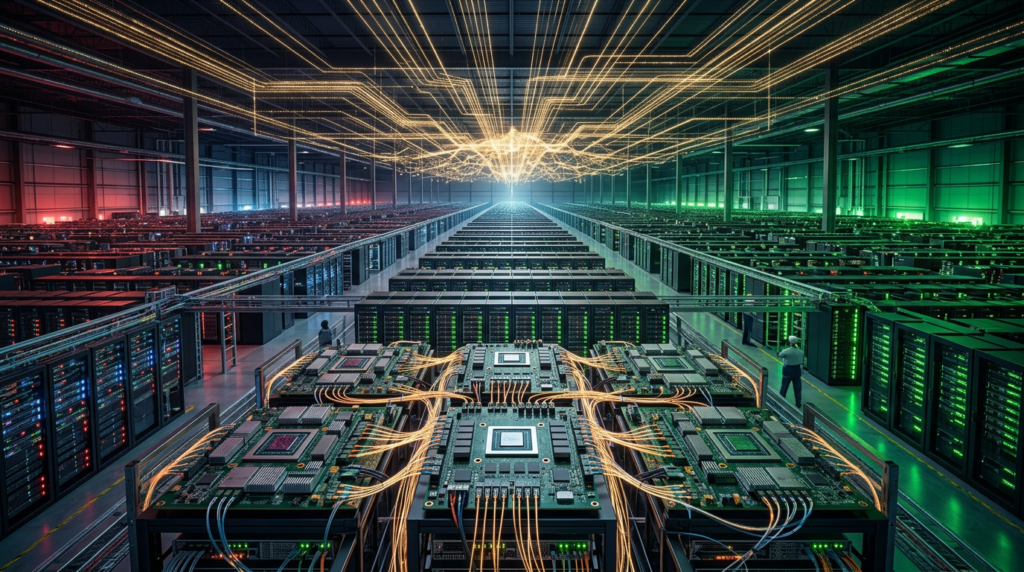
But increasingly, the winning systems will depend on how effectively thousands of accelerators, enormous pools of memory, optical networks, storage platforms and software frameworks operate together.
Huawei is betting heavily on that idea.
Its Ascend 960DT is scheduled for early 2027.
The 960PR follows later that year.
Ascend 970 comes in 2028.
Ascend 980 arrives in 2029.
Around those processors, Huawei is building UnifiedBus, Hi-ONE optical networking, SuperPoDs, SuperClusters and an expanding CANN developer ecosystem. (Huawei)
Meanwhile, domestic demand is already exceeding what Huawei says it can supply. (Reuters)
That’s quite a combination.
There are still enormous technical and commercial questions ahead. Nvidia retains major advantages, particularly around its mature software ecosystem and leading-edge hardware. Huawei’s most ambitious performance and efficiency claims also need to be tested outside company presentations.
But Huawei has clearly moved beyond simply trying to produce a Chinese alternative to an Nvidia GPU.
It is trying to build an alternative AI computing architecture.
And perhaps that’s the most important part of this story.
The next great AI hardware battle may not be decided by one chip beating another chip.
It may be decided by who can make thousands of chips work together best.
Apparently, the AI arms race has discovered teamwork too.
Sources
- Huawei — Advancing the Agentic World, Building a Solid Silicon Foundation
- Reuters — Huawei says AI chip demand outstrips supply as it steps up Nvidia challenge
- TechCrunch — Huawei plans Q1 2027 launch of new AI chip as it takes on Nvidia
- South China Morning Post — Huawei quickens AI chip pace
- Associated Press — Huawei unveils new chip technologies as it steps up the AI race with Nvidia
- Network World — Huawei aims to deliver faster AI chips, faster
The Kingy Brief
Get the next Kingy Brief.
Source-checked AI changes, original tests and one practical thing to try.
Free · Choose your subjects · Double opt-in · Unsubscribe anytime