
The Nvidia CEO isn’t mincing words. If China’s hottest AI lab ditches American chips for Huawei’s hardware, he says it would be “a horrible outcome” for the United States. Here’s why that matters — a lot.

The Warning Nobody Saw Coming
Picture this. You’re Jensen Huang — CEO of Nvidia, the most valuable company in the AI supply chain, worth over $3 trillion. Your chips power virtually every major AI model on the planet. Life is good.
Then someone asks you about DeepSeek running on Huawei chips.
Suddenly, the leather jacket doesn’t feel so cool anymore.
On the Dwarkesh Podcast on Wednesday, April 16, Huang didn’t hold back. He called the prospect of DeepSeek optimizing its next-generation AI models on Huawei’s chips “a horrible outcome” for the United States. Not a bad outcome. Not a concerning outcome. A horrible one.
That’s a strong word from a man who usually speaks in superlatives about his own products. So what exactly is going on? Buckle up, because this story is wild.
Meet the Players: DeepSeek, Huawei, and the Chip War Nobody Asked For
Let’s set the stage. DeepSeek is China’s most capable AI lab. It burst onto the global scene in late 2024 with its V3 model — trained on just 2,048 Nvidia H800 GPUs — and shocked the AI world by matching or beating models that cost orders of magnitude more to build. Then came R1, its reasoning model, which went toe-to-toe with the best American AI had to offer.
The kicker? DeepSeek did all of this on a shoestring budget, with chips that were already banned from sale to China.
Now DeepSeek is gearing up to launch V4 — a multimodal foundation model expected to drop later this month. And this time, the rumor mill is spinning hard. The Information reported that V4 will run on Huawei’s brand-new Ascend 950PR processor. That’s not just a hardware swap. That’s a declaration of independence from the American tech stack.
Huawei, for its part, is pushing hard to become China’s answer to Nvidia. Its Ascend chip line has been steadily improving, and the company is targeting 750,000 AI chip shipments in 2026. It’s not Nvidia-level yet — not even close — but it’s moving fast.
The CUDA Moat: America’s Secret Weapon

Here’s the thing most people miss when they talk about the chip war. It’s not just about the hardware.
Nvidia’s real superpower isn’t the H100 or the Blackwell GPU. It’s CUDA — the software framework that Nvidia spent two decades building into the DNA of AI development. When researchers write AI code, they write it for CUDA. When startups build products, they build on CUDA. When governments invest in AI infrastructure, they buy Nvidia GPUs because that’s what the software demands.
CUDA is the moat. The chips are just the castle.
Export controls can stop Nvidia hardware from reaching China. But as long as Chinese labs wrote their software for CUDA, they stayed dependent on the Nvidia ecosystem — even when using alternative processors. It was a second layer of American control, invisible but powerful.
DeepSeek’s move to CANN — Huawei’s competing software framework — threatens to drain that moat entirely. The lab has spent months rewriting its core code to work with Huawei’s ecosystem. If V4 launches successfully on Ascend chips, DeepSeek won’t just be using different hardware. It will have cut the software cord too.
That’s what Huang is really worried about. And honestly? He’s right to be.
“China Will Become Superior to the US”
Huang didn’t just say the Huawei-DeepSeek combo would be bad for business. He went further. He said that if future AI models get optimized for Chinese hardware and then spread globally, China “will become superior to” the United States in AI.
Think about what that means. AI is not just a tech product. It’s infrastructure. It’s national security. It’s economic leverage. Whoever sets the global standard for AI development controls the rules of the game for decades.
Right now, America sets those rules. CUDA is the standard. Nvidia is the supplier. American labs lead the frontier. But standards can shift — and they shift fast when a better or cheaper alternative emerges.
Huang told the Dwarkesh Podcast that even if China had inferior chips, it could still catch up with the US in AI development. Why? Because China has “abundant energy” and a “large pool of AI researchers.” Raw silicon performance is just one variable. Talent, optimization, and energy availability can compensate for hardware gaps — especially when the gap is closing.
That’s a sobering admission from the CEO of the company that makes the best chips on Earth.
But Wait — Huawei’s Chips Aren’t That Good, Right?
Fair point. Let’s be honest about the hardware reality.
Huawei’s Ascend 910C — the predecessor to the 950PR that V4 will reportedly run on — delivers roughly 60% of the inference performance of Nvidia’s H100. And the H100 is already two generations behind Nvidia’s current best. American chips are approximately five times more powerful than their Chinese equivalents today. By 2027, that gap is projected to widen to 17 times.
So why is Huang worried? Because the gap in training performance doesn’t necessarily translate to a gap in commercial value.
Here’s the distinction that matters: training is the most compute-intensive phase of AI development. Inference — where models actually serve users and generate revenue — is less demanding. DeepSeek’s R2 model ran into serious trouble when it tried to train on Huawei hardware. Stability issues forced the lab to revert to Nvidia GPUs for training while using Huawei chips only for inference.
So Huawei chips can’t yet handle the hardest AI workloads. But they can handle the profitable ones. And if V4 performs competitively at inference on Ascend silicon, it proves the concept. Other labs will take notice. The ecosystem starts to shift.
The Export Control Paradox Nobody Talks About
Here’s where the story gets genuinely ironic.
The US government has spent years tightening chip export controls to limit China’s AI capabilities. The H800 — the chip DeepSeek used to train V3 — was banned from sale to China in 2023. The H100 was restricted even earlier. The goal was to keep China’s AI development behind America’s.
But something unexpected happened. The restrictions didn’t slow DeepSeek down. They pushed it to innovate around the constraints. And now, the lab is on the verge of launching a frontier model that doesn’t need American chips at all.
Nvidia actually restarted production of the H200 — a more powerful chip — for sale in China under the Trump administration’s eased restrictions. But China has been blocking H200 imports to protect Huawei’s domestic chip business. Nvidia’s CFO confirmed the company has recorded zero revenue from China H200 sales.
Let that sink in. The US eased restrictions to sell chips to China. China said no thanks. Because China is building its own.
The export controls designed to contain China’s AI ambitions may have inadvertently accelerated the development of a fully independent Chinese AI stack. That’s not a great outcome for anyone who wanted the controls to work.
US Lawmakers Are Turning Up the Heat
While Huang was sounding the alarm on the podcast, US lawmakers were holding their own fireside chat — and it wasn’t friendly.
On Thursday, lawmakers and experts accused China of buying “what they can” and stealing “what they cannot” in the AI industry. They called on the government to evaluate placing DeepSeek, Moonshot AI, and MiniMax on the entity list for export control — a designation that would effectively cut them off from American technology and partnerships.
It’s a significant escalation. DeepSeek isn’t just a competitor anymore. In Washington’s eyes, it’s a national security concern.
But here’s the uncomfortable question: if DeepSeek is already migrating away from American hardware and software, does putting it on the entity list actually change anything? You can’t restrict access to technology a company has already stopped using.
The policy tools designed for the old world — where Chinese AI labs depended on American chips — may not be fit for purpose in a world where they don’t.
What Happens If V4 Actually Works?
This is the question everyone in the AI industry is quietly asking. DeepSeek’s V4 is expected to launch later this month. If it runs competitively on Huawei’s Ascend 950PR, the implications cascade fast.
First, it validates the Huawei ecosystem as a viable alternative to Nvidia for AI inference. Other Chinese labs — and potentially labs in countries that can’t access American chips due to export restrictions — will start paying attention.
Second, it weakens the argument for maintaining export controls. If the controls haven’t stopped DeepSeek from building frontier AI, what exactly are they protecting?
Third, and most importantly, it starts to erode the CUDA moat. Not overnight. Not completely. But the process begins. Every lab that migrates to CANN is one less lab locked into the Nvidia ecosystem.
Huang’s warning is ultimately about trajectory, not today’s snapshot. Huawei isn’t about to overtake Nvidia this year. The performance gap is real. The R2 training failures showed that Chinese hardware isn’t ready for the most demanding workloads. But Huang isn’t warning about today. He’s warning about where this road leads.
The Bigger Picture: A Fork in the Road for Global AI
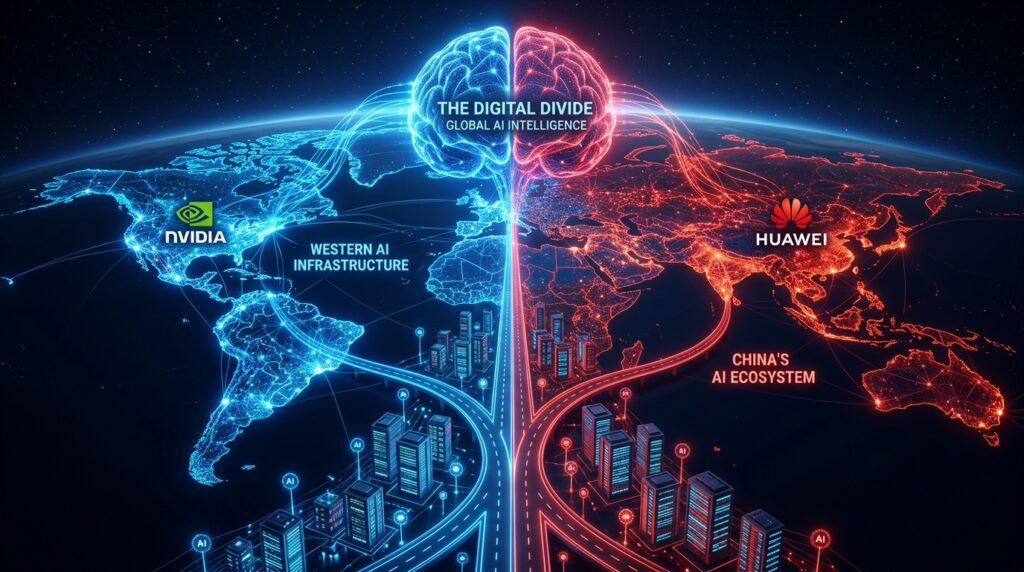
Step back and look at the full picture. The world is approaching a fork in the road for AI development.
One path leads to a world where American hardware and software remain the global standard — where CUDA is the lingua franca of AI, Nvidia is the indispensable supplier, and the US maintains its technological leverage.
The other path leads to a bifurcated world — where Chinese AI runs on Chinese chips with Chinese software, and the rest of the world has to choose which ecosystem to plug into. That’s not just a business problem. It’s a geopolitical one.
Jensen Huang has repeatedly called for more collaboration between the US and China in AI. But the political winds are blowing the other way. Lawmakers want more restrictions, not fewer. China is building its own stack, not buying into America’s.
DeepSeek’s V4 launch will be the first major test of which path the world is actually on. If a multimodal foundation model runs competitively on Huawei silicon, Huang’s warning won’t just look prescient. It will look like the most important forecast in the AI chip war so far.
The leather jacket might need to come off. Things are heating up.
Sources
- The Next Web — Nvidia’s Huang warns DeepSeek running on Huawei chips would be ‘horrible’ for the US
- Huawei Central — DeepSeek V4 with Huawei AI chips can be terrible for US: Nvidia
- Dataconomy — Nvidia CEO says DeepSeek V4 on Huawei Ascend chips is a big threat to US dominance
- South China Morning Post — Nvidia’s Jensen Huang warns Huawei chips for DeepSeek AI models would be ‘horrible’ for US
Continue Reading
Compare
- China Accuses NVIDIA of Anti-Monopoly Violations
- Cheaper Blackwell AI chip for China: A Compliant Market Strategy
Latest News
- China Investigates Nvidia’s H20 GPUs Over Spying Hardware Claims
- China’s Rapid AI Growth Threatens US Dominance – Chip Curbs Slows Them Down
- Nvidia and AMD’s $ Billions at Stake: U.S. Demands 15% Cut on China AI Chip Sales
- Alibaba Wants to Break Free From Nvidia — And Its New AI Chips Show It’s Serious
- The Great GPU War: How AMD’s OpenAI Alliance Is Reshaping the Future of AI
The Kingy Brief
Get the next Kingy Brief.
Source-checked AI changes, original tests and one practical thing to try.
Free · Choose your subjects · Double opt-in · Unsubscribe anytime