Google Wants Its New CC AI Agent to Help Run Your Entire Household
AI assistants have spent years promising to make our lives easier.
They can summarize emails. Draft documents. Plan vacations. Explain homework. Generate recipes. Remind you that the carton of milk in your refrigerator probably shouldn’t have developed its own ecosystem.
Google’s latest experiment goes considerably further.
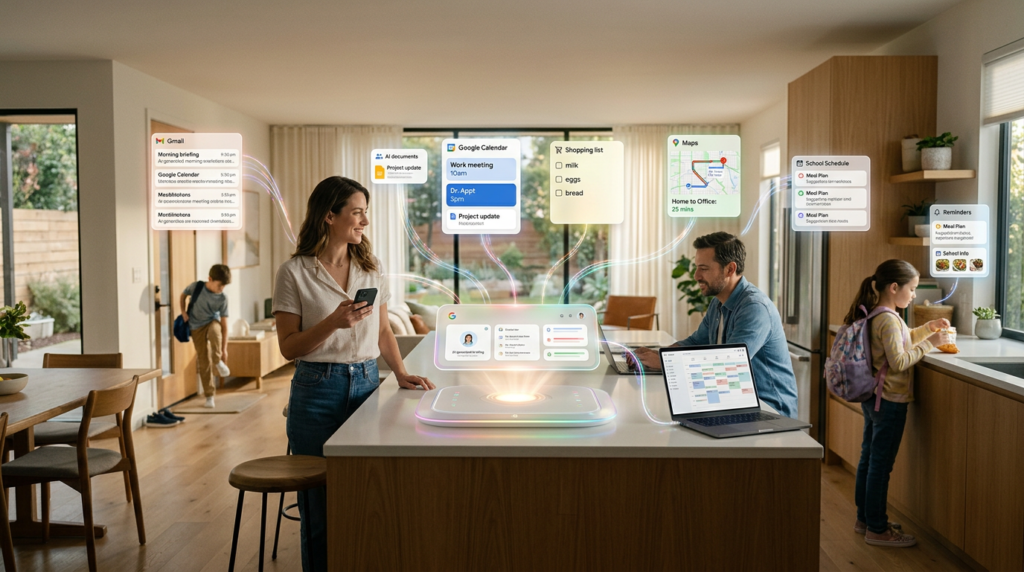
On September 17, Google Labs announced that CC, its experimental Gemini-powered AI agent, is expanding from a personal productivity assistant into a shared agent designed for families and households. Up to six people can contribute information to the same CC, allowing the AI to coordinate calendars, track tasks, organize household information and even complete certain administrative chores. (blog.google)
The ambition is surprisingly big.
Google isn’t simply putting another chatbot in your home. It’s experimenting with an AI that sits between multiple family members, understands shared responsibilities and actively helps coordinate everyday life.
School schedules. Soccer practice. Vet appointments. Grocery lists. Registration forms. Dinner plans.
Basically, the logistical chaos previously known as “Tuesday.”
And beneath the friendly family-organizer pitch sits something much more important.
CC offers a glimpse of Google’s vision for what AI agents could eventually become: persistent digital assistants that don’t simply answer questions but understand context, remember information, use software and take action.
From Personal Assistant to Family Assistant
CC isn’t completely new.
Google originally introduced the experiment in December 2025 as a personal productivity agent built with Gemini. The original version connected to services including Gmail, Calendar and Drive and produced a morning “Your Day Ahead” briefing containing schedules, tasks and useful updates. (blog.google)
Google later brought the daily briefing concept into the Gemini app as Daily Brief.
But early users apparently wanted something broader.
Google Labs senior product manager Tom Shane said one of the most common requests was for CC to help manage busy households. That’s tricky because family information rarely exists neatly in one place.
Mom has the school email.
Dad has the vet appointment.
Someone has the soccer schedule.
Someone else has absolutely no idea what’s happening but has confidently promised to be there at 4:30.
Google’s answer is shared context.
The redesigned CC can work with as many as six household members, each contributing information they choose to share. The agent then organizes that information into a common operational picture for the household. (blog.google)
It’s a deceptively important transition.
CC isn’t just learning about you anymore.
It’s learning how a group functions.
Everyone Gets a “Your Day Ahead” Brief

One of CC’s central features remains its morning briefing.
But now it’s communal.
Every morning, CC can produce a shared Your Day Ahead summary showing family members what needs to happen, where people need to be and what tasks remain outstanding. It can also report what it completed the previous day. (blog.google)
Consider the amount of information involved in an ordinary household.
There’s an email announcing an early school dismissal.
A sports coach changes practice time.
The veterinarian sends an appointment reminder.
Someone needs groceries.
A permission slip needs completing.
And one heroic family member is somehow expected to remember all of it.
CC attempts to pull those scattered details together.
The agent can identify important dates and tasks from information family members share and place them into a common Calendar or Tasks list. When plans change, Google says CC can help keep those records updated. (blog.google)
That’s different from asking Gemini, “What’s on my calendar?”
The AI is increasingly responsible for assembling and maintaining the underlying picture.
In other words, the assistant isn’t simply reading the family schedule.
It’s helping operate it.
CC Gets Its Own Google Account
Here’s one of the most interesting design choices.
CC gets its own verified Google Account.
That gives the agent a distinct identity inside the household instead of making it appear to operate as one particular family member. (blog.google)
Think of CC almost like another member of the group—although hopefully one that never leaves wet towels on the bathroom floor.
Its account also creates a clearer permissions structure.
Google says CC responds only to members of the group. It won’t take action or share information outside that group without permission. (blog.google)
That’s particularly important because a family AI agent potentially handles much more sensitive context than an ordinary chatbot conversation.
Calendars reveal movements.
Emails contain personal information.
Documents can contain addresses, schedules and financial details.
Google therefore isn’t simply pooling everyone’s accounts into one giant Gemini buffet.
Each person decides what CC can access.
That permission model could become one of the defining challenges for shared AI agents.
A useful family assistant needs context.
But family members still need individual privacy.
Google is trying to give CC enough information to understand the household without assuming that everything belonging to one person automatically belongs to everybody.
You Decide What CC Gets to Know
Google provides several ways to feed information into CC.
One is essentially an automatic sharing rule.
Users can designate particular email senders whose messages should routinely be available to the agent. A parent could, for example, automatically share messages from a child’s school, an airline or a local activity center. (blog.google)
Google says users receive a private weekly list of new senders that they can decide to share—or ignore.
One-off information works differently.
Receive a birthday invitation?
Forward it to CC.
Someone sends a soccer schedule?
Share it.
You can even send CC a photo containing relevant information through email or Google Chat. CC can then use that information to update the household calendar. (blog.google)
Users can also share Drive files, folders and calendars directly with the agent.
This sounds mundane until you consider what Google is building.
CC doesn’t require every piece of household information to originate inside one specialized app.
Instead, it tries to act as an intelligent layer over information already flowing through Gmail, Chat, Drive and Calendar.
And that’s where Google’s enormous ecosystem starts becoming very useful.
Google Already Has the Apps an Agent Needs
Plenty of companies can build an impressive AI chatbot.
Google possesses something harder to replicate.
Infrastructure.
Gmail.
Calendar.
Drive.
Docs.
Sheets.
Chat.
Maps.
And, of course, Gemini.
CC connects directly with many of the Google services people already use. (blog.google)
That means the agent doesn’t need to live inside an isolated chat window.
It can potentially understand an email, convert its information into a calendar event, create a document and incorporate travel information from Maps into the resulting plan.
Google gives a great example involving back-to-back activities.
CC can check live driving times through the Google Maps API, helping a family determine whether its schedule actually makes sense. (blog.google)
That’s exactly the kind of small logistical problem humans deal with constantly.
Calendar says Activity A ends at 4:00.
Activity B starts at 4:15.
Looks fine.
Except they’re 35 minutes apart.
A useful agent needs to understand more than isolated data points.
It needs relationships between them.
Google’s ecosystem gives CC plenty of relationships to work with.
CC Can Actually Do the Boring Stuff

The most significant difference between a chatbot and an agent is action.
Chatbots primarily tell you things.
Agents increasingly do things.
Google says CC can assist with household administrative work such as filling out permission slips or activity-registration PDFs, generating school-supply shopping lists and preparing weekly meal plans. (blog.google)
Suppose a registration form arrives.
Instead of merely reminding you that it exists, CC can potentially pre-fill information it already knows.
If something is missing, the agent can ask.
Once supplied, that information can help CC handle similar work more effectively later.
That begins to resemble actual delegation.
“Remind me about the form” becomes:
“Help me complete the form.”
The distinction matters.
AI companies increasingly want their products to move beyond generating text toward completing multi-step objectives.
Forms are an excellent example because they’re boring, repetitive and usually structured.
Few people wake up excited to spend Saturday afternoon copying the same contact information into another PDF.
If AI agents can reliably remove those little administrative burdens, their usefulness becomes much easier to understand.
Underneath CC Is an Isolated AI Computer
CC’s friendly household interface hides some serious technical machinery.
Google says every CC instance operates on its own isolated cloud computer.
The system runs using Google’s agentic harness, Antigravity, together with the company’s latest Gemini models. (blog.google)
That isolated environment allows CC to perform multi-step operations rather than simply generating a response.
Google says this architecture can enable tasks such as pre-filling PDF forms, checking live driving times, and creating shared Docs and Sheets. (blog.google)
Ars Technica reports that the current system uses Gemini 3.8 Flash. (Ars Technica)
This architecture tells us something important about where Google’s AI strategy is heading.
The model is only one component.
An effective agent also needs tools, permissions, memory, software access and an execution environment.
Think of Gemini as the brain.
The isolated cloud computer gives that brain somewhere to work.
Suddenly, an AI assistant isn’t just generating an answer.
It has a workspace.
That’s a much more powerful concept—and one we’re seeing increasingly across the AI industry.
Shared Memory Could Make CC More Useful Over Time
There’s another ingredient that separates CC from a traditional chatbot:
memory.
Google says CC develops shared household memory as people use it.
Importantly, the system distinguishes between information relevant to the entire household and information that belongs to an individual. (blog.google)
Maybe the family has a standard grocery list.
That’s shared.
Perhaps everyone regularly eats at several favorite restaurants.
Also potentially shared.
But an individual’s dietary preferences or local timezone might belong specifically to that person.
This distinction matters enormously for group AI.
A personal assistant can theoretically treat everything you tell it as information about one user.
A family agent can’t.
It needs to understand relationships.
Who prefers what?
Which information applies to everyone?
Who has permission to see something?
Which schedule belongs to whom?
The better CC understands those boundaries, the more useful it can become without turning the family’s information into one giant undifferentiated pile.
Persistent memory also reduces repetition.
Instead of explaining the household from scratch every morning, the agent gradually builds context.
That’s when AI assistance starts becoming genuinely personal.
The Privacy Challenge Is Impossible to Ignore
Of course, giving an AI enough information to help run a household raises obvious privacy questions.
Google appears very aware of that tension.
The company repeatedly emphasizes that users choose what they share. Each household member can modify those choices, and CC won’t communicate information outside the group or take external action without permission. (blog.google)
Ars Technica notes another important limitation: CC currently requires personal Google accounts belonging to adults aged 18 or older. (Ars Technica)
So despite Google’s description of CC as a family agent, children aren’t directly operating it under the current experiment.
In practical terms, it’s closer to an agent helping adults coordinate a household.
That’s an important distinction.
The bigger question will be whether users become comfortable sharing enough information to make agents like CC genuinely useful.
An assistant with almost no context is safer but less capable.
An assistant that understands schedules, emails, preferences and routines becomes dramatically more helpful—but requires considerably more trust.
The success of persistent AI agents may ultimately depend as much on permission design and transparency as raw model intelligence.
Google’s CC experiment gives the company an opportunity to learn exactly where users draw those lines.
This Is Where Google’s Ecosystem Becomes a Huge Advantage
Google has been building consumer software infrastructure for decades.
Now AI can potentially connect those pieces.
An email becomes a task.
A task becomes a calendar event.
A calendar event triggers a Maps travel-time check.
A document provides information for a form.
A conversation updates shared memory.
Gemini provides the reasoning layer connecting everything.
That’s a fundamentally different vision from an AI assistant that exists primarily inside a standalone chat interface.
Google isn’t starting from zero.
Millions of households already organize parts of their lives through Google products.
CC’s job is to become the connective tissue.
That also helps explain why the household is such an interesting testing ground.
Family administration contains countless small tasks that aren’t individually difficult but collectively consume enormous amounts of attention.
Remember this.
Forward that.
Schedule this.
Fill out that.
Buy these.
Check whether we can get from here to there in 20 minutes.
AI doesn’t need to solve quantum gravity to make itself useful.
Sometimes it just needs to remember that soccer practice moved to Thursday.
Don’t Expect CC Everywhere Just Yet
For now, CC remains experimental.
Google says the new family version is available on web and mobile as an early Google Labs experiment for adults in the United States with personal Google accounts. (blog.google)
Existing CC users should receive invitations to upgrade, while new users can join the waitlist.
That limited rollout makes sense.
Shared agents introduce challenges that personal assistants don’t.
Google needs to learn how families share information, how much autonomy they’re comfortable granting, which tasks work reliably and where permissions become confusing.
There’s also the question of cost.
Running an isolated cloud environment powered by Gemini for every household agent isn’t computationally trivial. Ars Technica notes that CC currently isn’t tied directly to Google’s paid AI subscriptions, leaving interesting questions about how the experiment might eventually be packaged if it expands. (Ars Technica)
But experiments are exactly where those questions belong.
Google doesn’t need CC to be perfect today.
It needs to discover whether people actually want a persistent AI agent helping coordinate their household.
Early user demand apparently suggests they might.
AI Assistants Are Starting to Become Participants

For most of the chatbot era, AI has been reactive.
You ask.
It answers.
Google CC points toward something different.
An agent that remembers.
An agent that organizes.
An agent that works across applications.
An agent that collaborates with several people.
And, with permission, an agent that takes action.
That’s a substantial shift.
Google isn’t simply asking whether Gemini can produce better answers. It’s asking whether Gemini-powered agents can become useful participants in everyday routines.
Today, that might mean sorting school emails and preparing permission slips.
Tomorrow, the same underlying idea could extend much further.
Travel planning. Household budgeting. Shopping. Appointments. Home maintenance. Shared projects. Family logistics.
The technology doesn’t need to replace anyone to become valuable.
If CC can reliably eliminate dozens of tiny administrative chores, that’s already meaningful.
And perhaps that’s the most interesting thing about Google’s latest AI experiment.
The future of artificial intelligence may not always arrive as some dramatic robot revolution.
Sometimes it arrives quietly at 7:00 in the morning with an email saying:
Here’s what everyone needs to do today.
And, by the way, I already handled the permission slip.
Sources
- Google Labs — CC is an AI agent for families and groups
- Ars Technica — Google announces new experimental CC AI agent for families
- SiliconANGLE — Google expands CC into a shared AI agent for up to six family members
- Thurrott — Google Labs CC Evolves Into an AI Agent for Families
- Google Labs — Original CC productivity-agent announcement
The Kingy Brief
Get the next Kingy Brief.
Source-checked AI changes, original tests and one practical thing to try.
Free · Choose your subjects · Double opt-in · Unsubscribe anytime