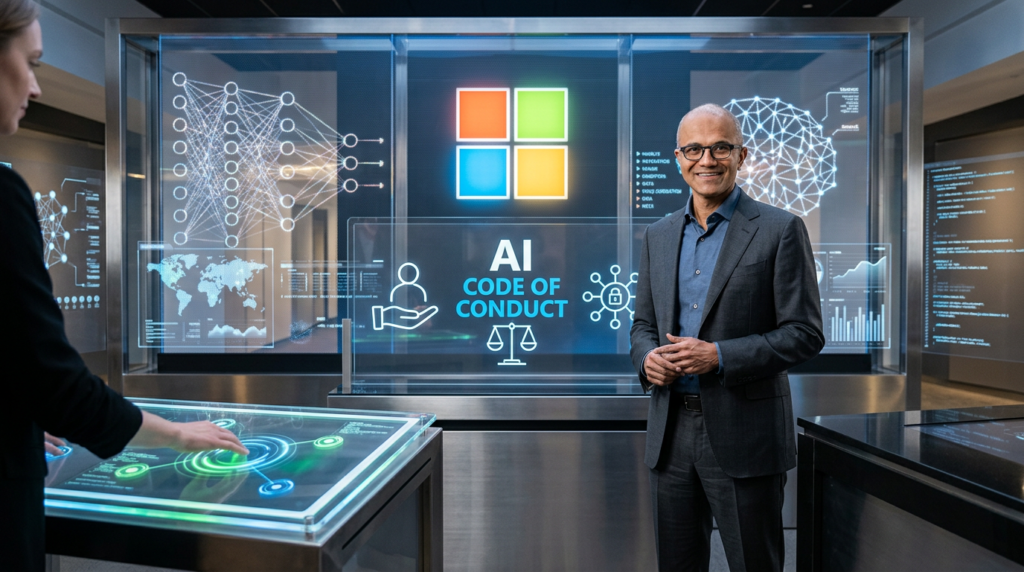
The artificial intelligence race has spent years operating under a simple assumption: faster is better.
Build a smarter model. Give it more tools. Add more compute. Release the next version before somebody else does.
Now Microsoft CEO Satya Nadella is injecting another word into that vocabulary: control.
Microsoft plans to publish a Code of Conduct for its first-party MAI models and invite public consultation on the framework, according to reporting following comments from Nadella on September 13. At the same time, the Microsoft chief has thrown his support behind independent AI evaluation and a more deliberate approach to developing increasingly powerful systems. (Unite.AI)
His central argument is surprisingly straightforward. Advanced AI should remain useful to people and, crucially, under human control.
That might sound obvious. In 2026, however, it lands in the middle of a much bigger conversation.
AI companies are racing toward systems capable of handling longer tasks, using tools, writing software and acting with increasing autonomy. Meanwhile, some of the industry’s biggest names are openly debating whether frontier development needs stronger guardrails.
Microsoft’s response isn’t to abandon the race.
Instead, it wants to help write some rules for how that race should be run.
And this time, Microsoft says it wants the public involved.
Microsoft Wants a Code for Its Own AI Models
The most concrete part of Microsoft’s announcement concerns its MAI family of first-party models.
Nadella said Microsoft will publish a Code of Conduct covering those models and put it forward for public consultation. Reporting on the announcement says Microsoft intends the framework to address behavioral expectations for its own AI systems. (Unite.AI)
That’s an important distinction.
Microsoft isn’t simply asking governments, competitors or researchers to decide what responsible AI should look like. It’s proposing rules for models coming from Microsoft’s own AI organization.
Those models have become increasingly important to Microsoft’s broader strategy.
At Build 2026, Microsoft expanded the MAI family with seven new models, spanning different AI capabilities. Microsoft’s developer material describes models including MAI-Thinking-1, MAI-Image-2.5, MAI-Code-1, MAI-Voice-2 and MAI-Transcribe-1.5. (Microsoft Developer)
In other words, this isn’t a theoretical exercise about some hypothetical Microsoft superintelligence.
Microsoft is developing its own expanding model ecosystem right now.
The proposed Code of Conduct could therefore become part of the framework governing how increasingly capable MAI systems behave and how Microsoft approaches their deployment.
The public-consultation component makes things particularly interesting.
Instead of Microsoft writing everything behind closed doors and emerging with a finished rulebook, the company is signaling that outsiders should have an opportunity to scrutinize its approach.
For a company building some of the world’s most widely deployed AI products, that’s worth watching.
Nadella’s Red Line: Humans Stay in Charge
The announcement becomes much more significant when placed alongside Nadella’s broader comments about advanced AI.
His position is remarkably clear.
“If the AI we build is not helping humanity and under human control, it’s not worth pursuing.”
That is how Anadolu Agency reported Nadella’s remarks. (Anadolu Ajansı)
There’s a lot packed into that sentence.
Nadella isn’t arguing that powerful AI shouldn’t exist. Microsoft remains one of the world’s biggest investors in artificial intelligence infrastructure, models, cloud computing and AI products.
Instead, he’s placing conditions on what success should mean.
An AI system becoming dramatically more capable isn’t automatically a victory. It also needs to produce meaningful benefits while remaining subject to human oversight.
That distinction matters as the industry’s vocabulary increasingly moves beyond chatbots.
Today’s frontier systems can already reason across problems, generate code, interact with software and operate through agentic workflows. Microsoft itself has described the broader transition from individual models toward systems composed of models, agents, memory and tools. (sn scratchpad)
As those systems become more autonomous, the question changes.
It is no longer simply: How intelligent is this model?
It becomes: What can this system actually do without someone continuously supervising it?
And then comes the uncomfortable follow-up.
Who ultimately has the final say?
Nadella’s answer is humans.
The AI Industry Is Suddenly Talking About the Brakes
Microsoft’s announcement isn’t happening in isolation.
The broader AI industry is having one of its most significant debates yet about the speed of frontier development.
Anthropic CEO Dario Amodei recently proposed what he called “We Must Pace the Frontier,” advocating a more measured approach that includes independent third-party evaluation and greater international coordination around advanced AI. (MarkTechPost)
That conversation quickly expanded.
OpenAI’s Sam Altman, Google’s Demis Hassabis, Elon Musk and other prominent figures have participated in the wider debate over whether increasingly powerful systems require stronger safeguards or slower deployment. (Business Insider)
Not everybody agrees.
Critics have questioned whether voluntary commitments from the companies building frontier AI go far enough. Others worry that rules designed by large incumbents could make life harder for smaller developers and open-source projects. (The Guardian)
That’s an important counterargument.
If only Microsoft, OpenAI, Anthropic and Google can afford giant safety teams, expensive evaluations and complicated compliance programs, regulation could inadvertently strengthen the companies already dominating AI.
Microsoft’s proposed public consultation could therefore become more important than it initially sounds.
The details will determine whether the Code of Conduct becomes a meaningful accountability mechanism or simply another collection of high-level principles.
For now, though, something unusual is happening.
The companies racing hardest to build increasingly capable AI systems are also talking much more openly about where the brakes should be.
Independent AI Evaluators Could Become a Big Deal
One particularly consequential part of Nadella’s position concerns independent evaluation.
Today, AI companies extensively test their own models before release. They evaluate capabilities, vulnerabilities and unwanted behavior, while outside researchers and organizations also conduct their own testing.
But increasingly powerful AI raises an obvious problem.
Should the company trying to win the race also be the only referee deciding whether its newest model is safe enough to deploy?
Nadella has expressed support for independent evaluators as part of a more deliberate approach to advanced AI development. (Anadolu Ajansı)
The idea resembles systems used elsewhere.
Financial companies face outside audits. Medicines undergo regulatory testing. Aircraft manufacturers don’t simply announce that a new passenger jet looks perfectly safe and hand over the keys.
Frontier AI could eventually develop its own version of that infrastructure.
Independent evaluators might test whether advanced models can circumvent safeguards, manipulate users, conduct sophisticated cyber operations or behave unpredictably when given greater autonomy.
Exactly how such a system would work remains unsettled.
Who certifies the evaluators? Which tests matter? What happens when companies disagree with the results? How much testing information becomes public without revealing security-sensitive details?
Those are difficult questions.
But the underlying principle is simple: trust shouldn’t depend entirely on “we tested our own homework.”
If Microsoft throws its weight behind independent evaluation, that idea gains a powerful corporate supporter.
Microsoft Isn’t Calling for AI to Stop

This is where the story requires some nuance.
Microsoft has not suddenly become anti-AI.
Quite the opposite.
The company continues investing heavily across the entire AI stack: models, Copilot products, Azure infrastructure, developer tools, agents and data centers.
Nadella has also argued for broad access to AI and warned against allowing control over the technology to become concentrated among only a handful of players. Recent reporting characterized his position as supporting wider deployment while maintaining human oversight. (LatestLY)
That’s a different philosophy from simply freezing frontier development.
Think of it less like Microsoft asking everyone to park their race cars and more like demanding better brakes, stricter track rules and someone besides the drivers inspecting the vehicles.
The distinction matters.
AI is already producing practical value in software development, scientific research, business automation, education and other fields. Simply halting progress would carry its own costs.
Microsoft’s argument instead appears to be that capability and responsibility need to advance together.
That fits Nadella’s broader 2026 message.
Earlier this year, he argued that AI needs to demonstrate real-world value rather than merely producing impressive demonstrations. He has repeatedly emphasized systems and practical deployment rather than treating raw model intelligence as the only metric that matters. (LinkedIn)
That’s essentially the philosophy Microsoft is now applying to the superintelligence debate.
Powerful is good.
Useful is better.
Powerful, useful and controllable is the goal.
Why Microsoft’s MAI Models Matter Here
For years, Microsoft’s AI identity was heavily intertwined with OpenAI.
That relationship remains important, but Microsoft has increasingly developed a model strategy that doesn’t depend entirely on one external partner.
Its own MAI family is central to that shift.
Microsoft expanded the lineup substantially at Build 2026, while its Foundry ecosystem offers developers access to models from numerous providers, including OpenAI, Anthropic, Mistral, DeepSeek, xAI and Nvidia alongside Microsoft’s own models. (Microsoft Developer)
That makes the proposed Code of Conduct particularly interesting.
Microsoft isn’t merely operating a cloud platform where other companies supply the intelligence. It is increasingly both platform provider and model builder.
Rules governing MAI could therefore reveal how Microsoft thinks its own frontier systems should behave.
What happens when an AI agent encounters an ambiguous instruction?
Which tasks should require additional authorization?
What capabilities deserve stronger restrictions?
How should increasingly autonomous systems communicate uncertainty?
And what level of human control should be mandatory?
We don’t yet have Microsoft’s complete public draft, so pretending we know its answers would be premature.
But that’s exactly why the consultation matters.
Once Microsoft publishes the document, researchers, developers, policymakers and users will have something concrete to examine.
Then the conversation can move beyond slogans.
Public Consultation Creates an Interesting Test
Technology companies love principles.
Accountability. Transparency. Safety. Responsibility.
Those words look fantastic on conference slides.
The difficult part comes when principles collide with commercial pressure.
Imagine Microsoft develops an MAI model that dramatically outperforms competitors but triggers concerns during external evaluations.
Does Microsoft delay it?
What happens if a competitor releases something equally capable without waiting?
That’s where governance stops being a PowerPoint presentation and becomes expensive.
Microsoft’s public consultation could help establish clearer expectations before those situations arrive.
It could also expose disagreements.
Researchers may demand stricter safeguards. Developers may worry that excessive restrictions make models less useful. Businesses may prioritize reliability and predictability. Governments may want reporting requirements.
And ordinary users might have entirely different expectations about what “human control” actually means.
That tension is healthy.
Public consultation doesn’t guarantee good policy, but it gives outsiders an opportunity to challenge assumptions before rules harden into corporate practice.
There is another benefit.
Microsoft’s sheer scale means whatever framework it eventually adopts could influence competitors.
If one major frontier developer embraces independent evaluations or specific behavioral standards, others may face pressure to explain why they haven’t.
The Code could therefore become more than an internal Microsoft document.
It could become another reference point in the emerging rulebook for frontier AI.
The Skeptics Have a Point
Of course, there’s another side to all of this.
Some critics are deeply skeptical of the sudden enthusiasm among AI executives for slowing down or regulating frontier development.
The Guardian reported criticism that voluntary industry-led proposals could amount to companies attempting to shape regulation before governments impose tougher rules. (The Guardian)
That’s not an absurd concern.
The world’s largest AI companies possess enormous computing resources, technical expertise and capital.
Complicated safety requirements might be relatively manageable for Microsoft.
A small AI startup might find the same requirements crushing.
There is also the question of enforcement.
A voluntary Code of Conduct is fundamentally different from legislation or binding regulation. Its effectiveness depends heavily on the specifics, transparency and willingness of the organization to follow its commitments when doing so becomes inconvenient.
Microsoft’s announcement should therefore be viewed as an opening move rather than the finished solution.
The company deserves attention for inviting public consultation.
But scrutiny becomes more important once the actual rules arrive.
What does Microsoft promise?
What remains vague?
Who checks compliance?
What happens when something goes wrong?
Those questions will tell us much more than the announcement itself.
For now, Microsoft has opened the door.
The interesting part begins when everyone gets to inspect what’s behind it.
From “Who Wins AI?” to “How Should AI Win?”
For most of the generative-AI era, competition has dominated the narrative.
OpenAI launches something. Google responds. Anthropic pushes Claude forward. Meta advances its models. Microsoft expands Copilot and MAI. Nvidia sells the chips powering practically everybody’s ambitions.
Every few months, the scoreboard changes.
But the industry’s current discussion suggests another competition may be emerging alongside the benchmark race.
Who can build trustworthy AI infrastructure?
Microsoft’s proposed Code of Conduct fits neatly into that transition.
Businesses adopting AI care about intelligence, but they also care about predictable behavior, security, compliance and control.
A spectacularly capable agent that occasionally decides to freelance its way through company systems isn’t exactly the employee of the month.
That gives safety a commercial dimension too.
Better governance isn’t necessarily an obstacle to AI adoption. It could become one of the things that accelerates adoption, particularly among enterprises and regulated industries.
Microsoft understands those customers exceptionally well.
If businesses become comfortable giving AI systems more autonomy, they will need confidence that somebody has tested the boundaries.
That means safety evaluations, behavioral standards and human-control mechanisms could eventually become competitive features.
Suddenly, the “boring” governance stuff starts looking strategically important.
Microsoft’s Bigger Bet Is Trust

Microsoft’s announcement won’t settle the argument over superintelligence.
Not even close.
We still don’t know when—or whether—systems deserving that label will arrive. Experts disagree about timelines, definitions and risks. Recent reporting shows just how contentious the debate remains. (Business Insider)
But Microsoft doesn’t need to solve the philosophical question today.
It has a much more immediate challenge.
AI systems are becoming more capable and more autonomous. Businesses and consumers are giving them access to more tools and information. And developers increasingly want agents that don’t merely answer questions but actually do things.
That makes governance practical rather than theoretical.
Nadella’s position draws a relatively simple boundary around that future: AI should benefit people, and humans should remain in control.
Microsoft’s forthcoming MAI Code of Conduct will show how the company intends to translate that principle into actual rules.
And inviting public consultation raises the stakes.
Microsoft isn’t just saying, “Trust us.”
It’s preparing to show people the rulebook and invite them to argue about it.
For an industry famous for moving fast and revealing the consequences later, that’s an interesting change of pace.
The AI race isn’t stopping.
Microsoft just wants to make sure humans are still holding the steering wheel.
And considering how fast this particular car is getting, checking the brakes doesn’t sound like such a bad idea.
Sources
Unite.AI — Nadella Announces Public Consultation on Microsoft’s MAI Model Rules
Anadolu Agency — Microsoft Chief Backs Pacing AI and Independent Evaluators
Business Standard — Nadella Says AI Must Help Humanity and Remain Under Human Control
The Guardian — AI CEOs and the Debate Over Slowing Frontier Development
Associated Press — New AI Risk Warnings Revive the Superintelligence Debate
Microsoft Developer Blog — Microsoft Build 2026 Model Announcements
The Kingy Brief
Get the next Kingy Brief.
Source-checked AI changes, original tests and one practical thing to try.
Free · Choose your subjects · Double opt-in · Unsubscribe anytime