
Australia Makes Its Big AI Pitch
Australia wants a larger seat at the artificial intelligence table and it is not being shy about asking.
Deputy Prime Minister Richard Marles and Assistant Minister for Science, Technology and the Digital Economy Andrew Charlton recently travelled to San Francisco to meet some of the technology industry’s biggest players. Their targets included Nvidia, OpenAI and Anthropic, alongside Microsoft, Google and Amazon.
The mission was straightforward: convince these companies to build more AI infrastructure in Australia.
According to The Australian, proposals involving the companies could eventually produce up to 10 gigawatts of new Australian data-centre capacity. That is an enormous figure. However, it should be treated as potential capacity under discussion not as 10 gigawatts of approved, financed or contracted construction.
The Australian government officially described the US visit as an effort to promote the country as a destination for “sustainable AI infrastructure” and secure AI innovation. That wording matters. Canberra does not simply want foreign companies to park warehouses full of processors beside the electricity grid.
It wants investment, local capability, computing access and national benefits.
In other words, Australia is offering land, renewable-energy potential, political stability and proximity to the Asia-Pacific market. In return, it wants more than an impressive collection of very expensive server racks.
Why Australia Looks Tempting
At first glance, Australia has several ingredients that AI infrastructure developers crave.
It has plenty of land. It possesses substantial solar and wind resources. Its institutions remain stable, its capital markets are mature, and its construction and data-centre industries already understand large infrastructure projects. Sydney and Melbourne have also become established digital hubs.
Then comes geography.
Australia sits inside the rapidly growing Asia-Pacific economy while maintaining close political, security and commercial ties with the United States. For American AI companies looking to spread their infrastructure beyond North America, that combination can look unusually attractive.
There are weaknesses. Australia sits far from many major international users. It also has a relatively small domestic population. Building a giant AI campus there only makes sense if the facility serves a wider regional or global purpose, such as training frontier models, supporting government workloads or supplying computing power across Asia-Pacific markets.
RenewEconomy argues that Australia could still become a destination of choice because it offers renewable energy, software skills, land and experienced property developers. Yet the article also identifies an awkward global constraint: companies cannot operate an AI factory without the specialised chips, memory and equipment needed to fill it.
A data-centre shell without processors is just an extremely sophisticated shed. Nice cooling system, though.
Three Giants, Three Different Roles
Nvidia, OpenAI and Anthropic occupy different positions in this infrastructure scramble.
OpenAI and Anthropic need immense computing capacity to train and operate their models. Their requirements can create long-term demand for entire campuses. Nvidia supplies much of the accelerator hardware behind those workloads, while also investing in and partnering with infrastructure operators.
That distinction is important. Nvidia does not need to act like a traditional data-centre tenant to influence Australia’s expansion. It can shape projects through chips, networking systems, software, reference designs, technical partnerships and investment.
The Australian report notes Nvidia’s existing involvement with local AI-infrastructure company Firmus Technologies and says further initiatives are expected. Firmus has been developing large-scale computing infrastructure through its Project Southgate partnership, placing it near the centre of Australia’s AI-capacity ambitions.
OpenAI already has a local pathway through a memorandum of understanding involving Australian operator NEXTDC and a proposed Sydney AI campus. Anthropic has meanwhile explored capacity from several Australian providers.
Put the pieces together and Canberra’s strategy becomes clearer.
Australia is courting the model developers that consume computing power, the chip company that enables it and the domestic operators capable of turning an enormous electricity connection into a working AI facility.
This is less like chasing one trophy investment and more like assembling the entire machine.
Anthropic’s Hunt Shows the Scale
Anthropic provides one of the clearest examples of how serious the Australian opportunity could become.
A June report from the Australia Data Centre Index said Anthropic was considering the purchase of between 300 and 500 megawatts of Australian training capacity. CDC Data Centres was reportedly the front-runner, with AirTrunk, NEXTDC and Firmus Technologies also involved in the process.
At that stage, no lease had been signed. That caveat deserves a spotlight, flashing lights and perhaps its own tiny brass band. A reported procurement process is not a completed deal.
Still, even the lower end of that range would represent a serious infrastructure commitment. AI developers measure these facilities in megawatts because electricity availability determines how many processors they can install and operate. More power can mean more accelerators, larger training clusters and greater model-serving capacity.
CDC may have an attractive platform for such a customer. Its Marsden Park development received approval for 504 megawatts and reportedly offers a path toward one gigawatt. The operator also has experience handling sensitive Australian government and defence workloads.
For Anthropic, that combination could deliver physical capacity, local credibility and connections to Canberra.
For Australia, landing the project would help transform its AI campaign from diplomatic courtship into steel, substations, cooling equipment and actual computing power.
OpenAI Gives Australia a Head Start
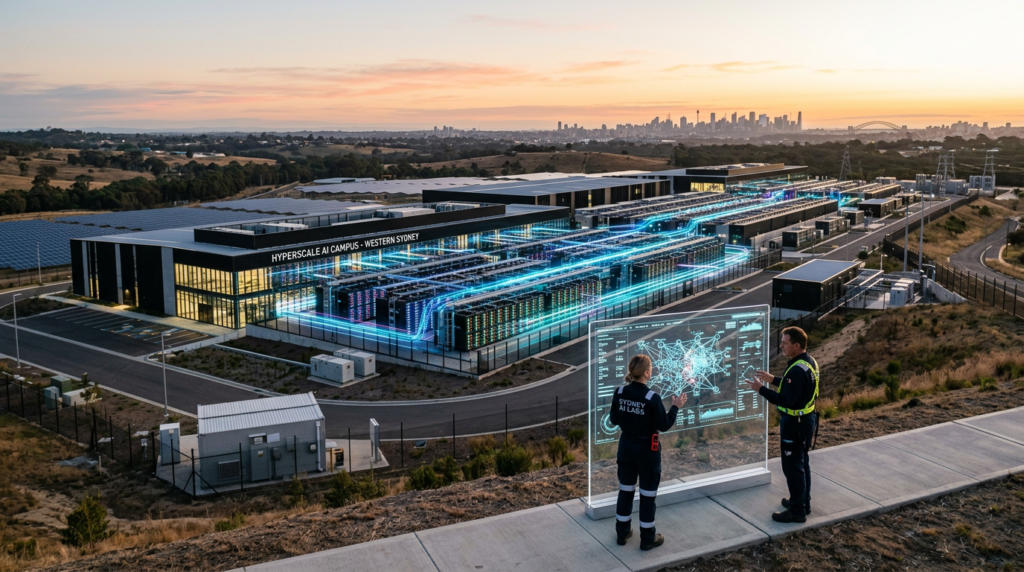
OpenAI’s existing relationship with NEXTDC gives the government another card to play.
The proposal announced in late 2025 contemplated sovereign AI infrastructure and a large GPU cluster at NEXTDC’s planned S7 campus in western Sydney. Reports have valued the broader plan in the billions of Australian dollars.
However, the project began as a memorandum of understanding. It should not be confused with a finished campus or an unconditional construction contract. Development still depends on commercial arrangements, approvals, power availability and the broader policy environment.
Even so, the proposal carries strategic weight.
OpenAI’s involvement signals that Australia can attract conversations at the frontier of the AI industry. It also gives local officials a working example when they sit down with other American companies. Canberra can point to land, domestic operators and government support instead of arriving with a PowerPoint presentation and a hopeful smile.
The real prize is not merely hosting OpenAI-branded infrastructure. Australia wants domestic start-ups, researchers, public agencies and businesses to benefit from the computing capacity built inside the country.
Charlton has argued that hyperscalers should make some compute available to Australian organisations and work with the local innovation ecosystem. That turns infrastructure policy into industry policy.
If Australia only supplies electricity and real estate while importing the processors, models and expertise, much of the value will leave the country. Local access could change that equation.
The Economic Opportunity Comes With Fine Print
The investment numbers are undeniably dazzling.
Westpac estimates that Australia’s data-centre investment pipeline could exceed A$155 billion. Its analysis suggests the rollout could temporarily support hundreds of thousands of jobs and produce a substantial economic boost.
But a headline investment figure does not tell the entire story.
AI data centres require huge volumes of imported equipment. GPUs, servers, memory systems and specialised networking hardware swallow a large share of each project’s budget. Australian businesses may build the structures, connect the electricity, install cooling equipment and provide professional services, but much of the technology bill flows overseas.
The employment profile also changes as construction ends. Thousands of workers might help build a campus, while far fewer operate it once complete. Data centres create valuable technical and maintenance roles, yet they do not employ people on the same scale as factories with similarly enormous footprints and energy requirements.
Australia therefore needs to capture benefits beyond construction.
That could mean training engineers, improving university partnerships, attracting AI researchers, supporting local cloud services and reserving affordable compute for Australian companies. It could also mean strengthening domestic cybersecurity and ensuring that sensitive workloads can run on infrastructure subject to Australian law.
The buildings matter. The ecosystems around them matter more.
Otherwise, Australia risks becoming the AI boom’s very well-connected landlord.
The Grid Is the Real Gatekeeper
Money can buy processors. It cannot magically create an electricity network overnight.
A data centre rated at hundreds of megawatts behaves more like a major industrial facility than an ordinary office building. It needs power around the clock. It also requires transmission capacity, substations, backup systems and dependable cooling.
Australia’s electricity planners already see the wave approaching.
The Australian Energy Market Operator counted 162 operational data centres nationally at the beginning of 2026. Most were concentrated around Sydney and Melbourne. AEMO said the sector accounted for roughly 2% of grid-supplied electricity at that point.
Its forecasts have since become even steeper. The 2026 Electricity Statement of Opportunities projects data-centre electricity use rising from about five terawatt-hours to approximately 34 terawatt-hours over the following decade. That would lift the sector from roughly 3% to around 13% of operational demand.
AEMO also considered 225 known projects, but more than 40% had either dropped out or moved backwards in the connection process since 2025.
That statistic brings the boom back to Earth. Developers can announce ambitious campuses fairly quickly. Securing the energy and network capacity to run them is considerably harder.
Canberra Wants a Deal With Conditions
The Albanese government has responded by creating five expectations for data-centre and AI-infrastructure developers.
Projects should advance the national interest, support the energy transition, use water responsibly, develop Australian skills and jobs, and strengthen domestic research and innovation.
Under the government’s energy expectations, operators should underwrite additional renewable generation and pay their full share of new grid connections. The aim is to prevent the cost of serving hyperscale facilities from sliding quietly onto household and business electricity bills.
The policy also encourages flexible demand. In theory, some computing workloads could shift toward periods when renewable supply is abundant or temporarily reduce consumption when the grid comes under stress.
Anthropic became the first AI developer to sign an arrangement aligned with these expectations. Microsoft later signed a similar memorandum. These agreements show how Canberra hopes to use access to Australia’s infrastructure pipeline as bargaining power.
However, the expectations are not a magic shield. Governments still need transparent planning rules, credible enforcement and honest assessments of water, land and electricity use.
The challenge is to welcome investment without writing a blank cheque especially when the cheque might later arrive inside everyone’s power bill.
The “Bring Your Own Energy” Debate
Requiring data-centre companies to help fund new generation sounds sensible. Making each facility behave like an isolated private electricity system is more complicated.
RenewEconomy’s analysis argues that the grid works as a shared portfolio and an insurance mechanism. A combination of geographically dispersed wind, solar, batteries and other firming resources can usually supply energy more efficiently than forcing every data centre to build a self-contained power island.
The distinction matters.
A company can contract enough new renewable generation to match its demand while remaining connected to the wider grid. During shortages, it can draw from shared supply. During periods of high renewable output, batteries and flexible workloads can help balance the system.
Australia must also confront local concerns before they harden into widespread resistance. Large data centres can bring continuous fan noise, substantial water requirements, new transmission lines, diesel backup generators and pressure on industrial land.
The United States offers a warning. Opposition there has grown from neighbourhood disputes into a broader political argument over electricity prices and who pays for grid expansion.
Australia has not reached that level of backlash. Yet community objections already exist, particularly around proposed projects in populated areas.
If Canberra wants social licence, consultation needs to happen before excavators arrive. “Trust us, the GPUs are important” is unlikely to calm residents listening to cooling fans at three in the morning.
Australia Wants Sovereignty, Not Just Servers
The government’s push also carries a national-security dimension.
AI increasingly influences defence, intelligence, public administration and critical infrastructure. Depending entirely on computing systems located overseas could leave Australia exposed to foreign policy changes, supply restrictions or commercial disputes.
Local infrastructure does not automatically create technological sovereignty. Nvidia would still supply key processors. American companies would still control many leading models. Imported hardware would remain essential.
But domestic facilities could give Australia more options.
They could allow sensitive workloads to remain inside the country, improve resilience and support Australian organisations that cannot easily obtain frontier-level compute. They could also help the government negotiate better access to advanced models and technical expertise.
That explains why Marles, Australia’s defence minister as well as deputy prime minister, played a prominent role in the US meetings. Canberra sees AI infrastructure as more than a technology-sector investment. It increasingly treats compute as strategic infrastructure closer to telecommunications, energy and defence capability than an ordinary commercial service.
The goal is ambitious: attract foreign capital without becoming entirely dependent on foreign platforms.
Pulling that off will require careful contracts, domestic skills and clear rules around security, data control, intellectual property and access.
A Huge Opportunity If Australia Builds It Properly
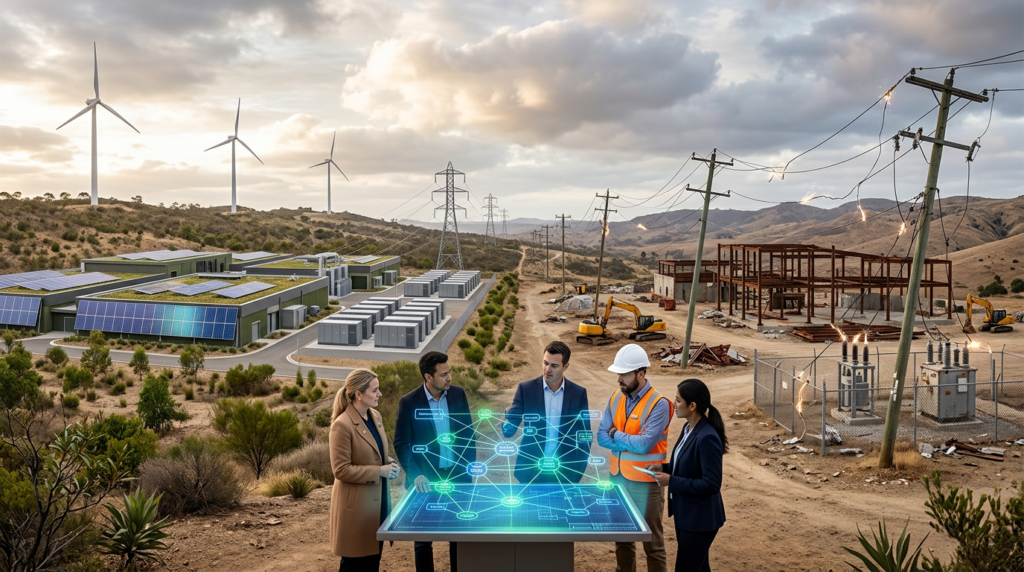
Australia has a genuine opening.
Nvidia, OpenAI and Anthropic need more infrastructure. The United States faces growing community resistance, grid constraints and political pressure around hyperscale development. Australia can offer land, renewable-energy resources, skilled operators and a stable base in the Asia-Pacific region.
But none of that guarantees a boom on the scale currently being discussed.
The proposed capacity figures mix signed agreements, memoranda, reported tenders and longer-term ambitions. Some facilities will proceed. Others may shrink, change location or vanish into that mysterious cupboard where ambitious infrastructure announcements go to nap forever.
The winners will be projects that secure power, equipment, planning approval, financing and community support at the same time.
Canberra’s courtship therefore represents an opening move, not the final result. The government has brought some of the world’s most powerful AI companies to the table. Now it must negotiate what Australia receives in return.
More renewable generation would help. So would local jobs, research partnerships, sovereign computing capacity and meaningful access for Australian start-ups.
If Australia gets the bargain right, it could become one of the most important AI-infrastructure hubs outside the United States.
If it gets the bargain wrong, it may gain enormous sheds, busier transmission lines and an electricity bill wearing a very fashionable Nvidia jacket.
Sources
- The Australian — AI giants Nvidia, Anthropic and OpenAI wooed by Labor for Australian data spending blitz
- Australia Data Centre Index — CDC reported front-runner for Anthropic’s Australian capacity contract
- RenewEconomy — Is Australia a good place for data centres?
- Australian Government — Expectations for data centres and AI infrastructure
- Australian Government — US visit promoting sustainable AI infrastructure
- AEMO — Preparing Australia’s power systems for rising data-centre demand
- Westpac IQ — Australia’s A$155 billion data-centre investment pipeline
The Kingy Brief
Get The Kingy Brief.
AI changes, original tests and one practical thing to try. Fridays at 09:00 Vancouver time.
Free · Double opt-in · Unsubscribe anytime
Sign up for The Kingy Brief on Beehiiv.
Signup help and newsletter schedule
Signup form provided by Beehiiv. After submitting, check your inbox for "Confirm your subscription to The Kingy Brief" and open its confirmation link. Check Spam or Promotions if you cannot find it.
Fridays at 09:00 Vancouver time: source-checked AI changes, original tests and one practical thing to try. We skip a week when there is not enough verified material. Free. Unsubscribe anytime.