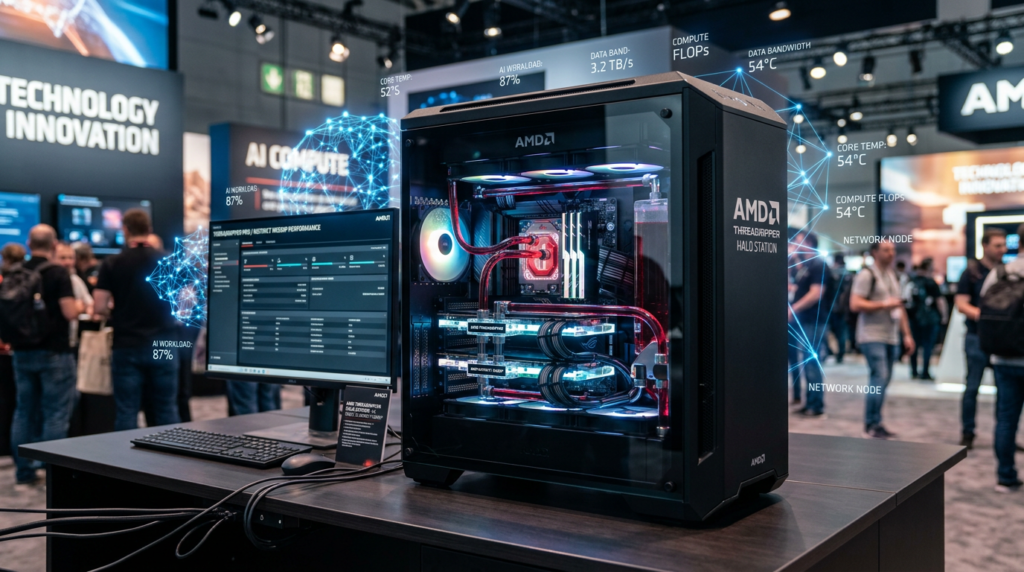
AMD Just Put a Data Center on a Desk
There are powerful workstations. There are ridiculously powerful workstations. And then there is whatever AMD just wheeled onto the stage at IFA 2026.
AMD has unveiled the Threadripper Halo Station, a liquid-cooled AI workstation centered on its flagship Ryzen Threadripper PRO processor and Instinct accelerators. The company isn’t being shy about it either. AMD describes the machine as the most powerful workstation in the world, with enough memory and processing muscle to run AI models containing more than one trillion parameters locally.
That last word matters: locally.
Instead of sending huge workloads to a distant cloud data center, the Halo Station is designed to bring a frankly absurd amount of AI horsepower into a workstation-sized machine.
At the heart of the system sits AMD’s Ryzen Threadripper PRO 9995WX, equipped with 96 Zen 5 CPU cores and 192 threads. AMD then pairs it with two Instinct MI350P accelerators carrying enormous pools of HBM3E memory.
And AMD apparently isn’t satisfied with two GPUs.
The company says there is a path toward four.
At that point, calling it a workstation almost feels unfair to normal workstations.
This thing is basically a server that found a desk job.
Meet the 96-Core Monster Inside
The foundation of the Threadripper Halo Station is the Ryzen Threadripper PRO 9995WX.
This isn’t exactly the processor you’d install because Chrome feels a little sluggish.
The chip packs 96 Zen 5 cores and 192 threads, with boost clocks reaching up to 5.4GHz. It also offers 384MB of L3 cache and carries a 350-watt thermal design power rating.
More importantly for this particular machine, Threadripper PRO provides the connectivity and memory capacity required to feed some extremely hungry accelerators.
According to VideoCardz, the processor supports eight-channel DDR5 memory and a whopping 128 PCIe 5.0 lanes. AMD’s IFA demonstration system was fitted with 2TB of DDR5 RAM.
Yes, terabytes.
Not storage.
RAM.
For perspective, even an enthusiast PC equipped with 64GB or 128GB already has enough memory for demanding gaming, editing and development workloads.
The Halo Station strolls into the room carrying two terabytes.
That capacity isn’t there simply for bragging rights. Large AI models can devour memory, particularly when researchers want to keep data and model components close to the compute hardware.
The Threadripper chip therefore acts as more than a fast CPU. It becomes the backbone connecting an unusually large local AI platform together.
Then AMD Added Two MI350P Accelerators
As wild as the 96-core CPU sounds, the real AI fireworks begin with the GPUs.
AMD’s demonstration Halo Station contains two Instinct MI350P accelerators based on the company’s CDNA 4 architecture.
Each accelerator carries 144GB of HBM3E memory.
Put two together and you get 288GB of dedicated accelerator memory.
That’s an enormous memory pool by workstation standards.
Each MI350P also provides memory bandwidth of up to 4TB per second, according to VideoCardz and TechTimes. For large AI inference workloads, that bandwidth can become crucial because the hardware needs to shuttle massive amounts of model data around rapidly.
These aren’t ordinary graphics cards repurposed for AI tinkering, either.
AMD’s Instinct family targets high-performance computing and artificial intelligence workloads. The MI350P is rated for up to 600 watts of total board power per accelerator.
Two accelerators potentially demanding that much power generate one very predictable side effect:
Heat.
Lots of it.
That’s why AMD didn’t slap a few oversized fans into the case and call it Tuesday.
The Halo Station uses liquid cooling for its CPU and accelerators, turning the machine into something much closer to compact data-center infrastructure than your typical desktop tower.
Two GPUs Are Apparently Just the Beginning
AMD’s IFA demonstration already looks excessive.
Naturally, AMD wants to make it even more excessive.
The company says the architecture has a path to four MI350P accelerators. If implemented, that would increase the available HBM3E memory from 288GB to a staggering 576GB.
There is an important caveat here.
The actual workstation AMD showed at IFA physically contained two MI350P accelerators. Tom’s Hardware notes that the demonstrated chassis only had room for those two cards, meaning a four-accelerator implementation could require a different configuration or system design.
So don’t picture four MI350Ps squeezed into the exact box AMD displayed unless AMD or one of its partners confirms such a design.
Still, the roadmap tells us something important about AMD’s ambitions.
This isn’t merely a showcase workstation for rendering videos faster or shaving a few minutes from engineering simulations.
AMD is aiming directly at enormous artificial intelligence workloads.
With four accelerators, the platform would have more than half a terabyte of ultra-high-bandwidth GPU memory alongside as much as 2TB of ordinary system memory.
That’s the kind of specification sheet that makes the phrase “personal computer” start doing some serious philosophical work.
And it leads directly to AMD’s biggest claim.
The Trillion-Parameter Party Trick
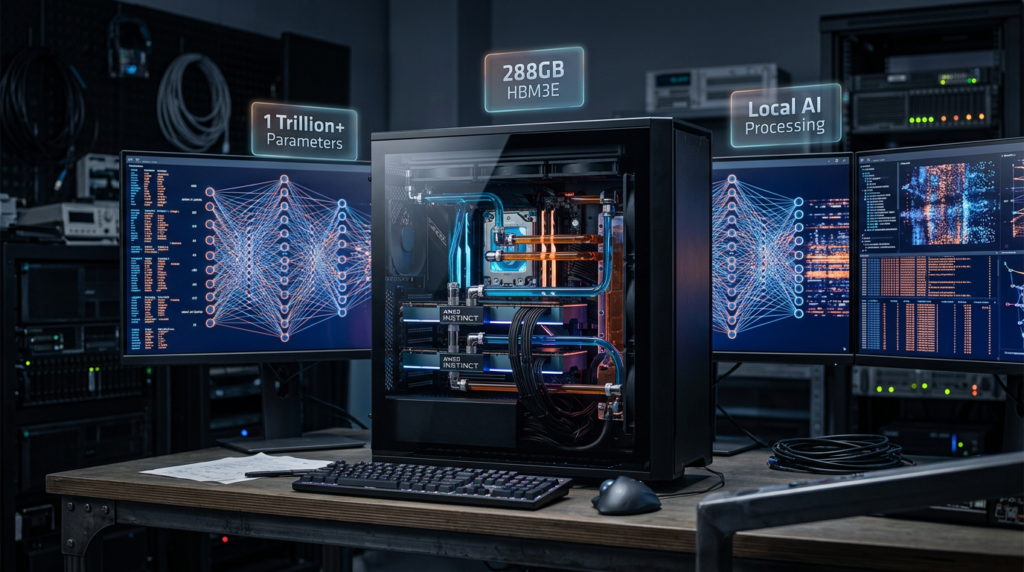
AMD says the Threadripper Halo Station can run AI models exceeding one trillion parameters locally.
That’s the headline feature.
And it’s a significant one.
Running gigantic language models isn’t simply about having enough raw compute performance. The system must also have somewhere to put the model.
Large models require enormous amounts of memory, with requirements varying considerably depending on numerical precision and quantization.
TechTimes gives a useful illustration: a 300-billion-parameter model stored at FP16 precision could require roughly 600GB, while aggressive FP4 quantization could shrink that requirement to around 150GB.
That helps explain AMD’s obsession with memory capacity.
A dual-MI350P Halo Station brings 288GB of HBM3E. Moving toward four accelerators raises that to 576GB.
At sufficiently compressed precision, AMD says this opens the door to trillion-parameter-class AI models.
There is an important nuance, though.
Saying a machine can run a trillion-parameter model doesn’t automatically tell us how fast that model will operate, what quantization level will be required or whether performance will match large clustered cloud systems.
AMD hasn’t released enough Halo Station-specific benchmark data yet to answer those questions.
But fitting such a model into a local workstation at all would already be quite a feat.
Why Running AI Locally Matters
At this point, you might reasonably ask: why not simply use the cloud?
That’s what most organizations already do.
Rent some GPU capacity, send the workload away, receive the result and avoid having a miniature power station humming beside someone’s desk.
The Halo Station presents another option.
Local AI processing can give organizations greater control over sensitive data because workloads don’t necessarily have to leave the machine. It can also eliminate recurring per-token cloud inference charges for workloads that are suitable for local processing.
Then there is availability.
Once you own the hardware, you aren’t waiting for cloud GPU capacity every time you want to experiment.
AMD is clearly leaning into this idea across its broader IFA announcements. TechTimes reports that the company is pushing both its Ryzen AI Halo systems and the vastly more powerful Threadripper Halo Station as ways to move increasingly sophisticated AI workloads closer to users.
Of course, local doesn’t automatically mean cheaper.
A workstation containing multiple high-end accelerators, 2TB of DDR5, exotic cooling and a flagship 96-core CPU is going to have substantial purchase and operating costs.
Still, enterprises repeatedly running large models may eventually compare those expenses against years of cloud bills.
That’s where the Halo Station becomes particularly interesting.
It’s not replacing ChatGPT on your laptop.
It’s challenging part of the infrastructure behind machines like it.
The Power Bill May Need Its Own Chair
All this processing power comes with another specification worth discussing: actual power.
Each MI350P can consume up to 600 watts.
Two of them potentially account for 1,200 watts before we even consider the Threadripper PRO processor, which itself carries a 350-watt TDP.
Add memory, storage, cooling equipment, motherboard components and everything else, and you begin to understand why this machine isn’t destined for a tiny desk beside the office cactus.
A future four-accelerator system would push the infrastructure requirements further still.
Cooling also becomes serious business at these levels.
AMD’s showcased machine uses liquid cooling for both its CPU and accelerators. That’s hardly surprising when the major compute components alone can produce enough heat to make a normal workstation reconsider its career choices.
This also reinforces who AMD appears to be targeting.
The Halo Station isn’t really a consumer desktop for someone experimenting with Stable Diffusion after dinner.
It’s aimed much higher: AI researchers, enterprises, universities, developers, engineering teams and organizations that need extreme local compute capability without necessarily deploying a conventional rack-mounted server cluster.
AMD has basically blurred the border between workstation and server.
The result still sits under a desk.
Your electricity meter may notice, though.
About That Potential Six-Figure Price
AMD hasn’t announced an official price.
That point deserves emphasis because the component list makes speculation incredibly tempting.
Tom’s Hardware estimates that the major components alone could push the dual-GPU system above $100,000, and suggests a completed configuration with storage, cooling and other supporting hardware could potentially exceed $150,000.
Those are estimates from Tom’s Hardware, not prices announced by AMD.
VideoCardz similarly notes that comparable extreme AI workstation hardware can easily enter six-figure territory.
Why so expensive?
The Threadripper PRO 9995WX alone reportedly sells in roughly the $11,000-$12,000 range. Then you’ve got two Instinct accelerators, enormous quantities of DDR5 memory, specialized cooling and enterprise-class supporting hardware.
And we’re talking about the two-GPU configuration.
Start dreaming about four MI350Ps and your accountant may suddenly stop returning your calls.
Still, enterprise AI hardware lives in a very different financial universe from consumer PCs. Businesses already spend enormous sums on servers, accelerator clusters and cloud computing.
Against that backdrop, even a six-figure desktop-style workstation could potentially make sense for particular workloads.
The important thing is that we don’t know yet.
Until AMD or its partners announce pricing, every dollar figure remains an estimate.
AMD Is Coming After the Local AI Workstation
The Halo Station also reveals something broader about AMD’s strategy.
AI computing is spreading outward.
The first wave of generative AI relied overwhelmingly on massive centralized GPU clusters. Now hardware companies want portions of those workloads running closer to the user.
We’ve already seen compact AI PCs pitched at developers.
The Threadripper Halo Station takes that concept and feeds it several cans of energy drink.
Instead of asking how much AI can fit inside an ordinary PC, AMD appears to be asking how much data-center hardware it can squeeze into something recognizable as a workstation.
The answer, apparently, is quite a lot.
The combination of 96 CPU cores, 192 threads, 2TB of DDR5, two MI350P accelerators and 288GB of HBM3E places the Halo Station in extraordinarily rare territory.
And AMD’s four-accelerator ambition could take things considerably further.
The real test will come when independent reviewers can measure performance.
How quickly can it actually run enormous models?
How efficient is it?
How well does AMD’s ROCm software ecosystem handle these workstation deployments?
And perhaps most importantly, how does its total cost compare with competing local systems and cloud infrastructure?
The specification sheet is spectacular.
Now AMD has to prove the experience matches it.
An AI Supercomputer Wearing Workstation Clothes
AMD’s Threadripper Halo Station might be one of the clearest examples yet of how dramatically the meaning of “workstation” is changing.
A 96-core processor would have been enough to make headlines by itself.
Instead, AMD surrounded it with two data-center-class AI accelerators, hundreds of gigabytes of HBM3E, two terabytes of system memory and liquid cooling.
Then it casually mentioned that four GPUs are eventually on the menu.
The result is less “premium desktop PC” and more “data center that escaped containment.”
There are still plenty of unanswered questions.
AMD has not announced official pricing, a firm release date, specific OEM partners for the Halo Station, or all the configurations customers will eventually be able to purchase.
We also need independent testing before knowing how useful the trillion-parameter claim will prove in real-world AI workflows.
But the direction is fascinating.
AI development has spent years racing into enormous centralized server farms.
AMD now wants some of that computing power sitting locally.
Maybe not on everyone’s desk.
Definitely not at everyone’s budget.
But if the Threadripper Halo Station delivers what AMD is promising, the next frontier of local AI might look suspiciously like someone parked a supercomputer beside the office printer.
Just don’t plug both into the same extension cord.
Sources
The Kingy Brief
Get The Kingy Brief.
AI changes, original tests and one practical thing to try. Fridays at 09:00 Vancouver time.
Free · Double opt-in · Unsubscribe anytime
Sign up for The Kingy Brief on Beehiiv.
Signup help and newsletter schedule
Signup form provided by Beehiiv. After submitting, check your inbox for "Confirm your subscription to The Kingy Brief" and open its confirmation link. Check Spam or Promotions if you cannot find it.
Fridays at 09:00 Vancouver time: source-checked AI changes, original tests and one practical thing to try. We skip a week when there is not enough verified material. Free. Unsubscribe anytime.