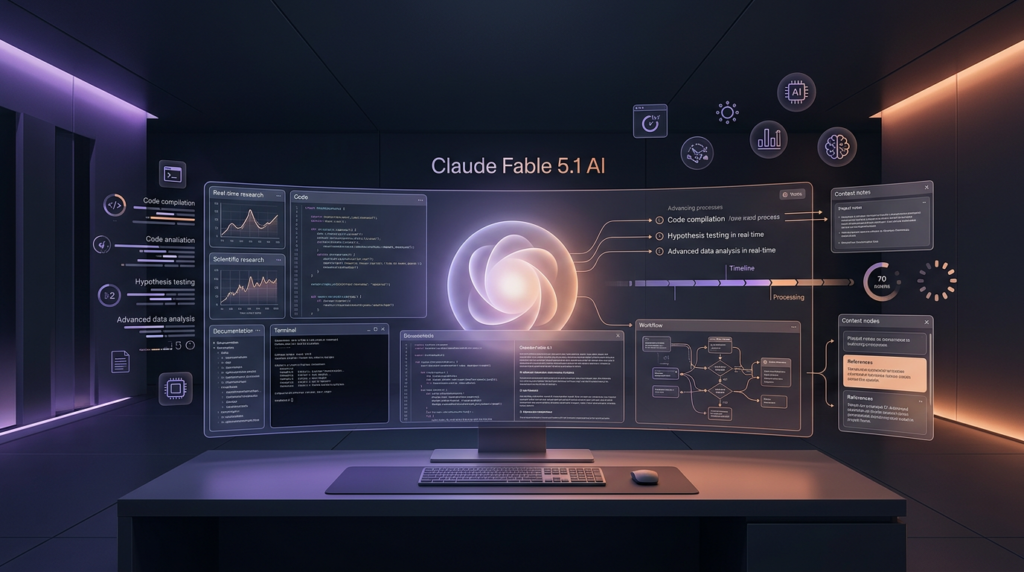
Anthropic has a new heavyweight Claude model, and this time the headline is not simply “more intelligence.”
It is also about how long that intelligence can keep working — and how much the bill hurts afterward.
On September 1, Anthropic launched Claude Fable 5.1 alongside Claude Mythos 5.1, describing the pair as its most advanced models yet for coding and knowledge work. Fable 5.1 is broadly available, while Mythos 5.1 uses the same underlying model with different safeguards and is restricted to vetted users working in areas including cybersecurity and life sciences. citeturn1view0
That alone would make this another major entry in the increasingly crowded frontier-model race. But Anthropic is pushing a slightly different message.
Fable 5.1 is designed for work that does not end after one clever answer.
Think debugging a sprawling codebase. Researching a difficult question across multiple steps. Analyzing documents. Building presentations. Operating tools. Or letting an AI agent chew on a project for hours while you do something refreshingly human, like sleep.
And then there is the pricing.
Anthropic says typical token-billed workloads could cost around 25% less than Fable 5, while highly agentic workloads could see savings approaching 45%, largely because prompt-cache reads have become dramatically cheaper. citeturn1view0
That combination — stronger performance plus lower effective cost — may be the real story.
Fable 5.1 Is Built to Keep Going
The easiest way to understand Fable 5.1 is to stop thinking about AI as a chatbot.
Anthropic increasingly wants Claude to behave like a worker.
Fable 5.1 targets what the company calls long-horizon agentic work: tasks requiring the model to plan, use tools, examine results, adjust its approach and continue working without constantly asking a human what to do next.
The official model documentation gives Fable 5.1 a 1-million-token context window and maximum output of 128,000 tokens. It accepts text and images and uses adaptive thinking by default. citeturn0search55
That giant context window matters because long-running agents accumulate baggage.
Code. Logs. Documents. Previous tool results. Research. Instructions. Failed attempts. More code. More logs. Probably a metaphorical coffee stain somewhere.
The model needs to keep track of all of it without losing the plot.
Anthropic says Fable 5.1 improves precisely in these scenarios, including long-running coding, multistep research and document, spreadsheet and presentation work. citeturn0search55
That is an important shift.
The frontier AI competition is increasingly moving beyond “Who answers this prompt best?” toward a harder question:
Which model can actually finish the job?
The Benchmark Numbers Are Pretty Serious
Anthropic has plenty of numbers to support its claims, although, as always, benchmark results should be treated as indicators rather than divine commandments engraved on a GPU.
Still, Fable 5.1 posts some eye-catching scores.
On Terminal-Bench-Science 0.1, which evaluates agentic scientific research, Fable 5.1 scored 52.6% in Anthropic’s testing. Fable 5 managed 24.7%, while Opus 5 reached 29.0%. citeturn1view0
That is more than a modest version-number bump.
On Terminal-Bench 4.0, Fable 5.1 scored 55.8%, while the less-restricted Mythos 5.1 reached 60.9%. Fable 5 scored 42.0%.
The model also scored 73.4% on CursorBench 3.2.0, compared with 70.5% for Fable 5 and 70.0% for Opus 5. citeturn1view0turn2view1
Business workflows improved too.
On AutomationBench, Fable 5.1 reached 31.4%, nearly doubling Fable 5’s 17.1% and beating Opus 5’s 26.9%. Its GDPval-AA v2 knowledge-work score reached 1,853 versus 1,723 for Fable 5. citeturn2view1
Benchmarks never perfectly reproduce messy real-world work.
But the pattern is hard to miss.
Anthropic has tuned Fable 5.1 around agents that reason, investigate and execute.
One Bug Had Apparently Been Hiding for Years
Benchmarks are fun. Real bugs are more convincing.
Anthropic shared an especially interesting example involving investment firm Millennium.
According to Anthropic, Millennium had an extremely rare software crash that occurred roughly once in a million runs. Engineers had reportedly been unable to explain the problem for four or five years.
Other models missed it.
Fable 5 missed it.
Fable 5.1 apparently did not.
The model reportedly disassembled an external vendor library, compared the results with a core dump and traced the crash back to a bug inside that library. citeturn1view0
That story illustrates what Anthropic seems to be chasing.
The useful AI coding agent of the future cannot simply generate a nice-looking Python function in twelve seconds. It needs persistence. It needs to inspect unfamiliar systems. It needs to test hypotheses and discard bad ones.
Most importantly, it has to dig.
Early testers reported similar behavior. MongoDB said Fable 5.1 worked for hours unattended while building a complex prototype, while Shopify reported that the model could sustain lengthy workflows, maintain records and reprioritize as circumstances changed. citeturn1view0
In other words, Claude is getting better at staying on task after the novelty wears off.
Very relatable.
The 75% Cache Discount Could Be the Sleeper Feature
Now we reach the less glamorous part of AI: the invoice.
Fable 5.1 keeps Fable 5’s standard API pricing at $10 per million input tokens and $50 per million output tokens. citeturn0search55turn1view4
So where are the savings?
Prompt caching.
A cache allows applications to reuse previously processed context rather than repeatedly paying the full price to process the same information. That becomes enormously important for agents constantly referencing large codebases, instructions, documents or conversation histories.
Anthropic has reduced Fable 5.1’s cache-read price to $0.25 per million tokens, one-quarter of the previous cost — effectively a 75% reduction. citeturn0search55
That sounds like accounting trivia until you consider how agents work.
A long-running coding agent may repeatedly consult the same repository context. A research system might revisit dozens of documents. An enterprise assistant could continuously work from the same enormous knowledge base.
Suddenly, cache pricing matters a lot.
Anthropic estimates the change can make typical Fable 5.1 workloads around 25% cheaper, with highly agentic jobs potentially costing up to approximately 45% less than Fable 5. citeturn1view0
The smarter model is interesting.
The smarter model that becomes cheaper the longer you use it? Now developers are listening.
Anthropic Is Also Giving Developers an Effort Dial

Not every problem deserves maximum brainpower.
Asking Claude to rename a variable probably does not require the computational equivalent of summoning the AI Avengers.
Fable 5.1 therefore gives developers more control over reasoning effort.
Anthropic says the model can achieve performance comparable to or better than Fable 5 at low or medium effort while using significantly less compute. The model defaults to high effort in Claude Code, while Claude.ai and Claude Cowork use medium effort by default. citeturn1view0
That introduces an increasingly important concept into frontier AI: intelligence on demand.
Developers can reserve deeper reasoning for difficult tasks while running simpler jobs more economically.
It also changes how model comparisons should be interpreted.
The question may no longer be:
“Which model is smartest?”
Instead, developers may ask:
“Which model gives me enough intelligence at the lowest cost for this particular step?”
Fable 5.1’s combination of adjustable effort and cheaper cache reads makes that question much more interesting.
And potentially much more economical.
Research Is Becoming a Bigger Part of Claude’s Identity
Coding gets much of the attention, but Anthropic is making unusually ambitious claims around research.
The standout number remains that 52.6% Terminal-Bench-Science score, more than double Fable 5’s result in Anthropic’s setup. citeturn1view0
Anthropic says its testing across scientific domains suggests models like Fable 5.1 and Mythos 5.1 are beginning to show how AI could contribute more directly to scientific discovery. citeturn1view0
Mythos 5.1 goes even further.
Anthropic says the model was tested on molecular design using open-source protein-design and folding tools. For three targets, its designed binders achieved affinities ten times higher than the best designs submitted to Adaptyv Bio’s protein-design competitions. Anthropic also reported a hit rate approaching 50% across 12 targets, compared with what it described as typical rates of roughly 10–15%. citeturn1view0
Those results need the usual scientific caution. AI-generated candidates still require experimental validation, and benchmark performance is not equivalent to autonomous scientific discovery.
But the direction is significant.
AI companies are no longer presenting frontier models merely as assistants that summarize scientific papers.
They increasingly want them participating in the research loop itself.
Mythos 5.1 Is the Same Brain With Different Guardrails
The Fable and Mythos naming might make the models sound like two different products.
Technically, Anthropic says they are the same underlying model.
The difference lies in safeguards and access.
Fable 5.1 is generally available. Mythos 5.1 is invitation-only through Anthropic’s Project Glasswing trusted-access programs and is intended for vetted organizations and specialists working in cybersecurity and life sciences. citeturn1view0turn0search56
Why bother?
Because some legitimate scientific and security work overlaps awkwardly with knowledge that could also be misused.
Anthropic says Mythos allows vetted specialists to perform more sensitive work while maintaining tighter access controls.
Meanwhile, Fable’s cybersecurity safeguards have also become less trigger-happy.
Anthropic says its updated protections produce roughly 60% fewer safeguard interventions per Claude Code session compared with Fable 5. The company is also allowing Fable 5.1 to identify software vulnerabilities for defensive purposes, while maintaining restrictions around harmful exploit development. citeturn1view0
That matters because overly aggressive safety systems can make legitimate cybersecurity work frustrating.
Anthropic is trying to thread the needle: fewer annoying false alarms without throwing the doors wide open.
Not exactly an easy engineering problem.
Fable 5.1 Is Already Moving Into Professional Work
The model did not launch into a vacuum.
It is already showing up inside professional software.
Legal AI company Harvey announced Fable 5.1 availability for customers on September 1. In Harvey’s early testing, the model showed its biggest improvement on litigation and dispute-resolution work, while also performing well on data privacy, cybersecurity and capital-markets tasks. citeturn2news1
Harvey also found something particularly relevant to the cost discussion.
At Fable 5.1’s lowest reasoning setting, the model reportedly remained thorough while using roughly half the output tokens. citeturn2news1
For legal teams processing mountains of contracts and documents, that is not a small detail.
It illustrates why efficiency improvements may ultimately matter as much as benchmark trophies.
Meanwhile, Fable 5.1 is also generally available in GitHub Copilot, while Snowflake has announced a private preview through Cortex AI.
Anthropic’s own documentation lists availability through the Claude API, Amazon Bedrock, Google Cloud, Microsoft Foundry and Claude Platform on AWS. citeturn0search55
This is clearly being positioned as infrastructure, not merely another chatbot upgrade.
Privacy Gets an Enterprise Makeover
There is another issue Anthropic needed to address: data retention.
For companies working with proprietary code, confidential legal documents or sensitive research, sending information to an external AI provider can create obvious headaches.
Anthropic is introducing what it calls Enterprise Frontier Safeguards, or EFS.
Under the system, customer data can remain in cloud infrastructure controlled entirely by the customer rather than Anthropic. The company describes this as offering privacy equivalent to zero data retention while still allowing its safeguards to operate. citeturn1view0
Anthropic plans to roll out EFS to enterprise customers in phases beginning later this fall. Eligible customers can use Fable 5.1 under zero-data-retention arrangements in the meantime. citeturn1view0
Harvey’s implementation provides a glimpse of why this matters.
The company is making Fable 5.1 opt-in rather than automatic and notes that Fable’s data-processing practices may differ from commitments in some existing customer agreements. Harvey also says Fable 5.1 data is processed in the United States and does not currently support regional processing. citeturn2news1
That may sound less exciting than benchmark charts.
For enterprise buyers, however, privacy architecture can determine whether a powerful model gets deployed at all.
The Bigger Story Is AI That Works While You Don’t
Fable 5.1 arrives during an interesting transition.
For years, AI progress largely meant better responses.
Ask a question. Receive an answer.
Then models started using tools.
Then they began browsing, coding, operating computers and chaining multiple actions together.
Now the industry is chasing something more ambitious: AI systems that can take responsibility for increasingly large chunks of work.
Fable 5.1 fits neatly into that trend.
Anthropic’s own examples include models running for hours unattended, navigating large codebases, investigating failures, conducting multistep research and maintaining enough internal continuity to continue complicated projects over long periods. citeturn1view0
That is why the cache-price reduction matters so much.
An agent that works for five minutes can be expensive.
An agent that works for five hours can become spectacularly expensive.
Reducing the recurring cost of context turns longer-running AI workflows from an impressive demo into something companies might actually deploy every day.
Fable 5.1 therefore represents more than another benchmark bump.
Anthropic is trying to improve three things simultaneously: capability, endurance and economics.
That combination could prove far more consequential than simply making Claude better at answering prompts.
Claude’s Next Battle Is About Finishing Work

There is no shortage of powerful AI models in 2026.
Every major lab can produce benchmark charts. Every launch promises smarter reasoning. Every model apparently possesses enough intelligence to frighten a graduate student.
The harder challenge is reliability.
Can an AI receive a complicated objective, understand the surrounding information, use tools intelligently, recover from mistakes, manage its context and eventually deliver something useful?
Fable 5.1 looks like Anthropic’s latest attempt to answer that question.
Its stronger coding and research performance is impressive. Its 1-million-token context window gives agents enormous working room. Its improved safeguards should reduce interruptions. And its dramatically cheaper cache reads attack one of the least glamorous but most important barriers to persistent AI agents: cost. citeturn0search55turn1view0
The model still comes with caveats.
Anthropic’s benchmark claims need independent testing. Enterprise customers must examine data-processing requirements carefully. And even powerful agents require human oversight when mistakes carry serious consequences.
But the direction is unmistakable.
The frontier-model race is evolving from “Which AI gives the best answer?” to “Which AI can take the hardest assignment and actually see it through?”
With Claude Fable 5.1, Anthropic clearly wants its answer to be Claude.
And if the AI can spend three days fixing the code while everyone else sleeps?
Well, somebody should at least buy the server a coffee.
Sources
- Anthropic — Claude Fable 5.1 and Claude Mythos 5.1 announcement
- Anthropic — Claude Fable 5.1 technical documentation
- The Decoder — Claude Fable 5.1 promises better coding and research at lower cost
- VentureBeat — Fable 5.1 and Mythos 5.1 launch and cache pricing changes
- 9to5Mac — Anthropic upgrades Claude with Fable 5.1
- HW Busters — Claude Fable 5.1 and cheaper cache reads
- Geo News — Claude Fable 5.1 and long-running problem solving
- Blockchain.News — Claude Fable 5.1 launches in Harvey
- Harvey — Fable 5.1 now live in Harvey
The Kingy Brief
Get The Kingy Brief.
AI changes, original tests and one practical thing to try. Fridays at 09:00 Vancouver time.
Free · Double opt-in · Unsubscribe anytime
Sign up for The Kingy Brief on Beehiiv.
Signup help and newsletter schedule
Signup form provided by Beehiiv. After submitting, check your inbox for "Confirm your subscription to The Kingy Brief" and open its confirmation link. Check Spam or Promotions if you cannot find it.
Fridays at 09:00 Vancouver time: source-checked AI changes, original tests and one practical thing to try. We skip a week when there is not enough verified material. Free. Unsubscribe anytime.