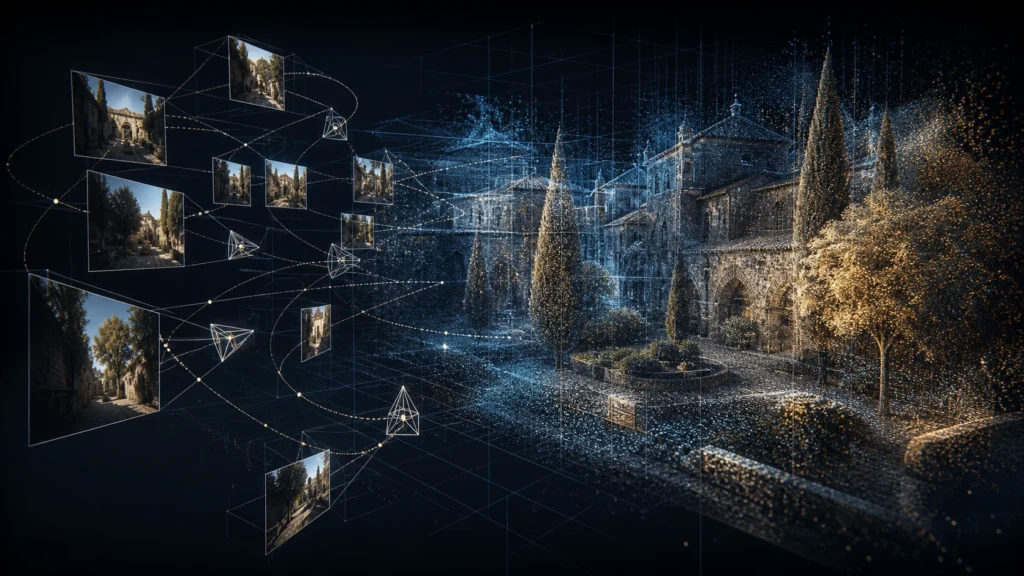
Atlas combines camera-conditioned image and video generation, sparse-view reconstruction, depth, point clouds and Gaussian splats inside one model. The launch evidence is impressive—but it is still company-selected evidence for an early-access system whose cost, speed, training data and physical accuracy remain undisclosed.
Originally published: September 1, 2026
Last updated: September 8, 2026
Version: 1.1 (Week 1)
Research cutoff: September 8, 2026, 2:05 a.m. PDT (America/Vancouver)
Access status: Early access for unnamed select partners; public request form available
Testing disclosure: No first-hand Atlas access. This assessment is based on World Labs’ launch materials, current documentation and policies, official baseline repositories, and publicly accessible demonstrations.
Next review: September 15, 2026
Bottom line
Atlas is best understood as a spatially conditioned generative model—not yet as a proven general-purpose simulator. Its key idea is the shared spatial context: text, images, camera poses and depth can be arranged in one sequence, letting the model generate new views and explicit geometry. That could make camera control and sparse reconstruction far more useful to filmmakers, VFX artists, game teams and robotics researchers. But the launch leaves the operational questions unanswered. Atlas has no public model ID, API, price, latency, model card, parameter count or training-data disclosure. Its video benchmark gives Atlas native camera trajectories while competitors receive text descriptions, and its reconstruction results are company-published. The demos justify attention and early experimentation. They do not yet justify trusting Atlas for measured digital twins, physics, safety-critical robotics or production deadlines.
What launched / What changed this week
World Labs announced Atlas on September 1, 2026 as an “omni” world model pretrained from scratch. The company says one architecture can natively work with text, images, camera poses and depth maps; represent video as image sequences; generate camera-controlled images and videos; reconstruct scenes; output point clouds and 3D Gaussian splats; reframe multi-camera footage; and support parts of a robotics Real-to-Sim workflow. Atlas is entering early access with select partners and is intended to power future versions of Marble and other World Labs products. World Labs, “Atlas: A World Model for Spatial Intelligence”
The launch language is aggressive. World Labs called Atlas the “world’s first multimodal world model” of its type, while co-founder and CEO Fei-Fei Li called it a “first of its kind,” “pixel-perfect” and the “best camera conditioned world model ever.” Those are attributable company claims, not independently established facts. World Labs launch post Fei-Fei Li launch post
Week 1 update: No material Atlas product change was found between the September 1 and September 8 cutoffs. Atlas remains in selective early access, is still absent from the public World API model list, and still has no public price, model card, latency disclosure, named partner list or independent benchmark reproduction.
One comparison baseline did change. On September 7, the VGGT-Ω maintainers replaced their August 18 benchmark-contamination warning with released training code, a retrained checkpoint and a detailed reproduction report. They say the rechecked run produced broadly comparable performance, with modest movements in both directions, and that the new checkpoint supersedes the original for future benchmark comparisons. This improves that baseline’s auditability but does not reveal which VGGT-Ω checkpoint World Labs tested, so it does not change this article’s Atlas verdict. VGGT-Ω September 7 repository change VGGT-Ω reproduction report
Five-point executive summary
-
Atlas appears to unify capabilities that World Labs previously split across Marble, RTFM and its robotics stack. It can generate pixels from posed context and also emit explicit depth-derived 3D representations. That combination, if it survives independent use, is more important than any single polished demo. Atlas launch
-
Native camera conditioning is the clearest practical advantage. Atlas accepts camera poses directly; the creative-video competitors in World Labs’ benchmark were told camera movements in text. Atlas therefore won a camera-following contest under an interface it was built to use. The result is relevant, but it is not a general video-quality leaderboard. Atlas benchmark description
-
“Reconstruction from one image” includes invention. Atlas can preserve the visible evidence and generate plausible unseen regions, but a single view cannot measure the back of an object or a building hidden outside the frame. World Labs says this explicitly: with fewer views Atlas must imagine more. Atlas spatial reconstruction
-
The launch does not prove physical simulation. Atlas demonstrates scene reconstruction, RGB/depth sensor-view generation and assistance within a larger robotics workflow. World Labs does not show that Atlas itself supplies metric scale, collision geometry, calibrated materials, forces, rigid/deformable dynamics, policy training or a physics engine. Its separate R2S2R system does claim many of those functions, but the company does not disclose which components in those demonstrations are Atlas. Atlas robotics section World Labs R2S2R
-
Product reality trails the demonstrations. As of the cutoff, Atlas is not listed in the public World API model documentation, which names only Marble 1.0, 1.0 Draft, 1.1 and 1.1 Plus. Atlas pricing, quotas, generation time, hardware, commercial terms specific to early access and named partners are not public. World API model mapping Atlas early-access notice
Key facts
| Field | What is established at launch |
|---|---|
| Developer | World Labs |
| Release status | Early access with select, unnamed partners; request form available |
| Company description | “Omni” world model pretrained from scratch |
| Disclosed architecture | Multimodal autoregressive diffusion transformer; rectified-flow latent diffusion |
| Native modalities disclosed | Text, images, camera poses and 3D depth maps; video represented as image sequences |
| Spatial mechanism | Each image/depth map is conditioned on an explicit camera pose and placed in a shared spatial context |
| Claimed maximum showcase output | Up to one minute of video at 1440p with a manually designed camera path |
| Explicit 3D output | Depth, point clouds and 3D Gaussian splats |
| Native mesh output | Not established for Atlas |
| Public API/model ID | None disclosed; current World API docs list Marble models only |
| Pricing, quota and latency | Not disclosed |
| Parameter count / training compute | Not disclosed |
| Training data | Described only as a “large diverse corpus of multimodal data” |
| Independent reproduction | None found by the cutoff |
| First-hand testing here | None |
Sources: Atlas launch and technical details, World API model mapping, Marble models and credit costs.
Why Atlas exists: the path from Marble and RTFM
Atlas makes more sense as the convergence of World Labs’ earlier systems than as a product appearing from nowhere.
Marble is the shipping 3D-world product. It creates navigable worlds from text, images, video or coarse 3D layouts. Users can edit, expand and compose worlds, then export Gaussian splats, meshes or video. Marble also offers collider meshes for coarse physics work and a higher-quality mesh intended to approximate splat appearance. Those are Marble capabilities; Atlas’s launch does not say Atlas natively outputs meshes. World Labs, “The Marble World Model”
Marble has the clearer production story. Its public interface and World API are available, and its documentation lists four models. Marble 1.1 costs 1,500 credits per generation; Marble 1.1 Plus has a 1,500-credit base plus up to 1,500 variable credits; Marble 1.0 Draft costs 150 credits. These prices belong to Marble, not Atlas. Marble model documentation The current API accepts model values such as marble-1.1 and marble-1.1-plus; there is no atlas entry. World API models
RTFM explored learned rendering and persistence. Announced in October 2025, the Real-Time Frame Model generates interactive frames on a single H100. It uses an autoregressive diffusion transformer over posed frames and retrieves nearby frames through “context juggling,” allowing a world to persist without attending to the complete interaction history. RTFM does not require an explicit 3D representation; it acts as a learned renderer whose KV cache implicitly represents the scene. World Labs, “RTFM”
Atlas inherits at least the intellectual shape of RTFM: an autoregressive diffusion transformer, camera pose as a first-class signal, and a spatially organized context. World Labs does not say Atlas is a direct RTFM descendant, reuse its weights, or use the same context-juggling mechanism. The responsible conclusion is that Atlas shares architectural ideas with RTFM, while adding broader modalities, explicit depth and 3D outputs, and much higher-quality offline generation. A direct lineage remains undisclosed.
The World API makes Marble programmable, not Atlas. It accepts text, single images, multi-image sets, panoramas and video, returning navigable worlds for browser rendering or downstream tools. World Labs cites gaming, filmmaking, architecture and robotics partners for this API, including Escape.ai, Preview, Fenestra and Lightwheel. None is identified as an Atlas early-access partner in the launch post. World Labs, “Announcing the World API”
The R2S2R stack is the robotics context. World Labs’ July 2026 Real-to-Sim-to-Real announcement describes a broader engine that reconstructs tasks, calibrates observations and dynamics, varies objects and physical properties, trains policies in simulation, and evaluates whether simulated performance predicts hardware performance. It includes explicit physics and policy components that go beyond image generation. World Labs, “Real-to-Sim-to-Real” Atlas’s launch shows it contributing reconstruction and sensor-view generation to this direction. It does not map every R2S2R component onto Atlas.
What Atlas is, in plain English
Imagine placing photographs on an invisible 3D stage and attaching a camera position and angle to each one. Atlas takes that spatial arrangement as context. You can then ask for a new camera view, a moving shot through the space, a depth map, or a 3D representation. Where the source images contain evidence, Atlas tries to preserve it. Where they do not, it generates what might plausibly be there.
That last sentence is the dividing line between reconstruction and generation. With many well-placed views, Atlas can be constrained by observations. With a single photograph, its “full 3D world” necessarily mixes recovered visible structure with synthesized unseen content. World Labs gives a useful example: from one garden image, Atlas recreates the visible garden but invents surrounding buildings; adding cottage and house images progressively replaces invention with evidence. Atlas reconstruction examples
“Omni” does not mean Atlas accepts every conceivable signal or solves every spatial problem. In the disclosed implementation it means one model architecture handles multiple input and output types and multiple sequence arrangements. At launch, those types are text, images, camera poses and depth maps. There is no disclosed native audio, mesh, material, force, action, tactile, lidar or joint-state token type. Atlas technical details
How the architecture works
Plain-English version
Atlas converts its inputs into an internal sequence. Unlike a normal video model that mainly sees frames in time order, Atlas attaches an explicit 3D camera pose to images and depth maps. That turns the context from “what happened before” into “what has been seen from where.” The model then produces the next requested element—an image, depth map or other supported output—one element at a time, conditioned on everything earlier in the sequence. Atlas model architecture
To make an image or depth map, Atlas starts from noise and repeatedly denoises it. World Labs calls it a rectified-flow model and also a latent diffusion model, meaning the denoising happens in a compressed representation rather than directly over every output pixel. More denoising steps can generally trade speed for quality, although World Labs provides no Atlas-specific step counts, latency curves or distillation results. Atlas technical details
Technical version
The disclosed design combines four properties:
- Multimodal: the sequence can contain text, images, camera poses and depth maps. Images and depth are explicitly posed. Video is represented as a series of image elements. World Labs does not disclose the encoders, tokenizers, VAE dimensions or how text and geometry share representation space.
- Autoregressive: sequence elements are generated one after another, with each new output conditioned on preceding inputs and outputs. The company points to LLM-serving techniques such as KV caching, cache-aware routing and disaggregated serving as potentially applicable, but does not state which are deployed for Atlas.
- Diffusion / rectified flow: continuous outputs are generated through iterative denoising. World Labs says the model can use techniques such as distillation, classifier-free guidance, shifted noise schedules and improved VAEs; this is a statement of architectural compatibility, not confirmation of Atlas’s exact inference recipe.
- Transformer: attention and matrix multiplication provide the shared backbone across modalities.
Source: World Labs’ architecture disclosure.
The useful departure from an ordinary video context window is spatial grounding. A conventional video model is typically conditioned on frames ordered mainly by time and perhaps motion descriptions. Atlas’s context associates views with 3D locations and orientations, so it can be queried along a specified camera trajectory and can combine images that were never adjacent in time. This is conceptually related to RTFM’s posed-frame memory, but Atlas’s exact attention pattern, context-selection policy and maximum token or frame count are not public. RTFM spatial memory Atlas spatial context
World Labs says Atlas was pretrained from scratch on a large, diverse multimodal corpus and that larger training runs improved performance. It does not disclose parameter count, dataset composition, data provenance, number of training tokens or frames, compute, hardware, energy use, model weights, inference hardware, generation time or cost. The scaling section is therefore a company-reported trend, not a reproducible scaling law. Atlas model scaling
Capability-by-capability deep dive
Native camera-controlled image and video generation
Atlas accepts reference images and explicit camera poses, then generates views along a user-designed path. This is materially different from asking a video generator to “crane up and orbit left” in prose: pose input can specify the desired geometry precisely. The launch page demonstrates one to six reference images across its camera-generation examples and states that a showcased one-minute sequence was rendered at 1440p using “a small number” of images and a hand-designed path. Atlas camera-controlled generation
What this establishes: the company has generated polished sequences in which the virtual camera follows designed trajectories and the scene appears coherent through substantial motion. What it does not establish: success rate, prompt sensitivity, how often geometry mutates, whether the one-minute result was one uninterrupted autoregressive rollout, whether segments were regenerated or selected, generation time, compute cost, or whether the published 1440p was native throughout the pipeline.
The “one to six input images” caption and the one-minute example are not a proven contradiction. The first describes the collection of camera-generation examples; the long-video paragraph says only “a small number” of references. World Labs does not disclose the exact count for the one-minute result. Fei-Fei Li’s social post separately says Atlas can reconstruct large scenes from as few as one image, but does not say the minute-long shot used one image. Fei-Fei Li launch post
Likely failure modes include invented off-camera structure, identity drift, mirrored or inconsistent architecture, thin geometry, changing text and logos, collisions between the designed path and inferred surfaces, and accumulated errors over longer trajectories. None is quantified at launch.
Multi-image spatial composition
World Labs shows two unrelated reference images placed at different positions, with Atlas creating corridors, doors and other transitions between them. This is generation constrained by endpoints, not recovery of a real intervening space. The workflow could be powerful for concept design, virtual production and previsualization because it lets creators block a world with images rather than model every connecting area. Atlas spatial context demonstration
The practical question is editability. A generated connecting room may look convincing but still be hard to revise at object level. Atlas’s launch does not show semantic scene graphs, layers, object IDs or local editing. Marble has editing and coarse-layout tools, but Atlas integration is promised only in general terms. Marble editing and Chisel
Sparse-view novel-view synthesis and reconstruction
Atlas can accept one to more than 100 posed images. World Labs says two or three views often produce faithful reconstructions and demonstrates Stanford’s Main Quad from between two and 25 ground-level images, including aerial paths beyond the captured camera positions. Atlas spatial reconstruction
“Faithful” must be interpreted locally. Atlas may accurately preserve observed façades while generating roofs, courtyards or hidden rooms. More views reduce uncertainty but do not automatically supply calibrated metric scale or prove every unseen surface. The model’s valuable property may be precisely this controlled blend: it can interpolate where evidence exists and plausibly complete where it does not. That is useful for media; it is dangerous if users confuse plausibility with measurement.
Depth, point clouds and Gaussian splats
Atlas operates on images and depth maps and can combine predicted depth into point clouds. It can then fill missing regions and convert the result into a 3D Gaussian splat, the neural rendering representation already used by Marble. Atlas explicit 3D outputs
Point clouds and splats make Atlas more than a pure video generator. They can be inspected, rendered from new viewpoints and integrated into some real-time pipelines. But neither representation automatically supplies watertight surfaces, topology, semantic objects, UVs, material properties or collision geometry. World Labs’ separate Marble product can export meshes, including collider meshes, but no Atlas-specific source confirms native mesh output. Marble exports
For VFX and games, splats can be excellent for background plates, location capture, scouting and non-deforming environments. They are less convenient for close interaction, relighting, object animation and conventional asset workflows. A usable production handoff will depend on cleanup, coordinate systems, scale, splat size, compression, licensing and integrations—none of which is disclosed for Atlas.
Video reframing and “bullet time”
World Labs says Atlas reconstructs a scene from footage captured by three to five ordinary phones or action cameras, then generates views from new angles, including frozen-time “bullet time” shots. Atlas reframing video
The demo establishes a lightweight capture concept and visually plausible novel views. It does not establish frame-accurate reconstruction of fast motion, synchronization tolerance, rolling-shutter correction, occlusion handling, subject identity under extreme reframe, or evidentiary reliability. A generated camera angle is not a recording from that angle. In news, law, documentary and security contexts, that distinction must remain explicit.
Robotics navigation
For navigation examples, World Labs says it captured environments with phone video, using 24 frames for reconstruction, then generated RGB and depth views along simulated robot paths. Atlas robotics simulation
This can reduce the visual-domain gap in a simulator: a robot policy can encounter viewpoints that resemble the target location. Yet the launch does not report metric depth error for these environments, camera calibration, collision meshes, lidar, noise models, lighting calibration, domain randomization settings, closed-loop navigation success or sim-to-real results attributable to Atlas. The model appears to provide the scene and sensor-view layer within a wider stack.
Robotic manipulation and dynamics
The launch says Atlas “aids in building” simulations of rigid, articulated and deformable interactions from a few recordings. That wording matters. World Labs’ R2S2R engine includes task-aligned simulation, physical variation, policy training and evaluation; Atlas is not shown performing all those functions by itself. Atlas robotics section R2S2R system description
Atlas therefore does not yet establish calibrated materials, friction, mass, forces, contacts, constraints, deformable-body solvers or action-conditioned state transitions. It may reconstruct appearance and help generate observations while an external engine and additional learned components handle dynamics. Until World Labs publishes the system boundary, “Atlas simulates robot manipulation” is too strong.
Text-to-image and 360-degree panoramas
World Labs shows Atlas generating images and equirectangular 360-degree panoramas from text or image prompts, including text rendering and varied styles. Atlas image generation These are supporting capabilities, not the strongest reason to use the system. Mature image models are easier to access, benchmark and edit. Atlas becomes interesting when the output must remain connected to a larger spatial context.
Demo and claim audit
| Claim | Evidence | What it establishes | What it does not establish | Confidence |
|---|---|---|---|---|
| “World’s first” multimodal world model of this kind | Company launch post | World Labs’ positioning | Priority over every research and commercial system | Low |
| Pretrained from scratch | Company technical disclosure | An explicit developer statement | Dataset provenance, weights, compute or independent verification | Medium |
| “Pixel-perfect” camera control | Selected demos; human-preference benchmark | Strong camera-path following in shown cases | Literal pixel accuracy, calibrated pose error, reliability across prompts | Low–medium |
| Up to one minute at 1440p | One company-published example | At least one polished output of that stated length/resolution | Native resolution, generation time, compute, edit/selection history, repeatability | Medium |
| Reconstruction from one image | Single-view examples and explanation | Visible evidence can anchor generated novel views and geometry | Measurement of unseen surfaces, metric accuracy or a true scan | High for capability; low for hidden-surface fidelity |
| Explicit 3D output | Depth, point-cloud and splat demonstrations | Atlas produces inspectable/renderable spatial representations | Native mesh, topology, materials, semantics or collision geometry | High |
| Outperforms specialist 3D models | Company benchmark on seven datasets | Lower reported average AbsRel point-map error under World Labs’ protocol | Independent reproduction, code, splits, confidence intervals, contamination handling | Medium–low |
| “Simulation” | Reframing and robotics workflow demos | Spatial reconstruction and generated RGB/depth observations within a simulation pipeline | Atlas-only physics, dynamics, planning or policy learning | Low for full simulation claim |
| Early access | Request form and launch statement | Some partner program exists | Who has access, what they can use, cost, SLA or terms | High |
Benchmark analysis: useful results with major missing context
Camera-control preference test
World Labs reports the share of third-party voters preferring Atlas for camera-path following over five video models: 75% against MiniMax H3, 81% against Gemini Omni Flash, 86% against Happy Horse 1.1, 93% against FLUX 3 and 94% against Seedance 2.5. Each trial reportedly used one input image and a path composed of one to three cinematic motions. Atlas received the native camera trajectory; competitors received text descriptions using terms such as pan, truck and crane. Atlas benchmarks
This test measures a real product question: if a user specifies a camera path, which output looks more like it followed that path? Atlas’s native pose interface is the point, so using it is defensible. But the asymmetry narrows the conclusion. The benchmark does not show that Atlas has better visual quality, motion realism, audio, prompt adherence, editing, speed, cost or overall creative value. It also does not compare competing systems through any available multimodal motion references or first/last-frame controls. World Labs acknowledges that better prompting or multimodal inputs could improve competitors.
The post omits the number of prompts, outputs per prompt, random seeds, sample selection, rater count, votes per pair, rater instructions, blinding procedure, tie handling, confidence intervals, sampling settings, duration and resolution. It also does not link three of the five exact model labels to public vendor documentation. MiniMax’s official H3 page describes a July 31, 2026 multimodal generator with native stereo audio, 15-second output at up to 2K and text-guided relationships among image, video and audio references. MiniMax H3 ByteDance describes Seedance 2.5 as a 30-second audio-video model with reference control, editing, camera movement and up to two extensions. Seedance 2.5 Exact public primary sources for the launch table’s “Gemini Omni Flash,” “Happy Horse 1.1” and “FLUX 3” labels were not located by the cutoff. Without a protocol and resolvable version ledger, the percentages should be treated as directional company evidence.
Sparse 3D reconstruction benchmark
World Labs reports mean absolute-relative point-map error, multiplied by 1,000, across DTU, ETH3D, KITTI, NRGBD, 7-Scenes, Tanks and Temples, and ScanNet. Atlas’s reported average is 25.3, versus 28.7 for posed Pi3X, 34.7 for π³, 36.4 for VGGT-Ω 1B, 39.3 for Depth Anything 3 and 47.7 for MapAnything. Lower is better. Atlas reconstruction benchmark
In plain English, absolute-relative error averages the magnitude of each predicted 3D point’s error relative to the corresponding ground-truth scale. It penalizes the same absolute miss more heavily when the true distance is small. The exact number depends on alignment, valid-pixel masks, coordinate conventions and how scale is handled; World Labs does not publish those details.
The dataset table is more informative than the headline average. Atlas is best on DTU, ETH3D, KITTI, NRGBD, 7-Scenes and ScanNet under the reported protocol. On Tanks and Temples it ties Pi3X at 42.4 but trails VGGT-Ω’s 40.2. The average advantage over posed Pi3X is 3.4 points, about 11.8% relative. That is promising, not overwhelming.
The VGGT-Ω baseline now has a more informative caveat. Its maintainers warned on August 18, 2026 that benchmark contamination in an ancestor checkpoint might have inflated the released 1B model’s results. On September 7 they removed that warning, published training code and a retrained checkpoint, and reported that the rechecked run was broadly comparable to the original, with modest changes in both directions across benchmarks. The retrained model did not receive the same extensive qualitative evaluation on in-the-wild video, and World Labs still does not identify which VGGT-Ω checkpoint or code state it used. The reproduction package reduces uncertainty about VGGT-Ω’s overall performance; it does not make Atlas’s unpublished evaluation traceable. VGGT-Ω repository change VGGT-Ω reproduction report
The other baselines are credible, open reconstruction systems. Pi3X adds camera, intrinsic and depth conditioning plus approximate metric scale to π³. π³/Pi3X repository Depth Anything 3 predicts spatially consistent geometry with or without poses and publishes code and models trained on public academic datasets. Depth Anything 3 repository MapAnything is an open feed-forward metric reconstruction framework with multiple input configurations. MapAnything repository
The benchmark measures point-map accuracy for input pixels. It does not measure the final Gaussian splat’s visual quality, invented unseen geometry, temporal consistency, camera-path video quality, physics, material accuracy, cleanup time or end-to-end production usability. World Labs says it reproduced all baselines under a common protocol, but has not released evaluation code, predictions, splits or confidence intervals. The result remains company-published until reproduced.
Atlas versus World Labs’ own systems and relevant alternatives
Inside the World Labs stack
| System | Core role | Inputs | Outputs | Interaction/access | What Atlas changes |
|---|---|---|---|---|---|
| Marble 1.1 / Plus | Shipping generative 3D-world product | Text, images, multi-view, panorama, video, coarse 3D | Splats, meshes, collider meshes, video | Public UI and API; credit pricing disclosed | Atlas is intended to power future Marble versions, but is not yet a public Marble model |
| RTFM | Research preview learned renderer | Posed image/frame context | Real-time generated frames | Browser demo; single-H100 target | Atlas broadens modalities, output quality and explicit 3D, but no real-time claim |
| World API | Programmable Marble interface | Text and visual prompts | Navigable Marble worlds | Public API with model IDs | No Atlas model ID at launch |
| R2S2R | Robotics reconstruction, simulation, training and evaluation stack | Real robot/task captures and system data | Aligned simulations, varied trials, policy evidence | Partner/research system; public commercial details absent | Atlas appears to contribute reconstruction and sensor views, not the whole stack |
| Atlas | Unified spatial generator/reconstructor | Text, images, poses, depth; video as image sequences | Images, video, depth, point clouds, splats | Select-partner early access | Consolidates posed pixel generation and explicit geometry in one foundation model |
Sources: Marble, RTFM, World API, R2S2R, Atlas.
Creative video
Atlas’s advantage is not that it obviously makes the most beautiful clip. MiniMax H3 and Seedance 2.5 disclose native audio, multimodal reference and editing capabilities that Atlas does not claim. MiniMax H3 Seedance 2.5 Atlas instead offers explicit camera geometry, much longer claimed output and a spatial representation that can be revisited from multiple paths. A filmmaker choosing among them should separate four jobs: generating a performance, controlling a camera, reconstructing a location and exporting a 3D scene. No launch evidence shows one model winning all four.
Feed-forward reconstruction
Open systems such as Pi3X, VGGT-Ω, Depth Anything 3 and MapAnything are inspectable, runnable and more reproducible. Atlas reports better average point-map error while also supporting generative tasks, which is impressive if verified. But Atlas’s weights, code and evaluation artifacts are closed, its metric-scale status is undisclosed, and its product cost is unknown. Research teams that value reproducibility may still prefer the open specialist models even if Atlas ultimately proves more accurate.
Interactive world renderers and physical-AI systems
Atlas should not be placed on one “world model leaderboard” with interactive renderers, game generators, physics simulators and robot planners. Those systems optimize different contracts. An interactive renderer is judged on latency and persistence; a reconstruction system on geometry; a simulator on state and dynamics; a planner on actions and outcomes. World Labs’ own taxonomy makes the same distinction between renderers, simulators and planners. World Labs, “A Functional Taxonomy of World Models”
Practical workflows that could change
Previsualization and virtual production. A director could arrange concept frames in 3D, explore camera paths, generate shot options and hand a splat environment to the next stage. The immediate value is faster spatial iteration, not final-pixel replacement of a VFX pipeline.
Location capture and VFX. Small crews could capture a location with phones, reconstruct a splat, design new viewpoints and produce background plates or bullet-time shots. Production use will require tests for moving subjects, calibration, edge detail, legal consent and reproducible export.
Games and immersive media. Teams could turn concept art or captured spaces into navigable backgrounds quickly. Close interaction still needs collision, semantics, objects, level logic, optimization and art direction—areas where Marble’s mesh and editing tools may matter more than Atlas alone.
Architecture and design communication. Atlas could convert early images into explorable spatial concepts and generate multiple views from a consistent proposal. It should not be used as measured BIM or construction documentation without independent dimensional validation.
3D reconstruction research. One model spanning posed reconstruction and generative completion could be useful for testing the boundary between measured and inferred geometry. Researchers need access to uncertainty maps, camera calibration, scale behavior and reproducible outputs.
Robotics environment generation. Atlas may reduce the cost of visually matching a real environment and generating RGB/depth viewpoints. For policy training, it must be paired with validated geometry, sensor models, collision and dynamics. The decisive evidence will be whether Atlas-backed simulation predicts hardware outcomes across tasks—not whether a rendered robot view looks plausible.
Limitations, failure modes and missing disclosures
- No public access path beyond an application. Select-partner early access prevents ordinary users and independent researchers from testing reliability.
- No model card or technical report. Architecture size, safety evaluation, training data, compute, known failure classes and intended-use boundaries are absent.
- No operational profile. Inference hardware, latency, generation time, concurrency, quotas and cost are undisclosed.
- No uncertainty output is described. A reconstruction/generation hybrid needs a way to distinguish observed, inferred and low-confidence regions.
- Metric scale is unresolved. Depth and point maps do not automatically imply calibrated real-world units.
- No native Atlas mesh is confirmed. Point clouds and splats are valuable but do not replace editable, watertight or collision-ready assets.
- Long-video construction is opaque. The one-minute sample’s rollout, regeneration, selection and post-processing history are not disclosed.
- Benchmarks are incomplete. There are no prompt sets, sample counts, seeds, confidence intervals, artifacts or independent replications.
- Dynamic-world evidence is narrow. Reframing multi-camera footage and assisting a robotics stack do not prove general action-conditioned dynamics.
- Failure galleries are absent. Selected successes reveal capability, not the base rate of failures.
- Training provenance is broad rather than specific. “Large diverse corpus” does not answer licensing, consent, geographic coverage or bias questions.
- Safety mechanisms are unspecified. The launch does not describe watermarking, C2PA metadata, likeness controls, location safeguards or red-team results.
Access, pricing, licensing, privacy and safety
Access and pricing
Atlas is in early access with select partners. World Labs provides an application form but names no partners, eligibility rules, supported regions, model ID, API, UI, price, credits, rate limits, quota, SLA or support tier. Atlas early access The public World API and its prices apply to Marble and must not be imputed to Atlas. World API models Marble prices
Ownership and commercial use
World Labs’ general Terms of Service, last updated January 21, 2026, say paid-account users own outputs generated through the services, subject to exclusions and compliance with the terms; paid API users may use outputs commercially. Free-account outputs remain owned by World Labs and are licensed only for personal, non-commercial use. Account status at generation time controls the rights. World Labs Terms, section 3.3
Those are general terms, not necessarily the complete Atlas early-access agreement. The same terms treat information about a pre-general-availability product as confidential unless otherwise agreed, which could constrain what testers may disclose. World Labs Terms, pre-GA products Prospective partners should obtain the actual order form and Atlas supplemental terms before assuming publication, sublicensing or benchmark rights.
Inputs, training and privacy
The terms grant World Labs a broad license to collect, aggregate, use and analyze user content for product development, marketing, benchmarking and model training. For free users that license is described as irrevocable, subject to law. Paid users may opt out prospectively, but revocation does not require removal from models already trained. World Labs Terms, section 3.6
The Privacy Policy says user-submitted content may include images, video, 3D models, spatial data, geospatial information and likenesses, and that the service may derive spatial measurements. It also says training data may include public, licensed and synthetic sources, without publishing dataset-level provenance. Content used for training may be retained longer to maintain model integrity. World Labs Privacy Policy
That matters more for a spatial system than for a generic image tool. Uploads can reveal the layout of private homes, workplaces, laboratories, security systems and people’s locations. Teams should remove unnecessary metadata, obtain consent, avoid sensitive facilities and confirm enterprise retention and training terms in writing. “Paid opt-out” is not the same as “never stored” or “never processed by vendors.”
Safety and provenance
The Acceptable Use Policy prohibits unlawful surveillance, privacy violations, unauthorized impersonation and certain digital replicas. It also requires disclosure when recipients could reasonably believe AI-generated public or professional content was human-created. World Labs Acceptable Use Policy
The policy is relevant but not a technical provenance system. No Atlas launch source discloses embedded watermarking, C2PA credentials, detection, output labeling or tamper-evident capture history. That gap is especially important for video reframing: Atlas can synthesize a view no camera captured, potentially creating footage that looks evidentiary while containing generated pixels and geometry. Productions should preserve originals, label generated reframes and document the transformation chain.
For robotics, safety requires a stronger standard than visual plausibility. Policies trained or evaluated in Atlas-assisted simulation should face hardware validation, uncertainty bounds, failure-region testing and conservative deployment controls. World Labs’ general terms prohibit using the service in ways that create certain high-risk AI classifications, and the company places regulatory responsibility on the customer. World Labs Terms, AI considerations
Why Atlas matters—and why it might not
Atlas matters because it treats camera geometry and explicit 3D as core model inputs and outputs rather than accessories. Generative video, novel-view synthesis and reconstruction have often lived in separate tools. A single model that can move between them could preserve context across a workflow: capture a few views, fill the gaps, design a camera path, generate the shot and export a spatial representation.
The deeper shift is from prompting pictures to constructing a spatial context. World Labs’ “3D as code” argument is persuasive: structured spatial artifacts can be inspected, edited, rendered and passed between systems in ways that latent state or finished video cannot. World Labs, “3D as Code”
Atlas might matter less if the missing product facts prove unfavorable. A one-minute 1440p output is not useful if it takes hours, costs too much, fails unpredictably or cannot be revised locally. A splat is not a production asset if scale drifts and cleanup exceeds manual reconstruction. A robotics “simulation” is not trustworthy if its dynamics come from an opaque stack that cannot reproduce failures. And a benchmark lead is less valuable if users cannot access the model or reproduce the protocol.
The central question is therefore not whether the launch reel looks good. It is whether Atlas turns spatial generation into a controllable, inspectable, economically usable system.
Who should care now, and who should wait
Apply for early access now: VFX and virtual-production teams with difficult camera-control or lightweight capture problems; game and immersive-media teams experimenting with splat environments; reconstruction researchers who can compare against open baselines; and robotics groups that already have validated simulation and hardware test infrastructure.
Watch rather than commit: architecture and design teams needing conceptual visualization; studios that can tolerate experimental cleanup; and developers considering a future Atlas-powered Marble workflow.
Wait for stronger evidence: anyone needing guaranteed turnaround, predictable costs, metric digital twins, editable production meshes, deterministic simulation, safety-critical robotics, legal evidence, or clear enterprise data isolation.
Twelve-week watchlist
- Public or expanded access, eligibility and named partners.
- Atlas integration into Marble or a public World API model ID.
- Pricing, credits, quotas, latency, resolution tiers and generation time.
- A technical report, model card, parameter count and training-data disclosure.
- Camera benchmark prompts, samples, raters, confidence intervals and competitor input recipes.
- Reconstruction evaluation code, predictions, splits, scale/alignment protocol and independent replication.
- Identification of the exact VGGT-Ω checkpoint World Labs evaluated, now that VGGT-Ω has published a retrained reference checkpoint.
- Failure cases for long paths, text, people, dynamic scenes and hidden geometry.
- Metric scale, uncertainty maps and observed-versus-generated labeling.
- Mesh, semantic, material, collision and professional-tool outputs.
- Atlas’s precise role inside R2S2R, including physics and action conditioning.
- Commercial rights, enterprise privacy, training opt-out, watermarking and C2PA.
FAQ
Is Atlas available to everyone?
No. It is entering early access with select partners. Anyone can submit the request form, but World Labs has not disclosed acceptance criteria, timing or pricing. Atlas early access
Is Atlas the same as Marble?
No. Marble is World Labs’ existing product and public API for creating and editing 3D worlds. Atlas is a new foundation model that World Labs says will power future Marble versions and other products. Current API documentation lists Marble models only. Atlas World API models
Can Atlas really reconstruct a world from one image?
It can generate a spatially coherent 3D interpretation from one image. The visible regions are constrained by the photograph; unseen regions are inferred or invented. That is generative completion, not a complete measurement of the real scene.
Does Atlas output meshes?
Not according to the Atlas-specific launch disclosure. It outputs depth, point clouds and 3D Gaussian splats. Marble can export meshes, but that capability should not be attributed to Atlas until World Labs confirms it. Atlas explicit 3D outputs Marble exports
Is Atlas a video model?
Partly. It represents video as image sequences and can generate long, camera-controlled video. But its disclosed remit is broader: it also reconstructs and emits explicit 3D.
Is Atlas a physics simulator?
Not on the evidence available. Atlas helps reconstruct environments and generate RGB/depth observations, and it contributes to Real-to-Sim workflows. The launch does not show Atlas alone computing physical state transitions, contacts, forces or policy rollouts.
Did Atlas beat Seedance, MiniMax and other video models?
In World Labs’ human-preference test for following camera paths, yes, under the company’s reported protocol. Atlas received native camera trajectories; competitors received text descriptions. The test does not establish overall video superiority. Atlas benchmarks
Did Atlas beat specialist 3D reconstruction models?
World Labs reports the best average point-map error across seven datasets. The result has not been independently reproduced, and the company has not released its evaluation package. VGGT-Ω’s maintainers have now released a retrained reference checkpoint after reviewing their training data for benchmark overlap, but World Labs has not disclosed whether its Atlas comparison used the original or retrained checkpoint. Atlas benchmarks VGGT-Ω reproduction report
How much does Atlas cost?
Not disclosed. Published Marble credit prices do not establish Atlas pricing.
Can Atlas outputs be used commercially?
World Labs’ general terms grant commercial output rights to paid and API users, with conditions, while free outputs are limited to non-commercial use. Atlas early-access partners may receive additional terms, so the applicable order form must be checked. World Labs Terms
Was Atlas tested for this review?
No. There was no first-hand access. The launch pages, videos’ accompanying descriptions, documentation, policies and official baseline repositories were reviewed. No output was generated through Atlas.
Methodology and testing disclosure
The initial research was conducted on September 1, 2026. For Week 1, official World Labs launch, blog, API-model, pricing, release-note and policy pages were rechecked through the cutoff stated above, along with official baseline repositories and searches for access changes, named partners, independent tests and technical disclosures. No material Atlas product change or independent reproduction was found. The VGGT-Ω repository change was inspected at the commit level and against its new reproduction report.
The evaluation distinguishes developer claims, visible demonstrations, policy text, reasoned inference and unknowns. No Atlas login, API, model weights or partner access was available. Demonstrations were not reproduced. “Tested,” “measured” and “verified” are not used for Atlas performance except when describing what a named source itself did. Search at launch found no independent reproduction, Atlas model card, technical report, public API model ID or named partner announcement.
One verification pass checked the article’s numerical values, version names, Atlas-versus-Marble attribution, benchmark caveats, access language and source links. Legal and policy discussion is editorial analysis, not legal advice.
Version history
| Version | Date | Material changes | Verdict changed? |
|---|---|---|---|
| 1.1 | September 8, 2026 | No Atlas product change; updated the VGGT-Ω benchmark caveat for its released training code, retrained checkpoint and reproduction report | No |
| 1.0 | September 1, 2026 | Initial launch analysis; architecture, capabilities, benchmarks, product reality, rights and safety audited | Initial verdict |
Direct source list
The launch source set was accessed September 1, 2026. Volatile World Labs pages and baseline repositories were rechecked September 8, 2026.
- World Labs — Atlas: A World Model for Spatial Intelligence (September 1, 2026)
- Fei-Fei Li — Atlas launch post (September 1, 2026)
- World Labs — Atlas launch post (September 1, 2026)
- World Labs — The Marble World Model (November 12, 2025)
- World Labs — RTFM (October 16, 2025)
- World Labs — A Functional Taxonomy of World Models (June 3, 2026)
- World Labs — Real-to-Sim-to-Real (July 28, 2026)
- World Labs — 3D as Code (March 3, 2026)
- World Labs — Announcing the World API (January 21, 2026)
- World Labs documentation — API model mapping
- World Labs documentation — Marble models and prices
- World Labs documentation — Marble release notes
- World Labs — Terms of Service (effective January 21, 2026)
- World Labs — Privacy Policy (effective November 12, 2025)
- World Labs — Acceptable Use Policy (effective November 12, 2025)
- MiniMax — MiniMax H3 (July 31, 2026)
- ByteDance Seed — Seedance 2.5
- Meta AI / Oxford VGG — VGGT-Ω repository
- π³ / Pi3X official repository
- ByteDance Seed — Depth Anything 3 official repository
- Meta — MapAnything official repository
- Meta AI / Oxford VGG — VGGT-Ω reproduction report (September 7, 2026)
- Meta AI / Oxford VGG — VGGT-Ω training and reproduction commit (September 7, 2026)
The Kingy Brief
Get The Kingy Brief.
AI changes, original tests and one practical thing to try. Fridays at 09:00 Vancouver time.
Free · Double opt-in · Unsubscribe anytime
Sign up for The Kingy Brief on Beehiiv.
Signup help and newsletter schedule
Signup form provided by Beehiiv. After submitting, check your inbox for "Confirm your subscription to The Kingy Brief" and open its confirmation link. Check Spam or Promotions if you cannot find it.
Fridays at 09:00 Vancouver time: source-checked AI changes, original tests and one practical thing to try. We skip a week when there is not enough verified material. Free. Unsubscribe anytime.