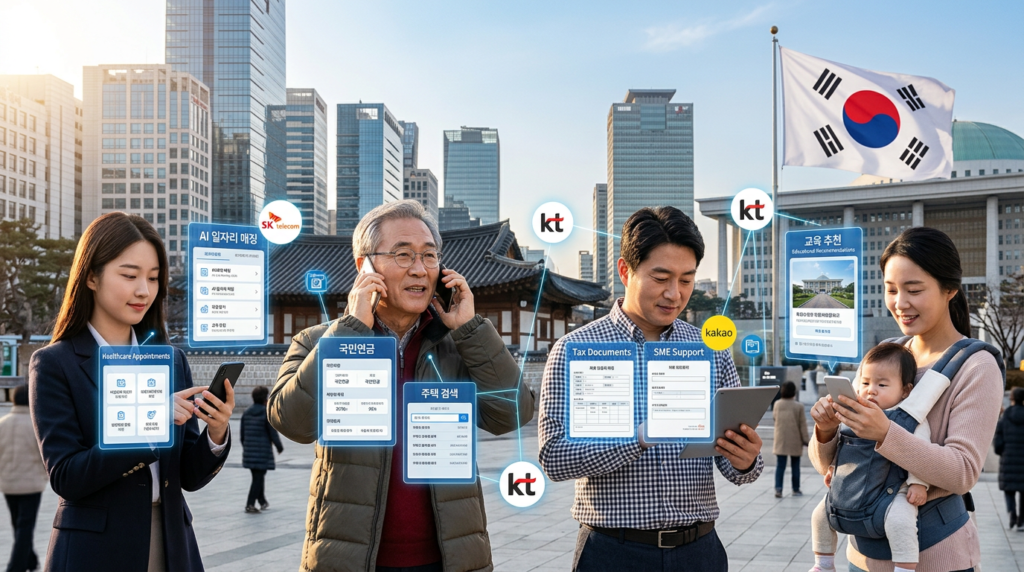
A National AI Rollout With Serious Ambition
South Korea is preparing to put generative AI within reach of its entire population, free of charge. Yes, everyone. No, this is not a coupon that expires just as you discover the useful button.
Through its government-backed “AI for All” program, the country plans to offer general-purpose chatbots and public-service AI agents without ordinary usage or token limits. The Ministry of Science and ICT has selected three consortia led by SK Telecom, KT and Kakao to build and operate the services. Beta testing is due to begin in September, followed by a broader launch before the end of 2026.
South Korea wants AI to help people navigate healthcare, housing, tax questions, education, employment and government benefits. It also wants those services to run largely on Korean technology rather than depend entirely on foreign platforms.
As TechSpot reports, users should be able to book medical appointments, search for apartments and receive tax guidance. Small businesses could check support eligibility, while parents could find educational recommendations.
Seoul is attempting to build a public-facing digital layer that can answer questions and, eventually, help finish the job.
Free Does Not Mean Every AI Product Is Suddenly Free
The headline needs one important guardrail. South Korea is not buying every resident unlimited subscriptions to ChatGPT, Claude, Gemini or whichever shiny model launches next Tuesday.
The program will provide government-supported services developed by the three winning consortia. According to Crypto Briefing, the initiative is designed to cover roughly 52 million people. Its general-purpose chatbot and public-service agent will form the free core.
Reports describe access as unlimited or free from token caps. That refers to normal use of the supported basic services. It should not be read as a promise that every specialist tool, premium feature or commercial add-on will cost nothing forever. The exact boundaries will become clearer as beta versions arrive and operators publish terms.
Offering population-scale AI without the familiar “you have three messages left” warning would mark a major policy experiment. It shifts the question from affordability to whether a country can keep broadly available AI reliable.
A clever demo can charm a conference hall. A national service must survive rush hours, regional accents, difficult paperwork and millions of computationally expensive questions at once.
Three Winners, Three Different Front Doors
The government chose the three groups from six bidders. Rather than force everyone into one giant state app, the project will use familiar channels.
SK Telecom plans an action-oriented assistant that can move from planning to execution and then confirm the result. Its service should work through apps and the web, but also through phone calls and text messages. That matters. An AI program cannot honestly call itself universal if it assumes every user enjoys installing apps, managing passwords and tapping through six menus before breakfast.
KT wants to support searching, comparing, deciding, executing and managing services within a single conversation. Its consortium includes Upstage, Musinsa and Zigbang. The proposed assistant could appear across portals and commercial services, bringing public and everyday tasks into one conversational flow.
Kakao has perhaps the most familiar doorway: KakaoTalk. The messaging platform already occupies a central place in Korean digital life, so asking people to find AI there makes more sense than demanding a brand-new habit.
The Seoul Economic Daily’s overview says ease of use and differentiated service plans played a major role in the selection. The best national interface may simply be the one people can find.
Kakao and LG Uplus Aim for an Everyday Assistant
Kakao’s consortium shows how broad this project could become. LG Uplus serves as a core partner, while the wider group contains 14 companies and institutions. Participants include LG AI Research, LG Electronics, LG CNS, Kakao Enterprise, Seoul National University Hospital, Shinhan Bank, Lunit, Jobis & Villains, Crowdworks and FuriosaAI.
That roster is not decorative. It maps directly to the areas the service hopes to cover: medicine, finance, taxation, education, jobs and caregiving.
According to a separate Seoul Economic Daily report on the consortium, the platform will combine a general chatbot, a public-sector agent and specialized agents. KakaoTalk and voice-call AI will provide the main access points.
The group plans to use domestic models, including LG AI Research’s K-EXAONE and Kakao’s Kanana. It also promises quality and safety checks before verified features reach the full service.
Accessibility sits near the center of the pitch. Older adults, people with disabilities and users at risk of digital exclusion should be able to reach the system without wrestling with unfamiliar software. LG Uplus says people could use it through a phone call without installing an app or creating a new account.
If AI only works for people already comfortable with technology, “AI for All” becomes “AI for the Usual Crowd.” South Korea wants a wider guest list.
From Answers to Actions

Most public chatbots explain what form you need, point toward a website and wish you luck in the maze. South Korea wants its agents to go further.
The selected proposals emphasize completing tasks, not merely describing them. A person might ask about a government benefit, learn whether they qualify and receive help with the application. Another user could compare housing options. A small-business owner might check tax obligations or discover an assistance program that would otherwise remain buried in administrative language.
This is the project’s most exciting promise—and its hardest technical challenge.
Completing a public-service task requires current data, secure identity checks, reliable system connections and clear user approval. It also needs an escape hatch when the AI gets confused. “Close enough” is a terrible standard for taxes or medical appointments.
The winning consortia scored well for public AI agents capable of handling complex application procedures, according to Seoul Economic Daily. Yet these remain proposed capabilities ahead of public testing.
That distinction matters. The beta will reveal whether the agents can navigate real bureaucracy rather than a polished demonstration. If they can, the program may turn government services from a scavenger hunt into a conversation. That would be a genuine upgrade—and possibly the first chatbot people thank without being prompted.
The Hardware Behind the Helpful Voice
Free AI still sends someone a very real electricity and computing bill. Seoul plans to support the three consortia with a combined total of up to 512 Nvidia B200 graphics processors during 2026. Starting next year, the government also intends to fund nationwide service-delivery costs through its budget.
The Ministry of Science and ICT has not publicly disclosed the program’s precise total cost. That missing figure will attract attention, especially if usage climbs quickly.
South Korea is already an unusually active AI market. TechSpot cites a government survey indicating that about one-quarter of South Koreans pay for generative AI services. It also reports that officials estimate more than 20 million people use free generative AI tools. The government has not announced a formal adoption target for the new service.
The Lee Jae Myung administration has allocated roughly 10 trillion won—about $7.2 billion—for AI-related spending in 2026, around triple the previous year’s allocation. “AI for All” sits within that wider national push rather than standing alone as a novelty giveaway.
Still, 512 powerful processors do not erase capacity questions. The beta should show how providers balance speed, depth and availability while keeping normal public use free.
A Big Bet on Korean AI Sovereignty
The project also works as industrial policy wearing a friendly chatbot hat.
South Korea wants more people using locally developed AI. The government is therefore backing domestic models, domestic platforms and Korean-language services that understand local institutions. That reduces reliance on foreign systems while creating enormous real-world demand for homegrown technology.
Crypto Briefing reports that at least half of the models used for the initiative must be domestically developed. The winning groups bring several Korean systems and partners into the mix, including SK Telecom’s AI work, Upstage, Kakao’s Kanana and LG AI Research’s K-EXAONE.
This does not guarantee Korean models will outrun every global rival. It does give them exposure to practical use at national scale. Millions of queries can reveal where models stumble over local regulations, formal language and regional speech.
There is a competitive wrinkle too. Seoul selected three groups, not one. Each consortium can approach access, partnerships and specialist services differently. That may reduce the risk of a single design becoming the only door to government-supported AI.
If the experiment succeeds, South Korea could strengthen its domestic AI sector while creating public value. If it struggles, the country will at least discover where sovereign-AI ambition collides with cost, capability and citizens who refuse to phrase prompts like engineers.
Inclusion Is the Real Benchmark
Can an older person use the service over a normal phone call? Can a visually impaired user navigate it? Can someone who does not understand government jargon complete an application without accidentally submitting the wrong information? Can the platform explain uncertainty in plain Korean and hand the case to a human when necessary?
SK Telecom’s phone-and-text plan and Kakao-LG Uplus’s voice access directly address that challenge. Kakao’s consortium also says it will design for older adults, people with disabilities and other groups vulnerable to digital exclusion.
Those promises deserve close scrutiny during testing. Access involves more than removing a price tag. People need suitable devices, connectivity, accessible interfaces and enough trust to share information. They also need to know when an answer comes from an AI, which records it consulted and how to correct a mistake.
The program’s familiar distribution channels could help. KakaoTalk, telecom services, phone calls and text messages already fit into daily routines. They may lower the learning curve far more effectively than another standalone portal with a logo, a tutorial and the emotional warmth of an airport kiosk.
The goal is not simply to report a giant user number. It is to make advanced software usable by people who rarely appear in product keynotes.
Privacy, Accuracy and Trust Will Decide the Outcome
Connecting AI to healthcare, finance, taxes and public benefits raises an obvious question: what happens to the data?
The supplied reports describe planned quality and safety verification, but many operational details remain to be seen. The providers will need strong rules for consent, data minimization, retention, security and human review. Citizens should also receive clear explanations when an agent takes—or cannot take—an action on their behalf.
Accuracy poses another challenge. Generative AI can sound certain while being wrong, a talent previously reserved for unprepared meeting attendees. Errors become more serious when a system discusses eligibility, deadlines, medical information or money.
The operators must measure more than response speed. They should track task completion, incorrect guidance, failed handoffs, accessibility problems and whether users can fix mistakes.
Competition among three consortia may help expose which design works best. It may also create inconsistent experiences if services handle data, corrections or government integrations differently. Clear baseline standards will matter.
The Seoul Economic Daily’s financial briefing confirms that agreements are expected in September, followed by beta service and a full launch this year. That timetable is fast. Useful, safe integration with public systems is not. The rollout will need both urgency and brakes—an awkward combination, but a necessary one.
The World Will Be Watching This Experiment

Governments have spent years debating AI rules, research funding and national computing capacity. South Korea is now asking a more immediate question: what happens when the public can actually use nationally supported AI every day?
The answer could influence policy beyond Korea. A successful launch could show how governments support local models, widen access and connect conversational systems to public services.
A troubled launch would be equally instructive. Capacity shortages, inaccurate advice, privacy concerns or low adoption could expose the distance between a bold announcement and dependable public infrastructure.
For now, the facts are straightforward. Three consortia—led by SK Telecom, KT and Kakao—will build the services. The government will contribute major computing resources and budget support. Beta testing starts soon, and the broader rollout is targeted for the end of 2026. The basic offering aims to reach the whole population at no charge and without ordinary token limits.
The program’s legacy will depend on less glamorous details: whether calls connect, forms submit, answers stay accurate and people feel safe using it.
South Korea is trying to move AI from a premium app into the fabric of everyday life. The chatbot era may be about to meet public infrastructure. Let us hope it has filled out the correct form.
Sources
- TechSpot — South Korea is giving its entire population free access to AI, no token limits
- Crypto Briefing — South Korea to give all 52 million citizens free AI access
- Seoul Economic Daily — Kakao-LG Uplus Consortium Wins Government AI Service Project
- Market Sanity — South Korea will provide free access to AI for all citizens
- Seoul Economic Daily — Korea Picks SK Telecom, KT, Kakao for Free Nationwide AI Service
- Seoul Economic Daily — SK Telecom, Kakao, KT Win Korea’s Free AI Service Project
The Kingy Brief
Get The Kingy Brief.
AI changes, original tests and one practical thing to try. Fridays at 09:00 Vancouver time.
Free · Double opt-in · Unsubscribe anytime
Sign up for The Kingy Brief on Beehiiv.
Signup help and newsletter schedule
Signup form provided by Beehiiv. After submitting, check your inbox for "Confirm your subscription to The Kingy Brief" and open its confirmation link. Check Spam or Promotions if you cannot find it.
Fridays at 09:00 Vancouver time: source-checked AI changes, original tests and one practical thing to try. We skip a week when there is not enough verified material. Free. Unsubscribe anytime.