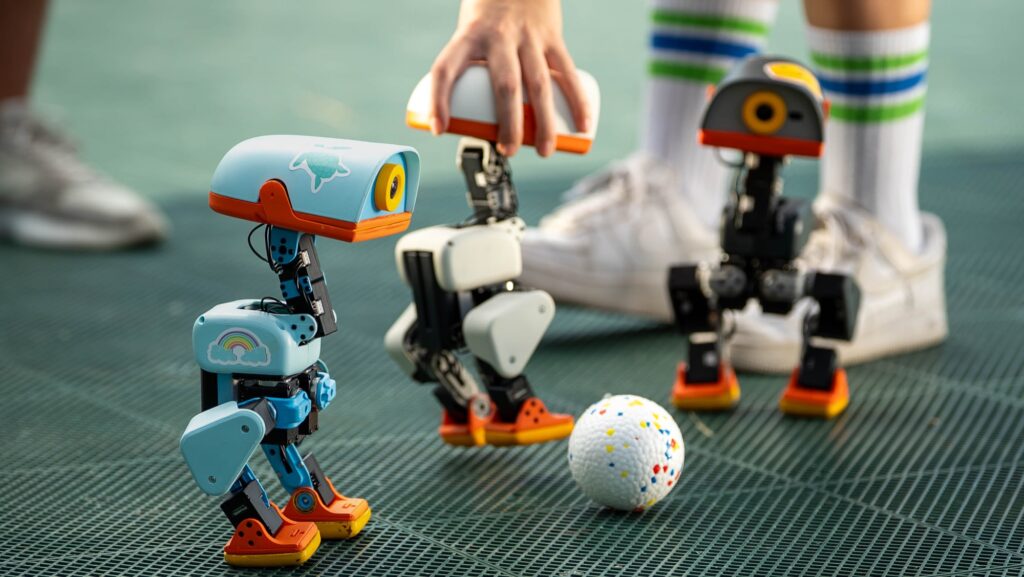
Evidence-first verdict: Hugging Face and Pollen Robotics are selling a 25-centimeter biped with a public simulator, a reinforcement-learning stack, and onboard inference. The bet is that cheap, recoverable failure can move embodied AI beyond specialist labs. First, the robot has to ship and its community has to do something new with it.
Testing disclosure: Kingy.ai did not test a shipping Microduck. This launch-day analysis is based on official documentation, public repositories, company demonstrations, and independent reporting. Specifications and delivery timing may change.
In Pollen Robotics’ launch footage, Microduck ends up on the floor. The one-eyed machine folds its legs, shifts its weight, pushes against the ground, and returns to its feet. Then it waddles away.
The footage comes from the company and cannot establish durability. Still, the fall explains Microduck better than the scenes of it carrying a sock or moving on roller attachments. Reinforcement learning depends on repeated failure. With a large robot, each bad attempt can damage hardware, threaten people, and require a human to reset the machine. A robot that weighs less than 800 grams can make failure routine enough to study.
That is the serious proposition inside Hugging Face’s latest cute robot. Microduck, announced on August 27, 2026 by Hugging Face’s Pollen Robotics team, is a 25-centimeter biped with 15 motors and an introductory preorder price of $399 before taxes and shipping. First deliveries are targeted before Christmas 2026. “Targeted” matters: nobody outside the company has yet tested a mass-produced unit over months of falls, repairs, updates, and retraining.
The hardware is dense for the price, although Pollen labels several technical specifications provisional. Microduck has a front camera, an 8-by-8 time-of-flight depth sensor, two inertial measurement units, microphones, a speaker, two NFC antennas, Wi-Fi, Bluetooth, and an articulated beak that can grasp small objects. A Rockchip RK3566 with an AI accelerator runs the robot, backed by 1 GB of RAM and 32 GB of storage. Its removable battery is rated for roughly an hour, depending on use. The box includes a gamepad, and Pollen says seven behaviors will be available at launch, including walking, sitting, standing, kicking, a grasp sequence, skating, and recovery from common falls. The control design shows that learned body motion and separate beak control cooperate during a grasp, rather than one end-to-end policy learning the entire act. The official press sheet does not publish a payload rating; the widely repeated 800-gram figure is the robot’s own weight.
Specifications at a glance
| Item | Launch-day specification |
|---|---|
| Price | $399 introductory preorder price, before tax and shipping |
| Delivery target | Before Christmas 2026; target, not guarantee |
| Availability | Listed for the US, Canada, EU, UK, Norway, Switzerland, Japan, and South Korea at launch |
| Dimensions and weight | 25 cm tall, 14 cm wide, under 800 g |
| Motion | 15 motors; walking, sit/stand, crouching, recovery, kicking, grasping, and skating behaviors demonstrated or listed |
| Vision and ranging | Front camera; 8×8 time-of-flight depth sensor |
| Other sensors and I/O | Two IMUs, microphones, speaker, two NFC antennas |
| Compute | Rockchip RK3566 with AI accelerator; 1 GB RAM; 32 GB storage |
| Connectivity | Wi-Fi and Bluetooth |
| Battery | Removable NP-F550, 2,600 mAh; approximately one hour depending on use |
| Included | Robot, battery, USB-C cable, game controller |
| Policy runtime | ONNX policies evaluated onboard at 50 Hz |
| Training | PPO in MuJoCo Warp/mjlab; local CUDA GPU or Hugging Face Jobs |
| Open-source scope | Apache-2.0 runtime and RL software; some 3D models CC BY-SA-NC; mechanical and electronic design files not published |
The product is a learning loop
Plenty of inexpensive robots can execute scripted tricks. Microduck’s stronger claim is a documented route for teaching a physical machine a new movement.
Its locomotion policies are small neural networks trained with reinforcement learning. In the published training stack, the Proximal Policy Optimization algorithm, usually shortened to PPO, tries actions in a MuJoCo physics simulation. Reward functions give the policy higher scores for useful outcomes such as tracking a target speed, staying upright, or completing a recovery. A training run can advance 4,096 simulated Microducks in parallel, compressing an impractical amount of physical trial and error into a GPU job.
Simulation creates its own problem. A virtual joint has perfect dimensions unless engineers teach it otherwise; the real version has friction, gear play, voltage sag, delayed commands, manufacturing variation, and a floor that never matches a mathematical plane. This mismatch is the “sim-to-real gap”. Microduck’s repository attacks it with domain randomization, which varies physical conditions during training, plus detailed actuator physics and explicit simulation of mechanical backlash. At this size, the project says actuator fidelity accounts for much of that gap.
The resulting policy is exported to ONNX, a portable neural-network format, and loaded by the onboard runtime. The robot evaluates its movement policy at 50 Hz rather than asking a laptop what to do on every step. Different policies can take over for walking, recovering, or performing a trick while using a shared observation format.
Those policies use body state, joint readings, previous actions, and movement commands. Camera and depth frames are absent from the low-level locomotion inputs; the ball-kick task is explicitly ball-blind. Perception runs separately and can issue higher-level intent. Microduck’s AI claim is an offboard-trained, proprioceptive movement policy that its RK3566 runs as inference.
Pollen’s repository says a usable walking gait can train in roughly one to two hours at 4,096 parallel environments. The estimate omits the GPU model, seed, and success threshold, so it cannot serve as a benchmark across consumer hardware. Local training requires a CUDA-capable GPU. The project’s Hugging Face Jobs helper defaults to one L4 GPU, priced at $0.80 an hour as of launch day. Retries and parameter sweeps increase that bill. The $399 robot lowers the hardware entry price without eliminating compute costs or the expertise needed to design good rewards.
Making failure cheaper
Microduck’s strongest argument is economic. Robot learning is slow when every failed policy means an emergency stop, an inspection, and a person lifting the machine back into place. A self-righting robot removes part of that reset tax. A sub-kilogram machine also makes a classroom, home workbench, or small lab a more plausible testing site.
Cheap programmable robots already exist. Petoi lists its Bittle X V2 quadruped at $319 for a kit and $339 assembled, although its product page was marked sold out at the time of checking. Antoine Pirrone’s community-built Open Duck Mini already targets a bill of materials below $400 and publishes a MuJoCo-to-ONNX reinforcement-learning workflow. Berkeley’s Humanoid Lite publishes a much more capable, fully open humanoid design with a parts cost below $5,000.
Those examples leave the “first affordable robot teachable through reinforcement learning” label unsupported as a historical first. Axios attributes the claim to Hugging Face CEO Clem Delangue.
Microduck packages the pieces differently. It arrives assembled, includes a controller and working behaviors, runs the learned policies onboard, and exposes the simulator, training environments, deployment path, and robot software. That combination could shorten the distance between opening a box and running a real sim-to-real experiment. Standardized hardware matters too: a policy shared online is more useful when the recipient’s motors, sensors, and geometry match the machine on which it was developed.
The next step would be a community that trades movements the way Hugging Face users trade model weights and datasets. A better recovery policy, a new gait, or a multi-robot football behavior could travel with its environment and training recipe, allowing another owner to reproduce it. Hugging Face CEO Clément Delangue floated an open app store of robotics skills after the company acquired Pollen Robotics in April 2025. Microduck supplies a plausible piece of common hardware for that idea.
No such marketplace exists at launch. There are public runtime and RL repositories, a browser-accessible simulator, and a Discord community. The project roadmap still lists the stable SDK, app, and model channel as unfinished; policies currently travel inside software releases. Whether these pieces become a dependable library of reproducible behaviors is the central test, not a launch-day download count.
Comparison: where Microduck fits at $399
Prices and availability checked August 27, 2026. These products serve different audiences; the comparison tests accessibility and openness rather than declaring a single “winner.”
| Platform | Current price/status | Assembly and locomotion | Sensors and interaction | RL/simulation path | Open-source scope | Intended audience |
|---|---|---|---|---|---|---|
| Microduck | $399 introductory preorder; tax/shipping extra | Assembled 25 cm biped; 15 motors; beak gripper | Camera, 8×8 ToF, two IMUs, audio, NFC | Published MuJoCo/PPO training, ONNX export, 50 Hz onboard deployment | Software Apache-2.0; hardware design files closed; 3D-model licensing includes noncommercial terms | AI developers, makers, classrooms, home labs |
| Open Duck Mini v2 | Target BOM under $400; self-sourced | DIY/3D-printed, roughly 42 cm biped | IMU-based locomotion; repo describes some expression hardware as incomplete | MuJoCo training, actuator identification, ONNX deployment to Raspberry Pi Zero 2 W | Main repo Apache-2.0 with public CAD/BOM/build resources; check licenses for each linked subproject and asset | Advanced makers and community robotics builders |
| Petoi Bittle X V2 | $319 kit / $339 assembled listed; product page marked sold out when checked | Kit or assembled 9-DOF quadruped; optional arm | Gyro, touch/voice control; optional camera, sensors, and gripper | Free browser simulator; community and vendor-documented RL/Isaac paths, but no single first-party train-to-deploy workflow like Microduck’s | Current OpenCatESP32 firmware is MIT; selective STLs; full production hardware design not published | STEM education, coding, makers, entry-level research |
| Unitree Go2 | From $1,600 in official catalog; page configuration checked at $2,800, plus $399–$1,000 shipping | Assembled, larger 12-DOF quadruped | 4D LiDAR, app control, mapping, richer locomotion | Official SDK, MuJoCo and RL repositories; secondary-development access varies by version and is not offered on Air/Pro | Public BSD/Apache-licensed development tools; commercial hardware design is proprietary | Consumer/commercial Air/Pro; research-oriented EDU requires a quote |
| Berkeley Humanoid Lite | Under $5,000 US-market parts cost | DIY, about 1 m and 16 kg; novice build estimated around one week | Full humanoid locomotion and teleoperated manipulation platform | Isaac Lab training, sim-to-sim validation, RL locomotion and deployment | Hardware design, embedded code, and training/deployment stack published; assets include CC BY-SA 4.0 | Research labs and experienced builders |
Productization may be the invention
Microduck also has an intellectual predecessor that deserves attention. Open Duck Mini is a roughly 42-centimeter DIY biped created by Antoine Pirrone, a Pollen Robotics engineer and member of Microduck’s launch team. Its public project includes CAD, a parts list, build material, a Raspberry Pi runtime, MuJoCo training tools, and ONNX policies. Hugging Face and Pollen sponsored it.
The overlap in personnel, price ambition, form, and training method suggests a lineage. The reviewed public sources do not establish that Microduck is a direct commercial version of Open Duck Mini, nor do they promise compatible parts or policies. The maker project demonstrated much of the idea before Hugging Face packaged a heavily redesigned, smaller robot around it. That product-line connection is an inference; the material advance is easier to see in repeatable manufacturing, distribution, support, safer updates, and a uniform software target.
That fits Hugging Face’s earlier affordable-robotics push and its broader robotics strategy. The company began LeRobot in 2024 and acquired Pollen in April 2025, gaining a team that had already built research robots. Pollen describes Reachy Mini as a platform for AI that interacts through vision, speech, and expression. Microduck starts with action: balance, locomotion, contact, and recovery. Hugging Face is trying to extend its role from distributing models and datasets to distributing things models can make bodies do.
Open software, closed hardware files
The word “open” needs a boundary. Microduck has an open-source software stack, but its hardware design files remain closed. Its runtime and reinforcement-learning repositories use the Apache 2.0 software license. Developers can inspect, modify, and redistribute that code. The RL repository places its 3D model files under a noncommercial Creative Commons license.
Pollen’s press kit explicitly says the mechanical and electronic design files are closed. A third party cannot reproduce its hardware from published manufacturing files. Berkeley Humanoid Lite, by comparison, publishes its hardware design, embedded software, and training and deployment tools. Microduck trades some of that manufacturing freedom for a dramatically lower price and an assembled product.
Its camera and microphones create another unfinished test. Public code makes surveillance behavior easier to audit, but it cannot stop an application from sending frames or audio elsewhere. The current WebRTC development design has no robot-side authorization on a local network; its authors write that anyone who reaches the signaling server can view the camera and drive the robot, and call that unacceptable for a home. The Bluetooth provisioning design says the test board’s default 000000 PIN and unencrypted provisioning expose credentials to a bystander, treating encryption and per-device secrets as shipping blockers. Meanwhile, the press kit promises a visible camera-use light, while the roadmap says the indicator hardware remains unresolved.
Because these documents describe a prototype under development, they do not establish the security of retail units in either direction. The target architecture calls for revocable consent, encrypted media, signed updates, health checks, and automatic rollback. Buyers need confirmation that those controls moved from design notes into tested hardware and software.
Other limits are more ordinary. Camera resolution, field of view, depth-sensor range, radio versions, SDK languages, and an age recommendation were still provisional at announcement. An hour of battery life constrains long experiments. One gigabyte of RAM limits what can run onboard. The beak can move small objects, but Microduck is not equipped for useful household labor. Its Christmas delivery date is a target, and $399 is an introductory price that excludes optional packs, taxes, and shipping.
What would prove the thesis?
Microduck needs evidence after launch:
- deliveries close to the stated window;
- published durability and repair data;
- stable SDK and update interfaces;
- clear local-versus-cloud privacy controls; and
- third-party policies that transfer across multiple retail units, with independent reproductions that include environments, checkpoints, and training recipes.
A community full of short demo clips would show enthusiasm. A community that can reproduce one another’s behaviors would show a platform.
Without those results, Pollen will have built an unusually polished developer toy. With them, it will have lowered the cost of each failed physical-AI experiment to something many more people can afford.
Reader FAQ
Is Microduck an AI chatbot with legs?
No. Its central AI feature is a set of neural movement policies trained with reinforcement learning. The architecture anticipates vision and remote or server-side programs, including LLM-controlled applications, but the launch proposition is learned physical behavior rather than an onboard conversational model.
Is Microduck open-source hardware?
No. Pollen says the runtime, SDK, simulator, and RL training software are open source. Its press kit explicitly excludes the mechanical and electronic design files. Some simulation-model assets also carry noncommercial Creative Commons terms.
Can it really learn a new trick in one or two hours?
The RL repository says a usable walking gait can train in roughly one to two hours with 4,096 simulated environments. That estimate requires a CUDA GPU and is not a guarantee for every behavior or hardware configuration. Moving a policy successfully from simulation to a real robot remains the harder test.
Is Microduck a useful household robot?
Not in the ordinary sense. It can move, react, grasp small objects, and serve as a robotics development platform. Its size, one-hour battery estimate, and simple beak rule out substantial cleaning, carrying, or manipulation work.
Sources and methodology
This launch-day analysis is based on public documentation, source repositories, official demonstrations, and independent reporting. Kingy.ai did not test a shipping Microduck unit. Product specifications and availability were checked on August 27, 2026; preorder delivery remains a company target.
Primary sources
- Pollen Robotics announcement
- Microduck product page
- Official press kit
- Store listing and specifications
- Microduck runtime and SDK repository
- Microduck reinforcement-learning repository
- Browser simulator
- Open Duck Mini repository
Independent context
For continuing coverage of embodied AI and robotics platforms, see Kingy.ai’s AI Hardware Radar.
The Kingy Brief
Get The Kingy Brief.
AI changes, original tests and one practical thing to try. Fridays at 09:00 Vancouver time.
Free · Double opt-in · Unsubscribe anytime
Signup help and newsletter schedule
Signup form provided by Beehiiv. After submitting, check your inbox for "Confirm your subscription to The Kingy Brief" and open its confirmation link. Check Spam or Promotions if you cannot find it.
Fridays at 09:00 Vancouver time: source-checked AI changes, original tests and one practical thing to try. The weekly restart begins October 9, 2026. We skip a week when there is not enough verified material. Free. Unsubscribe anytime.