DeepSeek Targets the Machinery Behind AI Agents
DeepSeek has spent much of its public life competing through models. Bigger benchmarks. Lower prices. More efficient training. The familiar AI arms race, in other words.
Now it wants to compete somewhere else: the machinery surrounding those models.
The company has released DeepSeek Harness, an open-source runtime designed to help AI models use tools, edit files, execute commands, manage sessions and complete multi-step assignments. The software, also called dsh, has entered developer preview under the permissive MIT license.
Its sales pitch fits neatly on a sticker: “Everything is a plugin.”
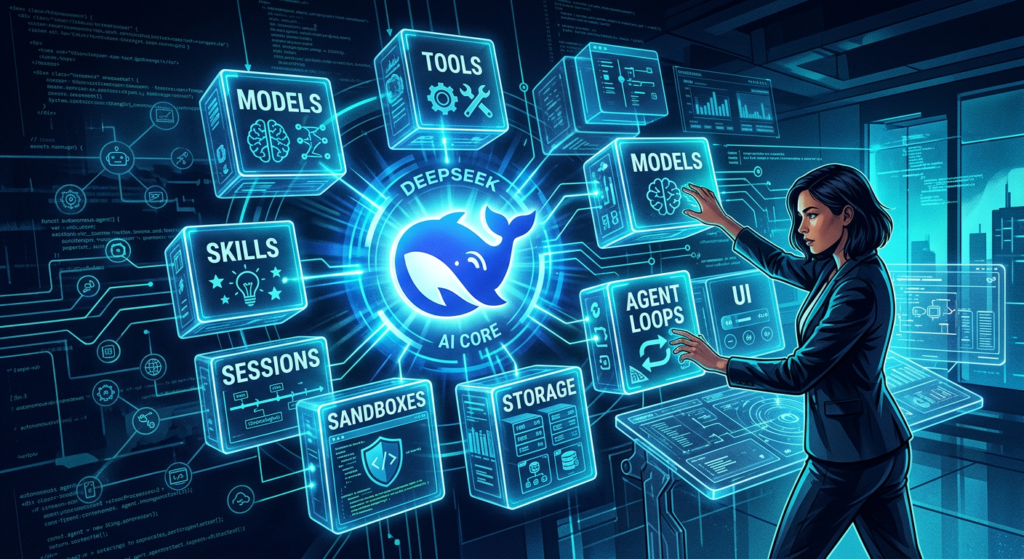
DeepSeek means that almost literally. Models, tools, skills, sessions, sandboxes, storage systems, agent loops, schedulers and even the user interface operate as replaceable components. Developers can assemble an agent for a particular job without rewriting the entire runtime.
That makes Harness different from a conventional AI coding assistant. It is less like hiring one preconfigured digital programmer and more like receiving a workshop full of interchangeable parts. Bring your preferred model. Pick the tools. Replace the storage layer. Add a sandbox. Change the agent loop. If something does not fit, unplug it.
As The Register observed, competition is shifting beyond the model itself. Models may supply the intelligence, but harnesses determine how that intelligence behaves in the real world.
And behavior is where things get interesting.
What Exactly Is an Agent Harness?
A language model generates responses. An agent must do considerably more.
It needs to inspect its environment, choose tools, perform actions, evaluate results and decide what to do next. It may also need to remember earlier steps, recover from errors and ask for permission before touching sensitive files.
The harness manages that work.
DeepSeek summarizes the relationship with a simple formula: Agent = Model + Harness. The model provides reasoning and language generation. The harness supplies the operational layer that lets it act.
Imagine an excellent chef standing in an empty room. No stove, No knives, No ingredients. Technically gifted, practically useless. The harness supplies the kitchen—and ideally prevents the chef from flambéing the curtains.
Products such as Claude Code, Codex, Aider, Cline, OpenCode and OpenHands already wrap models in different combinations of prompts, tools, permissions and control loops. However, the word “harness” remains flexible. Sometimes it describes little more than a tool-calling loop. Elsewhere, it covers the entire runtime, including interfaces, memory, subagents, scheduling and security controls.
DeepSeek adopts the broader definition. Its harness manages practically every layer between a model and the environment it can affect.
That matters because the same model can perform very differently when placed inside different harnesses. Tool design, prompt size, context management, caching and recovery logic can all change speed, cost and reliability. The engine matters. So does the car built around it.
Everything Really Is a Plugin
Many software platforms call themselves modular. Then developers discover that three pieces are modular, two require special adapters and one mysterious component apparently predates electricity.
DeepSeek Harness makes a more ambitious architectural promise.
Its model provider is a plugin. So are file-editing tools, web search, shell access, sessions, skills, sandboxes and storage. Even the agent’s control loop and interface can be replaced. Developers select and combine these parts through configuration instead of modifying the central Harness code.
According to DeepSeek’s official announcement, developers can swap or extend capabilities while leaving the underlying runtime untouched. That could make experimentation considerably easier.
A team might create a cautious internal assistant with read-only tools and a tightly restricted sandbox. Another could build a coding agent with shell access, repository search and several specialized subagents. A research lab could strip the system down for controlled model evaluations.
Same foundation. Very different creatures.
The system also supports community-discoverable plugins. Developers can tag compatible repositories with the dsh-plugin topic, helping an ecosystem form outside DeepSeek’s official packages.
That openness creates opportunity, although it also transfers responsibility. A plugin that can execute commands or inspect private repositories deserves more scrutiny than a browser theme. Modularity makes software flexible. It does not magically make every module trustworthy.
Still, the central idea is compelling: extend the system by mounting another component, not by cutting open the engine every Tuesday.
Cordis Keeps the Pieces From Fighting
DeepSeek Harness builds its plugin architecture on a system called Cordis. DeepSeek describes Cordis as a meta-framework for “spatiotemporal composability,” a phrase that could frighten an innocent cup of coffee.
The practical meaning is friendlier.
Cordis manages how plugins mount, unmount and depend on one another. Spatial composability allows components to express and resolve dependencies. Temporal composability focuses on adding or removing components while correctly reversing their effects.
That second part matters. Traditional plugin systems often allow extensions to activate but struggle to remove them cleanly without restarting the host application. A plugin might register tools, subscribe to events or modify shared state. Unloading it requires the system to reverse each of those changes.
Cordis attempts to make that lifecycle manageable.
Services and events let the plugins communicate without welding them into one giant application. The kernel handles composition, while the capabilities remain in the plugins themselves.
As The Register’s analysis explains, this approach reflects DeepSeek’s effort to support components that developers can dynamically add, remove or rearrange.
The result resembles a construction kit for agent runtimes. Cordis supplies the rules that keep the bricks connected. DeepSeek Harness supplies a working collection of those bricks.
Hopefully, nobody steps on one barefoot.
Four Modes Offer Four Starting Points
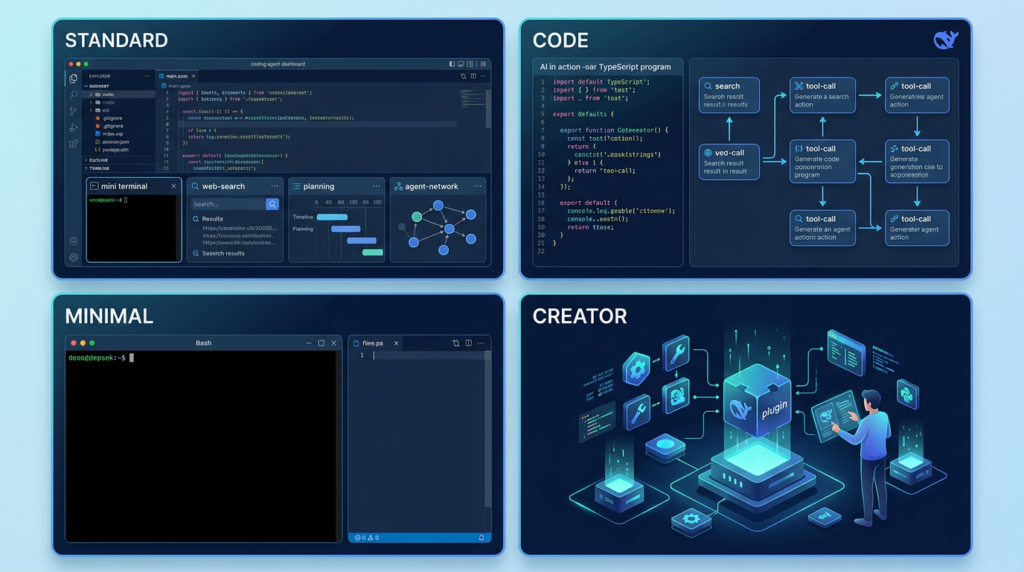
DeepSeek Harness currently ships with four runtime presets: Standard, Code, Minimal and Creator.
Standard mode provides the broadest coding-agent setup. It includes file editing, shell commands, file and web search, planning, skills, goals, workflows and subagents. This is the closest option to a complete general-purpose coding assistant.
Code mode offers the same broad capabilities but exposes tools through a TypeScript software development kit. The model can write a small program that coordinates multiple tool operations. That can compress several sequential calls into one larger action, reducing the back-and-forth needed for complicated jobs.
Minimal mode takes the opposite approach. It gives the agent only a persistent Bash shell and a str_replace_editor. Researchers can use this stripped environment to test a model without burying it beneath elaborate scaffolding. DeepSeek has also used Minimal mode for code-agent benchmarking, making the setup relevant when interpreting performance claims.
Finally, Creator mode helps developers build custom presets. It combines Standard mode’s capabilities with runtime inspection, in-memory plugin experiments and guidance for assembling new configurations.
These modes show why Harness is not merely another chat window with repository access. DeepSeek wants developers to treat the runtime itself as an editable product.
A benchmarker can remove almost everything. An enterprise can lock everything down. An ambitious developer can assemble a multi-agent coding contraption with enough moving parts to make a project manager nervous.
Every Agent Run Leaves a Trail
Autonomous agents can fail in wonderfully creative ways. Unfortunately, “it did something weird” is not a useful debugging report.
DeepSeek addresses that problem with an append-only session log. The system records the information shown to the model, including system instructions, reasoning records, tool calls, tool results, subagent scheduling and context injections.
DeepSeek’s Trajectory view then lets developers inspect those events by source. Resume, search, fork and replay operations all use the same underlying event stream.
This design could make agent behavior easier to reconstruct. If an assistant edits the wrong file after receiving outdated context, developers can trace what it saw and when it saw it. They do not have to infer the answer from a handful of scattered logs and a final message saying, “Done!”
The system also includes permission and sandboxing controls. I-Scoop’s technical review reports platform-specific protections, including Linux Landlock, macOS Seatbelt and restricted execution mechanisms on Windows. Users can select permission levels ranging from read-only access to much broader control.
Those choices deserve attention. A coding agent with unrestricted shell and filesystem access can accomplish more, but it can also make more consequential mistakes.
Traceability does not prevent every failure. It does make failures less mysterious. In agent engineering, that represents genuine progress. A visible disaster is usually easier to fix than an invisible one.
DeepSeek Is Not Locking the Door
Despite the name, DeepSeek Harness is not limited to DeepSeek models.
The documented provider options include DeepSeek, Anthropic, OpenAI, AWS Bedrock, Microsoft Azure and Google-related enterprise services. Developers can also configure compatible endpoints and potentially connect locally hosted models.
More unusually, the system can treat Claude Code and Codex as subagent providers. A Harness workflow could theoretically delegate one assignment to Claude Code, send another to Codex and coordinate the results through DeepSeek’s runtime.
That feature complicates the “DeepSeek versus Claude Code” narrative.
VentureBeat framed Harness as an open-source rival, which makes strategic sense. All three systems compete for developer attention. Yet Harness can also sit above competing coding agents and use them as components.
MindStudio’s examination therefore describes it as something closer to an orchestration framework than a straightforward replacement. Claude Code and Codex arrive with more opinionated, vendor-controlled operating models. DeepSeek offers a runtime that developers can disassemble and rebuild.
That flexibility could appeal to teams worried about model lock-in. If models become increasingly interchangeable, companies may prefer an agent layer they control.
Of course, theoretical compatibility and effortless interoperability are different things. Harness remains young. Integrations will need testing under real workloads before anyone declares universal agent harmony.
The License Could Be a Strategic Weapon
DeepSeek released the Harness source code under the MIT license.
That license generally allows people and companies to use, modify, redistribute and incorporate the software into commercial products, provided they preserve the required copyright and license notice. It places relatively few restrictions on downstream development.
For startups, that lowers the barrier to experimentation. For larger organizations, it creates the possibility of maintaining internal versions, building proprietary plugins or operating the runtime within controlled infrastructure.
The license also helps DeepSeek compete through distribution.
A closed agent product asks developers to accept its interface, roadmap and business model. An MIT-licensed foundation invites them to build on top of it. If enough developers create plugins, tools and integrations, the surrounding ecosystem could become more valuable than the original runtime.
The early response suggests considerable curiosity. As of August 17, 2026, the GitHub repository displayed more than 143,000 stars and 14,000 forks. Those numbers will change, and GitHub popularity does not equal production adoption. Stars are applause, not a service-level agreement.
Still, that burst of attention shows that DeepSeek has touched a developer nerve. Builders want more control over the layer between models and real work.
The company is effectively betting that openness can attract the experimentation needed to improve that layer quickly.
Developer Preview Means “Bring a Helmet”
DeepSeek has not labeled Harness production-ready. Quite the opposite.
The project’s README places its warning in capital letters: “THERE WILL BE COMPATIBILITY-BREAKING CHANGES.” The APIs and core plugins remain under active development. Anyone building on version 0.1 should expect movement.
Installation is relatively direct. Developers with Node.js can launch the local web interface by running npx @deepseek-ai/dsh web. The official instructions say the interface uses 127.0.0.1:3080 by default. Developers can also clone the repository and build it with pnpm.
But easy installation does not guarantee efficient operation.
MindStudio reported that one test involving an International Space Station tracker consumed roughly 20 million tokens across two turns and about 35 minutes. That result came from one hands-on workload, not a controlled universal benchmark, but it highlights a practical concern: highly autonomous agents can become ferociously token-hungry.
Broader testing supports the importance of harness efficiency. A separate Composio comparison found meaningful differences in speed, token consumption, cost and task completion when several harnesses used the same DeepSeek model. No option dominated every measure.
So developers should experiment, measure and resist falling in love with a demo. A polished interface can hide an astonishing appetite.
Harness may be free software. The models it calls still know where your API bill lives.
The Bigger Battle Is Moving Above the Model
DeepSeek Harness arrives at an important moment.
AI companies have spent years presenting model intelligence as the main competitive advantage. Better reasoning supposedly produced the better product. That remains partly true, but the surrounding system now matters enormously.
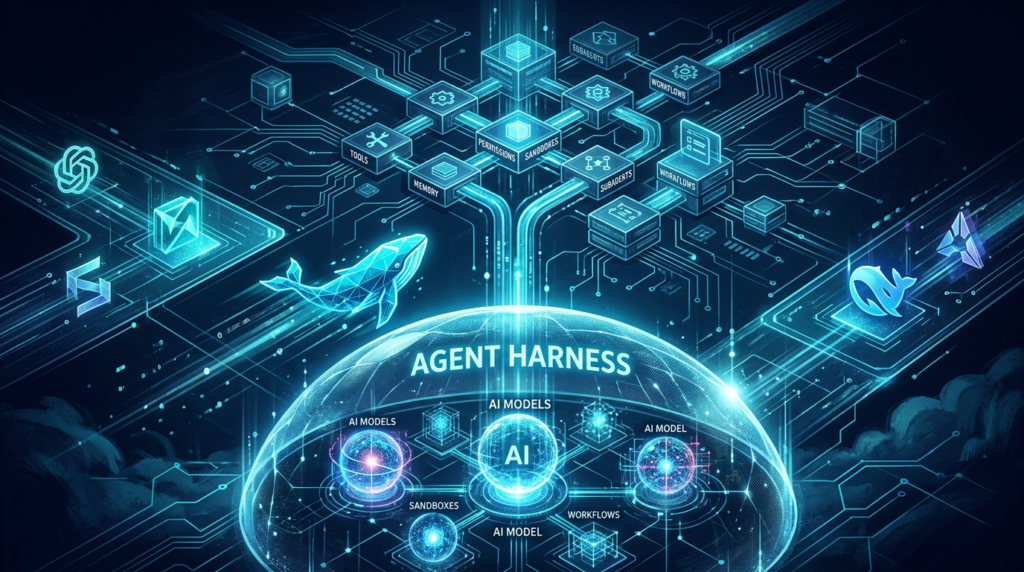
A harness decides which tools an agent receives. It controls context, permissions, memory, retries, subagents and recovery. It shapes how much the agent costs and how reliably it finishes a task. In many cases, it also owns the interface developers use every day.
DeepSeek is moving into that strategic layer with a clear proposition: make the runtime open, composable and model-agnostic.
The project still carries substantial caveats. It remains a developer preview. Compatibility will break. Efficiency needs broader testing. Enterprises must evaluate its security controls, integrations and governance before allowing it near sensitive environments.
Nevertheless, Harness expands the conversation. Developers no longer have to ask only, “Which model is smartest?” They can also ask, “Which runtime turns that intelligence into dependable action?”
That second question may become more important.
Models will continue improving. Prices will shift. Benchmark crowns will change heads, perhaps before lunch. A flexible harness promises something more durable: the ability to replace individual pieces without demolishing the whole system.
DeepSeek is betting that the future of agents will not belong to one model or one fixed assistant. It will belong to whoever builds the best operating layer around them.
And this time, DeepSeek brought plugins. Lots of them.
Sources
- DeepSeek Harness — Official announcement
- DeepSeek Harness — Official GitHub repository
- DeepSeek Harness release analysis — MarkTechPost
- DeepSeek’s innovative harness treats everything as a plug-in — The Register
- DeepSeek open sources an agent harness — The New Stack
- DeepSeek Harness launches as an open-source rival — VentureBeat
- What Is DeepSeek Harness? — MindStudio
- DeepSeek Harness: Open-Source Agent Runtime — Eigent
- DeepSeek Harness technical analysis — I-Scoop
- Finding the Best Harness for DeepSeek V4 Flash — Composio
The Kingy Brief
Get future Kingy Brief editions.
Source-checked AI changes, original tests and one practical thing to try.
Free · Choose your subjects · Double opt-in · Unsubscribe anytime
Regular sending is paused; no restart date is set.