
The Inbox Strikes Back
For decades, email scammers have operated with a simple advantage: they only need one person to take the bait.
Send enough fake invoices, inheritance offers, urgent payment requests and suspiciously generous business proposals, and eventually somebody will respond. Most recipients will delete the message. Spam filters will catch another chunk. Yet the scammer can keep sending because rejection costs almost nothing.
Now an AI-powered project called ScamBuster wants to change that calculation.
Presented at Black Hat USA 2026, ScamBuster does more than detect or delete suspicious email. It responds. The system adopts a believable human persona, starts a conversation with the suspected scammer and quietly steers the exchange toward the information investigators actually want.
That could include a bank account, telephone number, payment domain, cryptocurrency address or other part of the criminal’s financial infrastructure.
In other words, the scammer believes a victim has entered the trap. In reality, the trap has swallowed the scammer.
According to PCMag’s report from Black Hat, ScamBuster is free and open source. That distinction matters. Instead of remaining locked inside a commercial security platform, the framework can potentially be inspected, adapted and deployed by researchers and organizations with the technical resources to operate it.
It is scam baiting with automation, structure and a serious intelligence-gathering mission. Also, admittedly, a dash of poetic justice.
Meet the Artificial Victim
ScamBuster works by creating the sort of person a criminal expects to manipulate.
Depending on the scheme, the AI might act like an elderly widow, an overwhelmed executive, a small-business owner or a confused traveler. Each persona can respond differently. One may appear trusting. Another may seem distracted. A third might need endless clarification before supposedly making a payment.
Those delays are not accidental.
Traditional scam baiters often keep fraudsters occupied through long telephone calls or elaborate email conversations. Every minute the criminal spends pursuing a fake victim is time not spent targeting a real one. ScamBuster borrows that concept but adds automated analysis.
Its objective is not simply to waste time or produce an amusing conversation. It wants the scammer to reveal the machinery behind the pitch.
Sooner or later, most financial scams reach the same awkward destination: “Send the money here.”
That request may expose an account number, payment service, digital wallet or contact detail. Once disclosed, the indicator could help researchers connect several campaigns that initially appeared unrelated.
ScamBuster therefore behaves less like an inbox prankster and more like a conversational honeypot. A normal honeypot presents attackers with a decoy computer system. This one presents them with a decoy human being.
The criminal pulls the strings, or at least thinks so. Meanwhile, the software watches where those strings lead.
Six AI Agents Enter the Conversation
ScamBuster does not depend on one chatbot improvising its way through every message. Its official project description presents it as a multi-agent system in which six AI agents handle separate responsibilities.
One component classifies the incoming scam. Another selects or manages the persona. A response agent writes the next email, while other agents extract and validate useful indicators. Additional safeguards watch for attempts to manipulate or hijack the AI.
That division of labor gives the system a clearer operational structure. It also reduces the chance that one model must simultaneously play a character, investigate the attacker, enforce security rules and remember every detail in a long conversation. Asking one chatbot to do all of that would be like hiring the receptionist as detective, accountant, security guard and undercover actor. Possible? Maybe. Sensible? Not particularly.
The system reportedly learns which personas obtain the most useful results. If one character consistently persuades a particular category of scammer to disclose payment information, ScamBuster can favor that approach in future encounters.
This creates a feedback loop. The conversations generate intelligence, while the results help refine subsequent conversations.
The strategy mirrors the psychological experimentation scammers already perform. Fraudsters constantly adjust their language, timing and emotional pressure according to a target’s reaction. ScamBuster turns that adaptability around.
The AI is not trying to become more persuasive so it can sell something. It is becoming more convincingly persuadable—which is a wonderfully strange sentence, even by 2026 standards.
Hunting the Moment Money Moves
Most cybersecurity systems concentrate on familiar technical indicators. They collect malicious domains, IP addresses, suspicious files, malware hashes and links associated with known attacks.
That information remains valuable. However, many scams do not revolve around sophisticated malware. They revolve around persuasion and payment.
A fraudster may use a disposable email address, rotate domains or communicate through an ordinary service. The most useful clue might appear only after several messages, when the criminal finally provides instructions for transferring money.
ScamBuster targets that moment.
Its creators describe the payment stage as the “cash-out layer.” That is where the abstract story becomes something concrete. The stranded traveler needs a transfer. The fake supplier provides a replacement account. The bogus executive demands an urgent payment. The imaginary investment adviser introduces a wallet.
Those details can connect campaigns.
Five different emails may use different names, stories and addresses. Yet if they point toward the same bank account, telephone number or payment domain, investigators may be looking at pieces of the same operation.
ScamBuster converts what it collects into structured threat-intelligence formats, including STIX 2.1 and MISP. These formats allow security teams to store, exchange and analyze indicators without manually copying fragments from lengthy email threads.
The bot is therefore doing two jobs. It conducts the conversation, and it turns the resulting mess into data that other security systems can understand.
That second job may prove more valuable than all the entertaining back-and-forth combined.
Built to Answer, Not Hunt Random People
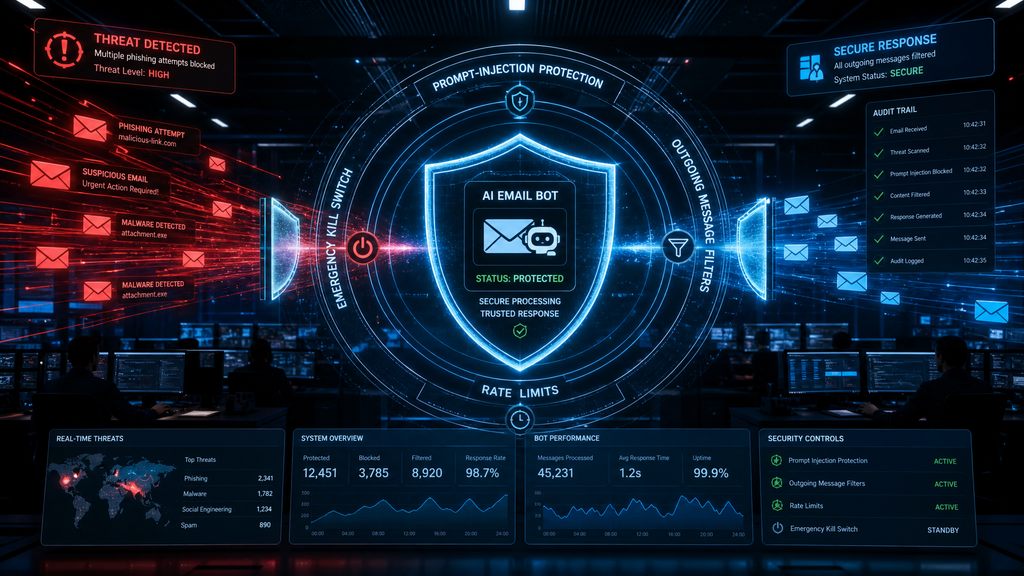
An autonomous bot that sends deceptive messages naturally raises an important question: What stops it from bothering innocent people?
ScamBuster’s architecture addresses that concern by operating as an inbound-only system. It responds to messages received by the designated email environment. It does not roam the internet searching for people to contact first.
That boundary is critical. Without it, a defensive research tool could start looking suspiciously like an automated harassment machine wearing a tiny cybersecurity badge.
The project also describes several controls intended to keep conversations contained. These include two layers of prompt-injection protection, deterministic filtering for outgoing messages, rate limits and a kill switch.
Prompt injection represents a particularly relevant risk. Once scammers realize an AI system may be answering them, they could place instructions inside their emails designed to override the bot’s rules. A message might tell the model to reveal its configuration, ignore its persona or send prohibited content.
ScamBuster’s defenses aim to prevent an attacker from turning the system against its operator. Still, no AI safeguard should be treated as infallible. Organizations deploying the software would need monitoring, logging, access controls and a clear response procedure if the bot behaved unexpectedly.
Open source improves transparency because defenders can inspect the design. It does not sprinkle invincibility dust over the code. Sadly, invincibility dust remains trapped in venture-capital pitch decks.
Why Black Hat Was the Right Stage
ScamBuster appeared at an appropriate moment during Black Hat USA 2026 in Las Vegas.
The conference’s official schedule placed “Scambuster: Social Engineering Scammers at Scale” in its Human Factors and Threat Hunting and Incident Response tracks. That combination captures the project neatly. It studies human manipulation while producing information that investigators can use.
A recent report from FOX5 Las Vegas also highlighted a broader concern discussed around the conference: generative AI is making scams harder to recognize.
Criminals can now produce cleaner emails, revise awkward language and rapidly generate variations of the same pitch. They can also personalize messages with information gathered online. The familiar advice to look for spelling mistakes no longer carries the weight it once did. The robotic grammar has improved. The robot may even use better punctuation than your manager.
ScamBuster represents the defensive side of that AI escalation.
If criminals can automate persuasion, defenders can automate engagement and evidence collection. The contest then shifts from humans manually reading every suspicious message to systems operating at greater scale on both sides.
That does not guarantee victory for defenders. It does mean scammers may increasingly encounter targets that never existed—and accidentally provide those targets with useful evidence.
Free Software, But Not Effort-Free
ScamBuster’s open-source release under the MIT license could encourage experimentation by universities, security researchers and enterprise teams. The license generally permits users to inspect, modify and redistribute the software with relatively few restrictions.
However, calling the framework free requires a small asterisk.
The code may cost nothing to download, but operating an AI-driven email environment still requires infrastructure. A deployment needs an email account or server, computing resources, model access, secure storage, monitoring and people who understand the legal and technical boundaries of the project.
If the system uses a commercial AI service, API usage may also create ongoing expenses. A locally hosted model could reduce dependence on an external provider, although it would introduce hardware and maintenance costs of its own.
The project is reportedly model-agnostic. That gives operators flexibility to choose an appropriate language model rather than tying the framework permanently to one company.
Flexibility also creates responsibility. Different models offer different levels of reliability, security, cost and conversational quality. A cheap model that repeatedly breaks character could alert scammers. A powerful model with excessive permissions could create a larger security risk.
“Free” therefore means the framework is accessible, not that deployment consists of clicking a large green button marked Release the Decoy Grandmother.
Organizations should treat it as security infrastructure, not a novelty chatbot.
Intelligence Is Not the Same as Identification
ScamBuster could reveal valuable clues, but those clues come with limitations.
A bank account supplied by a scammer does not necessarily belong to the operation’s leader. Criminal groups often use money mules, stolen identities and accounts controlled by intermediaries. A telephone number may be disposable. A domain could disappear within hours.
The system can establish connections and generate investigative leads. It cannot automatically determine guilt.
Investigators would still need to validate the information, work with financial institutions, compare it against other evidence and follow applicable legal procedures. False positives also matter. An email may look fraudulent without actually belonging to a criminal campaign.
The developers’ performance claims should likewise receive independent testing. A successful conference demonstration shows that the concept works under particular conditions. It does not prove the tool will perform equally well against every language, scam category or adversarial tactic.
Criminals will adapt, too. Once AI baiting becomes common, scammers may introduce tests designed to distinguish human victims from automated personas. They could demand voice calls, send unusual instructions or attempt increasingly creative prompt injections.
This will become a cat-and-mouse game—except both the cat and mouse may eventually be language models arguing over a fictional wire transfer at three in the morning.
The technology is promising. Sensible scrutiny will make it stronger.
A New Direction for Scam Defense
The most compelling part of ScamBuster is not that it annoys criminals. Plenty of scam baiters already do that with remarkable creativity.
Its real contribution is the attempt to transform conversations into structured intelligence at scale.
Deleting an email protects one inbox. Extracting and sharing the account behind that email could help protect many more. If investigators can connect payment details across multiple campaigns, they gain a clearer view of the operation rather than another isolated message in a spam folder.
That approach makes ScamBuster proactive without requiring it to initiate contact. It waits for criminals to arrive, gives them the performance they expect and records what they reveal.
The project also demonstrates how defensive AI may evolve. Many security tools currently use AI to classify content, summarize alerts or identify anomalies. ScamBuster gives the model a more active role. It participates in the exchange while remaining inside defined boundaries.
That shift brings new risks, but it also opens useful possibilities.
The result feels like a glimpse of the next phase of online fraud prevention. Scammers will use AI to sound more human. Defenders will use AI to manufacture humans who cannot lose money, panic under pressure or accidentally disclose their passwords.
Those artificial victims may also possess endless patience. Good luck rushing a chatbot that can discuss transfer instructions until the heat death of the universe.
The Bottom Line

ScamBuster will not eliminate email fraud by itself. No single tool could.
Its importance lies in changing the economics and direction of the encounter. Instead of letting scammers send millions of messages without resistance, the framework gives some of those messages an intelligent decoy to pursue. The criminal spends time, explains the scheme and may expose the infrastructure needed to collect the money.
That is a far more useful outcome than simply moving the email into a junk folder.
The project must still prove itself through broader deployments, independent evaluation and real-world cooperation with security teams, banks and law enforcement. Operators will also need to manage privacy, accuracy and AI-security risks carefully.
Nevertheless, the central idea is both simple and sharp: exploit the scammer’s confidence.
Fraudsters succeed because they believe they understand their victims. ScamBuster presents them with the perfect target—interested, responsive and always one message away from supposedly paying.
Behind the performance, however, six AI agents are taking notes.
The scammer thinks the fish has bitten. Then the fish requests the bank details, exports them as structured threat intelligence and files a report.
Technology can be exhausting. Occasionally, though, it delivers a punchline worth keeping.
Sources
- PCMag — “Meet the Free AI Bot That Tricks Scammers”, published during Black Hat USA 2026.
- Black Hat USA 2026 — Briefings Schedule, official conference listing for “Scambuster: Social Engineering Scammers at Scale.”
- ScamBuster — Official Project Website, technical overview presented alongside Black Hat USA 2026.
- FOX5 Las Vegas — “Cybersecurity Expert Warns AI Is Making Scams Harder to Detect”, published August 4, 2026.
The Kingy Brief
Get the next Kingy Brief.
Source-checked AI changes, original tests and one practical thing to try.
Free · Choose your subjects · Double opt-in · Unsubscribe anytime