
Alibaba has unveiled Qwen3.8-Max, a colossal multimodal artificial intelligence model built for coding, research, visual analysis, and autonomous work that can stretch across days.
The headline number practically demands its own postcode: 2.4 trillion parameters.
Yet raw size tells only part of the story. Qwen3.8-Max uses a mixture-of-experts architecture that activates roughly 95 billion parameters for each request. That approach should make the model more computationally manageable than its full size suggests. It can also process as many as one million tokens of context while working with text, images, and video.
Alibaba describes it as the most capable model in the Qwen family. More importantly, the company plans to release its weights publicly, giving developers an opportunity to download, customize, and deploy the system.
That decision puts Qwen3.8-Max at the intersection of several increasingly lively contests: China versus the United States, open weights versus proprietary platforms, Alibaba versus Moonshot AI, and useful autonomous agents versus chatbots that merely compose elegant shopping lists.
The AI race just gained another very large runner.
A Giant Model With a Surprisingly Selective Brain
A model containing 2.4 trillion parameters sounds like something that requires a small power station whenever someone asks it to fix a spreadsheet.
Fortunately, that is not quite how Qwen3.8-Max operates.
According to The Next Web, the model uses 95 billion active parameters during inference. Its mixture-of-experts architecture divides the system into specialized components and activates only the portions most relevant to a particular request.
Think of it as a gigantic consultancy that does not summon all 2.4 trillion employees to every meeting. Only the appropriate experts enter the room. The rest can continue enjoying their imaginary coffee.
This structure matters because total parameter count does not directly reveal a model’s speed, intelligence, or operating cost. A smaller dense model may use every parameter for every task, while a larger sparse model activates only a fraction.
Qwen3.8-Max is still huge. It sits fairly close to Moonshot AI’s 2.8-trillion-parameter Kimi K3, another Chinese open-weight heavyweight. However, comparing them by parameter count alone would be like judging two cars entirely by engine size. Architecture, training, data quality, inference efficiency, and software integration all affect actual performance.
Alibaba wants developers to focus on what the model can accomplish—not merely how many numerical knobs it contains.
It Reads More Than Text
Qwen3.8-Max is a multimodal model. It can interpret text, images, and video rather than treating language as the whole universe.
Its one-million-token context window also gives it considerable working space. In practical terms, the model could analyze extensive document collections, large codebases, lengthy research material, or hours of transcribed media without immediately losing track of the opening chapters.
As WE News English reports, Alibaba has positioned the model for working with long documents, television programs, and live streams. It can use those materials to help create searchable knowledge bases.
Alibaba has also demonstrated more visual and creative applications. The model can reportedly reproduce software interfaces from screenshots, generate educational animations and interactive games, and turn two-dimensional floor plans into three-dimensional visualizations.
Those abilities make Qwen3.8-Max relevant beyond the familiar chatbot box. Developers could apply it to design prototyping, video understanding, enterprise search, software production, media analysis, or visual documentation.
Of course, supporting a million tokens does not automatically guarantee perfect comprehension across every token. A massive context window is capacity, not proof of flawless memory or reasoning. Independent testing will need to determine how reliably the model retrieves details buried deep inside long inputs.
Still, the scale opens several useful doors—and possibly analyzes the architectural plans for those doors afterward.
Alibaba Wants an AI That Keeps Working
The most interesting part of Qwen3.8-Max may not be its size. It may be stamina.
Alibaba designed the model for long-horizon agentic work: complex assignments that involve planning, tool use, corrections, and repeated decisions over extended periods. That is a different challenge from answering a single prompt or generating a neat block of code.
The Decoder describes three internal demonstrations intended to show this capability. In one, the model spent 16 days autonomously building a command-line tool called “oh-my-cli.”
The system reportedly converted user requests into GitHub issues, assigned tasks to itself, wrote code, ran tests, fixed problems, and refined the project. By July 30, it had completed 265 commits, 127 pull requests, and 151 issues without direct human intervention.
Alibaba also said the model reproduced and improved results from a research paper and operated a simulated e-commerce business. These projects tested whether it could preserve goals, manage intermediate work, and respond to changing conditions.
The demonstrations sound impressive. They remain company-run case studies, though, not independent proof that Qwen3.8-Max can safely run a real business or reliably maintain production software for weeks.
Autonomous work magnifies errors. A chatbot can produce one bad answer. An agent can turn that answer into 127 energetic pull requests.
The Benchmarks Put Qwen Near the Frontier
Alibaba says Qwen3.8-Max competes with leading systems from Anthropic and OpenAI. Public rankings offer some support for that claim, although no single benchmark can settle the matter.
According to The Verge, Qwen3.8-Max became the highest-ranked Chinese model for text on Arena.AI. It also performed particularly well in visual evaluation, landing near the top of the platform’s multimodal rankings.
Arena.AI gathers human preferences through blind comparisons. Users see outputs from two unidentified models and select the better response. This method captures what people prefer during real interactions, which makes it valuable. However, it does not measure every form of accuracy, reliability, safety, or specialized reasoning.
Alibaba’s published evaluations also show strong results on coding, science, visual understanding, and agent-oriented tasks. The company reported scores of 86.6 on Terminal-Bench 2.1, 67.7 on SWE-bench Pro, and 92.6 on GPQA Diamond.
Those numbers suggest a genuinely competitive model, but readers should keep the source in view. Alibaba selected and ran the reported comparisons. Independent researchers still need to test the downloadable model across hardware configurations and real workloads.
Benchmarks are useful scoreboards. They are not magical truth vending machines.
Open Weights Change the Competitive Equation
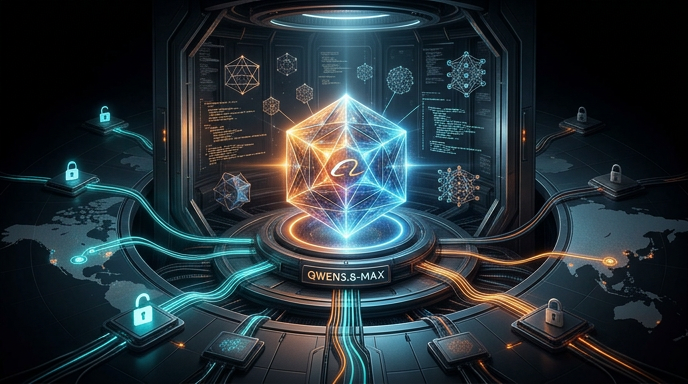
Qwen3.8-Max will become the first Qwen-Max model released with publicly downloadable weights. That is strategically significant.
Alibaba had kept several recent flagship models proprietary, raising questions about whether it was drifting away from the open-weight strategy that helped Qwen gain international adoption. The new release answers those questions with a rather emphatic 2.4-trillion-parameter thud.
The model is already accessible through Alibaba’s cloud services and developer tools, while the downloadable weights are scheduled to follow. That distinction matters: API availability does not mean developers can already retrieve the entire model.
Once the weights arrive, organizations can inspect, fine-tune, and potentially host Qwen3.8-Max on infrastructure they control. That offers greater flexibility and reduces dependence on a single hosted service.
“Open weight” does not necessarily mean fully open source, however. A complete open-source release would ideally include extensive training details, data disclosures, code, evaluation methods, and a permissive license. Public weights provide substantial access, but they do not automatically expose the entire development recipe.
Even so, releasing a frontier-scale model gives researchers and companies far more control than a closed API normally provides. For Alibaba, that openness can turn Qwen into infrastructure used far beyond its own cloud ecosystem.
China Is Making Openness a Competitive Weapon
Chinese AI developers have increasingly used open-weight releases to attract users, researchers, and companies around the world.
DeepSeek demonstrated how quickly a capable and inexpensive model could capture international attention. Moonshot AI followed with Kimi K3. Now Alibaba is placing its most powerful Qwen model into the same arena.
As The Verge notes, open-weight development has become an important part of China’s broader AI strategy. It supports local experimentation while increasing the global influence of Chinese technical ecosystems.
American frontier laboratories generally follow a different pattern. OpenAI and Anthropic keep their most advanced models closed, offering access through subscriptions and APIs. Meta has released downloadable models, but policymakers and companies continue debating how open the most capable systems should become.
Alibaba’s approach creates commercial pressure. If developers can customize a competitive Chinese model at a lower cost, closed providers must justify their premiums through stronger performance, reliability, safety, or convenience.
This does not guarantee that Qwen3.8-Max will replace American models. Hosting a system of this size will require serious infrastructure. Many organizations will still prefer a managed API.
Nevertheless, open weights let an ecosystem spread horizontally. Developers can adapt the model without waiting for Alibaba to approve every use case. In platform wars, distribution can become as important as intelligence.
Moonshot Is Both Rival and Family Business Complication
Qwen3.8-Max arrives shortly after Moonshot AI introduced Kimi K3, a 2.8-trillion-parameter open-weight model.
That comparison carries extra spice because Alibaba is one of Moonshot’s major investors. The company therefore finds itself supporting a startup that also competes directly with its flagship AI operation.
Kimi K3 remains larger by total parameter count. Yet Alibaba argues that Qwen3.8-Max performs better in several evaluations and offers particularly strong multimodal and long-horizon capabilities.
The rivalry shows how quickly China’s AI market has intensified. Companies are no longer measuring progress in leisurely annual cycles. A major release can grab the spotlight for days before another laboratory rolls a larger model onto the stage.
This competition may benefit developers. Alibaba and Moonshot have incentives to offer lower prices, broader access, better tools, and increasingly capable models. It may also accelerate the release of systems before researchers fully understand their limitations.
Size itself has become part of the marketing contest. Bigger numbers generate headlines, but successful deployment depends on memory requirements, inference speed, active parameter count, model quality, and total operating cost.
A 2.4-trillion-parameter system sounds impressive at a conference. The person paying the compute bill will ask several follow-up questions.
Investors Liked What They Saw
Alibaba’s announcement also moved financial markets.
Reports cited by Yahoo Finance linked the model’s debut to a jump in Alibaba’s shares. The size of the rise varied by exchange and trading period, with the company’s Hong Kong-listed stock climbing sharply and its US-listed shares gaining during premarket trading.
Investors appear to see Qwen3.8-Max as more than a research trophy. It strengthens Alibaba Cloud’s product offering and supports the company’s effort to become a central supplier of AI infrastructure.
The model can attract customers to Alibaba’s APIs, Model Studio tools, and QwenWork platform. Even when organizations eventually download the weights, many may still rent the computing power needed to run them. Conveniently, Alibaba happens to sell cloud computing. A remarkable coincidence, surely.
The company has committed hundreds of billions of yuan to AI and cloud infrastructure over several years. Qwen therefore serves two connected purposes: it demonstrates Alibaba’s technical capabilities and stimulates demand for the infrastructure surrounding those capabilities.
Still, a stock jump does not prove that a model will generate durable profit. Frontier AI development consumes enormous capital, while open-weight releases can make direct monetization more complicated.
Alibaba must convert developer excitement into cloud usage, enterprise subscriptions, and practical applications. The model has won attention. Now comes the quieter challenge of winning customers.
Powerful Models Bring Awkward Questions
Qwen3.8-Max’s release will also intensify debates about safety, governance, and geopolitical risk.
Open weights allow useful customization, private deployment, academic research, and local control. They can also make it harder for the original developer to restrict harmful modifications or revoke access after release.
Long-horizon agents add another concern. A model that can work autonomously for days may produce enormous value, but it also needs reliable supervision, permission boundaries, logging, and recovery systems. Persistence without judgment is not intelligence. It is a toddler with administrative access.
Organizations evaluating Qwen3.8-Max will also need to consider privacy rules, cybersecurity, licensing, data handling, and regulatory requirements. Companies operating outside China may examine how the model handles politically sensitive topics and whether its behavior fits local legal obligations.
Meanwhile, policymakers will watch whether open Chinese models gain adoption in Western businesses and research institutions. The debate will not remain purely technical. AI systems increasingly sit inside broader arguments about economic influence, national security, and technological dependence.
None of those issues erases the model’s usefulness. They simply make evaluation more complicated than checking an Arena ranking and declaring the race finished.
The best model is not always the one with the highest score. Sometimes it is the one an organization can deploy, audit, afford, and control.
The Frontier Is Becoming Crowded—and Messy
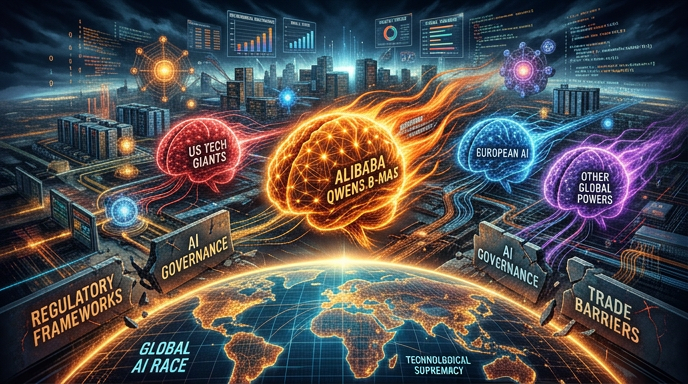
Qwen3.8-Max marks an important moment for Alibaba and the wider AI industry.
The model combines enormous scale, sparse computation, multimodal input, a one-million-token context window, and an emphasis on autonomous work. Its early benchmark performance places it near the global frontier, while the planned release of its weights gives developers a level of access that most leading American systems do not offer.
However, several questions remain open. Independent researchers must test its factual accuracy, agent reliability, resource requirements, safety behavior, and real-world cost. Developers also need the final weights, license, documentation, and model card before they can judge how open and practical the release truly is.
What already seems clear is that the global AI contest no longer resembles a simple Silicon Valley parade. Alibaba, Moonshot, DeepSeek, and other Chinese developers are producing models that compete on capability while using openness and pricing to challenge closed platforms.
Qwen3.8-Max will not end the argument over which country or company leads AI. It makes that argument harder—and much more interesting.
Alibaba has placed a 2.4-trillion-parameter bet on the idea that frontier performance and open access can travel together. Developers will soon decide whether the package works outside the showroom.
The heavyweight bout is underway. Judging by the release schedule, someone may unveil an even bigger contestant before everyone finds their seats.
Sources
- The Verge — China’s Alibaba takes another swipe at America’s AI supremacy
- The Next Web — Alibaba unveils Qwen3.8-Max, its most capable model
- The Decoder — Qwen3.8-Max takes on long-horizon AI tasks
- Yahoo Finance — Alibaba stock rises following the Qwen unveiling
- WE News English — Alibaba launches its most powerful AI model
The Kingy Brief
Get the next Kingy Brief.
Source-checked AI changes, original tests and one practical thing to try.
Free · Choose your subjects · Double opt-in · Unsubscribe anytime