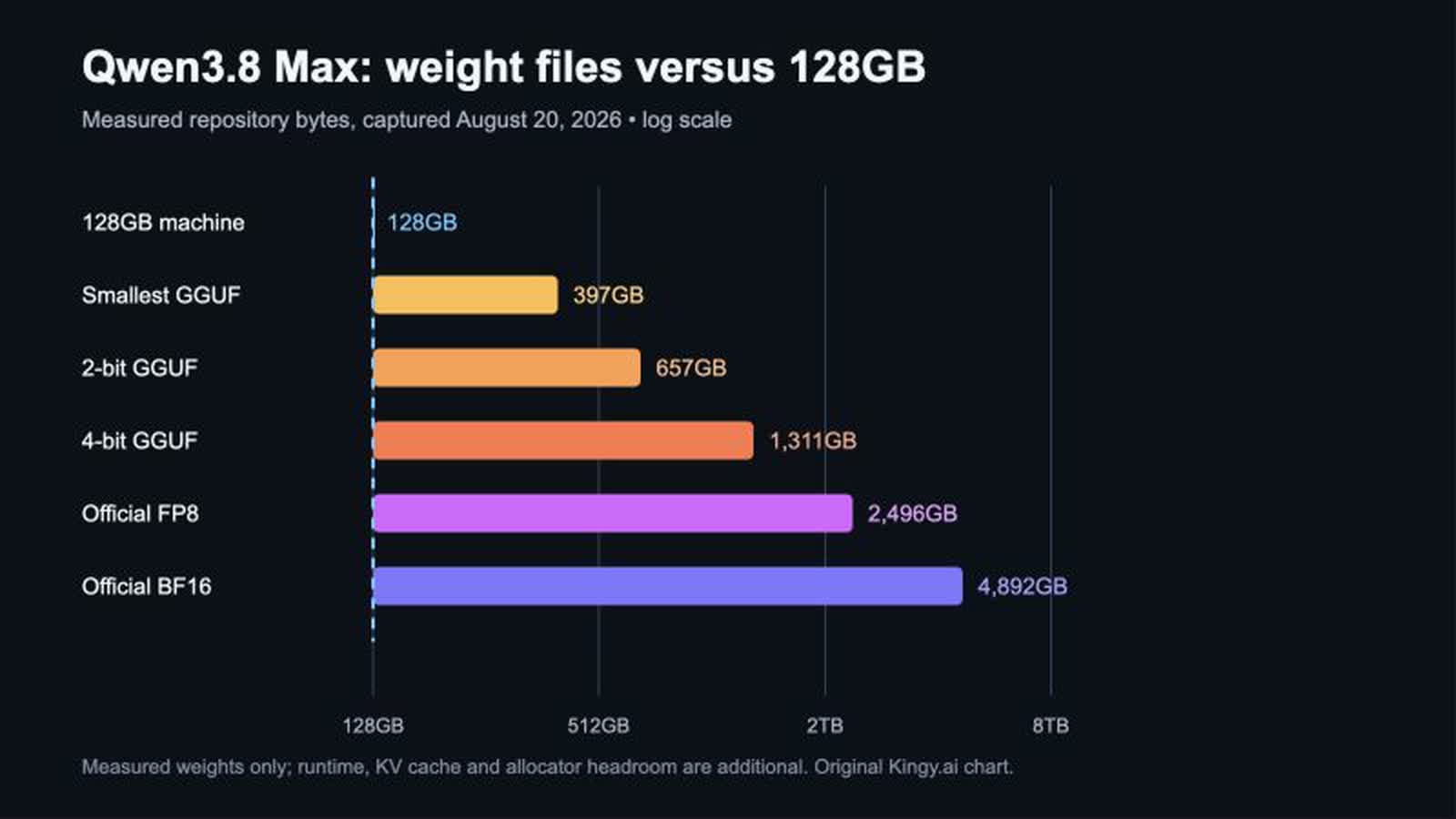
Verdict: You cannot run the downloadable Qwen3.8-2.4T-A95B weights entirely inside 128GB of RAM or VRAM with any currently published checkpoint I could verify. The official BF16 weights total 4.892TB. Official FP8 is 2.496TB. The current four-bit files are roughly 1.31–1.45TB. Even Unsloth’s smallest posted one-bit GGUF is 397GB before runtime overhead. The “95B active” number reduces work per token; it does not turn a 2.4-trillion-parameter checkpoint into a 95-billion-parameter download.
Testing disclosure: This is a source-audited hardware guide, not a Kingy.ai inference benchmark. I did not download a multi-terabyte checkpoint or claim hands-on throughput. File sizes labelled measured are sums from public repository manifests at the revisions listed below. Memory values labelled calculated use parameter count × bits ÷ 8. GPU counts labelled confirmed come from Qwen, NVIDIA, vLLM or AMD deployment material. Headroom and buyer guidance are estimated editorial recommendations.
That distinction matters because Qwen3.8 Max has created a perfect hardware-requirement trap. Its name appears beside “95B active,” so it is tempting to compare it with a dense 70B or 100B model. Its weights are downloadable, so it is tempting to treat “local” as synonymous with “desktop.” And four-bit quantization sounds like a 75 percent haircut, which it is—on a number so large that the result is still measured in terabytes.
The practical answer is blunt: use the hosted model if you are an individual developer. Self-host only if you already operate a modern multi-GPU server or cluster and have a concrete privacy, throughput or unit-economics reason to own the serving stack.
Qwen3.8 Max hardware requirements at a glance
| Checkpoint or quant | Weight files, measured | Minimum sensible capacity | What that means |
|---|---|---|---|
| Official BF16 | 4,892.4GB | 5.5–6TB aggregate memory | Cluster-scale reference weights |
| Official FP8 | 2,496.1GB | 3TB+ aggregate HBM | NVIDIA’s published recipe uses 16 GB300 GPUs |
| Inferact NVFP4 | 1,447.3GB | About 1.8TB aggregate HBM | Eight 288GB accelerators are the realistic single-node class |
| AMD Quark MXFP4 | 1,372.4GB | About 1.7TB aggregate HBM | Eight MI355X-class accelerators |
| Unsloth UD-IQ4_XS GGUF | 1,310.9GB | 1.6TB combined RAM/VRAM | Experimental workstation/server route, not a 128GB PC |
| Unsloth UD-IQ2_XXS GGUF | 656.6GB | 800GB combined RAM/VRAM | Severe quantization; still a very large server |
| Unsloth UD-Q1_0 GGUF | 397.3GB | 500GB combined RAM/VRAM | Smallest current file; quality is the first question, not fit |
“Minimum sensible capacity” is an estimate, not a vendor requirement. It adds roughly 20 percent for the runtime, allocator, cache and operating environment. Production serving can need more, especially at long context or concurrency.
Download the evidence pack and offline memory calculator. It includes the measured manifest CSV, frozen repository revisions, source snapshot and an editable version of the chart below.
The mistake: active parameters are not stored parameters
Qwen’s official model card describes a sparse mixture-of-experts model with 2.4 trillion total parameters and 95 billion activated per token. It has 512 routed experts, selects 10 routed experts plus one shared expert, and uses a 92-layer hybrid backbone. The downloadable release is text-only, requires thinking mode and has a native 262,144-token context that Qwen says is extensible to 1,010,000 tokens.
The active count answers a compute question: how much of the model participates in processing one token? The total count answers a storage question: how many learned weights must be available so the router can choose the appropriate experts?
Imagine a library with 512 specialist rooms. A request may send you into only 10 rooms, but the building still needs all 512 rooms ready because the next request may take a different route. Sparse activation saves arithmetic and memory bandwidth per token. It does not let you discard the unselected experts before you know which experts the router will select.
This is also why the open-weight checkpoint and the hosted Qwen3.8-Max product should not be treated as interchangeable. Qwen says the hosted Max service adds features such as vision input, non-thinking support, a one-million-token context by default and official built-in tools. The downloadable Qwen3.8-2.4T-A95B is the inspectable weight release; the cloud product is a managed system built around it.
The theoretical memory math—and where it fails
The lower-bound equation is simple:
weight memory = total parameters × average bits per weight ÷ 8
For 2.4 trillion stored parameters, the clean arithmetic looks like this:
| Precision | Calculated weight floor | 128GB equivalents | Important caveat |
|---|---|---|---|
| 16-bit | 4.8TB | 37.5 | No metadata or runtime included |
| 8-bit | 2.4TB | 18.75 | No scales, padding or mixed-precision layers |
| 4-bit | 1.2TB | 9.38 | Real FP4/GGUF files are larger |
| 3-bit | 900GB | 7.03 | Effective bit rate is rarely exactly three |
| 2-bit | 600GB | 4.69 | Very aggressive quality trade-off |
| 1-bit | 300GB | 2.34 | A mathematical floor, not a quality guarantee |
Those figures are useful for rejecting impossible ideas. They are not purchase specifications. Quantized formats store scales, block metadata and some tensors at higher precision. Model packages can also include an MTP head, embeddings and alignment padding. Then the serving engine needs memory for KV cache, CUDA graphs, communication buffers, temporary workspaces and its allocator.
The manifests show the gap. The official BF16 checkpoint is 4,892,365,649,336 bytes, about 1.9 percent above the 4.8TB arithmetic floor. Official FP8 is 2,496,102,697,232 bytes, about four percent above 2.4TB. The measured FP4 checkpoints are 1.372TB and 1.447TB, not 1.2TB. The current Unsloth four-bit GGUF directory totals 1.311TB.
That is why a calculator saying “4-bit = 1.2TB” should never be followed by “therefore 1.2TB of memory is enough.” It is only the first line of the budget.
What the repositories actually contain
I queried the public Hugging Face manifests with expanded blob metadata and summed the current weight files. These are measured repository bytes, not estimates inferred from the label.
| Repository | Frozen revision | Format | Measured weight bytes |
|---|---|---|---|
| Qwen/Qwen3.8-2.4T-A95B | 207bd685…c996 |
BF16 safetensors | 4,892,365,649,336 |
| Qwen/Qwen3.8-2.4T-A95B-FP8 | d2dc3565…bd29 |
FP8 safetensors | 2,496,102,697,232 |
| Inferact/Qwen3.8-2.4T-A95B-NVFP4 | a6abb8bf…bc40 |
NVFP4 safetensors | 1,447,334,495,504 |
| AMD Qwen3.8 Quark MXFP4 | 13dc9676…acae |
MXFP4 safetensors | 1,372,407,479,936 |
| Unsloth Qwen3.8 GGUF | 567d3e6a…5556 |
All posted variants | 12.617TB repository total |
The Unsloth repository total is not one model you download. It contains separate BF16, Q8 and low-bit directories. At the cutoff, the useful per-variant totals were 4.893TB for BF16, 2.600TB for Q8_0, 1.311TB for UD-IQ4_XS, 955.5GB for UD-IQ3_XXS, 656.6GB for UD-IQ2_XXS and 397.3GB for UD-Q1_0.
Repository contents can change. That is why the downloadable pack records revisions and byte counts rather than presenting rounded numbers without provenance.
Why no 128GB Mac, PC or GPU workstation can fit it
A 128GB unified-memory Mac is excellent for models whose quantized weights land below roughly 100GB. It is not a loophole around arithmetic. The smallest current Qwen3.8 Max GGUF is 3.1 times larger than the entire 128GB pool before macOS, the runtime or context consumes a byte.
A Windows or Linux workstation with a 96GB GPU and 128GB of system RAM has 224GB in two different memory pools. Some runtimes can split weights between GPU and CPU, but 224GB remains far below 397GB. Add a second 96GB GPU and the raw total reaches 320GB, still short of the smallest file.
Four 96GB GPUs plus 128GB of RAM provide 512GB of gross capacity. That may be enough to experiment with the one-bit GGUF after overhead, but it is not a sensible route to the four-bit model. The 1.311TB GGUF would still spill by roughly 799GB.
| Machine class | Gross memory | Smallest current GGUF | Four-bit GGUF | Verdict |
|---|---|---|---|---|
| 128GB unified-memory desktop | 128GB | Does not fit | Does not fit | No |
| 96GB GPU + 128GB RAM | 224GB | Does not fit | Does not fit | No |
| 2 × 96GB GPU + 128GB RAM | 320GB | Does not fit | Does not fit | No |
| 4 × 96GB GPU + 128GB RAM | 512GB | Possible only with tight one-bit setup | Does not fit | Research curiosity |
| 512GB CPU server + 96GB GPU | 608GB | Fits with headroom | Does not fit | One-bit experiment |
| 1.5TB RAM server | 1,500GB | Fits | Tight before runtime | Four-bit needs more headroom |
Capacity is not usability. A terabyte-scale checkpoint streamed largely from ordinary CPU memory will be constrained by memory bandwidth. Multi-GPU serving introduces tensor or expert parallelism, communication overhead and software compatibility. “It loaded” is a milestone, not a throughput result.
If your real target is a private model on a laptop or single GPU, Kingy.ai’s Qwen3.8-27B hardware guide is the relevant article. The 27B quantization comparison and private local coding-agent setup cover the consumer-scale branch of this family.
The confirmed NVIDIA deployment is 16 GB300 GPUs
NVIDIA’s NIM guide for Qwen3.8-2.4T-A95B is unusually clear: only GB300-NVL72 hardware is supported in that release, Kubernetes is required, and deployment needs at least four nodes.
A GB300 NVL compute tray contains four Blackwell Ultra GPUs with 1,152GB of aggregate HBM3E, according to NVIDIA’s GB300 reference architecture. Four trays therefore expose 16 GPUs and 4,608GB of raw HBM.
NVIDIA’s Dynamo recipe confirms the topology: the aggregated FP8 target uses 16 × GB300 across four nodes, tensor parallelism 16, FP8 weights and FP8 KV cache. It is a supported serving recipe, not a statement that every byte of the 4.608TB pool is occupied by 2.496TB of weights. The additional room supports cache, graphs, communication and real serving workloads.
The same recipe lists a 262,144-token context. Qwen’s model card describes extension beyond that, but context capacity and model capacity are different budgets. A cluster that barely holds weights is not automatically prepared for a million-token request, multiple users or high throughput.
Can FP4 fit on one server?
Yes—if “one server” means an eight-accelerator data-center node, not one GPU.
The vLLM Qwen3.8 launch guide says FP8 needs at least two NVIDIA B300 or AMD MI355X nodes, while the FP4 release can run on a single node. Its sample NVFP4 command uses tensor parallelism 8. Eight 288GB B300 GPUs provide 2,304GB of raw HBM, leaving meaningful space above the measured 1.447TB NVFP4 weights.
AMD’s MI355X platform likewise provides 288GB of HBM3E per accelerator. AMD publishes an MXFP4 checkpoint, and the vLLM team describes support on both NVIDIA and AMD stacks. The hardware capacity is comparable; the serving kernels, quant format and operational tooling differ.
These are the configurations worth evaluating if you need to self-host the model at useful speed:
| Objective | Practical starting topology | Why |
|---|---|---|
| Official NVIDIA FP8 path | 16 × GB300 across four trays | Matches NVIDIA NIM/Dynamo documentation |
| Single-node NVIDIA FP4 | 8 × B300/GB300-class GPUs | 2.304TB raw HBM for 1.447TB NVFP4 weights |
| Single-node AMD FP4 | 8 × MI355X | 2.304TB raw HBM for 1.372TB MXFP4 weights |
| Experimental GGUF | 1.5–2TB RAM plus GPU acceleration | Capacity can work; bandwidth and quality need measurement |
| Individual developer | Hosted Qwen3.8-Max API | Avoids multi-GPU ownership and operations |
Do not buy from this table alone. Confirm the exact chassis, usable post-ECC memory, interconnect, power, cooling, runtime build and checkpoint compatibility. A pile of PCIe cards with enough aggregate memory is not equivalent to an NVLink/NVSwitch or Infinity Fabric platform.
Local weights versus hosted Qwen3.8-Max
The open-weight release is valuable even when it is not desktop-friendly. Researchers can inspect the architecture and weights. Infrastructure teams can control data residency and serving policy. Model labs can quantize and optimize it. Large organizations can compare hosted token costs with owned capacity at sustained utilization.
For most people, however, “downloadable” describes licensing and access—not the best execution plan. The hosted route wins when you have bursty demand, do not already own the cluster, need the richer Max feature set or cannot keep eight to sixteen premium accelerators busy.
Self-hosting becomes rational when privacy requirements prohibit third-party inference, utilization is consistently high, latency must be controlled inside your network, or you are developing the runtimes and quantizations themselves. Even then, the hardware invoice is only part of the system. Storage must absorb a 1.4–4.9TB checkpoint. Cold starts move that data. Multi-node networking must stay healthy. Drivers, kernels and serving engines need pinned, tested combinations.
For capability comparisons rather than hardware fit, see Kingy.ai’s Qwen3.8 Max vs Kimi K3 vs DeepSeek V4 Flash. For a smaller local-versus-hosted coding comparison, see Qwen3.8-27B vs DeepSeek V4 Flash.
How to size a deployment without fooling yourself
Start with the exact checkpoint, not the marketing precision. Pull its immutable revision and sum its actual weight files. Add enough disk for the download, staging and at least one rollback or alternate build. Then budget device memory for the runtime and the real context/concurrency target.
The sequence I would use is:
- Freeze the model revision. “Qwen3.8 FP4” is not a reproducible identity.
- Measure actual bytes. Do not substitute
2.4T × 4 bitsfor the manifest. - Separate gross from usable HBM. ECC, drivers and runtime reservations matter.
- Choose the supported topology. Check tensor/expert parallelism and the interconnect, not just total memory.
- Add serving headroom. Start with 20 percent above weights for planning, then replace that estimate with engine measurements.
- Model context and concurrency. A one-user smoke test is not a production capacity plan.
- Price the hosted alternative. Include utilization, power, operations and idle time on the self-hosted side.
The included offline calculator deliberately reports a theoretical floor and a headroom-adjusted planning number separately. That is the honest way to use parameter arithmetic.
Bottom line
Qwen3.8-2.4T-A95B is open-weight, but it is not a consumer-local model. The smallest current checkpoint is 397GB. A credible four-bit deployment starts around 1.4TB of weights. The official FP8 route is a 16-GPU, four-node GB300 deployment.
If you own 128GB of unified memory, run Qwen3.8-27B locally and call Qwen3.8-Max through an API. If you own an eight-GPU B300 or MI355X server, FP4 is the interesting path. If you need the official NVIDIA FP8 recipe, think in clusters, not workstations.
The 95B active figure explains why inference can be computationally tractable on that infrastructure. It does not make 2.4 trillion stored parameters disappear.
FAQ
Can Qwen3.8 Max run on 128GB of RAM?
Not with any currently published checkpoint verified for this guide. The smallest posted Unsloth GGUF is 397.3GB before runtime overhead, more than three times a 128GB memory pool.
Why does Qwen call it 95B active if the weights are 2.4T?
It is a sparse mixture-of-experts model. The router activates 10 routed experts plus one shared expert for a token, reducing computation, but the system still stores all experts because different tokens can select different routes.
How much memory does the four-bit version need?
The clean arithmetic floor is 1.2TB. Current measured FP4 and four-bit GGUF weights are 1.311–1.447TB. A practical deployment should plan roughly 1.7–1.8TB or more until engine-specific measurements replace the estimate.
What is the minimum confirmed NVIDIA hardware?
NVIDIA’s current NIM path supports GB300-NVL72 and requires at least four nodes. Its Dynamo FP8 recipe uses 16 GB300 GPUs across four nodes with tensor parallelism 16.
Can one server run Qwen3.8 Max?
Yes, in the data-center sense. vLLM says the FP4 checkpoint can use one node and shows tensor parallelism 8. An eight-GPU B300 or MI355X-class server has 2.304TB of raw HBM, enough capacity for the current 1.37–1.45TB FP4 weights plus serving headroom.
Is the downloadable model the same as the hosted Qwen3.8-Max service?
No. Qwen says the hosted Max service adds features including vision input, non-thinking support, default one-million-token context and built-in tools. The downloadable Qwen3.8-2.4T-A95B release is text-only and requires thinking mode.
Sources and methodology
Research cutoff: August 20, 2026, Pacific time. Primary sources were the Qwen model card, official FP8 checkpoint, Qwen3.8-Max overview, NVIDIA NIM guide, NVIDIA Dynamo recipe, NVIDIA GB300 architecture, vLLM launch guide, Inferact NVFP4 repository, AMD MXFP4 repository and Unsloth GGUF repository.
Measured file totals came from the Hugging Face public model API with blob metadata expanded. The evidence pack preserves the exact revisions and byte counts. Theoretical values use decimal bytes so they match repository displays; TiB values in the pack use binary units. No throughput, quality or power result is asserted without a run.