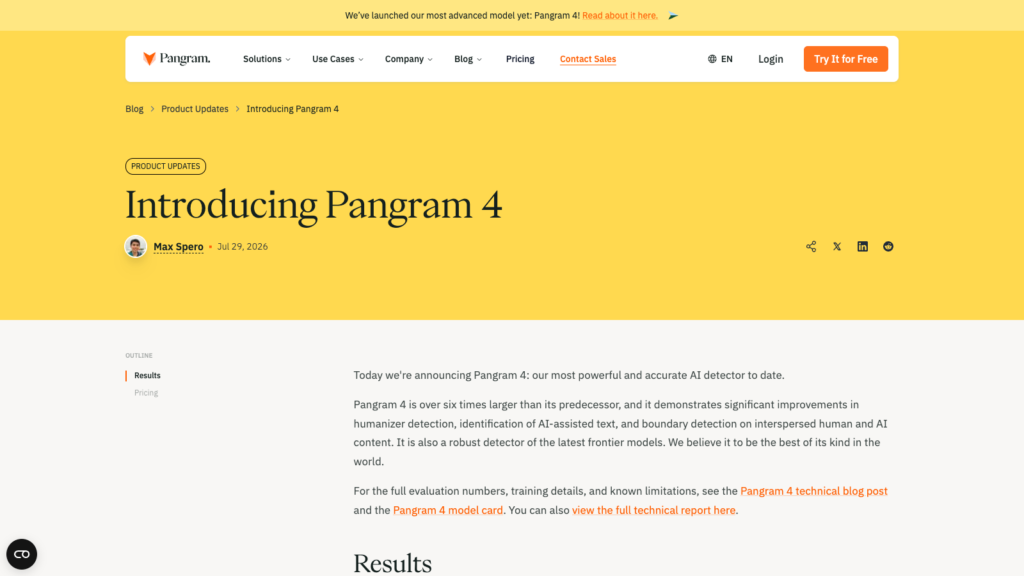
The short version: Pangram has released Pangram 4, a larger text detector built to separate human writing, AI-edited writing and mixed human-AI passages. It also opened a research preview of Pangram Image, which analyzes images and selected video frames without relying on watermark metadata. The release is useful, but the numbers need the right label: most of the headline performance claims come from Pangram’s own evaluations, and a detector result should inform a review rather than decide a person’s guilt.
The company launched both models on July 29, 2026, alongside new plan allowances and API pricing. TechCrunch also reported that Pangram raised $9 million in a round led by Menlo Ventures, with Haystack, ScOp, Script Capital and Cadenza participating. The product update arrives one week after Substack added Pangram scans to posts, notes, replies and comments, giving the detector a visible role in a live publishing platform.
That combination matters more than a benchmark alone. AI detection is moving from a niche classroom tool into publishing, recruiting, legal review and content moderation. A false negative can let synthetic material pass as human work. A false positive can wrongly accuse a student, writer or artist. Pangram 4 is an attempt to improve that trade-off while giving reviewers more detail than a single “AI” label.
What Pangram launched
Pangram says its fourth-generation text model is more than six times larger than Pangram 3. The company designed it to improve three difficult tasks: detecting text processed by “humanizer” tools, identifying writing that an AI edited rather than generated from scratch, and locating boundaries where human and AI-written passages are interspersed.
The distinction between AI-edited and AI-generated text is the most useful part of the launch. A binary score treats a lightly polished paragraph and a fully generated essay as the same event. Pangram 4 is supposed to classify those cases in one pass and highlight the affected sections, which gives a teacher, editor or compliance team a better starting point for a conversation.
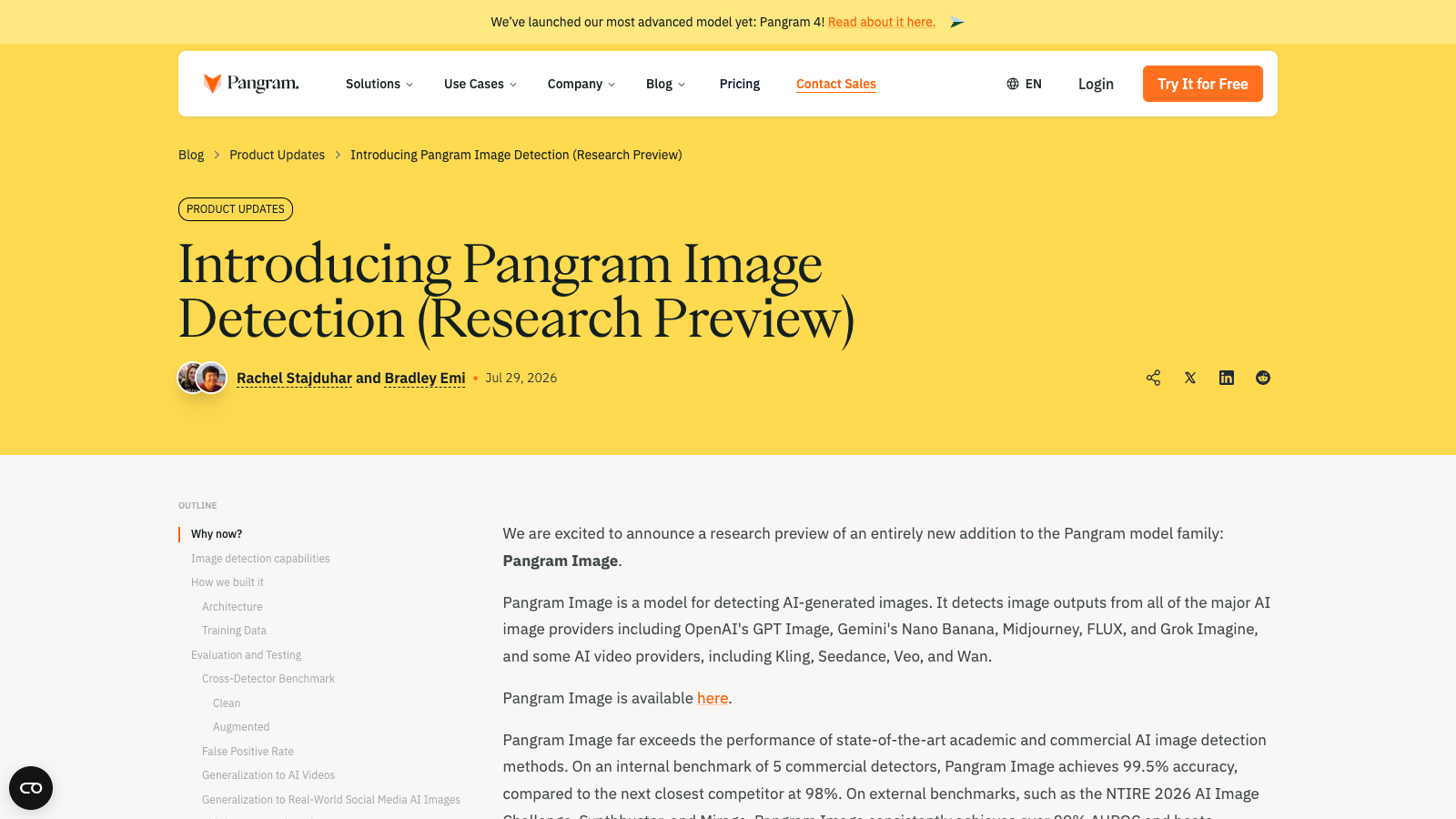
Pangram Image is a separate computer-vision model in research preview. The company says it can detect outputs from major image generators, including GPT Image, Gemini’s Nano Banana, Midjourney, FLUX and Grok Imagine. It also reports results on frames from Kling, Seedance, Veo and Wan videos. A heatmap can mark which areas of a composite image look synthetic, a potentially useful feature when an AI-generated picture appears inside a real screenshot or photograph.
The benchmark numbers are promising, not a verdict
Pangram reports a 0.0041% false-positive rate for Pangram 4 on its internal benchmark, or about one false positive per 24,000 documents. It reports a 0.3396% false-negative rate on new challenge datasets, down from 1.99% for Pangram 3, and says the model detected AI involvement in output from 13 commercial humanizer tools 98.83% of the time.
Those figures are specific and testable, but they remain company-reported results. Performance in a curated evaluation can differ from performance on short answers, unusual dialects, translated prose, heavily edited work or material from a model that appeared after the test set was built. Base rates matter too. Even a low false-positive rate can produce costly disputes when a school or platform scans millions of documents and treats the score as proof.
Pangram’s public materials acknowledge part of that problem. The company publishes a model card, technical report and known limitations, and its interface returns probabilities and passage-level analysis rather than hiding the result behind a single label. That transparency is useful. Independent replication on current, adversarial and multilingual material will determine how much confidence institutions should place in the new model.
Pangram Image has clearer limits
The image detector’s research-preview label should be taken seriously. Pangram says the current model cannot process images smaller than 512 by 512 pixels, does not confidently detect deepfakes or face swaps, and cannot accept material blocked by its safety moderation. The image API is invitation-only during the preview, although free and paid users can access the detector in Pangram’s web dashboard.
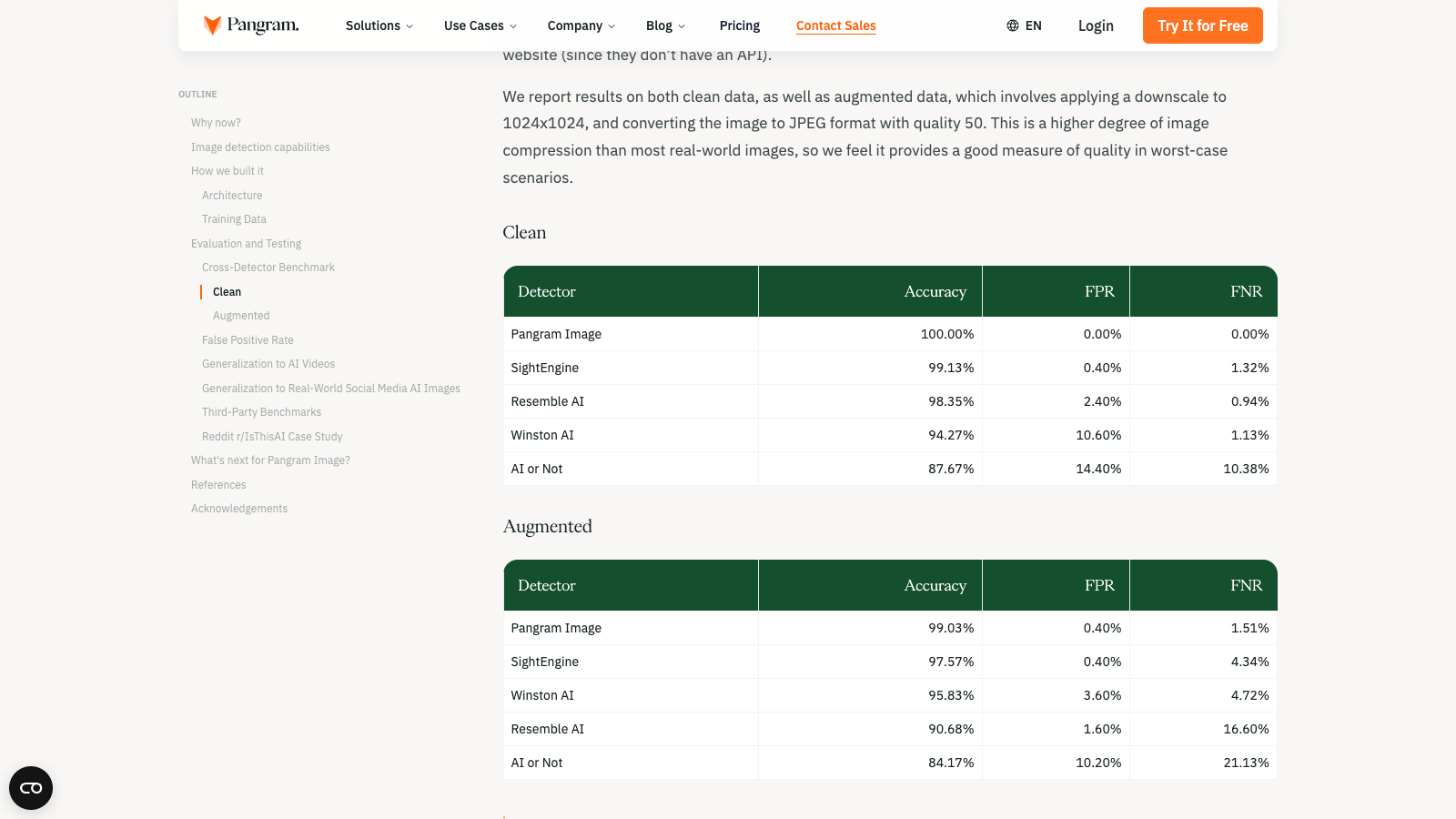
On an internal comparison of 1,130 images, Pangram reports 100% accuracy on clean examples and 99.03% after downscaling and heavy JPEG compression. It also reports a 0.16% false-positive rate on 10,000 pre-2022 images from ReLAION. These results suggest the model can survive common compression, but they do not prove that it will handle every screenshot, crop, camera photo or deliberate evasion attempt on the open web.
The detector also faces a policy problem that better accuracy cannot solve. A model can estimate whether pixels resemble synthetic output, but it cannot decide whether the use was deceptive, licensed, satirical, disclosed or harmless. Kingy.ai’s earlier coverage of TikTok’s likeness-detection tools reached the same boundary: detection is evidence for a process, not the process itself.
Pricing changed with the models
Pangram added image scans to its existing monthly plans without increasing the listed subscription price. The Individual plan now covers up to 300,000 words and 100 image scans per month, while Professional covers up to 1.5 million words and 500 image scans. The company’s pricing page lists the Individual plan at $20 per month and Professional at $65 per month when billed monthly.
API billing changed more materially. Pangram now prices text calls at $0.05 per 100 words instead of rounding each scan to 1,000 words. The company says the change can make short documents between one and two times more expensive and long-form documents as much as ten times more expensive. Pangram 3 will remain available until September 30, 2026; requests that do not specify a model will keep using Pangram 3 and the prior billing system until that deprecation date.
Why the $9 million round matters
TechCrunch’s funding report puts the product release in a wider business context. Pangram is not only selling a detector to individual users. It is building infrastructure for platforms that want an authenticity signal inside their own products. Substack is the clearest public example, while Pangram names Quora, universities, publishers, recruiters and other organizations as customers or users of its API.
The opportunity is real because generated content is getting cheaper and distribution systems reward volume. Kingy.ai has tracked the resulting flood of low-quality AI content and arXiv’s move to penalize submissions that show signs of unreviewed model output. Publishers, schools and marketplaces need triage tools when manual review cannot keep pace.
The risk is that institutions turn a probabilistic signal into an automatic punishment engine. Pangram’s buyers will need appeal paths, retained evidence, clear thresholds and human review for consequential decisions. A detector vendor can improve classification, but the customer decides whether an uncertain score becomes a warning, an investigation or a sanction.
Who should care
Publishers and trust-and-safety teams have the clearest immediate use case. Passage-level analysis can help prioritize suspicious material without rejecting an entire document. Educators may value the same detail, provided they use it alongside drafts, citations, interviews and a student’s prior work. Recruiters and legal teams should be more cautious because the personal cost of a false accusation is high and the relevant writing is often short, polished or templated.
Developers evaluating the API should run a private benchmark before changing a workflow. Test current model output, human work from the actual user population, AI-assisted editing, translated text and deliberately adversarial samples. Measure false positives separately from overall accuracy, then decide what evidence a human reviewer must see before acting.
What looks promising and what remains unproven
The strongest part of Pangram 4 is its attempt to describe degrees of AI involvement. Mixed-authorship detection matches how people use writing assistants in practice. The public model card, technical report and planned two-month migration window also give customers more information than a silent model swap.
The main unanswered question is external validity. Pangram reports excellent internal results and cites third-party work on earlier versions, but independent researchers still need to reproduce Pangram 4 and Pangram Image performance on fresh, messy, adversarial data. The image detector’s inability to handle deepfakes and face swaps also leaves two of the most consequential visual-manipulation categories outside the current preview.
Should you try Pangram 4?
It is worth testing if your team already reviews large volumes of text or images and needs a better triage signal. Start with non-punitive use, compare the output with known examples and document how reviewers should handle uncertainty. Do not deploy it as an automatic judge for students, employees, applicants or creators.
For individual users, the free scans and paid web plans make the release easy to evaluate. API customers should model the new per-100-word pricing before switching from Pangram 3, especially for long documents. The most useful test checks whether Pangram stays reliable on the borderline material that creates real disputes, not whether it can catch an obvious ChatGPT paragraph.
Official sources and original reporting
- Pangram: Introducing Pangram 4. Official launch details, internal text-detection results, pricing changes and Pangram 3 deprecation date.
- Pangram: Introducing Pangram Image Detection. Official research-preview scope, methodology, internal benchmarks and known limitations.
- Pangram 4 model card. Official evaluation scope and documented limitations.
- Pangram pricing. Current monthly plan allowances and API rates.
- TechCrunch: Pangram raises $9 million. Original reporting on the round, investors, product use and company strategy.
The Kingy Brief
Get the next Kingy Brief.
Source-checked AI changes, original tests and one practical thing to try.
Free · Choose your subjects · Double opt-in · Unsubscribe anytime