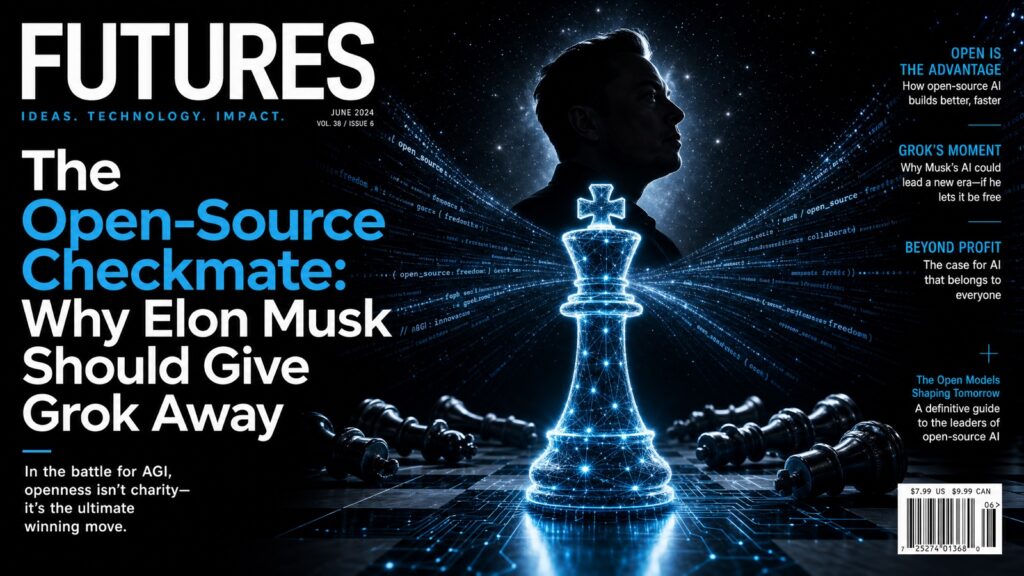
On 18 May 2026, after less than two hours of deliberation, a federal jury in Oakland handed Elon Musk a defeat that was also, quietly, a vindication. It rejected his case against OpenAI — but on a technicality, ruling his claims time-barred by the statute of limitations: he had known since 2017–18 that the non-profit he co-founded in 2015 “unconstrained by a need to generate financial return” was drifting toward a closed, for-profit future, and had waited too long to sue. The jury never decided whether he was right that OpenAI had betrayed its mission — only that he was late. Musk, characteristically, vowed to appeal, posting that Altman and Brockman “did in fact enrich themselves by stealing a charity. The only question is WHEN they did it.”
The most powerful way for Musk to prove his point about open AI, though, is not in the Ninth Circuit. It is on a server. He owns a frontier lab. He could open-source its best model tomorrow — and the striking thing, the thing this piece is about, is that doing so would not be principle at the expense of strategy. It would be the sharpest strategic move available to him.
The thesis, plainly: Musk should give Grok away — open-source the frontier weights, not the stale ones — not despite the fact that it would destroy the value of the model layer, but precisely because it would. Detonating the model layer is the winning move for the one player who makes his money almost everywhere except the model layer.
Commoditize your complement
The logic is old. In 2002 Joel Spolsky compressed it into a line: “Smart companies try to commoditize their products’ complements.” A complement is something you buy alongside another product — gas and cars, hardware and operating systems. Demand for a product rises as the price of its complement falls, so a rational company wants the things adjacent to its business as cheap as possible, ideally free. Gwern Branwen later promoted this into a general “law”: pick the layer you can defend and profit from, then drive every adjacent layer toward its marginal cost. You don’t give things away out of generosity — you give them away to move the profit to where you already stand.
The industry runs on this. Google underwrote Android and Chrome to keep the operating system and the browser cheap, because its business was the search box they led to. Meta pointed the same cannon at AI: it open-sourced Llama, and Mark Zuckerberg framed it, without embarrassment, as “the path forward” — because Meta doesn’t sell model access, it sells attention, and a free frontier-grade model commoditizes a cost center for its rivals while costing Meta a rounding error. When a company open-sources something expensive, the question is never “how generous,” but “what are they selling instead?”
The middle is already collapsing
Consider the shape of the whole industry. In the early 1990s Acer’s founder Stan Shih drew what he called the smiling curve: plot the stages of a value chain along the bottom and the value captured up the side, and the profit collects at the two ends — components and R&D at one, brand and distribution at the other — while the middle, commoditized assembly, earns least. The curve smiles because the money is in the corners.
Map today’s AI industry onto it and the middle — the model — is exactly where the floor is falling out. The clearest measure of commoditization is the price of a fixed unit of output, and it is in freefall. Stanford’s 2025 AI Index found the cost of querying a model at GPT-3.5 level dropped from $20.00 per million tokens in November 2022 to $0.07 by October 2024 — more than 280-fold in eighteen months. Andreessen Horowitz, tracking a slightly different capability line, put the collapse near 1,000× over three years, about tenfold a year, and named it “LLMflation.” OpenAI’s own list prices say the same from the inside: GPT-4 launched in March 2023 at $60 per million output tokens; sixteen months later GPT-4o-mini did comparable work for $0.60. A hundredfold, in-house, on purpose.
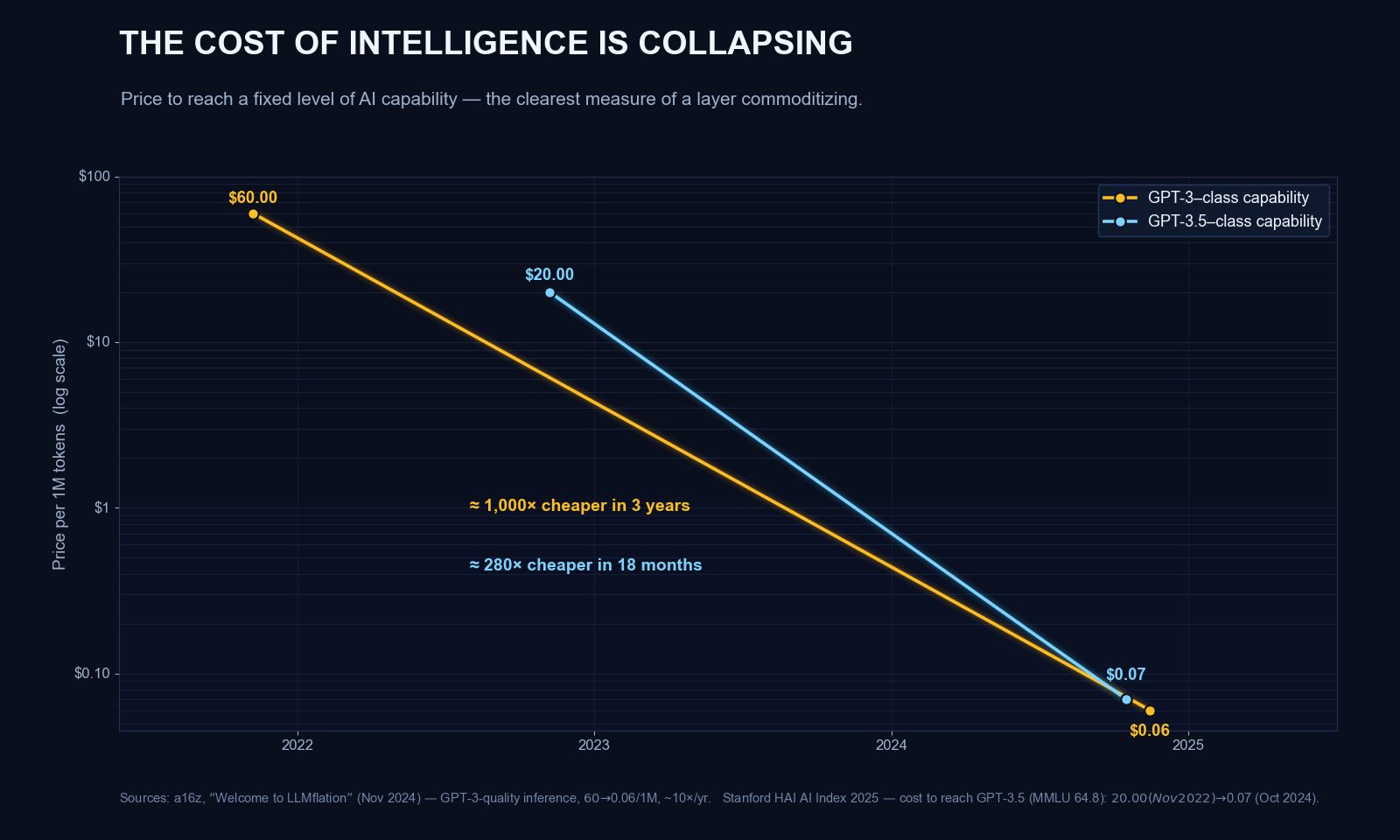
Then came the proof it wasn’t just incumbents discounting their own wares. In January 2025 the Chinese lab DeepSeek released R1, a reasoning model it claimed was on par with OpenAI’s o1, under a permissive MIT license, priced at $2.19 per million output tokens against o1’s $60 — roughly a twenty-seventh of the cost. The market grasped the implication instantly: the next day Nvidia lost about $589 billion in market value, the largest single-day loss for any company on record. (The much-repeated “$5.6 million training cost” deserves care: it is DeepSeek’s own accounting for the final run of its earlier V3 model, not R1’s all-in cost, which analysts put well above half a billion dollars. The number is contested; the direction isn’t.) Meta’s open weights had already shown a free model could sit within a generation of the closed frontier. DeepSeek showed it could undercut the frontier’s price by more than an order of magnitude — from outside the American labs entirely. “The model layer is commoditizing” is not a prediction. It is a chart with the axis already drawn.
One company at both ends of the smile
Now place Musk’s empire on that curve. Over the past year his companies have consolidated into one vertically integrated stack. In February 2026, SpaceX acquired xAI in an all-stock deal valuing the combined company at roughly $1.25 trillion — reported as the largest corporate merger ever — folding Grok, the Colossus supercomputers, and X under the SpaceX umbrella. (It went public in June 2026 and, in July, rebranded xAI as “SpaceXAI.”) That same entity, in June 2026, agreed to buy Anysphere, maker of the Cursor coding tool, for $60 billion in stock — a deal announced but, as of this writing, not yet closed and awaiting regulatory approval. Assemble the pieces and you get what no other AI company has: presence at both ends of the smiling curve at once.
At the bottom — the infrastructure end — sits some of the most capital-intensive hardware in the industry. Colossus, the Memphis supercomputer, went from bare factory to 100,000 Nvidia H100 GPUs training in 122 days, with Musk targeting a million. It runs on its own on-site power — natural-gas turbines that drew Clean Air Act litigation and, more tellingly, a June 2026 Justice Department intervention arguing the buildout is a matter of national security. Add Starlink, launch capacity, and the energy assets around them, and Musk owns more of the physical substrate of AI than almost anyone.
At the top — the application end, where users actually are — sits X, with hundreds of millions of accounts as a distribution channel, and, if the deal closes, Cursor, one of the fastest-growing software products ever, past $1 billion in annualized revenue by late 2025 and climbing. And in the middle — the commoditizing middle, where the floor is dropping out — sits Grok. It is, by Musk’s own reckoning, the weakest piece. Usage analytics from Similarweb put Grok fifth among AI chatbots by April 2026, behind ChatGPT, Claude, Gemini, and DeepSeek. More strikingly, Musk himself, testifying under oath on 30 April 2026, ranked four organizations ahead of his own — Anthropic, OpenAI, Google, and Chinese open-source models — calling xAI “a much smaller company with just a few hundred employees.” In July he conceded on X that a rival’s newest model “is definitely better than Grok 4.5,” his current flagship.
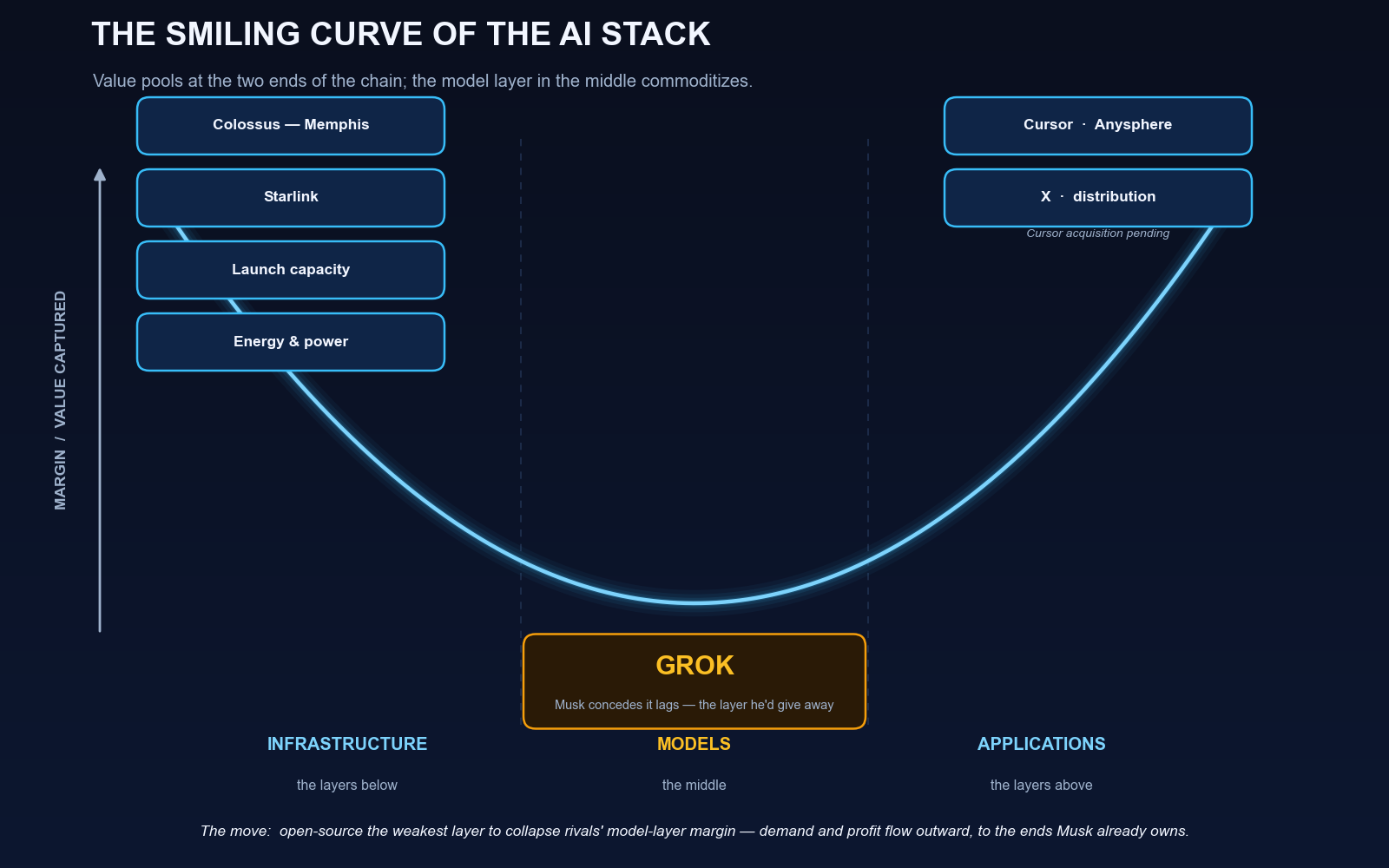
Here is the move. Grok is the weakest layer in Musk’s stack — and the only layer where his biggest rivals are strong. OpenAI and Anthropic are, fundamentally, model-access businesses: their revenue is tokens and subscriptions to the model itself, the thing in the middle of the curve. Musk’s isn’t. He sells rockets, satellite internet, cars, compute, and — soon, perhaps — coding software. The model-access revenue open-sourcing Grok would actually risk is, by his own companies’ numbers, modest and mostly indirect: X subscriptions that bundle Grok (X doubled Premium prices the week Grok 3 shipped), a Pentagon contract capped at $200 million, and integrations with Tesla, Kalshi, and Polymarket. Against Starlink and launch, it is a side dish. For his rivals, model access is the entrée.
So open-sourcing Grok’s frontier weights isn’t symmetric disarmament. It is Musk spending his weakest piece to blow up the most valuable real estate on the board for everyone who depends on it. If a genuinely frontier-grade Grok is free to download, run, and fine-tune, the premium OpenAI and Anthropic charge for comparable access compresses toward the cost of the electricity to serve it. Musk loses a business he was barely in. They lose the business they’re mostly in. That’s the checkmate: not a stronger model, but a move that makes “who has the strongest model” stop paying — commoditize-your-complement at grand-strategy scale.
You don’t have to take the thesis on faith, because a clean demonstration is already running inside the company Musk is buying. For its first three years Cursor was a wrapper — a very good one — around other people’s models, and it paid for the privilege: its largest single cost was its API bill to Anthropic, and reporting indicates it ran at negative gross margins. Then, in October 2025, it shipped Composer, its own in-house coding model, and routed inference through hardware it controlled. According to TechCrunch — anonymously sourced, not confirmed by the company — that shift helped move it from negative to slightly positive gross margins. It’s the whole argument in miniature: the application layer stopped letting value leak up to the model layer and captured it instead, making its own model a commodity input rather than a metered luxury. The app ate the model’s margin — and Musk is about to own the app that proved it works.
Skeptics will note Musk has already open-sourced Grok once and nothing happened. In March 2024 xAI released Grok-1 — the raw 314-billion-parameter mixture-of-experts base model, under a permissive Apache 2.0 license. The sky didn’t fall; OpenAI’s pricing didn’t blink. But Grok-1 was a half-measure, and the reason it changed nothing is the reason a real move would change everything. By the time its weights were posted it was already behind the frontier — it beat GPT-3.5 but trailed GPT-4, arrived as an un-fine-tuned base model too large for most people to run (it needed hundreds of gigabytes of memory), and was, by release day, a five-month-old checkpoint. Open-sourcing a stale model is a press release. Open-sourcing the current frontier model — a Grok that trades blows with the best closed systems on the day it ships — is a weapon, because it hands every developer and competitor a free substitute for the exact product the closed labs are trying to sell at a premium. The difference is the difference between donating last year’s phone and giving away this year’s, free, on launch day — the same margin migration already reshaping who funds AI media. Only one version moves the market.
The case against giving Grok away
None of this is a slam dunk, and the honest version has to sit with the strongest objections rather than the weakest.
First, irreversibility. You cannot un-release weights. Once a frontier Grok is in the wild it is there forever, including in the hands of adversaries — and if the smiling-curve thesis is wrong and closed models pull permanently ahead, there is no undo. It is a one-way door.
Second, and sharpest: frontier-racing. Commoditization only bites if the free thing is close to the expensive thing. If OpenAI and Anthropic answer an open Grok N by sprinting to a meaningfully better closed Grok N+1, the open model commoditizes only the past, and buyers who need the best still pay for it. The play depends on open models staying within a hair of the frontier — lately true, not guaranteed.
Third, regulatory and security entanglement. xAI isn’t a pure commercial actor: in July 2025 it won a Pentagon contract worth up to $200 million and launched “Grok for Government,” and the DOJ has since gone to court framing Colossus as national infrastructure. Open weights and defense contracts coexist awkwardly; a model the Pentagon leans on is not one the government will cheerfully see mirrored on every server on Earth.
Fourth, the top of the stack isn’t secured. The Anysphere acquisition — the leg that hands Musk the application layer where commoditized-model value is supposed to pool — hasn’t closed. If regulators block it, “own the app layer” collapses back to X alone, a distribution channel but not yet a great software business. Without a strong application end, half the smile is missing, and giving the model away looks less like strategy than unilateral disarmament.
Fifth, the most deflating: the Chinese labs may do the job for free. If DeepSeek and Qwen keep shipping frontier-adjacent open weights, the model layer commoditizes anyway, without Musk spending anything. Why burn your own model to light a fire someone else is already lighting? The counter — that being the one who does the commoditizing lets you shape the timing and pull the resulting demand toward your own infrastructure — is real, but it’s a bet. Weigh these together and the case is strong but contingent, resting on two things staying true: open models staying near the frontier, and Musk actually owning the ends of the curve. Both are live questions.
The kicker: a datacenter in orbit
There’s a longer game here, and it belongs clearly in the speculation column. If value flows to the ends of the curve and the bottom end is physical infrastructure, then the ultimate moat is infrastructure your rivals physically cannot build. Musk has started saying exactly this. In November 2025 he posted that “Starship should be able to deliver around 300 GW per year of solar-powered AI satellites to orbit, maybe 500 GW,” noting that US electricity consumption averages around 500 GW — that is, putting more compute-power in orbit each year than the United States runs on the ground. In January 2026 SpaceX filed with the FCC for authorization to launch up to a million “AI Sat Mini” satellites. He isn’t alone: Google’s Project Suncatcher is putting TPUs in orbit, an Nvidia-backed startup already flew an H100 to space, and Jeff Bezos predicts gigawatt-scale orbital datacenters within two decades.
The honest counterweight is that the physics is brutal and the economics are, for now, fiction. A datacenter in vacuum can’t shed heat by moving air; it can only radiate — and the numbers punish you. An ABI Research analyst calculated in IEEE Spectrum that a single 40-kilowatt rack would need roughly 80 square meters of radiator, “about the size of a pickleball court,” and that running a GPU in orbit costs “at least an order of magnitude” more than on the ground. Add radiation-induced errors in commodity chips, the impossibility of swapping a failed board, the latency floor for Earth-side users, and the debris problem of launching a million of anything, and the skeptics are right that it is nowhere near viable today. It all hinges on Starship, which in mid-2026 is still a test program, not an operational rocket: about a dozen flights, mixed results, no commercial payloads, a real cost per launch near $100 million against Musk’s someday-target of a few million. Orbital compute isn’t a plan; it’s a direction — the logical endpoint of the same idea: if you can’t win by owning the model, win by owning the ground, and the sky, the models run on.
He was right the first time
Return to that Oakland courtroom. Musk lost his case against OpenAI not because a jury decided he was wrong about the mission, but because it decided he’d waited too long to complain — a verdict about a clock, not a principle. He has spent years trying to get a court to force AI back into the open. He has been trying to win the argument by losing lawsuits.
He could win it by shipping a file. Open-sourcing a frontier Grok would do more to realize the 2015 vision of AI “unconstrained by a need to generate financial return” than any appeal to the Ninth Circuit — and, if the analysis here is right, it would be the most ruthless move on the board, not a sacrifice. The man who founded OpenAI to keep AI open, then sued when it closed, holds the one lever that would prove his case: not a better model, but a free one.
So, a falsifiable prediction to score this against in twelve months. By July 2027, one of two things will be true. Either xAI will have released open weights for a Grok model within roughly one generation of its best system — vindicating the thesis that the model layer is worth more given away than sold — or Grok’s best model will still be closed and metered, in which case either the strategy was wrong or Musk left the sharpest move on the board unplayed. The tell to watch is the Anysphere deal: secure the application layer, and the logic of giving the model away only gets stronger. Watch what he does with the weights. It will tell you whether he actually believes the thing he has spent two years suing about.
Analysis by kingy.ai. Sources are linked throughout; forward-looking and speculative claims are flagged as such. Corrections welcome.
The Kingy Brief
Get The Kingy Brief.
AI changes, original tests and one practical thing to try. Fridays at 09:00 Vancouver time.
Free · Double opt-in · Unsubscribe anytime
Sign up for The Kingy Brief on Beehiiv.
Signup help and newsletter schedule
Signup form provided by Beehiiv. After submitting, check your inbox for "Confirm your subscription to The Kingy Brief" and open its confirmation link. Check Spam or Promotions if you cannot find it.
Fridays at 09:00 Vancouver time: source-checked AI changes, original tests and one practical thing to try. We skip a week when there is not enough verified material. Free. Unsubscribe anytime.