TL;DR: The July 21 roundup covered five source-checked launches: Lunen’s agent controls, Rex’s order-to-cash work, Creed’s personal context for agents, Kogvio’s on-screen research tool, and Deck’s separate assistant inbox.
Launch Snapshot
The July 21 snapshot compares five launches on Kingy’s reporting criteria after source review. It does not compare product performance under a common test.
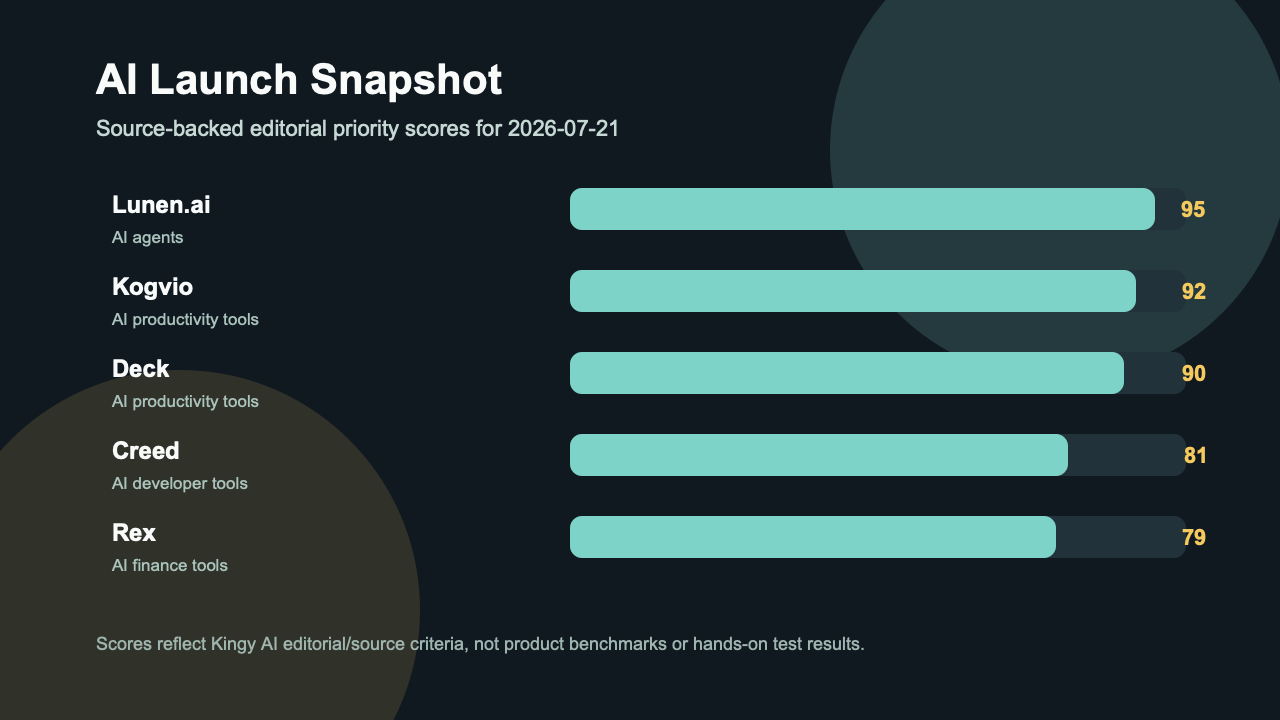
Strongest Launches
Lunen.ai
The July 21 report covered Lunen. On October 10, its official site described an early-access enterprise orchestration layer for defining agents in plain language and governing their tools, data access, approvals, schedules, and audit trails.
Sources checked: launch source, docs.
Why it matters: Enterprises experimenting with agents need controls at the action layer, not only prompt guidelines. Lunen’s launch focuses on tool-level authorization, approval, and auditability as core product features.
Who should care: AI Product Teams, Enterprises, Operators
Pricing: As checked October 10, 2026, Lunen’s official site invited early-access and design-partner requests. It listed no public numeric price or free-plan entitlement at that time. Confirm current terms on the official site.
What remains unproven: The October 10 official-site check described Lunen as early access; no independent deployment evidence or public numeric price was available in that check. Buyers should validate identity controls, log completeness, failure handling, model and data boundaries, and the enforcement of each MCP approval policy.
Verified tracker record: Open the verified Lunen enterprise agent orchestration layer record.
Kogvio
Kogvio launched a browser extension that lets users highlight text, equations, diagrams, or other visible content and ask an AI question without leaving the page.
Sources checked: launch source, docs.
Why it matters: Research tools often force users to copy material into a separate chat. Kogvio instead keeps the question anchored to the source view, which may reduce context-switching for study and technical reading.
Who should care: Developers, Researchers, Students
Pricing: As checked October 10, 2026, Kogvio’s official site listed Starter at ₹0 per month with five AI scans per day and Pro at ₹199 per month with unlimited scans, advanced vision, and unlimited history. Confirm current pricing before subscribing.
What remains unproven: The listing’s age, user count, and rating history could not be independently confirmed for this report. Because the extension reads webpage content, users should review its privacy disclosures and avoid sensitive pages until its data handling and reliability are independently established.
Verified tracker record: Open the verified Kogvio contextual AI browser extension record.
Deck
The Product Hunt page, published July 17 and updated September 3, presents Deck as an AI chief of staff with its own inbox. The maker says users can CC it on a thread or hand it a task, and schedule briefings and status updates; these are maker claims, not independent test results.
Source: Deck’s Product Hunt maker description. See the official docs for current product details.
Why it matters: Deck’s launch description says the assistant works through its own inbox and does not require blanket inbox authorization. That narrower access model is a maker claim; users should verify permissions before connecting an account.
Who should care: Small Business Owners, Founders
Pricing: The July 21 report listed Free at $0 with up to 20 messages per day and one email address, Pro at $29.99 per month, custom Enterprise pricing, and a 14-day Pro trial without a card. An official archive snapshot dated June 12 predates the report and does not confirm these terms; no dated first-party price schedule for July 21 is available in this evidence set. Treat the figures as unverified historical reporting, not a current offer; check the official site before purchase. Official site.
What remains unproven: Forwarded messages, documents, and calendar context may contain sensitive information even without full-mailbox access. Users should review permissions and privacy terms, verify drafts before sending, and test whether reminders and routines behave reliably for their workflow.
Verified tracker record: Open the verified Deck AI chief of staff with a delegated inbox record.
Creed
The Product Hunt page, published July 19 and updated September 29, describes Creed as a personal context file for every agent. The official site checked October 10 describes a Mac app built around an editable Markdown file shared across agents; the launch page does not establish that the July 21 version had the same file format or integrations.
Sources: Creed’s launch listing and current official homepage. The official docs link was unavailable in the October 10 check.
Why it matters: The launch listing describes one user-owned context file that connected agents can read. A shared file may reduce repeated setup, but that source does not establish version history or how every integration syncs changes.
Who should care: AI Engineers, Developers, Founders
Pricing: The July 21 report listed Open self-hosted as free, Personal at $12 per month, and Company at $129 per month for 10 seats, with bring-your-own-key use. An official July 5 archive lists Open $0, Personal $12 per month, Company advertised at $199 per month and marked “Coming Soon,” plus OpenRouter BYOK. No dated first-party source confirms the July 21 $129 Company price or 10-seat term; a change between dates is possible but unverified. Treat $129 as unverified historical reporting and check the official site for current plans. Official pricing page.
What remains unproven: A portable context file can concentrate sensitive personal and project information. Users should minimize stored secrets, inspect agent-proposed diffs, and evaluate access controls and retention before connecting multiple tools or sharing team context.
Verified tracker record: Open the verified Creed portable Markdown context for AI agents record.
Rex
Rex launched a set of governed AI agents for collections, customer-portal work, accounts-receivable inboxes, cash application, and dispute handling.
Sources checked: launch source, docs.
Why it matters: Order-to-cash work crosses inboxes, finance systems, and customer portals, making it a useful test of whether agentic software can automate multi-system operations while preserving finance-team oversight.
Who should care: Enterprises, Operators
Pricing: As checked October 10, 2026, Rex’s official FAQ described pricing around outcomes, with scope and volume determining the cost. No public numeric price was verified. Access began with a requested walkthrough. Confirm current terms with Rex.
What remains unproven: No public numeric pricing or independent performance benchmark was verified. Finance teams should test data permissions, approval thresholds, exception handling, and audit completeness before allowing agents to take customer-facing or ledger-affecting actions.
Verified tracker record: Open the verified Rex governed agents for order-to-cash work record.
Related Kingy AI Links
For category context, review the July 21 products in AI Launches and AI Tools. New evidence and pricing changes can be followed in the AI News archive; the AI Sponsored Video ROI Calculator serves a separate planning use case.
Sponsor path
Sponsor Kingy AI launch coverage
Launching an AI product that needs clear demos, creator education, and buyer trust? Sponsor a Kingy AI video or launch feature.
The Kingy Brief
Get The Kingy Brief.
AI changes, original tests and one practical thing to try. Fridays at 09:00 Vancouver time.
Free · Double opt-in · Unsubscribe anytime
Sign up for The Kingy Brief on Beehiiv.
Signup help and newsletter schedule
Signup form provided by Beehiiv. After submitting, check your inbox for "Confirm your subscription to The Kingy Brief" and open its confirmation link. Check Spam or Promotions if you cannot find it.
Fridays at 09:00 Vancouver time: source-checked AI changes, original tests and one practical thing to try. We skip a week when there is not enough verified material. Free. Unsubscribe anytime.