
Historical evidence boundary — checked October 13, 2026: The DocuSmart naming correction and October 10 pricing/access check, along with the October 10 Clark free-option and credit qualification, remain in the page. The original July 19 launch-chart methodology and the historical launch, performance, and privacy source snapshots were not recovered as a complete evidence set. Those sections remain part of the original dated Radar report. They are not a current product comparison or a newly recertified launch ranking. Prices, free offers, credit amounts and product claims below describe the July 19 report unless a later correction is dated. Current offers beyond those dated corrections have not been verified.
TL;DR: The July 19 Radar reviews DocuSmart AI, LiveDemo, ZooData, Clark, and Aye across document workflows, creative demonstrations, data infrastructure, and agent execution.
Launch Snapshot
The original July 19 report listed five products in its launch chart. Its underlying ranking method and complete launch-source snapshots were not recovered, so the list is preserved as a historical roundup, not a verified quality ranking or product test.
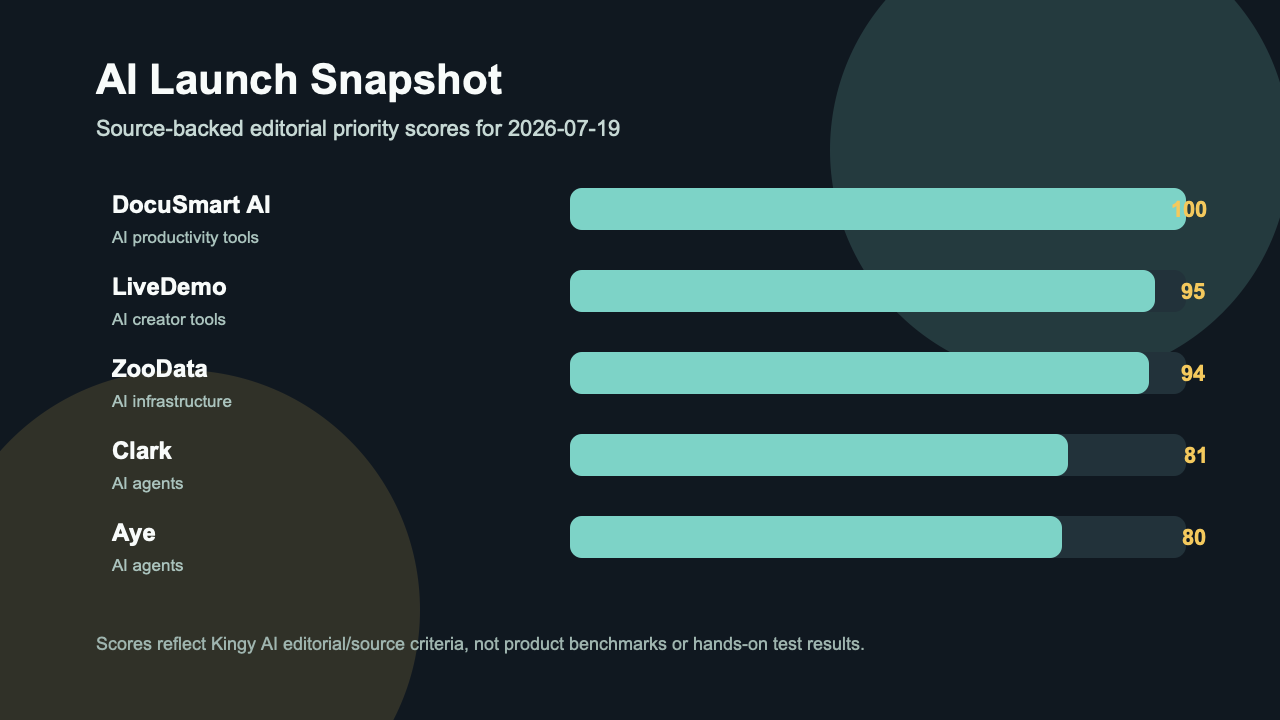
Products in the July 19 Report
DocuSmart AI
DocuSmart AI launched on Product Hunt as a document search system for teams that need citation-backed answers across fragmented cloud storage.
Sources checked: launch source, docs.
Why it matters: For nonprofits and small teams, retrieval quality and cited answers can reduce time spent digging through grant, programme, board, compliance, and operations documents.
Who should care: Small Business Owners, Enterprises, Researchers, Students
Pricing: The article’s earlier EUR 150/250 and custom Impact figures, plus the nonprofit-discount claim, are not independently verified by the retained first-party sources. The October 10 DocuSmart site capture did not show a numeric rate card; ask the vendor for current pricing and eligibility.
What remains unproven: The same October 10 site capture does not establish availability or a waitlist; confirm access directly with the vendor. Teams should review third-party AI model processing and privacy terms before connecting sensitive documents. Exact support for every file type should be verified during onboarding.
LiveDemo
LiveDemo launched a new Product Hunt release for creating interactive product demos with AI voiceovers, personalization, sharing, embedding, and analytics.
Sources checked: launch source, docs, GitHub repo.
Why it matters: AI-assisted demo creation is becoming a practical marketing and sales workflow for SaaS teams that want buyers to inspect product value without a booked call.
Who should care: AI Product Teams, Sales Teams, Small Business Owners, Founders
Pricing: The October 10 LiveDemo site capture listed Startup at $0 for one creator with three published demos, Pro at $34 per creator/admin per month, Growth at $49 per creator/admin per month, and Business as custom. The page exposed monthly and annual billing options; the captured text did not establish the selected commitment or final checkout total. Treat these as dated displayed terms and confirm billing terms before purchase.
What remains unproven: Open-source scope and license details need repository-level verification. AI personalization should be reviewed to avoid misleading buyer-specific claims. Analytics and lead capture need privacy review for each implementation.
ZooData
ZooData launched as an agent-ready data layer that turns web and commerce data into structured JSON for AI agents.
Sources checked: launch source, docs, GitHub repo.
Why it matters: Reliable structured data is a practical bottleneck for production agents; ZooData is positioned around reducing raw scraping and parsing work for commerce and research agents.
Who should care: AI Platform Teams, AI Engineers, Developers, Marketers
Pricing: The October 10 ZooData site capture said sign-up included 1,000 free credits and described per-call pricing with lower unit prices at higher volume. Exact public per-call rates were not visible in the captured page text; verify current terms on the pricing page before purchase.
What remains unproven: Exact pricing requires the current pricing page. Commerce intelligence coverage should be validated for each marketplace and geography. Users need to confirm acceptable-use and data-source boundaries before deploying scraping workflows.
Clark
Clark launched as an AI coworker with its own cloud computer for browser, file, code, and artifact-producing work.
Sources checked: launch source.
Why it matters: Agent products are moving from chat assistance toward longer-running workspaces. Clark is a useful signal for founders and operators evaluating asynchronous cloud-computer agents.
Who should care: AI Product Teams, Small Business Owners, Developers, Founders
Pricing: The October 10 Product Hunt capture did not confirm free options or the reported 2,000-credit amount. Current official pricing and account-credit terms were not verified.
What remains unproven: Official security, data retention, and pricing details need deeper review before recommending sensitive workflows. Artifact quality and autonomous reliability are not independently tested here. Cloud computer agents need careful permission boundaries.
Aye
Aye launched as a Chromium-based AI browser that can read visible pages, plan steps, and automate everyday browser work with reviewable progress.
Sources checked: launch source.
Why it matters: Browser agents are moving from demos into practical operator workflows; Aye focuses on teachable, repeatable web work while keeping visible-page context and user approval in the loop.
Who should care: Developers, Creators, Researchers, Students
Pricing: The October 10 Japanese Mac App Store listing showed Aye as free with in-app purchases. That storefront snapshot does not establish other regions or current paid-tier terms; check the App Store listing before purchase.
What remains unproven: Long-running reliability on changing websites needs practical testing. Credential, session, and profile storage details should be reviewed before sensitive use. Windows availability should be confirmed from the current official product page.
Related Kingy AI Links
Use AI Launches and AI Tools to compare the July 19 entries, with subsequent corrections and availability changes tracked in the AI News archive. The AI Sponsored Video ROI Calculator covers creator-campaign economics.
Sponsor path
Sponsor Kingy AI launch coverage
Launching an AI product that needs clear demos, creator education, and buyer trust? Sponsor a Kingy AI video or launch feature.
The Kingy Brief
Get The Kingy Brief.
AI changes, original tests and one practical thing to try. Fridays at 09:00 Vancouver time.
Free · Double opt-in · Unsubscribe anytime
Sign up for The Kingy Brief on Beehiiv.
Signup help and newsletter schedule
Signup form provided by Beehiiv. After submitting, check your inbox for "Confirm your subscription to The Kingy Brief" and open its confirmation link. Check Spam or Promotions if you cannot find it.
Fridays at 09:00 Vancouver time: source-checked AI changes, original tests and one practical thing to try. We skip a week when there is not enough verified material. Free. Unsubscribe anytime.