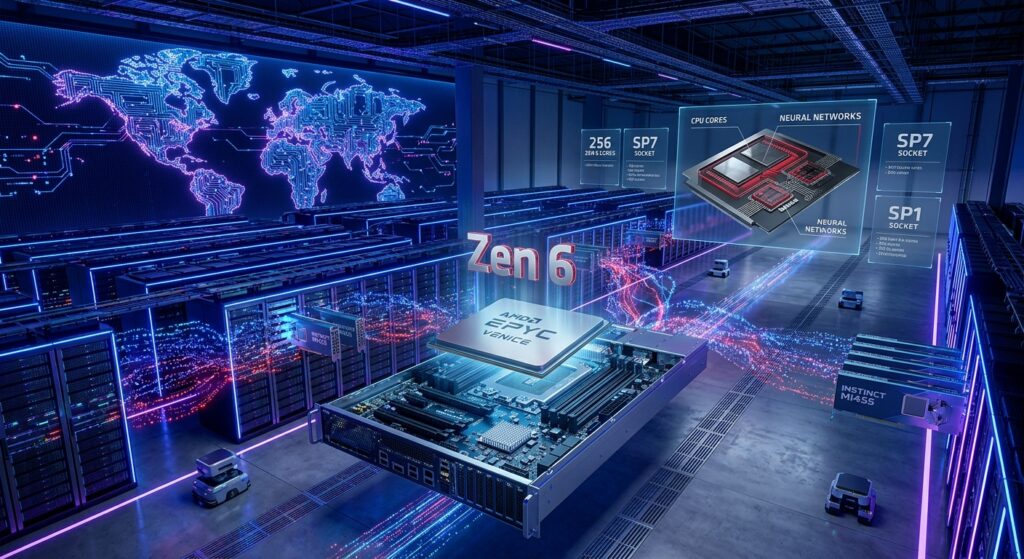
The Next Big Leap Has Finally Arrived
For years, the semiconductor industry has been running one of the most fascinating races in technology. Every generation of processors promises better performance, greater efficiency, and new possibilities. Sometimes those promises amount to modest upgrades. Other times, they mark the beginning of an entirely new chapter.
AMD appears ready to write one of those chapters.
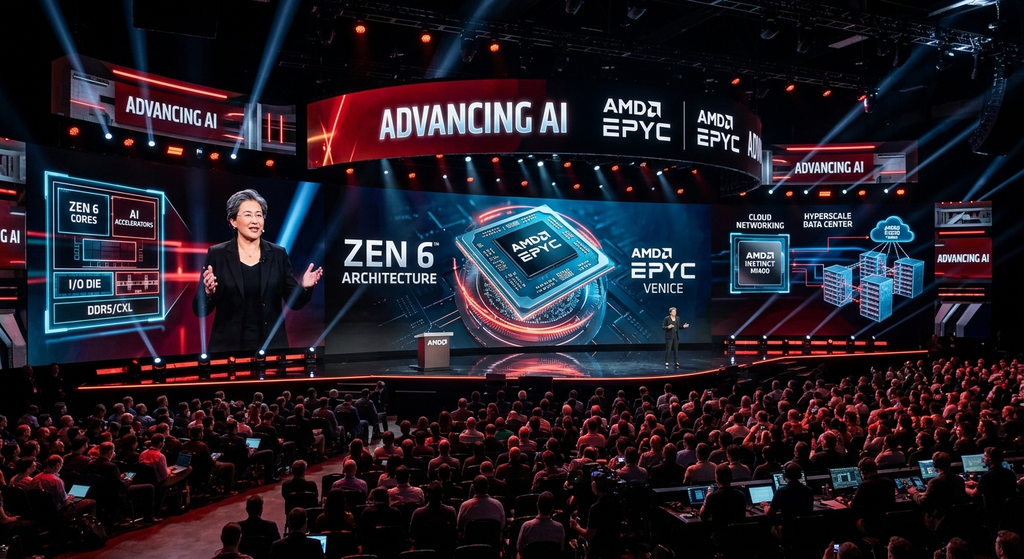
The company has officially confirmed that its first Zen 6 processors will debut during its Advancing AI event on July 22–23, with the spotlight firmly on the EPYC Venice server processors. Rather than launching consumer Ryzen chips first, AMD is taking an unusual but increasingly logical approach by putting enterprise computing and artificial intelligence at center stage.
That decision speaks volumes about where the computing industry is heading.
Artificial intelligence has transformed from an experimental technology into the driving force behind nearly every major investment in data centers. Companies are building larger AI models, governments are funding national AI initiatives, and cloud providers are racing to expand infrastructure. Every one of those workloads needs enormous computing power.
AMD wants Zen 6 to become one of the engines powering that future.
More importantly, AMD isn’t simply introducing another processor generation. It’s preparing to showcase the first EPYC CPUs built around TSMC’s advanced 2nm manufacturing process, signaling a major technological milestone that extends well beyond AMD itself.
Why AMD Is Launching Servers Before Desktop CPUs
Traditionally, enthusiasts expect new Ryzen processors to steal the spotlight. Gamers, overclockers, and PC builders eagerly wait for every new desktop architecture.
Zen 6 breaks that expectation.
Instead of introducing Ryzen first, AMD is leading with EPYC Venice, a processor family designed for servers, hyperscale cloud platforms, and AI infrastructure.
That decision isn’t accidental.
Today’s biggest technology spending isn’t happening inside gaming PCs. It’s happening inside massive AI data centers operated by companies like Microsoft, Amazon, Google, Meta, Oracle, and countless cloud providers worldwide.
Training and serving AI models require thousands of CPUs coordinating with even larger numbers of GPUs. Those CPUs handle memory management, storage, networking, scheduling, virtualization, and countless background tasks that keep AI clusters operating efficiently.
Without powerful server CPUs, even the world’s fastest AI accelerators would struggle.
AMD clearly recognizes this shift.
Launching Zen 6 through EPYC allows the company to target its highest-value customers first. Enterprise buyers purchase processors in enormous quantities, often investing hundreds of millions of dollars into server deployments.
Consumer Ryzen processors remain incredibly important, but enterprise infrastructure currently represents one of the fastest-growing opportunities in the semiconductor industry.
Several industry reports suggest AMD’s strategy reflects this changing market, where AI infrastructure investments continue reaching record levels.
Meet EPYC Venice: The First Face of Zen 6
The name “Venice” carries considerable weight inside AMD’s roadmap.
EPYC Venice represents the company’s first commercial implementation of the Zen 6 architecture, succeeding the already successful Turin family based on Zen 5.
Although AMD has not yet revealed every architectural detail, the company has confirmed several key milestones that make Venice especially significant.
Perhaps the biggest headline is manufacturing.
Venice becomes AMD’s first processor family built using TSMC’s N2 (2nm-class) process technology, making it one of the earliest commercial CPU products expected to leverage this advanced node.
Shrinking transistors isn’t simply about fitting more components onto a chip.
Smaller process nodes typically improve power efficiency, allow greater transistor density, and potentially increase overall performance while reducing energy consumption.
For data centers, that combination matters enormously.
Electricity has become one of the largest operating expenses for AI infrastructure. Every percentage point of improved efficiency can translate into millions of dollars in savings across large server fleets.
That’s one reason why the transition to 2nm technology has attracted so much attention throughout the industry.
AMD’s executives have repeatedly emphasized that Venice is designed not only for higher raw performance but also for delivering the efficiency modern AI deployments demand.
The AI Boom Changed Everything

Only a few years ago, conversations about processors often revolved around gaming benchmarks.
Today, the discussion looks completely different.
The explosion of generative AI has fundamentally changed how companies evaluate computing hardware.
Every chatbot response, image generator, recommendation engine, scientific simulation, autonomous system, and large language model depends on massive computing infrastructure operating behind the scenes.
GPUs usually receive most of the attention.
That’s understandable.
They’re responsible for the parallel computations that accelerate AI training and inference.
Yet CPUs remain indispensable.
Modern AI clusters rely on CPUs to coordinate workloads, feed data to accelerators, manage memory, maintain security, operate storage systems, and oversee networking across thousands of interconnected devices.
As AI models continue growing larger, CPUs become increasingly important rather than less.
AMD’s decision to unveil Zen 6 during an event dedicated to artificial intelligence reflects this reality.
Instead of treating AI as a side topic, the company is presenting its newest server architecture as an integral part of tomorrow’s AI infrastructure.
That positioning aligns with broader industry trends, where nearly every major chip manufacturer now frames product launches around AI capabilities rather than traditional benchmark numbers alone.
Why 2nm Matters More Than Just Marketing
Chip manufacturing terms like 5nm, 3nm, and 2nm often sound like marketing slogans.
They’re much more than that.
Each new manufacturing generation represents years of engineering breakthroughs involving transistor design, materials science, photolithography, and fabrication techniques.
Transitioning to TSMC’s N2 process could give AMD several advantages.
First comes transistor density. More transistors generally allow engineers to build increasingly sophisticated processor designs.
Next comes efficiency.
Reducing power consumption has become one of the industry’s highest priorities because AI data centers consume extraordinary amounts of electricity.
Lower power usage also means reduced cooling requirements.
Cooling may sound mundane, but it’s one of the biggest operational challenges inside modern server farms. Less heat translates into lower infrastructure costs and better long-term scalability.
Finally, there’s performance.
Although AMD hasn’t released benchmark numbers yet, new manufacturing processes typically enable higher frequencies, improved efficiency, or a combination of both.
For enterprise customers investing in AI infrastructure, these improvements compound across thousands of servers.
The result isn’t simply a faster processor.
It could be a significantly more economical platform for deploying large-scale AI systems.
Zen 6 Isn’t Just Another CPU Upgrade
Every new processor generation promises improvements, but not every generation changes the conversation. Zen 6 has the potential to do exactly that.
AMD has remained careful about revealing the finer architectural details before the official launch. Even so, the information confirmed so far paints the picture of a processor family designed for one goal above all else: handling the explosive growth of AI and cloud computing.
That doesn’t necessarily mean higher clock speeds alone. Modern server processors succeed by improving everything that surrounds raw performance. Memory bandwidth, cache efficiency, interconnects, security, virtualization, and scalability all matter just as much as gigahertz.
Large AI clusters are incredibly demanding. They constantly move enormous datasets between CPUs, GPUs, storage arrays, and networking hardware. Even small improvements in how processors manage those tasks can translate into substantial gains once multiplied across thousands of servers.
Zen 6 is expected to build upon the strengths of Zen 5 while introducing refinements that improve throughput, efficiency, and overall platform performance. AMD has spent years evolving its chiplet architecture, and each generation has demonstrated that thoughtful engineering often delivers bigger real-world benefits than simply increasing frequency.
The result could be a processor that feels less like a routine refresh and more like infrastructure built specifically for the AI era.
The Rise of Hyperscale Computing
If you have ever streamed a movie, backed up photos to the cloud, or asked an AI chatbot a question, you’ve already relied on a hyperscale data center.
These facilities represent some of the largest computing environments ever built. Instead of housing dozens of servers, they contain tens of thousands, sometimes hundreds of thousands, operating around the clock.
Companies like Microsoft, Google, Amazon, Meta, Oracle, and many regional cloud providers are continually expanding these facilities to meet rising demand.
Artificial intelligence has accelerated that expansion dramatically.
Training a frontier AI model can require thousands of GPUs working together for weeks or even months. Those GPUs depend on equally capable CPUs to coordinate workloads, feed training data, manage storage, and keep every component synchronized.
That’s where processors like EPYC Venice enter the picture.
AMD isn’t designing these chips for individual enthusiasts or small businesses. They’re intended for organizations building entire AI ecosystems. In that environment, performance isn’t measured by how quickly a single application opens. It’s measured by how efficiently thousands of servers work together without wasting energy or creating bottlenecks.
Winning even a handful of these hyperscale contracts can translate into millions of processor shipments over the lifetime of a platform.
AMD’s Steady Climb in the Data Center
A decade ago, Intel dominated the server market with very little serious competition.
That landscape looks very different today.
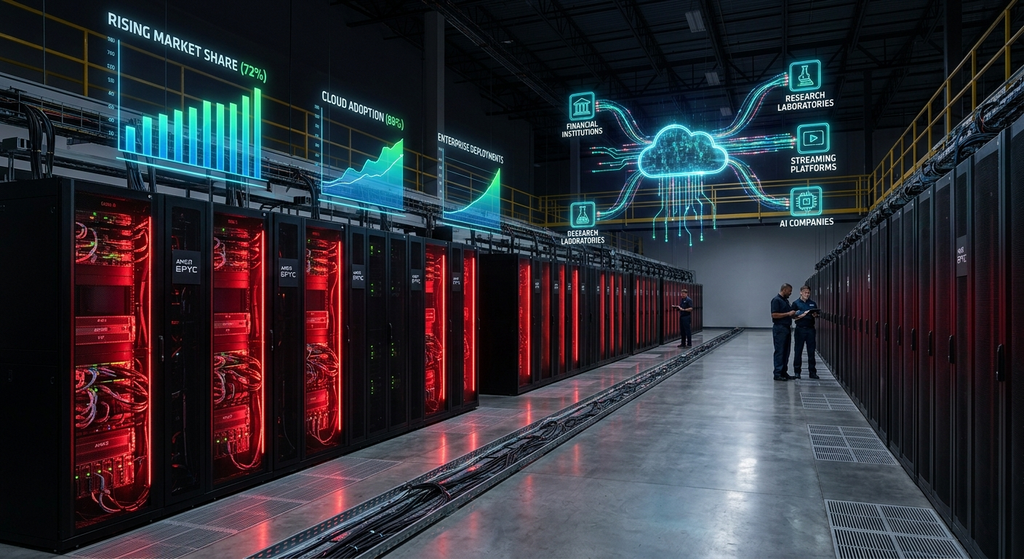
AMD’s EPYC family has steadily earned credibility by offering competitive performance, attractive power efficiency, and high core counts that appealed to enterprise customers looking for alternatives.
Each new EPYC generation has expanded AMD’s presence inside cloud infrastructure.
Major providers now deploy EPYC processors across a wide range of services, from virtual machines and enterprise databases to high-performance computing and AI workloads.
This momentum didn’t happen overnight.
AMD invested heavily in rebuilding its CPU roadmap after years of struggling to compete in the data center. The arrival of the original Zen architecture marked a turning point, and each generation since then has strengthened the company’s position.
Zen 6 represents the next phase of that journey.
Rather than simply defending its current market share, AMD now has an opportunity to capture additional enterprise customers that are modernizing infrastructure specifically for AI.
That distinction matters.
Traditional server refresh cycles often stretched across several years. AI demand has shortened those timelines considerably, encouraging organizations to invest in newer hardware much sooner than they otherwise might.
CPUs and GPUs: Partners, Not Rivals
Whenever artificial intelligence enters the conversation, GPUs usually dominate the headlines.
That makes sense.
Graphics processors excel at handling the massively parallel mathematical operations required for training and running neural networks.
Yet focusing exclusively on GPUs overlooks an important reality.
Modern AI systems cannot function efficiently without powerful CPUs.
Think of a GPU as the engine inside a race car. It’s incredibly powerful, but someone still needs to manage navigation, fuel delivery, communications, telemetry, and every other supporting system that keeps the car moving.
In an AI server, the CPU plays that supporting role.
It schedules workloads, handles operating system tasks, manages memory allocation, processes storage requests, secures data, coordinates networking, and ensures GPUs remain fully utilized.
When CPUs become bottlenecks, expensive AI accelerators spend valuable time waiting instead of computing.
That’s one reason AMD continues investing aggressively in both product lines.
Its EPYC CPUs complement its Instinct AI accelerators, allowing customers to build integrated computing platforms rather than piecing together hardware from multiple vendors.
As AI infrastructure grows more sophisticated, this kind of platform strategy becomes increasingly attractive.
Why Efficiency Has Become the New Performance Metric
For years, processor launches centered on benchmark charts.
Higher frame rates.
Faster rendering.
Shorter compile times.
Those numbers still matter, but enterprise customers increasingly ask a different question first.
How much power does it consume?
AI has transformed electricity into one of the industry’s most valuable resources.
Large data centers require enormous amounts of energy, not only to power servers but also to cool them. Every watt saved at the processor level reduces strain across the entire facility.
That creates a multiplier effect.
Lower power consumption means lower cooling costs.
Lower cooling costs allow denser server deployments.
Denser deployments improve operational efficiency.
Operational efficiency lowers the total cost of ownership.
This explains why AMD places so much emphasis on manufacturing technology and architectural improvements rather than simply advertising raw speed.
A processor that delivers similar performance while consuming significantly less power can become far more valuable over several years of continuous operation.
For organizations operating thousands of servers, even modest efficiency improvements may save millions of dollars throughout a deployment’s lifetime.
That is precisely why the move toward TSMC’s advanced 2nm manufacturing process has attracted so much attention. The benefits extend well beyond benchmark numbers.
The Enterprise Launch Strategy Makes Perfect Sense
Some desktop enthusiasts may wonder why Ryzen users have to wait while enterprise customers receive Zen 6 first.
The answer comes down to priorities.
Enterprise hardware follows a very different business model than consumer products.
Large organizations spend months, sometimes years, planning infrastructure upgrades. Hardware launches often align with procurement cycles, software validation, and long-term deployment strategies.
Introducing EPYC Venice first gives AMD an opportunity to engage directly with its largest customers during one of the biggest AI investment periods the industry has ever seen.
It also allows the company to showcase Zen 6 in the environment where its strengths are likely to be most visible.
Servers operate continuously.
Every efficiency improvement compounds every hour of every day.
Every reliability enhancement reduces maintenance costs.
Every performance gain accelerates workloads serving millions of users.
Desktop processors will undoubtedly follow, and they will almost certainly attract tremendous excitement among gamers and PC builders. But today’s technology landscape is increasingly driven by cloud infrastructure rather than individual desktops.
AMD’s launch sequence reflects that reality.
Instead of chasing headlines among enthusiasts first, the company is targeting the market segment where Zen 6 could have the greatest immediate business impact.
More Than a Product Launch: What to Expect from Advancing AI
AMD’s Advancing AI event is shaping up to be much more than a simple processor unveiling. The company has positioned it as a showcase of its broader AI strategy, one that extends beyond CPUs into accelerators, networking, software, and complete computing platforms.
That matters because modern AI isn’t built from a single piece of hardware.
Organizations investing millions—or even billions—of dollars in AI infrastructure want complete solutions. They need processors that work seamlessly with AI accelerators, memory subsystems, networking equipment, and software frameworks. Performance is important, but integration has become equally valuable.
EPYC Venice is expected to serve as one of the cornerstones of that strategy.
By introducing Zen 6 during an AI-focused event, AMD is signaling that future processor development will be closely tied to artificial intelligence rather than existing as a standalone product category.
That reflects a larger shift across the technology industry.
Almost every major chipmaker now frames new architectures around AI readiness. The question is no longer whether hardware supports AI. Instead, companies compete on how efficiently their platforms can deploy increasingly demanding workloads while keeping operational costs under control.
AMD clearly wants to position itself as one of the leaders in that conversation.
The Competitive Landscape Is More Intense Than Ever
Launching an advanced server processor is one thing.
Winning customers is another.
AMD enters this next phase facing fierce competition from multiple directions.
Intel remains one of the largest forces in enterprise computing, with decades of relationships across governments, financial institutions, healthcare providers, telecommunications companies, and cloud operators. Its Xeon processors continue powering enormous portions of the world’s data centers.
Meanwhile, NVIDIA has become the dominant name in AI acceleration. Although best known for GPUs, the company has expanded into networking, software, and increasingly complete AI infrastructure platforms.
Rather than competing in isolated product categories, semiconductor companies now compete across entire ecosystems.
Customers evaluate processors alongside networking technologies, software compatibility, AI frameworks, developer tools, security capabilities, and long-term support.
That makes every product launch far more significant than it once was.
Zen 6 therefore isn’t simply entering a CPU market.
It’s entering an infrastructure market.
AMD’s ability to integrate EPYC processors with its Instinct accelerator lineup strengthens its position, especially for organizations interested in reducing platform complexity while maintaining flexibility.
Competition remains fierce, but AMD has steadily demonstrated that it belongs in conversations once dominated by a single company.
Why This Matters Beyond the Data Center
It’s easy to assume that server processors have little impact on everyday technology users.
In reality, they influence almost everything we do online.
When AI assistants answer questions in seconds, server CPUs help coordinate those responses.
When businesses analyze massive datasets, server processors organize and distribute those workloads.
When researchers simulate new medicines, predict weather patterns, or study climate models, enterprise CPUs quietly perform countless supporting tasks behind the scenes.
Even streaming services, online banking, e-commerce platforms, and multiplayer games rely on enormous server infrastructures.
Improvements inside the data center eventually ripple outward.
More efficient processors can lower cloud operating costs.
Lower operating costs may enable providers to offer additional AI capabilities, expand services, or improve pricing.
Faster infrastructure also shortens development cycles for companies building AI-powered applications.
Consumers may never install an EPYC Venice processor inside their personal computers.
Yet they could experience its benefits every day without realizing it.
That’s one reason server launches deserve far more attention than they often receive.
The technology shaping tomorrow’s consumer experiences frequently begins inside enterprise hardware long before it reaches desktops or laptops.
The Road to Consumer Zen 6
Naturally, desktop enthusiasts are already asking the obvious question.
What about Ryzen?
Although AMD has confirmed that EPYC Venice will lead the Zen 6 rollout, consumer processors remain an important part of the company’s long-term roadmap.
Historically, innovations introduced in enterprise products often influence later consumer releases. Architectural refinements, manufacturing improvements, power optimizations, and platform technologies developed for servers frequently make their way into desktop and workstation processors.
That possibility has generated considerable excitement among PC builders.
If Zen 6 delivers meaningful gains in efficiency and performance within enterprise environments, future Ryzen processors could inherit many of those advantages.
Of course, AMD has not yet announced launch dates, specifications, or benchmark figures for consumer Zen 6 products.
Until those details arrive, enthusiasts will have to wait.
Still, the server-first strategy doesn’t diminish Ryzen’s importance.
Instead, it reflects where AMD believes the industry’s biggest opportunities currently exist.
Enterprise customers are investing aggressively in AI infrastructure today.
Desktop innovation will follow, but the first chapter of Zen 6 belongs to the data center.
A Defining Moment for AMD
Every processor generation tells a story.
Some represent incremental progress.
Others redefine expectations.
Zen 6 appears poised to belong in the second category.
By introducing EPYC Venice as its first Zen 6 processor family, AMD is making a statement about the future of computing. The company isn’t chasing desktop headlines first. Instead, it is focusing on the infrastructure powering artificial intelligence, cloud computing, scientific research, and next-generation enterprise applications.
That decision reflects the realities of today’s technology market.
AI has become the industry’s primary growth engine. Organizations around the world are investing unprecedented amounts in computational infrastructure, and processors have become one of the most critical building blocks supporting that expansion.
The transition to TSMC’s advanced 2nm manufacturing process adds another layer of significance. While real-world performance numbers will ultimately determine success, reaching this manufacturing milestone places AMD among the earliest adopters of one of the world’s most advanced semiconductor technologies.
For enterprise customers, that could translate into faster deployments, better efficiency, and lower operating costs.
For AMD, it represents another opportunity to strengthen its growing position in the server market.
Final Thoughts: The Beginning of the Zen 6 Era
The official unveiling of EPYC Venice marks more than the arrival of another server processor. It represents the beginning of AMD’s next architectural generation and offers an early glimpse into where high-performance computing is headed.
Artificial intelligence has fundamentally changed the priorities of the semiconductor industry. Raw performance remains essential, but efficiency, scalability, integration, and platform design now carry equal weight. Data centers are becoming larger, AI models are becoming more sophisticated, and infrastructure requirements continue to expand at an extraordinary pace.
AMD’s response is Zen 6.
Launching the architecture through EPYC Venice demonstrates confidence in the enterprise market and acknowledges that tomorrow’s technological breakthroughs will be built inside cloud infrastructure long before they reach consumer devices.
Whether Zen 6 ultimately becomes AMD’s most successful server architecture will depend on benchmarks, customer adoption, software support, and how effectively it competes against rival platforms. Those answers will emerge over time.
What is already clear, however, is that July’s Advancing AI event marks the beginning of an important new chapter.
The race to power the AI revolution is accelerating.
AMD has arrived at the starting line with one of its most ambitious processor launches yet.
Sources
- ExtremeTech — AMD to Debut First Zen 6 CPUs with EPYC Venice This Month
- TechPowerUp — AMD Confirms EPYC Venice Zen 6 CPUs Launch on July 22–23 at Advancing AI Event
- HWBusters — Zen 6 Gets a Date: July 22, and the Servers Grab It Before Your Ryzen Does
- Warp2Search — AMD Zen 6 Officially Confirmed for July 22: EPYC Venice Leads 2nm Shift
- Hi-Tech.ua — AMD Zen 6: A Powerful Breakthrough in Server Computing and AI
- TweakTown — AMD to Introduce Zen 6-Based EPYC CPUs at Its Advancing AI Event Beginning July 22
The Kingy Brief
Get The Kingy Brief.
AI changes, original tests and one practical thing to try. Fridays at 09:00 Vancouver time.
Free · Double opt-in · Unsubscribe anytime
Sign up for The Kingy Brief on Beehiiv.
Signup help and newsletter schedule
Signup form provided by Beehiiv. After submitting, check your inbox for "Confirm your subscription to The Kingy Brief" and open its confirmation link. Check Spam or Promotions if you cannot find it.
Fridays at 09:00 Vancouver time: source-checked AI changes, original tests and one practical thing to try. We skip a week when there is not enough verified material. Free. Unsubscribe anytime.