System-boundary buying guide
Creator autofocus, PTZ framing, security analytics, fleet events, and machine vision are different systems. Define the camera’s job and data path before comparing an “AI” feature.
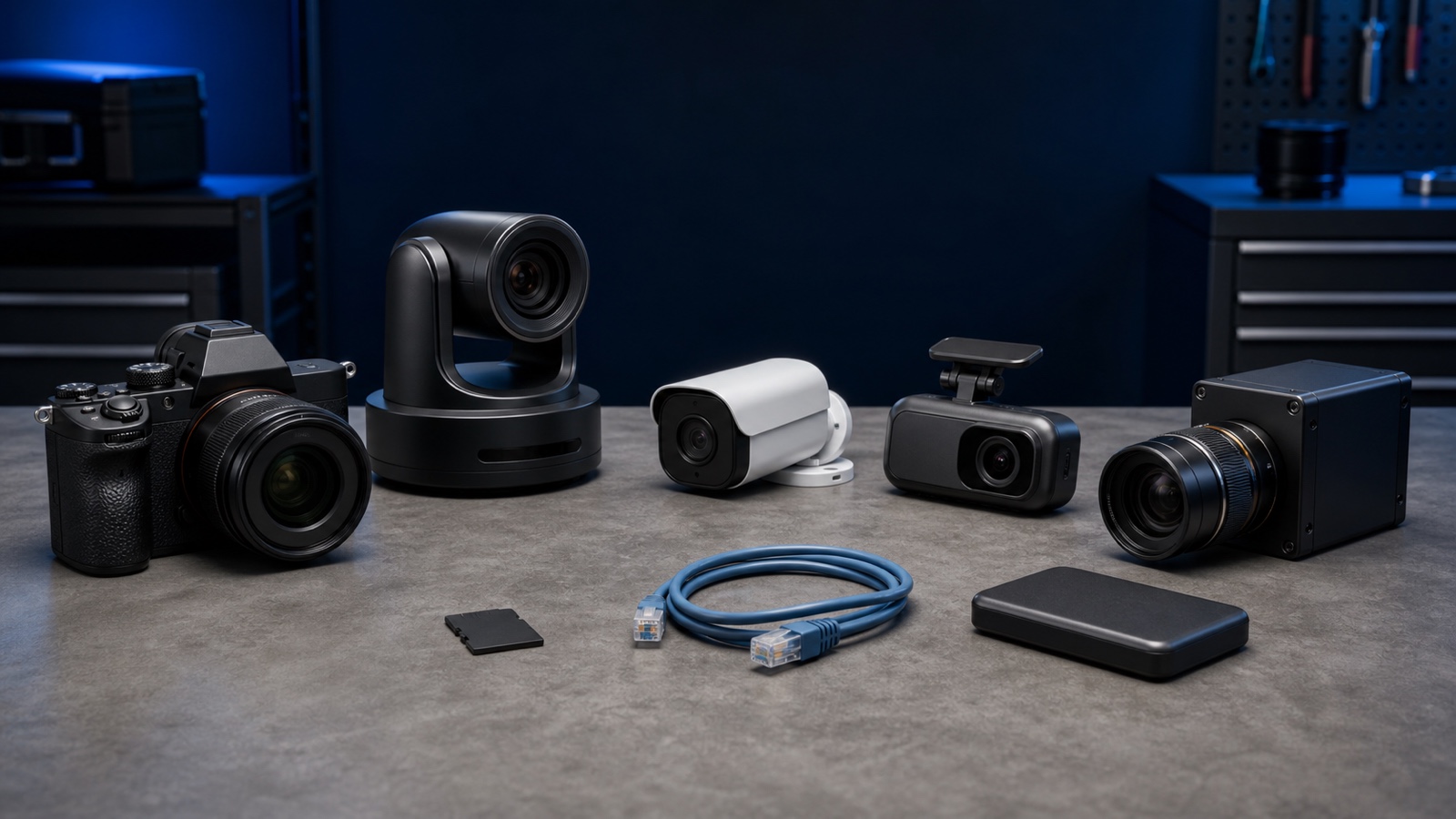
Separate five camera systems
Creator camera
AI-labelled functions usually assist autofocus, subject recognition, framing, stabilization, or in-camera processing. They do not establish lens quality, color, rolling shutter, low-light performance, or a complete production workflow.
PTZ production system
Automatic presenter framing connects camera analytics to pan, tilt, and zoom. Verify tracking modes, firmware, framing boundary, network protocols, controller, recording, operator override, and multi-camera integration.
Security camera system
Analytics may run in the camera, recorder, server, or cloud. Specify detection classes, scene assumptions, event rules, local and central storage, VMS, licenses, update track, retention, access, and evidence export.
Fleet and machine-vision system
Fleet cameras combine event detection, local rolling storage, uploads, driver workflows, and subscription services. Machine vision combines sensor, optics, trigger, lighting, inference, industrial interface, calibration, and deterministic application logic.
Documented examples of different boundaries
These examples identify architectures, not winners. Every row must still pass the buyer’s own scene and workflow test.
| Exact product or platform | Verified analytics location and purpose | Storage, integration, and lifecycle checks |
|---|---|---|
| Sony α7R V creator-camera platform | Sony documents a dedicated AI processing unit for human pose and subject recognition across named subject types. That is an autofocus/recognition function inside a creator camera, not proof of overall image quality or tracking superiority. | Verify exact firmware, subject mode, lens, recording format, card, tethering, editing support, and service. Test the intended subject, obstruction, movement, lighting, and composition. |
| Sony SRG-A40/SRG-A12 PTZ platform | Sony documents built-in AI analytics for presenter detection and PTZ Auto Framing. Its feature pages also distinguish current functions from firmware-version features that are scheduled or version-gated. | Verify exact model and firmware, tracking mode, network protocols, control interface, recording destination, face-registration policy, operator override, and support status. Treat scheduled features as unavailable until the release is installed and documented. |
| AXIS Q3839-PVE security-camera platform | Axis documents a deep-learning processing unit and preinstalled AXIS Object Analytics for edge detection, classification, tracking, and counting of supported object classes. | Confirm analytic version and license, camera scene, VMS, SD card or recorder, bitrate-derived retention, encryption, user roles, firmware track, end-of-support date, export, and integration. |
| Samsara AI Dash Cam platform | Samsara documents camera-side event detection with local rolling footage and selective cloud upload for safety events or requested clips. Its Privacy Mode can disable recording while retaining certain event detection, depending on license and configuration. | Verify exact camera model, gateway, vehicle compatibility, license, event configuration, local capacity, upload triggers, retrieval window, roles, retention, privacy mode, driver notice, connectivity, and offboarding export. |
| Basler Vision Connector platform | Basler documents an industrial connector between supported machine-vision cameras and Siemens Industrial Edge. The camera, connector, edge device, application, lighting, trigger, and inference stack form the system. | Verify exact supported camera, interface, frame format, edge hardware and software, licensing, update process, timing, calibration, data ownership, and failure behavior. |
Trace the pixels and metadata
Draw the path from sensor to user: image signal processor, on-device accelerator, removable media, recorder, phone app, local server, VMS, cloud service, notification, archive, and export. For each hop, record format, resolution, frame rate, compression, encryption, authentication, network, buffering, retention, deletion, and administrator.
Local analytics is not the same as local-only data. A camera can classify at the edge while still streaming video, metadata, thumbnails, diagnostics, or events to a recorder or cloud service. Conversely, a cloud-managed system may keep most continuous footage locally. Verify the exact configuration.
Size storage from measured bitrate and events
Resolution alone does not determine storage. Measure the exact codec, profile, quality setting, frame rate, scene motion, audio, number of streams, continuous versus event recording, pre/post-event buffer, redundancy, retention days, export reserve, and growth. Axis’s own edge-storage selector notes that bitrate is the driving factor and can vary substantially at the same resolution.
Test card or disk failure, recorder or network outage, clock drift, power loss, reconnect, upload backlog, export, and restore. A nominal capacity does not prove the retention window or that an event can be retrieved in usable form.
Privacy, surveillance, and security need independent review
Document the lawful purpose, fields of view, audio, biometric or face-related functions, signs and notices, access roles, audit logs, retention, sharing, subject requests, incident handling, and disposal. Consult the relevant legal, labor, insurance, safety, and regulatory owners for the deployment. Do not treat a vendor mode, encryption claim, or regional marketing page as compliance.
For networked cameras, record supported firmware track, end-of-software-support date, default services, certificate handling, credential policy, network segmentation, vulnerability notices, update method, rollback, inventory, and secure decommissioning. A camera’s AI accelerator does not establish the security of the complete system.
Acceptance gates
Identity and entitlement
Camera, lens, sensor, firmware, analytics package, license, recorder, storage, app, VMS, cloud plan, accessories, warranty, and support track match the approved system.
Scene and function
Representative subjects, backgrounds, lighting, occlusion, motion, weather, camera position, network state, and failure cases pass the defined detection, framing, recording, or production criteria.
Data and integration
Every stream and metadata route, storage tier, retention rule, permission, event, notification, API, export, deletion, audit, and recovery path works as documented.
Performance claims
Image quality, low-light behavior, tracking, detection accuracy, latency, reliability, and storage duration are accepted only from exact primary evidence or reproducible testing on the delivered configuration.
Official documentation
- Sony: α7R V AI processing and subject-recognition scope
- Sony Professional: SRG-A40/SRG-A12 PTZ Auto Framing and version-gated features
- Axis: Q3839-PVE edge analytics and supported object-analytics functions
- Axis: edge analytics, storage paths, and bitrate-based sizing
- Axis: firmware tracks and product software lifecycle
- Samsara: AI detection, local storage, automatic incident upload, and on-demand retrieval
- Samsara: Privacy Mode recording and event-detection behavior
- Basler: Vision Connector and Industrial Edge integration documentation