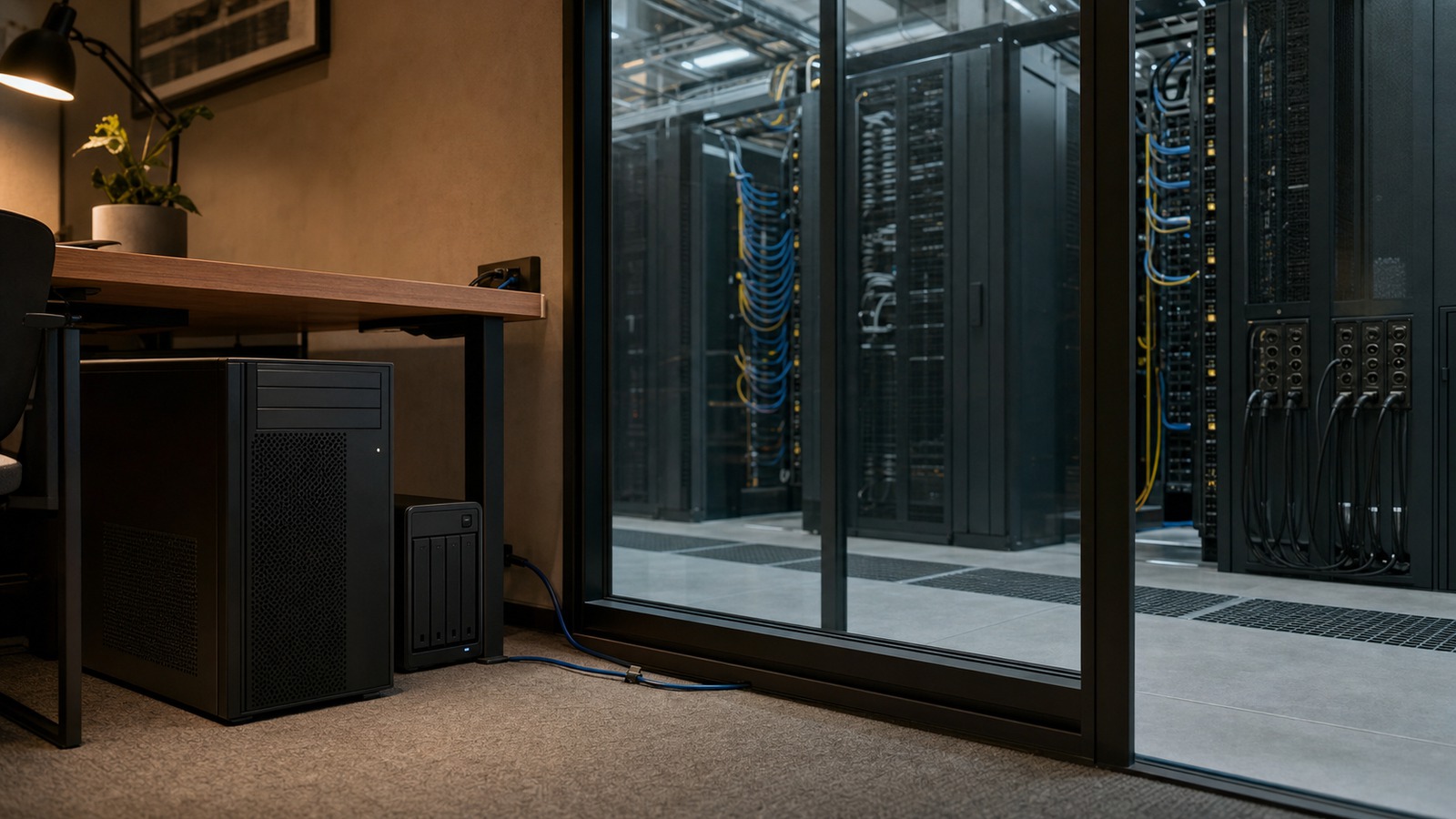
Deployment comparison
Local and cloud AI move different parts of the data path, capacity plan, availability design, security work, and cost model. Compare a defined workload and architecture—not ownership slogans.
The short answer
Local hardware places compute near the user or data and turns capacity into an owned operating constraint. Cloud infrastructure exposes remotely provisioned, metered resources and can change capacity without buying a new machine. Either can be reliable, insecure, expensive, economical, private, or exposed depending on the architecture and operation.
Define the boundary. “Local” may mean a laptop, an office workstation, or an edge server used by many people. “Cloud” may mean a raw GPU virtual machine, a managed endpoint, or a provider API. Those are different systems with different responsibilities.
Describe the workload before the location
Data path
Record where prompts, documents, media, embeddings, logs, model artifacts, outputs, backups, and telemetry travel and persist.
Latency and connectivity
Separate device-side processing time from network transit, queuing, cold starts, uploads, downloads, and failure or retry behavior.
Capacity and concurrency
Specify model memory, context or KV cache, activations, batch size, simultaneous users, arrival pattern, peak duration, and required headroom.
Service objective
Define operating hours, acceptable interruption, recovery time, data-loss tolerance, maintenance windows, and who responds when the system fails.
Architecture worksheet
| Decision factor | Local deployment | Cloud deployment |
|---|---|---|
| Capacity | Fixed by the installed CPU, accelerator, system RAM, VRAM or unified memory, storage, power, and cooling until hardware changes. | Chosen from available service or instance types, quotas, regions and zones; requested capacity may still be unavailable at a given place or time. |
| Latency | Can avoid internet transit, but still includes local queuing, model loading, storage, network hops, and device contention. | Includes network and service path plus compute; proximity, private connectivity, batching, autoscaling, and cold starts can change the result. |
| Availability | Requires local power, networking, monitoring, spares, backups, failover, and recovery appropriate to the service objective. | Requires region and zone selection, quota, architecture, backups, scaling, monitoring, and recovery; provider infrastructure alone does not make an application highly available. |
| Security and compliance | The operator controls physical access, identity, patching, configuration, encryption, logging, retention, and disposal. Locality alone proves none of them. | Responsibility is shared and changes by service model. The customer still owns important identity, configuration, application, data, logging, and governance decisions. |
| Operations | Hardware acquisition, installation, drivers, runtime, patching, cooling, power, monitoring, replacement, and end-of-life belong to the operator. | Provisioning, images or containers, identity, networking, quotas, monitoring, scaling, cost controls, patch scope, and decommissioning remain operational work. |
| Cost inputs | Purchase, financing, tax, support, power, cooling, space, networking, labor, downtime, spares, utilization, and residual value over a dated ownership period. | Region, instance or service, accelerator, runtime hours, utilization, storage, requests, data transfer, networking, public IPs, monitoring, support, discounts, commitments, and engineering labor. |
Capacity is a model-placement problem
For either location, the model file is only one allocation. Include model weights, runtime overhead, activations, context or KV cache, batching, concurrent requests, system services, and any CPU or accelerator split. A cloud instance name and a local “AI PC” badge are both insufficient.
Local systems may use dedicated VRAM, unified memory, shared system RAM, or CPU offload. Cloud services may expose a whole GPU, a fraction, multiple accelerators, or an abstract managed endpoint. Verify the execution device, available memory, runtime backend, and failure behavior for the exact service or machine.
Use the RAM and VRAM guides to construct the workload budget before selecting capacity.
Use dated cost inputs, not a break-even slogan
Cloud providers meter different resources and change prices, products, discounts, and availability. A useful estimate records its date and source, then includes compute, accelerator, storage, network and data transfer, observability, support, and any committed-use assumptions. Do not compare a discounted cloud rate with an undiscounted local purchase, or ignore idle and peak periods.
A local estimate needs an ownership window and realistic utilization. Include the complete usable system, power and cooling, storage, support, replacement risk, labor, downtime, and residual value. Sunk hardware is not free, and a cloud instance stopped between jobs is not billed like one running continuously.
Run at least steady, bursty, growth, and failure scenarios. Sensitivity to concurrency, context, uptime, utilization, electricity, data transfer, and staffing is more informative than one break-even month.
Security, privacy, and availability are designs
Local does not mean isolated
A local service can expose network ports, retain sensitive prompts, miss patches, lose disks, or rely on weak physical and account controls. Document its complete data path and threat model.
Cloud does not outsource every responsibility
Cloud providers secure parts of the underlying service, while customers retain responsibilities that vary by service model. Identity, data, application configuration, network policy, logging, and governance still require explicit decisions.
Availability must be engineered and tested
A local spare, a cloud availability zone, or a provider SLA is not the same as application recovery. Test failure, restore, capacity loss, network loss, credential loss, and data recovery against the stated objective.
A decision-quality pilot
Use the same model artifact, runtime behavior, inputs, quality settings, context, and concurrency. Record end-to-end and compute latency, throughput, queue time, errors, memory, network transfer, power or metered use, operator time, failure recovery, and dated costs. If local and cloud variants use different models or services, report the quality and operational difference rather than treating them as identical.
Primary documentation
- NIST: definition and essential characteristics of cloud computing
- AWS: shared responsibility model
- AWS: shared responsibility for resiliency
- AWS: EC2 on-demand pricing inputs
- Microsoft: Azure VM sizes, regions, quotas, and accelerators
- Microsoft: Azure VM cost inputs
- Google Cloud: GPU pricing and cost components