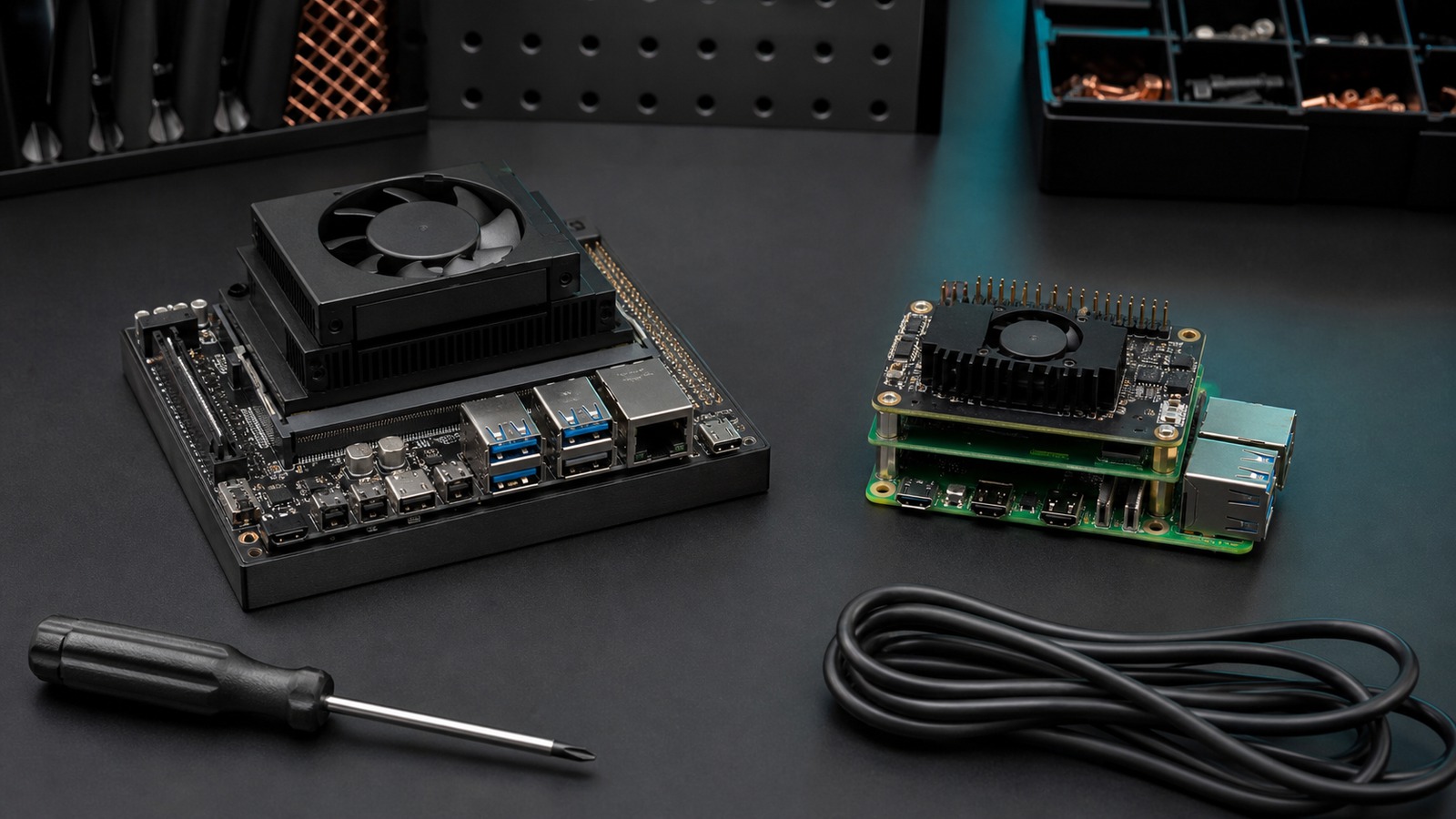
Edge-AI development platforms
“Jetson” and “Raspberry Pi AI Kit” describe different platform families and generations. Compare an exact module, developer kit, Pi board, accelerator, software release, model artifact, I/O plan, power mode, and cooling design.
The short answer
A Jetson developer kit combines an NVIDIA module and carrier board around JetPack, CUDA, and the Jetson software ecosystem. A Raspberry Pi AI configuration combines a Raspberry Pi 5 with a specific Hailo accelerator and Raspberry Pi OS integration. They differ in accelerator architecture, memory, software, storage, I/O, power, cooling, and deployment path; a family name or TOPS figure cannot select between them.
Do not compare “Jetson” with “Pi” in the abstract. Write down the full part names. A Jetson Orin Nano developer kit is not every Jetson module, and the discontinued Raspberry Pi AI Kit is not the same product as AI HAT+ or AI HAT+ 2.
Separate the products first
Jetson module
The compute module is intended for integration on a carrier board. Memory capacity, power modes, I/O exposure, storage, and thermal design depend on the exact module and product.
Jetson developer kit
A developer kit is a reference development platform, not automatically the production hardware. Record its included module, carrier board, storage target, power supply, and JetPack release.
Original Raspberry Pi AI Kit
This paired an M.2 HAT+ with a Hailo-8L accelerator for Raspberry Pi 5. Raspberry Pi documents it as no longer in production and functionally equivalent to the Hailo-8L AI HAT+ variant.
AI HAT+ and AI HAT+ 2
These are different Hailo-based accelerators. Raspberry Pi documents generative LLM and VLM support for AI HAT+ 2, not for the original AI Kit or AI HAT+.
Deployment comparison worksheet
| Layer | Jetson evidence | Raspberry Pi AI evidence |
|---|---|---|
| Compute hardware | Exact Jetson module, carrier board or developer kit, CPU/GPU/DLA resources, installed memory, and documented power modes. | Exact Raspberry Pi 5 memory capacity plus original AI Kit, AI HAT+ variant, or AI HAT+ 2 accelerator. |
| Model execution | JetPack and Jetson Linux version, CUDA or TensorRT path, supported precision and operators, conversion steps, and the device that actually executes each stage. | Raspberry Pi OS version, Hailo drivers and runtime, supported model artifact or Model Zoo entry, conversion steps, and whether work runs on CPU or NPU. |
| Memory | Module memory shared by CPU and integrated accelerator, model weights, activations, runtime buffers, camera pipelines, and other services. | Pi system RAM plus any accelerator-local memory documented for the exact HAT; do not assume every Hailo product has the same memory path. |
| Storage and I/O | microSD or NVMe plan, camera interfaces, USB, networking, GPIO, M.2 slots, and carrier-board constraints. | microSD or attached storage, camera interfaces, GPIO, USB, networking, PCIe/HAT connection, and physical stacking constraints. |
| Power and cooling | Supply, configured power mode, heatsink and fan, enclosure airflow, peripherals, ambient temperature, and throttling evidence. | Pi supply, active cooler, HAT cooling requirement, camera and storage draw, enclosure airflow, and throttling evidence. |
| Production lifecycle | Module availability, carrier-board design, flashing and recovery, software support, remote update, and replacement strategy. | Current HAT availability, OS and Hailo package compatibility, device provisioning, enclosure, recovery, remote update, and replacement strategy. |
Model support is not interchangeable
A model that exists in ONNX, PyTorch, or another source format is not automatically executable on either accelerator. Each path may require supported operators, a particular precision, conversion or compilation, matching runtime and driver versions, and preprocessing or post-processing code.
For the Raspberry Pi path, the official documentation ties the Hailo accelerator to supported camera pipelines, packages, and model artifacts; it also warns that Hailo software and driver versions must match. For Jetson, verify the current JetPack, CUDA, TensorRT, container, and hardware support matrices for the exact target.
If part of a graph falls back to CPU, report it. Accelerator TOPS does not describe unsupported operators, memory capacity, end-to-end latency, camera ingest, post-processing, or application responsiveness.
Choose by the complete deployment
A Jetson development path can fit
The required model and operators have a maintained JetPack execution path, the exact module meets memory and I/O needs, and the team accepts the carrier-board, cooling, storage, provisioning, and software-lifecycle work.
A Raspberry Pi AI path can fit
The required workload is supported by the exact Hailo product and software stack, Raspberry Pi 5 provides the needed host memory and I/O, and the assembly, cooling, storage, and OS lifecycle suit the deployment.
A prototype result is not a production decision
A developer kit on an open bench does not establish enclosure thermals, supply quality, camera reliability, remote recovery, security maintenance, component availability, or sustained field behavior.
A fair evaluation packet
Record every part number, module and board revision, memory, storage, camera and peripheral, power supply, cooling solution, operating system, JetPack or Hailo package versions, driver, runtime, model artifact and hash, precision, conversion commands, preprocessing and post-processing, execution placement, latency, throughput, memory use, power mode, temperature, throttling, session duration, and recovery procedure.
Primary documentation
- NVIDIA: Jetson Orin Nano Developer Kit guide
- NVIDIA: Jetson Orin Nano hardware layout and storage
- NVIDIA: Jetson power modes, monitoring, cooling, and operation
- NVIDIA: Jetson module lineup and JetPack ecosystem
- Raspberry Pi: AI HAT+, AI HAT+ 2, and original AI Kit distinctions
- Raspberry Pi: Hailo AI software, versioning, and model paths
- Raspberry Pi: original AI Kit status and specification