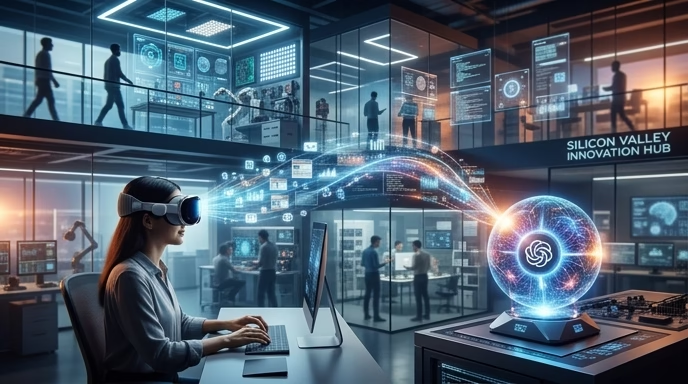
The Talent War Just Put on a Headset
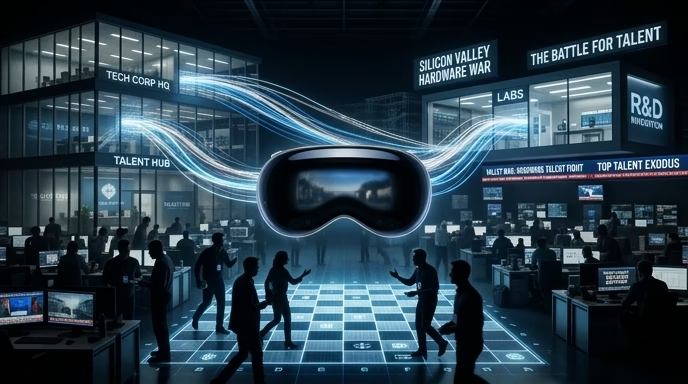
Apple has reportedly lost another senior executive to OpenAI, and this one comes with serious hardware credentials.
Paul Meade, the Apple vice president tied closely to the Vision Pro and Apple’s smart glasses work, is reportedly leaving the company to join OpenAI’s hardware team. That is not a tiny footnote. That is a bright red flare in the sky over Silicon Valley.
Meade was not just wandering around Cupertino holding a lanyard and sipping oat milk. He worked on some of Apple’s most ambitious hardware bets. According to reports, he helped lead Vision Pro hardware engineering and later oversaw Apple’s smart glasses efforts.
Now he is reportedly heading to OpenAI.
That matters because OpenAI no longer looks satisfied with living inside apps, browsers, and APIs. It wants hardware. It wants devices. It wants to move from “the chatbot you open” to “the computer you wear, speak to, carry, or live with.”
And Apple? Apple just watched one of its spatial computing leaders walk toward the company trying to invent the next AI-native gadget.
That sound you hear is not thunder. It is the talent market kicking over another expensive chair.
Who Is Paul Meade?
Paul Meade is a longtime Apple hardware executive. Reports from AppleInsider and MacRumors say he joined Apple in 2010, first worked around iPad program management, then moved into iPhone program management, and later joined the Vision Products Group in 2017.
That timeline matters.
Apple’s Vision Pro was not a quick weekend project cooked up between espresso shots. It took years of engineering, design, optics work, manufacturing planning, and software coordination. The device needed custom displays, sensors, cameras, chips, hand tracking, eye tracking, audio systems, and a body that humans could actually wear without feeling like they had strapped a polite toaster to their forehead.
Meade reportedly took over hardware engineering for Vision Pro around 2019. That placed him close to one of Apple’s most technically complex consumer products.
Vision Pro did not become a mass-market smash. Its price made sure of that. But as a piece of hardware, it showed Apple could build a high-end spatial computer with astonishing polish.
That experience is exactly the kind OpenAI would want if it plans to build physical AI devices.
Software dreams are cheap. Hardware makes you pay the invoice.
Why OpenAI Wants Apple Hardware People
OpenAI’s hiring pattern is not subtle anymore. It has been pulling in people who know how to turn futuristic product ideas into objects that ship.
The company already has deep links to former Apple design talent. Jony Ive, Apple’s former design chief, has been working with OpenAI on AI hardware. Other former Apple names connected to OpenAI’s hardware push include Tang Tan and Evans Hankey, both veterans of Apple’s product and design world.
This is not random collecting. This is architecture.
OpenAI already has the models. It has ChatGPT. It has developer tools. It has enterprise momentum. But if the company wants to control the next interface layer, it needs something beyond screens owned by Apple, Google, Microsoft, Samsung, and Meta.
That is where hardware comes in.
A dedicated AI device could let OpenAI shape the experience from the silicon-adjacent stack all the way to the user’s hand, face, voice, or pocket. It could decide how the assistant listens. How it answers. How it interrupts. How it stays quiet. How it sees.
That last bit is dangerous and powerful.
Because once AI gets eyes, ears, memory, and mobility, the app era starts looking a little dusty.
Apple’s Vision Pro Problem
Apple Vision Pro is brilliant hardware with a brutal commercial problem: it is too expensive for the mainstream.
The device arrived as Apple’s big spatial computing swing. It had gorgeous displays. It had impressive input systems. It had Apple polish all over it. But it also had a price tag that screamed, “This is for early adopters, developers, wealthy enthusiasts, and people who say ‘workflow’ too much.”
That does not make it a failure as technology. It makes it a difficult product category.
Headsets are awkward. They are intimate. They are heavy compared with glasses. They ask users to change behavior. They also fight the basic human urge not to wear a computer helmet during breakfast.
Apple appears to know this. Reports suggest the company has also been working on lighter smart glasses, including display-free versions designed to compete more directly with Meta’s Ray-Ban-style wearables.
That is why Meade’s reported departure matters so much.
If Apple’s next step is smart glasses, losing a leader connected to Vision Pro and glasses development is badly timed. It is not fatal. Apple is too deep to collapse because one executive leaves. But it hurts.
The Smart Glasses Race Is Heating Up
The next major AI hardware fight may not be over phones. It may be over glasses.
Meta already has a real product in the market with Ray-Ban Meta smart glasses. They are relatively affordable. They look like normal glasses. They let users capture photos and videos, listen to audio, and interact with Meta AI. That gives Meta a head start in a category where social comfort matters as much as technical specs.
Apple is reportedly working on its own smart glasses. But Apple tends to move carefully. Sometimes that works beautifully. Sometimes it lets rivals define the category first.
OpenAI is entering from a different angle. It does not have Apple’s hardware legacy or Meta’s social hardware footprint. But it has a powerful AI brand and a giant user base trained to ask ChatGPT for help with everything from code to recipes to awkward emails.
Now imagine that assistant in a device that sees what you see.
That is the prize.
Not a headset. Not a phone replacement on day one. A companion. A context engine. A second brain with sensors.
Very useful. Very weird. Extremely Silicon Valley.
OpenAI Wants an AI-Native Device, Not Another iPhone
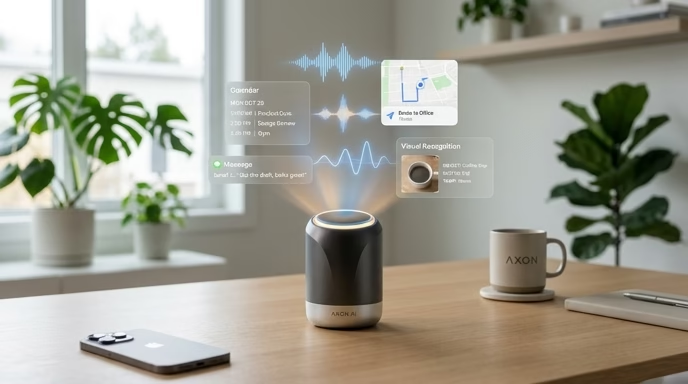
The phrase “AI-native device” gets thrown around a lot. Most of the time, it sounds like someone spilled buzzwords into a blender. But here it means something real.
An AI-native device would not be a normal gadget with a chatbot bolted on. It would be designed around continuous interaction with an AI system from the start.
That changes the product logic.
A phone assumes apps. A laptop assumes windows. A smartwatch assumes glances. A headset assumes immersion. An AI-native device may assume conversation, awareness, memory, and action.
It may not need a big screen. It may rely on voice. It may use cameras. It may understand location and context. It may handle tasks before users open a traditional app.
OpenAI CEO Sam Altman has previously talked about wanting something calmer than the iPhone. That is a bold ambition, because the iPhone became the remote control for modern life. But it also became a little chaos rectangle. Notifications. Feeds. Alerts. Red dots. Infinite scroll. Pocket-sized mayhem.
OpenAI seems to want a different interface.
The hard part is making that dream useful instead of annoying.
Why Hardware Is So Hard
OpenAI may be great at models, but hardware is a different beast.
Software can update fast. Hardware punishes mistakes. Batteries fail. Thermals matter. Cameras cost money. Sensors need calibration. Supply chains break. Factories delay. Materials scratch. Users drop things. Reviewers complain. Regulators ask questions. And nobody enjoys wearing a prototype that cooks their eyebrow.
Apple knows this world. That is why its hardware people are valuable.
A consumer AI device needs more than a clever demo. It needs industrial design, manufacturing discipline, component sourcing, durability testing, privacy architecture, repair planning, retail strategy, and customer support.
Then comes the really ugly part: finding a reason people should buy it.
The world is littered with dead gadgets that had great pitch decks. AI pins. weird wearables, voice-first gadgets, and “phone killers” have all struggled when they met actual human habits.
People do not want another device just because a tech company wants another platform.
They need a reason. A daily use. A habit. A wow moment that survives past Tuesday.
That is the mountain OpenAI must climb.
Apple’s Bigger Executive Shake-Up
Several reports frame Meade’s exit inside a broader Apple leadership reshuffle.
According to coverage based on Bloomberg’s reporting, Apple’s hardware organization has been changing as John Ternus prepares for a larger leadership role and Johny Srouji takes on more hardware responsibility. Some executives reportedly ended up with new reporting lines, and some may have felt pushed down the ladder.
That kind of reorganization can trigger exits.
In giant companies, title changes matter. Reporting lines matter. Access matters. If a senior executive once had a direct path to top leadership and suddenly reports through another layer, that can feel like a demotion even if the company insists everything is perfectly fine and the org chart is definitely not on fire.
OpenAI can use that moment.
A fast-growing rival can offer a cleaner pitch: come build the next thing. Come work with former Apple legends. Come shape a product category before it hardens. Come trade internal politics for frontier chaos.
That pitch will not work on everyone.
But it only needs to work on the right people.
The Polymarket Twist
Blockchain.News added a strange but interesting market angle: while OpenAI is grabbing attention with hardware talent, Polymarket traders still heavily favored Anthropic in a prediction market about which company would have the best AI model by the end of July.
That detail says something useful.
Markets may separate hardware momentum from model leadership. OpenAI can recruit Apple hardware executives and still face skepticism about whether it leads the frontier model race at a specific deadline. Talent headlines do not automatically translate into benchmark wins.
This is where the story gets more layered.
OpenAI is not only competing on models. It is competing on distribution, consumer products, enterprise usage, developer ecosystems, and now hardware. Anthropic may be perceived as strong on model quality. Google has massive infrastructure and research depth. Meta has wearables and open-model muscle. Apple controls premium devices.
Nobody owns the whole board.
That is why OpenAI’s hardware push matters. It is an attempt to change the game, not merely win one leaderboard.
When everyone races on models, the next advantage may come from owning the interface.
What This Means for Apple
Apple is not doomed. Let’s not get silly.
The company still has enormous hardware talent, deep supply-chain power, world-class chips, a giant installed base, and unmatched control over its ecosystem. Losing one executive does not sink Cupertino.
But the symbolism is ugly.
Apple spent years presenting itself as the place where hardware magic happens. Now OpenAI, a company born from AI research and software, is recruiting Apple veterans to build new devices. That flips the usual script.
Apple also faces pressure in AI. Critics argue it has moved too slowly compared with OpenAI, Google, Anthropic, and Meta. Its Apple Intelligence rollout has been uneven. Its Siri ambitions have drawn scrutiny. And now, rivals are not just competing for users. They are competing for Apple’s people.
That is the more serious issue.
Talent loss creates a story. The story affects morale. Morale affects retention. Retention affects execution.
Apple can absorb departures. But it cannot ignore a pattern if one develops.
The company needs to prove its AI hardware future is still the place ambitious builders want to stay.
What This Means for OpenAI
For OpenAI, Meade’s reported arrival would strengthen a hardware team that already looks increasingly Apple-flavored.
That is useful. But it also raises expectations.
OpenAI cannot simply announce a mysterious device, surround it with minimalist design language, and expect the world to clap forever. The AI hardware category has become skeptical for a reason. People have seen too many demos that looked magical for five minutes and useless after lunch.
OpenAI needs a product with a clear job.
It could be a screenless companion. It could be glasses. It could be a home device. It could be something more ambient. Reports have pointed broadly toward a family of AI-powered devices, but the exact form remains unclear.
That uncertainty is both exciting and risky.
If OpenAI nails the interface, it could create the first true AI-era consumer device. If it misses, it may learn the ancient hardware lesson: atoms are expensive, customers are impatient, and “cool” is not the same as “necessary.”
Still, hiring someone with Vision Pro experience gives OpenAI more credibility.
The company is no longer just imagining hardware. It is staffing for it.
The Bottom Line
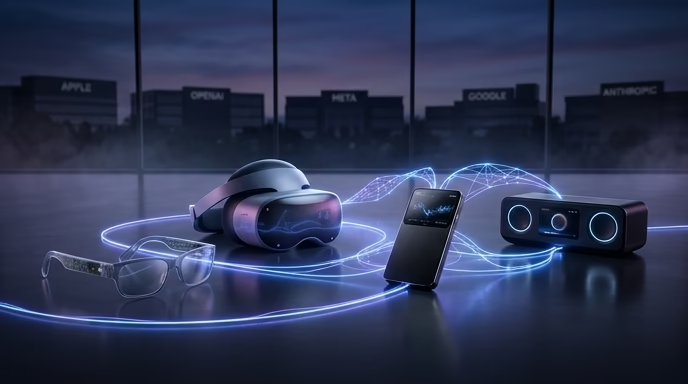
Paul Meade’s reported move from Apple to OpenAI is bigger than one executive changing badges.
It shows that the AI race is moving from software into physical products. It shows OpenAI wants to own more than the model layer. It shows Apple’s spatial computing team is facing pressure at a sensitive moment. And it shows former Apple talent may play a central role in whatever OpenAI builds next.
The fun part? Nobody knows what the winning AI device looks like yet.
Maybe it is glasses. Maybe it is a small voice-first companion. Maybe it is something that lives in the home. Maybe it is a product category we currently describe badly because the old vocabulary does not fit.
That is usually when tech gets interesting.
The smartphone era had a clear champion. The AI device era does not. Apple has hardware mastery. Meta has wearable traction. Google has infrastructure. Anthropic has model credibility. OpenAI has ChatGPT, momentum, and now more hardware talent from the house that built the iPhone.
So yes, this is a personnel story.
But it is also a warning shot.
The next AI war may not happen in a chat window. It may happen on your face, in your pocket, or quietly on your desk, waiting for you to ask what comes next.
Sources
- TechCrunch: Apple Vision Pro exec is reportedly leaving for OpenAI
- AppleInsider: OpenAI has poached another Apple executive for its hardware division
- Blockchain.News: Apple Vision Pro exec to OpenAI, but Polymarket still has Anthropic at 85.5%
- FourWeekMBA: Apple Vision Pro Chief Paul Meade Leaves for OpenAI
- MacRumors: Apple Loses Another Top Executive to OpenAI
- 9to5Mac: OpenAI poaches Apple Vision Pro and smart glasses chief
The Kingy Brief
Get future Kingy Brief editions.
Source-checked AI changes, original tests and one practical thing to try.
Free · Choose your subjects · Double opt-in · Unsubscribe anytime
Regular sending is paused; no restart date is set.