Verdict: Cursor now documents first-party TypeScript and Python SDKs for calling its coding agent from application code. Both offer local and Cursor-hosted cloud runtimes, but they have different packages and language requirements. Kingy did not run either SDK. Our only firsthand evidence is a separate, read-only Cursor Agent CLI planning interaction in a disposable synthetic repository. That observation cannot establish SDK behavior, performance, reliability, or cost.
Source status: Cursor’s official TypeScript SDK, Python SDK, and Models & Pricing pages were rechecked on August 29, 2026. Pricing and product documentation can change; recheck them on the day of publication.
What the Cursor SDK is
Cursor describes both SDK packages as ways to call the same coding agent used across Cursor’s other product surfaces. The TypeScript package is @cursor/sdk; the Python package is cursor-sdk. That is the cleanest starting point for evaluating the product: these are agent SDKs, not evidence that any particular model, workflow, or result will perform well in your repository.
Sources: Cursor TypeScript SDK documentation and Cursor Python SDK documentation, accessed August 29, 2026.
TypeScript and Python: documented differences
| Decision point | TypeScript SDK | Python SDK | Evidence boundary |
|---|---|---|---|
| Package | @cursor/sdk |
cursor-sdk |
Documented package identity only |
| Install | npm install @cursor/sdk |
pip install cursor-sdk |
Kingy did not install either SDK |
| Runtime requirement | Node.js 22.13 or later | Python 3.10 or later | Documented requirements, not compatibility tests |
| Local runtime | Agent loop and files operate against the configured local working tree | Agent runs against configured local files | “Local” does not establish offline model inference |
| Cloud runtime | Cursor-hosted isolated VM with a repository cloned in | Cursor-hosted isolated VM with a repository cloned in | Kingy did not run a cloud SDK workflow |
| Authentication | CURSOR_API_KEY or an explicit API key |
CURSOR_API_KEY or api_key |
Kingy did not test SDK authentication |
| Client style | TypeScript/Node API and streamed SDK messages | Sync and async Python clients with typed objects | No firsthand API comparison was performed |
The official TypeScript documentation is unusually explicit about one term that is easy to misunderstand: local mode means the agent loop and filesystem access are local, while model inference still goes through Cursor’s hosted models. The Python documentation describes the same local/cloud choice but should not be stretched into a claim about offline inference.
Sources: TypeScript SDK overview and runtime support and Python SDK overview and installation, accessed August 29, 2026.
Authentication, billing, and plan context
Both SDK pages document user and service-account API keys for local and cloud runs and say Team Admin API keys are not supported. They also say SDK runs follow the same pricing, request-pool, and Privacy Mode rules as IDE and Cloud Agent runs. Those are documentation claims, not results from Kingy’s account.
Cursor’s current Models & Pricing page lists Pro at $20 per month, Pro Plus at $60 per month, and Ultra at $200 per month. It describes Start as an India-only plan centered on the Cursor Models pool. The current page explicitly says Start does not include the Cursor SDK and that SDK access requires Pro or higher. Treat the listed prices as dated plan terms, not a prediction of total cost or included workload.
Sources: Cursor TypeScript SDK documentation, Cursor Python SDK documentation, and Cursor Models & Pricing, accessed August 29, 2026.
The firsthand evidence: one separate Agent CLI planning check
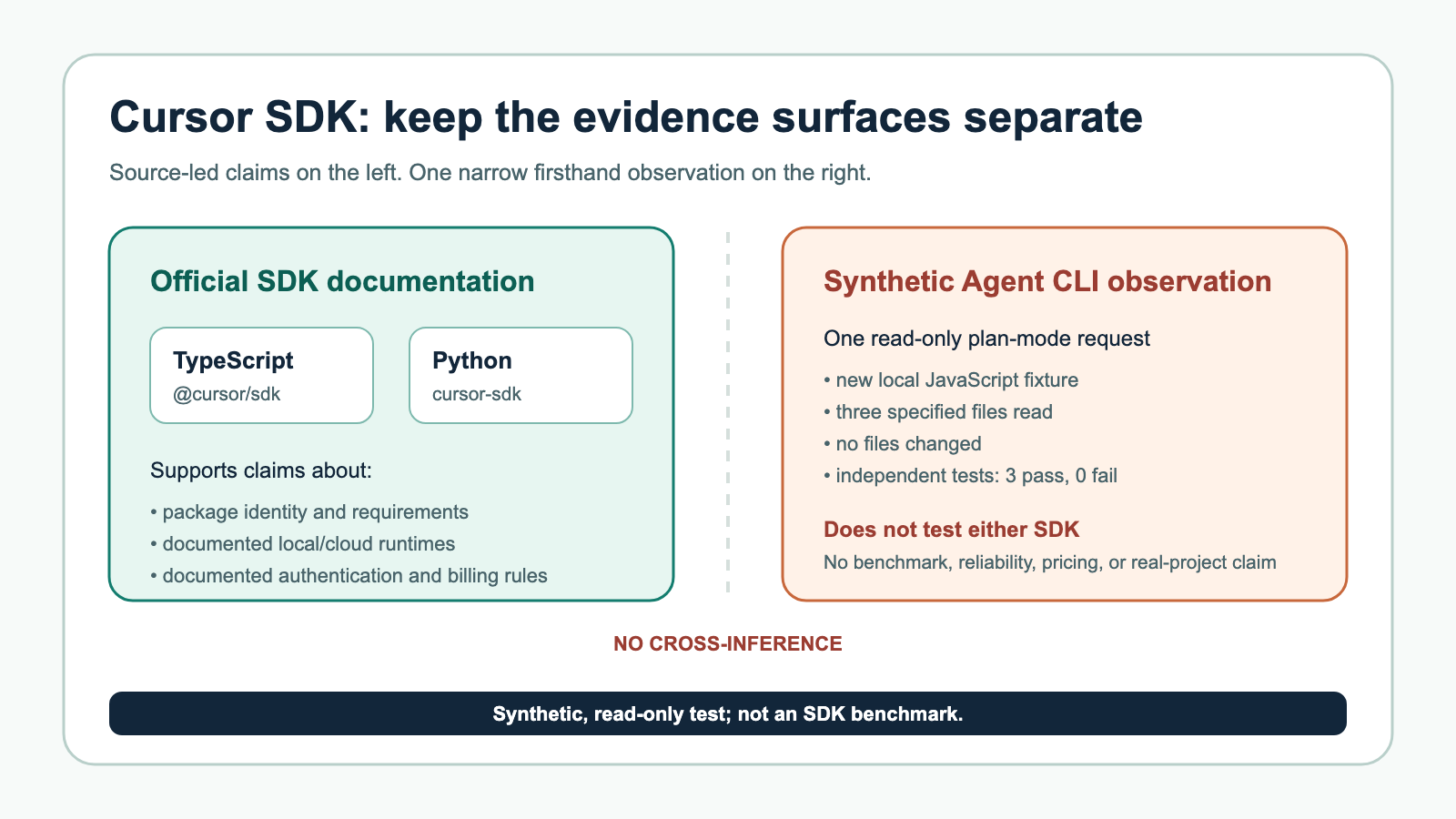
Kingy’s firsthand evidence did not use @cursor/sdk or cursor-sdk. It used an authenticated Cursor Agent CLI session against a newly created, non-sensitive JavaScript repository. The request was explicitly read-only: inspect README.md, src/temperature.js, and test/temperature.test.js; do not edit files, run commands, use external tools, create commits, or open another workspace.
One named-model request was declined under the available Free usage. One Auto plan-mode retry read the specified files, made no changes, explained why the existing tests passed, and noted that NaN and Infinity still pass a JavaScript typeof-number guard. An independent local test run remained 3 pass, 0 fail.
That supports one narrow statement: the Agent CLI produced a useful read-only planning observation in this synthetic case. It does not test either SDK, establish a benchmark, prove reliability, measure latency, validate pricing, or predict results in a real repository.
For a separate, equally bounded product example, see Kingy’s Cursor Composer 2.5 evidence review.
Evidence map
| Claim area | Evidence available | What must not be inferred |
|---|---|---|
| TypeScript SDK identity and requirements | Current official documentation | Successful installation or execution |
| Python SDK identity and requirements | Current official documentation | Successful installation or execution |
| SDK plan availability | Current Models & Pricing page | Total monthly cost or guaranteed capacity |
| Agent CLI planning | One disclosed synthetic read-only interaction | SDK behavior, benchmarks, reliability, or real-project quality |
| Security and governance | Documentation plus general least-authority practice | A completed security assessment of Cursor |
Who should evaluate the SDK next
The SDK is worth a controlled evaluation when you need a coding agent inside scripts, CI checks, internal developer tools, or another approved workflow. The next useful test is not another marketing demo. It is a small, representative repository task with a pinned SDK version, a fixed success criterion, narrow filesystem scope, explicit tool permissions, a recorded model selection, and independent verification of diffs and tests.
If you only need interactive coding help, the SDK may add operational complexity without adding much value. If you need repeatable programmatic runs, the local/cloud abstraction and language choice are the relevant documented differentiators—but they still need testing in your environment.
For wider product context, see Kingy’s Cursor 1.0 review and AI coding agents comparison.
FAQ
Does Cursor have an official Python SDK?
Yes. Cursor’s current documentation describes the cursor-sdk package, Python 3.10 or later, sync and async clients, and local and cloud agent runtimes. Kingy did not run it. Source: Cursor Python SDK documentation, accessed August 29, 2026.
Is the Cursor SDK TypeScript-only?
No. Cursor currently documents both TypeScript and Python SDKs, so treating the SDK as TypeScript-only would now be inaccurate.
Did Kingy test either SDK?
No. The firsthand observation used Cursor Agent CLI plan mode, not either SDK package.
Does local mode mean local model inference?
The TypeScript documentation says no: local describes the agent loop and filesystem access, while inference uses Cursor-hosted models. Source: Cursor TypeScript SDK documentation, accessed August 29, 2026.
How much does the SDK cost?
Cursor says SDK runs follow its normal pricing and request pools. Current plan documentation lists subscription tiers, but actual cost depends on plan, usage, and model selection. Recheck Cursor Models & Pricing on the day of publication.
The Kingy Brief
Get the next Kingy Brief.
Source-checked AI changes, original tests and one practical thing to try.
Free · Choose your subjects · Double opt-in · Unsubscribe anytime